Enemies & Lovers: The Crown of Elfhame – Justin Bell
I ran into AJ Porfirio of Van Ryder Games at SPIEL Essen 2025. During our catch-up, he handed me a copy of Enemies & Lovers, a game based on the Folk of the Air series written by Holly Black, who also designed this card game. The cover art, not to mention the illustrations on the handsome tarot-sized cards, is beautiful, and when I did a play with my family (wife, two kids, ages 12 and 9), everyone loved the look and feel of the cards.
The game was a mixed bag. Enemies & Lovers comes with a deck of 51 cards, a mix of action cards, court character cards, and a single crown card. The goal is to play cards from hand face-down into a tableau (known as your “Court’), with a winner named as soon as anyone can get a Prince, Coercion, and Conspirator to join that Crown in their personal Court. Of course, every action card in the deck makes that a challenge, with players regularly attacking everyone else…Enemies & Lovers becomes pure chaos quickly.
The second you play even a second card into your Court, someone will swoop in to assassinate one of your cards. Some cards force players to flip all their cards face-up, making it easy to see what each opponent has. Some cards let you swap a Court for an opposing player’s Court. Some let you dive into the discard pile. This means that Enemies & Lovers quickly becomes a game for some people, and a grind for others. I didn’t mind it. My kids loved it; my nine-year-old went out of his way to destroy the Courts of other players. My wife hated it, as she never got comfortable having all her cards stolen or assassinated. All I know is this: it’s not a game I will play with my family again any time soon!
Ease of entry?
★★★★★ – No sweat
Would I play it again?
★★★☆☆ – Wouldn’t suggest it, but would happily play it (but not with my wife)
Read more articles from Justin Bell.
Majolica – Andy Matthews
I bought Majolica on a whim at a recent board game flea market. The cover looked really pretty, and as I read some review coverage it sounded like an interesting optimization puzzle sort of game. After playing it for the first time, I can confirm that it is worth a look if you can find a copy.
Full disclosure—Majolica presents as an Azul knockoff. And while it has quite a bit of thematic overlap, it plays quite differently. In both games you select tiles from a central display, place tiles into “workshops”, then “run” those workshops. But Majolica is a bit more forgiving, but also a bit more complex. Here, you’re matching the criteria in each workshop (2 sets of 3 different tiles, 3 sets of two tiles, etc.). Additionally, you have “design cards” placed above each workshop which receive tiles when the workshop runs, and it’s these tiles which provide points. This means that you not only have to select tiles which meet the needs of the workshop, but also of the card above it (at that time). Finally, any tiles remaining in the workshop when it runs aren’t all discarded, they’re instead moved to the next workshop in line. This means that after proper setup, you might be able to run multiple workshops in a row.
There were a few hurdles with the Majolica. One open question we had was what to do when a workshop was full, but had no design card. But in general this is a clever, and very thinky puzzle game that rewards people who can think multiple turns ahead. It’s an older title, from 2018, and likely not available any more. But if you can get your hands on a copy, then I think you’ll really enjoy your plays of Majolica. I’m looking forward to more myself.
Ease of entry?
★★★★☆ – The odd bump or two
Would I play it again?
★★★★★ – Will definitely play it again
Read more articles from Andy Matthews.
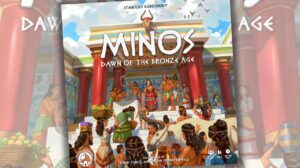
Minos: Dawn of Faith – Justin Bell
I dropped by a friend’s house to play some games, and they just happened to have an interest in playing the new expansion to Minos: Dawn of the Bronze Age, Minos: Dawn of Faith. I liked the first game, but didn’t love it; I thought the expansion might mitigate some of my issues with the base game.
As it turns out, Minos: Dawn of Faith wasn’t interested in my feelings. The only addition with the expansion are God tiles, which are paired with a new set of black dice to give players new options during the dice drafting phase. The drafting here is still the best part of Stan Kordonskiy’s design of the base game, and Dawn of Faith still has the tension present in the base game experience. Drafting a black die doesn’t allow a player to add these pips to a red, yellow, or blue die to boost your way up those matching tracks. Instead, players can spend “Tribute” (face-down draw deck cards) when activating a black die action to gain both minor and sometimes major bonuses by spending Tribute before taking a main action.
In a game that already felt overstuffed, Minos: Dawn of Faith leans even harder into long turns and an even longer playtime. There are 34 new cards (spread across the first and second Ages of the game), a couple of new Special Abilities, new bonuses, and the like. But there is no attempt to streamline the gameplay, which felt like a missed opportunity. The base game’s most glaring functional flaw was the advance boat/Trading Routes feature, and that area of the board is simply not powerful, nor interesting, enough for players to ever feel the need to invest. I would be shocked if core Minos players felt that Dawn of Faith was required viewing. My thoughts from my initial review remain: the base game is OK, but come for the very cool dice drafting…and don’t bring many friends, to keep the playtime at or under two hours.
Ease of entry?
★★☆☆☆ – Not an easy onboard
Would I play it again?
★★★☆☆ – Wouldn’t suggest it, but would happily play it
Read more articles from Justin Bell.
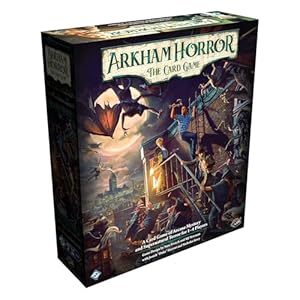
Arkham Horror: The Card Game – Jesse Fletcher
While Arkham Horror: The Card Game has been around for a good while, this 2026 version represents a new core set and initial jumping off point for newcomers. I had always heard good things about the card game. While I had no familiarity with traditional collectible card games like Magic: The Gathering, the prospect of a scenario-driven cooperative expandable card game drew me in, particularly from my positive experiences with playing loads of scenarios of Mansions of Madness, 2nd Edition.
While it can be played with up to four players, like most of my campaign games, I played it solo. I’m a sucker for solo campaign games, so I dove headfirst into it, with mostly positive results. Each player chooses a character then takes their character-specific deck. Everything is card-based. Some cards are locations, some are encounters, enemies, events, etc. The cards are loaded with text and keywords. I frequently had to consult the rulebook for reference, although I can see how after repeated plays the concepts will probably start to sink in.
The story pleasantly comes in bite-sized pieces, without interrupting the action like many narrative-based campaign games often do. The game is primarily about moving around, discovering things, and performing attribute-based skill checks. Checks can be boosted by playing additional cards, then usually hampered by required token draws from “chaos bag.” It was sufficiently difficult, but I managed to eke out the victory. While it didn’t instantly enthrall me like some other campaign games, I enjoyed my play enough to want to continue on to the next scenario. I’m keen to discover more cards to add to my deck via in-game earned experience, and I can tell the overarching story will have some intrigue. Each scenario can, however, be played as a “one-off,” independent of the campaign.
Ease of entry?
★★★☆☆ – There were a few questions
Would I play it again?
★★★★☆ – Would like to play it again
Read more articles from Jesse Fletcher
Discworld: Ankh-Morpork – Justin Bell
The strangest title for a game I’ve played this year is Discworld: Ankh-Morpork, a Martin Wallace game based on Terry Pratchett’s Discworld series of fantasy novels. (I had never heard of Terry Pratchett, Discworld, or this board game until a recent game night…then I learned that Pratchett wrote FORTY-ONE novels in this series. Crazy!!)
On a night where it just so happened that two other Wallace designs hit the table—Age of Steam and Cthulhu: Dark Providence, the remake of A Study in Emerald—Discworld: Ankh-Morpork is somehow a hidden role, area control, hand management game…with a loan system. (Brass games are always lurking around the corner if you are playing a Wallace game, right?) Players begin the game by drawing a role card, which becomes a fun way to try and suss out what the other players are going for. That’s because each player’s win condition might be very different, from having control of a certain number of regions across a 12-zone map to simply trying to empty the draw deck.
Play was snappy, and I liked the way cards play into each other by stacking with certain card effects. At the start of a player’s turn, if their win condition has been met, the game ends immediately, and thanks to a very solid player aid with descriptions of all potential roles held by players, everyone is constantly trying to use that aid to figure out what their neighbor might be going for. The game’s only drawback: some of the roles are just more interesting than others. (I was the guy who was “secretly” trying to wait out all the players by exhausting the draw deck. I wasn’t even close to winning.) Depending on the role you are assigned, Discworld: Ankh-Morpork might be a blast. No matter what, the card art is something to behold.
Ease of entry?
★★★☆☆ – There were a few questions
Would I play it again?
★★★★☆ – Would like to play it again
Read more articles from Justin Bell.