
Disclosure: Meeple Mountain received a free copy of this product in exchange for an honest, unbiased review. This review is not intended to be an endorsement.
Disclosure: Meeple Mountain was provided a pre-production copy of the game. It is this copy of the game that this review is based upon. As such, this review is not necessarily representative of the final product. All photographs, components, and rules described herein are subject to change.
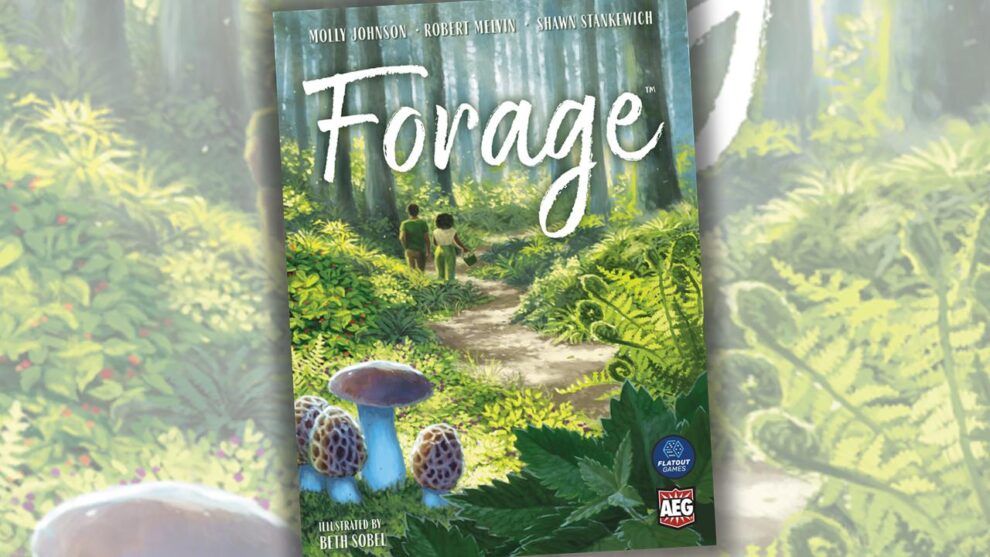
Flatout Games loves their unique themes: quilts for cats, turning playing cards into salad, wizard foxes, bee kingdoms, and of course the Pacific Northwest. Now they’re back with a crunchy roll and write that will have you traipsing around the countryside looking for good eats.
Take a walk with me through the woods as we play Forage.
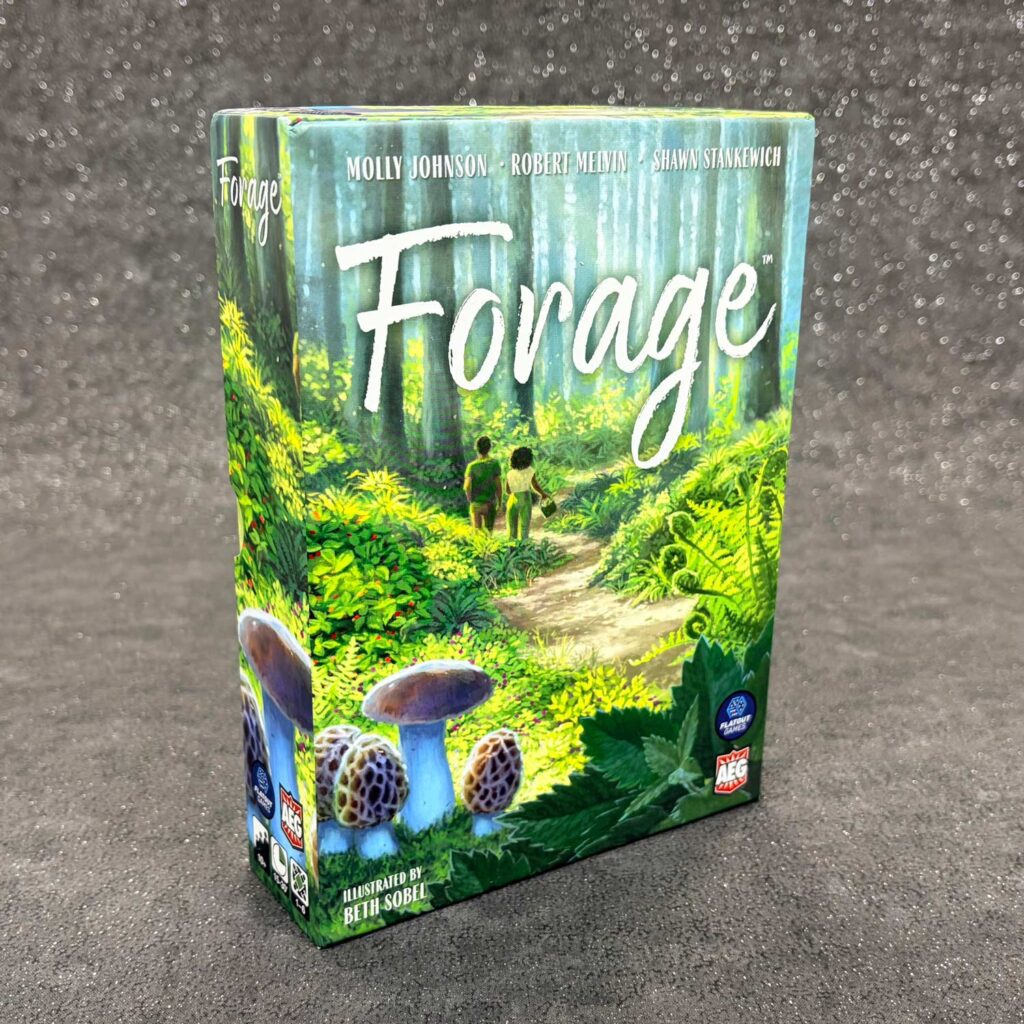
The Bounty of Nature
Many years ago I read a book by famed author Barbara Kingsolver called Animal, Vegetable, Miracle: A Year of Food Life, a memoir about how she and her family relocated to Virginia and committed to living off only what they could grow, forage, or trade for in the local community. It was fascinating because it introduced me to so many plants that I’d never heard of before. Fiddlehead ferns…you could eat them? Morel mushrooms that some people call “miracles” because it’s a miracle if you find them?
While I never did anything with that knowledge, it really captivated me, and led me to even more books on the same topic like The Mushroom Hunters: On the Trail of an Underground America, about people who can make tens of thousands of dollars taking a single trip into Canada to forage for mushrooms.
“But what’s that got to do with board games” you might ask? Quite lot in this case! In Flatout Games’ newest title Forage, players lace up their hiking boots, grab a wicker basket and head off into the woods in search of the bounty of nature; specifically looking for morel and porcini mushrooms, fiddlehead ferns, stinging nettles, salmonberries, and huckleberries.
How to Play Forage
Forage is a roll and write game with a shared dice pool. In this case that means one player rolls all the dice, then groups them together in the middle of the table according to the icons on each die. Rather than claiming a die for themselves, players simply pick which group works best for them at that point. But let’s back up a minute to get a high level picture of the game.
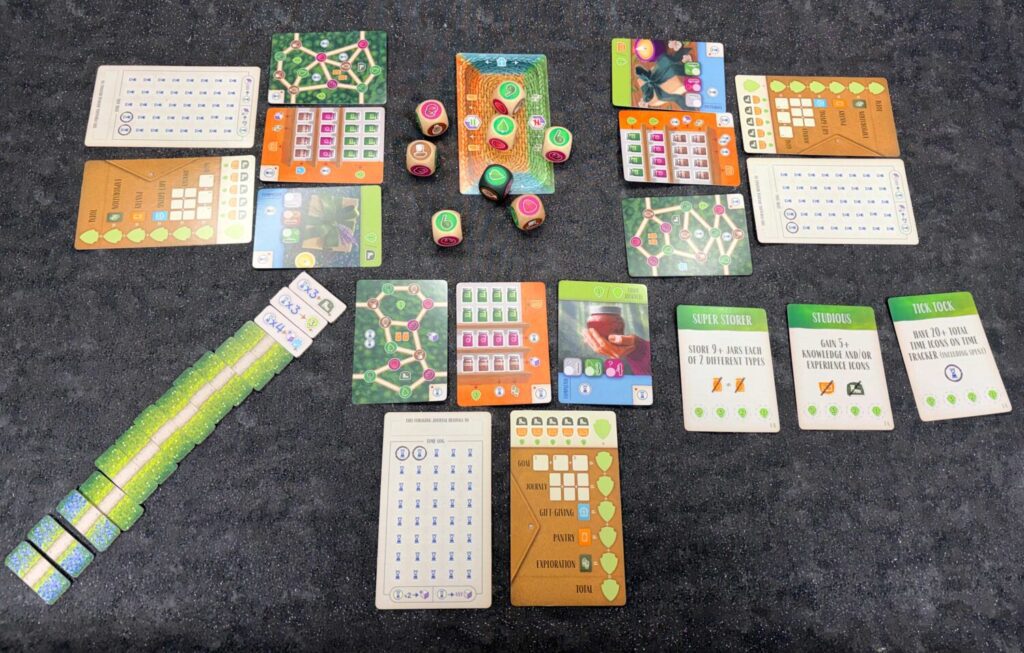
In Forage, players compete to earn the most points by exploring the forest to harvest food, returning to their pantries to can, jar, and pickle, and then turn around and gift those food items away to their friends and families. Each of these three actions are represented by dry-erase safe cards each player places into their personal tableau. Exploration cards are maps overlaid with specific icons found on the die faces, Pantry cards display colors (brown, purple, and green), and represent the bounty you bring back from the forest, while Gift-Giving cards mix both icons and colors.
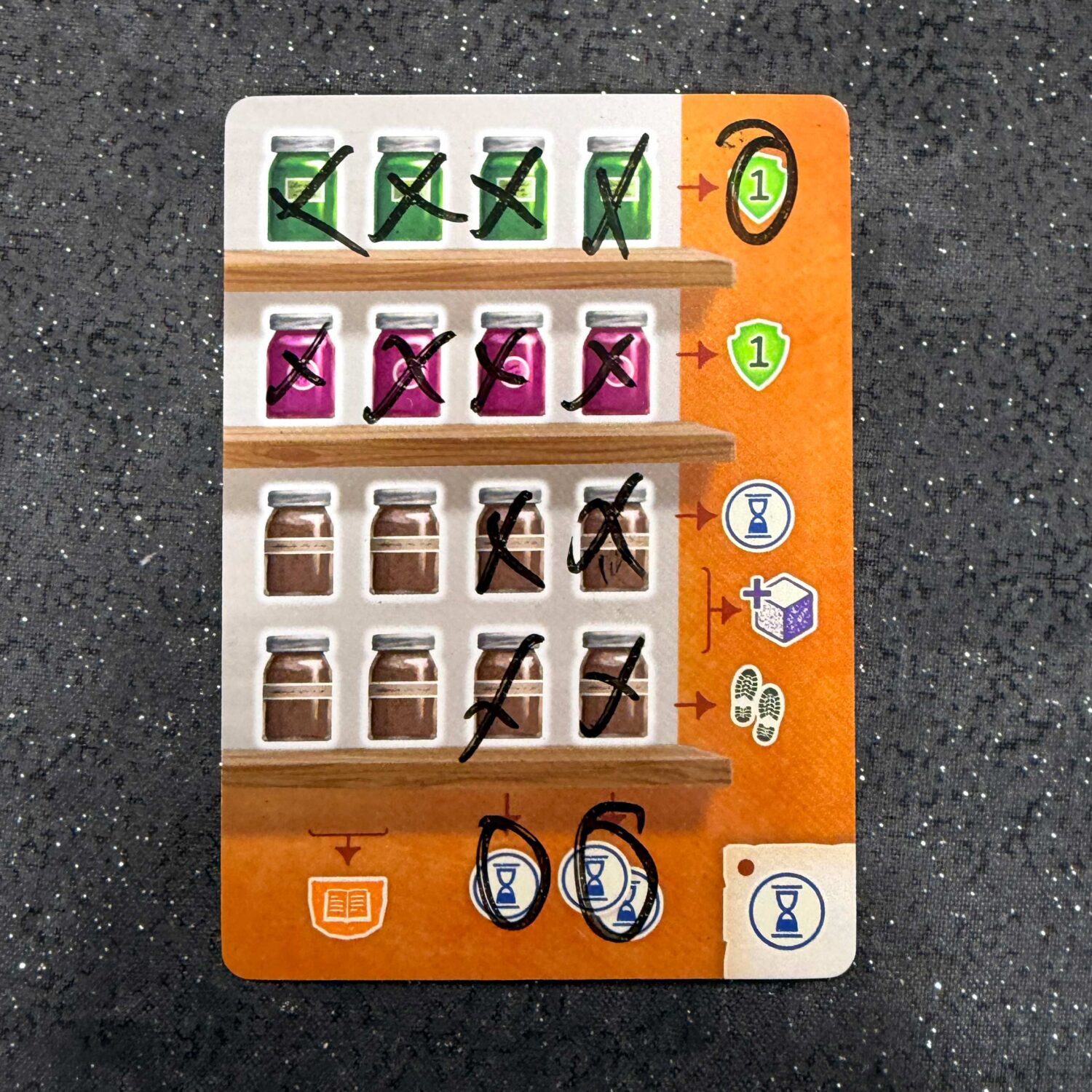
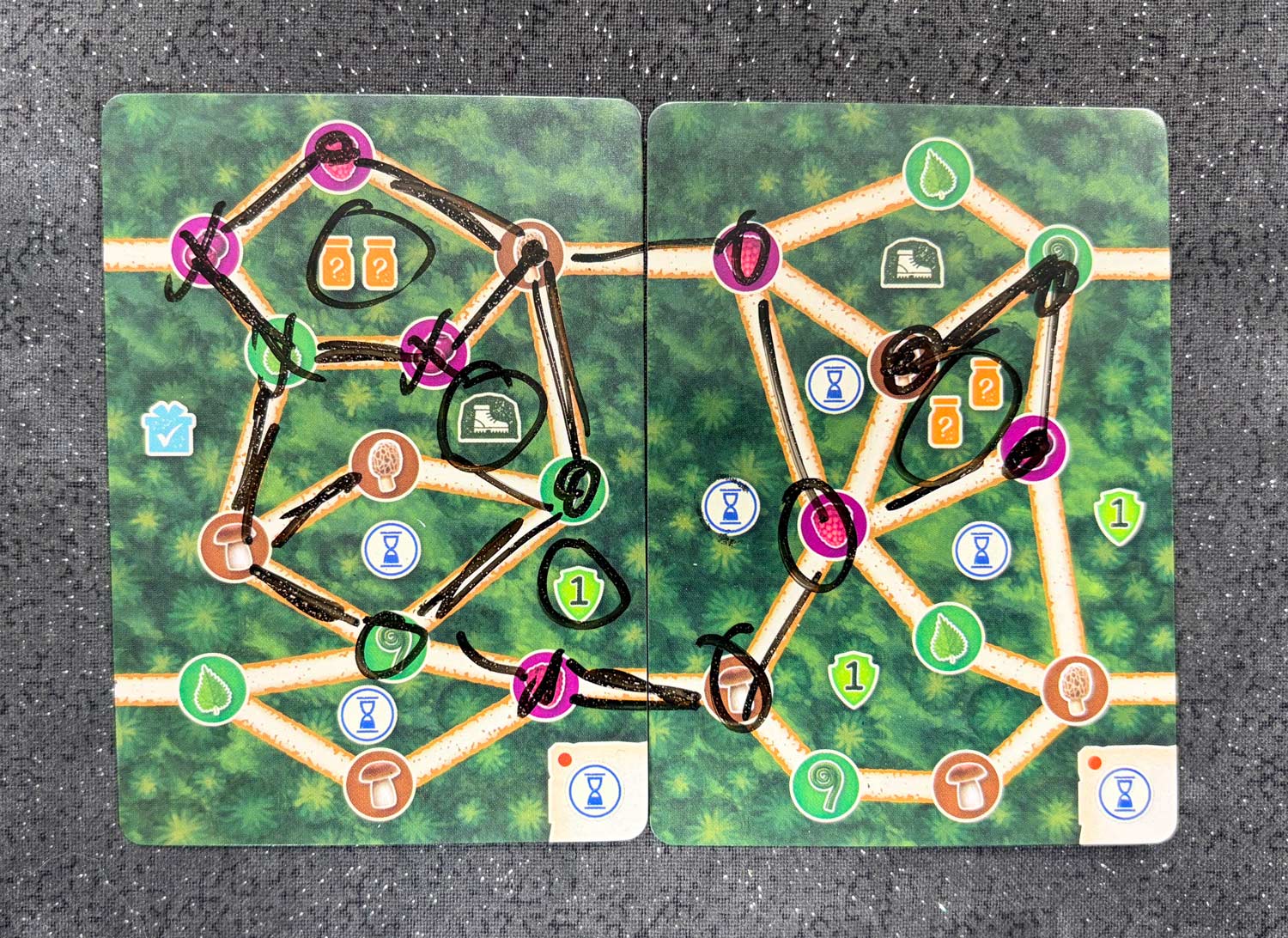
Back to the dice! Forage includes eight delightfully chunky wooden dice, each displaying icons for the 7 different plants matched with their colors. The mushrooms are brown, ferns and nettles are green, and of course the berries are purple. Roll the dice together then after placing the special green “foraging die” into the middle, split the rest into groups based on the icons. Any dice with two or more matching icons gets placed on the “Pantry” side of the display, while singleton dice go on the “Exploration” side.
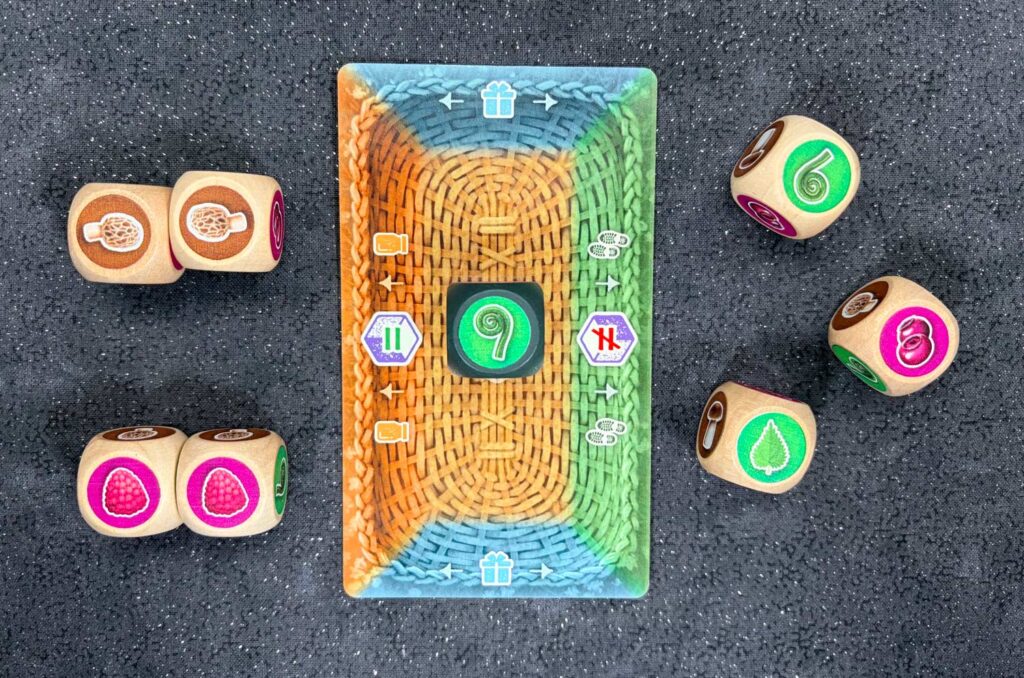
Players can make one of three choices based on their needs.
- Store – Select any one group of icons from the Pantry side (including the special foraging die if it matches their group).
- Explore – Select all dice on the Exploration side (including the special foraging die which will always be available in this action).
- Gift – Select any one group of matching, or non-matching dice. For example, this can either be grouped by color (any 4 dice with a green background), by icon (exactly 2 morel mushrooms), or any 5 dice (of any color or icon), and can pull from both the Pantry and Exploration sides of the display.
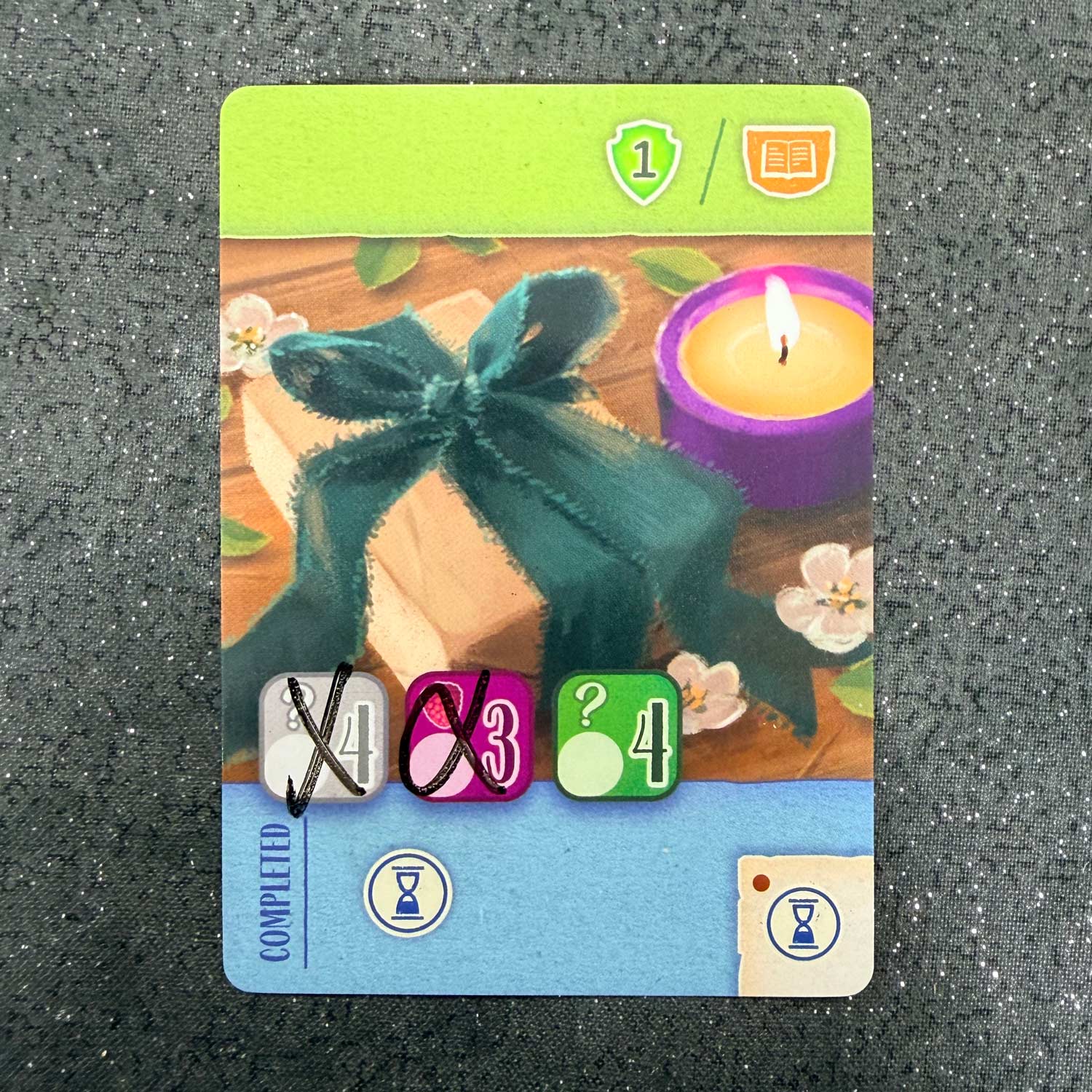
After making their dice selection players mark off spots on the appropriate card in their tableau. Since this is the heart of the game let’s take a look at some examples.
Card Examples
Even through there are three different card types, they each share a few similarities:
Exploration
On Explore cards, players use the icons on the dice and mark off any single spot on any map card in front of them. If two adjacent icons are marked, they draw a line between them, indicating the player has explored that path. After enclosing a section on their map, they get a bonus represented by the icon in the middle of the path. Once they mark off every icon on their map, they also earn the bonus found in the bottom right hand corner of the card. Every map card has paths going on both right and left sides. This means in order to enclose those items you need additional map cards, which we’ll talk about shortly.
The Pantry
Pantry cards represent storage space in your home (or basement perhaps), where you store the result of your harvesting. Pantry cards don’t care about the specific icons you collect, but rather the color. If you select 3 fiddlehead fern icons, you’ll be able to mark off any three green spaces on a Pantry card, etc. Pantry cards reward you for efficiency, so once you fill in a row or column, you’ll earn the bonus found at the right or bottom of the filled in section. As with Exploration cards, once you complete a Pantry card, you earn the bonus in the bottom right.
Gift-giving
Gift-giving cards require a mix of colors and icons, as represented by each individual card. You might need 5 brown dice, or 2 stinging nettles, etc. You must mark off each section completely, and can’t carry a space across multiple turns. In addition to the completion bonus found at the bottom right (like with Exploration and Pantry cards), Gift giving cards earn you a second bonus found at the bottom left, and also some end-game scoring condition.
A Turn of Forage
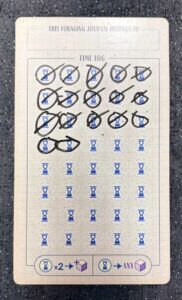 A game of Forage plays over 13 rounds, tracked by a series of “Journey tiles”, each featuring a deal that players can purchase, generally with “time” which is tracked on a separate dry-erase player card for that specific purpose.
At the beginning of each turn the next tile is flipped over, the dice are rolled, and players make their selections as explained above.
At the end of each turn, players are given the choice of drawing a new card, any one of the three cards listed above (or trading in the card to earn more time).
After all the rounds are over, players tally up their points from all of their cards, along with any end game bonuses, and determine the winner. The player with the most remaining time wins any ties.
Into the Great Wide Open
I’m quite a fan of the roll and write genre, having played and reviewed quite a few over the years. Standouts include Ganz schön clever and Fleet: The Dice Game, Silver & Gold, and Three Sisters. Some of them are themeless while others practically drip with it. But the main takeaway is that each of them bring their own distinct style, and approach to the genre.
Flatout Games’ release is a new entry to the already crowded space, but it’s good that the focus here is nature, because Forage is a wide open space. Heavily influenced by the Pacific Northwest, where the Flatout team is based, Forage is awash in colorful illustrations that might have you wiping your brow from imagined humidity. Everything you do in the game is centered around the concept of sustainability and nourishment: both food for your belly, and gift-giving for your relationships.
But how does it play you might ask…are there…combos? My friend, Forage is indeed combolicious…in some cases almost so much that it can be a challenge to keep track of where you are in a chain.
The concept of time here is central to your gameplay. Each player keeps track of time they earn and time they spend, and that bookkeeping is critical to your success. In addition to using time to pay for various Journey cards (3 time can earn you 5 points for example), you can also spend time to extend the value of a given turn. Mark off a single time icon to add an additional icon to your Exploration or Pantry choices. That could allow you to complete a path or pantry shelf which could kick off a combo chain. Cross off two time icons to take a second dice action, even duplicating the dice action you already selected.
While it can be tempting to focus on one area to the exclusion of the others, it’s really important to at least spend time on two of the three actions as you can earn valuable synergies from doing so. Closing off paths on Exploration cards can allow you to mark off additional spaces in your Pantry, and completing Pantry shelves can let you mark off entire items on a Gift-giving card.
Unlike some roll and write games, there is no dice mitigation, so it can be a challenge to get specific icons (fiddlehead ferns for example) when you really need them. That’s why planning ahead can be a good idea. Leaving just a single icon open to completing a space could mean that you can finish that section by using a time icon, and chain a combo to allow you to finish off a challenging Gift-giving card.
The main takeaway from our time playing Forage is that the indicated playtime is quite a bit off. The box lists the time as 15-30 minutes, but in our 3 and 4 player games we never finished in under an hour. There’s so much going on that it can be tough to move quickly. It’s clear that the Flatout Games team has spent a good deal of time balancing out the play so that no one area is overpowered, but they’re still tweaking and making changes going into the Kickstarter, which should be launching shortly.
If you love food, gift-giving, and the great outdoors, then Forage could be a great addition to your collection.