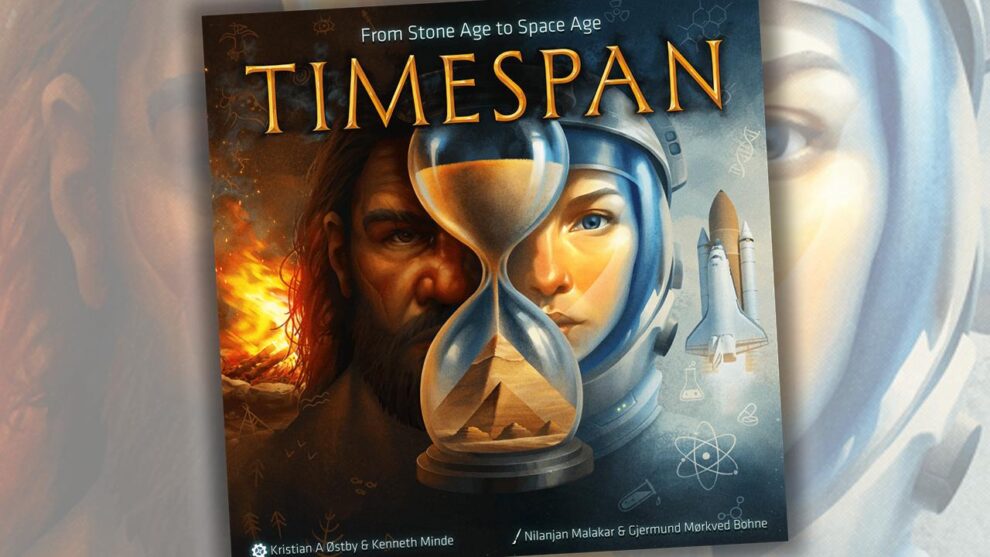

Disclosure: Meeple Mountain received a free copy of this product in exchange for an honest, unbiased review. This review is not intended to be an endorsement.
Here’s the fun thing about tabletop criticism: you can’t blame a game for doing the things that its designers say it is trying to do.
Here’s what I mean. If you read the BGG Designer Diary from the people behind Timespan—the newest title from Alion by Dr. Ø, the people who gave us last year’s Euro strategy title Recall—you know that Timespan is both a peaceful, simultaneous play-driven civilization game, and not a new game from the folks at Stonemaier.
That cuts a few things off at the knees. If I read a single review of Timespan that starts with “I can’t believe how little interaction there is in Timespan”, I will immediately write that person off. The back of the box literally references the following words: “peaceful”, “simultaneous”, “short.” There’s a solo mode…in a civ game.
Again: Timespan is a civ game with a solo mode. That should tell you where we are at…and, if you like the idea of a civ game where everyone in multiplayer is playing at the same time, and the game can be knocked out in less than 90 minutes (all seven of my plays clocked under that timeframe), do I have a game for you!

Uh, What Now?
Timespan is a tableau and engine building game for up to five players. The reality is that you will mostly be playing solo; in that regard, while I had fun playing Timespan with other people at the table, I prefer and recommend this game as a solo experience.
Here’s how solo Timespan is: there are no changes to the rules when playing solo, save for one mechanic that makes one additional action available each time a new round of actions begins. (This attempts to simulate additional structures built by another player during play.)
I’m really fascinated by the swim lane Timespan is attempting to occupy. It’s a medium-weight rules experience; if you’ve never played a civ game, you’ll be fine here. If you’ve never played a modern board game, you might be fine here as well, thanks to a very straightforward set of rules and a reasonable play time. It takes the experience of card “conveyor belt” games like Ancient Knowledge and last year’s Echoes of Time, and juices up play by letting players move at their own pace during the action round.

It’s a worker placement game, but in a format that lets each player build out their own action area. It’s a resource management game, with an exceptionally well-built mini puzzle on one of each player’s two personal play mat that requires players to use just eight small brown cubes to manage a series of different resources and an upgrade system that might be the cleanest upgrade system I’ve seen in a game this year. (You are going to see the word “clean” again a few more times in this review.)
There are hints of what makes games like Through the Ages shine, with real-world figures appearing on cards that can be built into a player’s “timeline”, a four-card tableau that is constantly in motion as players build new cards to push others off the right edge of the second player mat.
As the back of the box reminds us, there is no combat in Timespan. Competition is as Euro as Euros can get here, with tracks offering bonuses, a small tech board that players can use to upgrade their action efficiency and earn valuable one-time bonuses, and a “Peace” track that scores points and determines turn order when players draft new cards during the Discovery phases scattered across the game structure.
(Yes, Peace. And some cards cancel Peace icons on other cards, so if you wanna build that Guillotine card, just know that might cost you a spot in draft order!)

The Discovery phase is the only player interaction point in Timespan, but it’s still important. There are 14 phases of play in Timespan: five Discovery phases, five Action phases, and four Income phases. (The first Income phase is done during setup.) During Discovery, players get to add two “history” cards to their hand and take one bonus tile, from a pool of choices equal to the player count plus one.
Because all the bonus tiles are good, and because only one of the two cards in each draft pile is face up, you never really get hosed during this draft. But because cards come in five different flavors (inventions, people, construction, next gen, and special), and some end-game bonuses are tied to the flavors of these cards, you might want to slide in front of another player to draft a specific card first.
The draft choices are interesting, and some of the bonus tiles are a little better than others. (Exception: there’s a bonus tile or two that lets a player spend something to get an extra worker. In an action efficiency game, workers are pretty valuable.) But my findings across my plays is that everyone can find ways to pivot to a different strategy when faced with those limitations.
Those pivot points might be the best part of Timespan. That, or the combos.

“How are you doing all that?” someone might say during your plays, and they are right. Because some of these combos are extraordinary, as players add cards to their timeline then use a series of yellow smiley-faced workers—think the face used for anything based on the Watchmen property of graphic novels, movies and TV series—to trigger card effects that do almost anything you can imagine, from playing cards for free to scoring points based on the position of the card on the timeline.
Here’s something I really love about Timespan: you don’t need to wait until the third or fourth action phase to really see the combos heat up. I’ve had turns in the first round or two that were somewhat exhilarating, with small synergies in early-round history cards aligned with bonuses on that game’s technology board. Or getting a fourth worker in the first round thanks to a series of lucky breaks. Or using one of the game’s faction board bonuses (six factions are included, and there’s no question Timespan is already ready for expansion content) to skip ahead on the ship track three times or more in the first round of the game.
Watching other players execute combos in other games can really slow a game down for observers. Simultaneous play makes that a non-issue in Timespan.

But Wait, There’s More!
The praise for Timespan flows nice and easy.
Timespan has Wonder cards. Wonders, like in other games such as Through the Ages, 7 Wonders, World Wonders, and Ancient Knowledge (where they are known as “Monuments”), are famous structures from history, and in game form, these places grant a hefty bonus or power. In Timespan, two Wonders are available for all players to use during the beginning of the action phase, by placing a camel token on one of the Wonders. When visiting, players must pay one coin from their supply to use a neutral Wonder card.
But these Wonders are fascinating. In addition to the neutral Wonder cards placed in the middle of the board during setup, players can build Wonders from hand by spending gold from their resource area. Once new Wonders enter play, other players can use them before the beginning of each action phase, giving the owner a two-point bonus each time any player visits. Each round, players must move their camel to a new location, encouraging all players to build their Wonder cards in a win-win for both parties.

In my fifth play of Timespan, I built three Wonders, and I happened to have Wonder cards that were particularly useful. The Wonders can be used by other players as their bonus camel action before the Action phase begins…but Wonder owners can also use their own Wonders with workers during the Action phase. That means building Wonder cards early can have a substantial impact by offering a bonanza of ways to build up those combos.
Oh, you want more? Playing cards into a timeline adds built cards to the left, and pushes out a card that was in the final timeline position on their player board to the right. Lots of cards have “graveyard” effects that trigger when a card “dies” and moves out of your action selection area. Some of those bonuses are comedy, and help extend a combo from time to time. Using a card’s action, then moving it into a graveyard, became a fun way to maximize my best actions. If you suddenly don’t want to use a card, all good; they can be flipped into a discard bonus, differing by card and age level. That means even when you get cards from the Discovery phase draft that you don’t want, they can still be pretty useful.
The resource mini-game? Amazing. You have eight cubes that represent whatever resource space they are on. So, a box on the wood resource space is one wood. A box on the steel resource space is one steel. But based on the resource type, you can instead get rid of that resource to upgrade another resource, up a chain of different resources to spend and build cards or take actions.
You will watch other players move these cubes up and down to accommodate earnings in a way that I can’t really remember in another board game. Like, you will watch me as I try to figure out a way to get six coins, while seeing that I only have four cubes left to accommodate everything I just earned through a card action, by shuffling cubes around in a panic.
“I’ve got two steel, but I just earned six coins. Let’s see…I will turn one steel into two upgrades, with one of these turning the other steel into a gold, and the second one to turn a zero into a coin. Then I’ll begin to take those coins. As I get the coins, I’ll turn two coins into a wheat and two more coins into a wood. That turns all four coins back into zeroes. Then, I’ll…”

And these conversions are all within the rules. A first-time player might look over and think you are cheating, but then later find themselves in a similar predicament. “How do I make all these resources fit? I’ve got to upgrade a bunch of things to turn these boxes back into zeroes, so that I can take new rewards…but I love rewards!!”
How about the physical production of the game? First, it’s worth calling out: there are no player aids included in Timespan, but there is a single, four-page reference pamphlet that all players need to share. (This is another reason why I keep saying it: every game needs a player aid. Also, this is more validation that Timespan is a solo game, because that way, you don’t have to pass around the reference guide, which will get a lot of use in your early plays.)
Beyond that, Timespan is a surprisingly clean product from a graphic design perspective. All the icons make sense. Move up this track, the one that has the big picture with a right-facing green arrow. Spend this to get that. Timeline positions could have been called out on the faction mats with a large number above each of the four slots, but after the first time a player asks that question, all players figure it out. When something has a ratio—age I History cards, 2:1—that means you draw two cards and keep one.
That gives me hope that casual players will pick up the action here quite easily.
And if you are tight on space? Timespan’s trifold board uses the back of its middle panel to shrink the entire board to that one panel. For my solo plays, I used the smaller board and found that it was completely fine to use when it was a party for one. It’s a thoughtful way to use the extra real estate that often sits unused.

Buy It
Timespan is already great…and with the extra space in the history card tuckboxes and the faction board ranking system used to break ties, it’s clear that expansion content is inbound, even if the publisher has not confirmed anything just yet.
“This outpaces Ancient Knowledge,” one player said after we wrapped a multiplayer game of Timespan. I agree. It’s the same idea, with cards dancing down a timeline to eventually move into a graveyard or memories area. But here, the simultaneous play elements really shine. The combos are bountiful. The Timespan system is so clean and it encourages multiple play sessions. It’s a game that impressed everyone who saw it.
No game is perfect, and Timespan has a couple areas of opportunity beyond the ones I’ve called out here. The biggest one is my minor concern that the Culture track is the most important of the game’s tracks. That’s where players can earn up to three additional workers by moving up, and in a worker placement efficiency game, it has become clear that the path to my highest scores all came when I prioritized that track.
I’m sure there are ways around that; for example, one of the tech boards (of the six available, making for a handsome mix of faction and tech powers in each game) features a one-time bonus that lets a player spend an advanced resource to get another worker. Huge. If you are drafting boards, I expect that board to be selected first every time.

Another reason I recommend solo play is because of what we experienced in both of my multiplayer games: the potential of a runaway leader. It is literally impossible to affect another player’s engine. (That’s the problem with Peace, I guess!) There are going to be games where you watch another player take massive action round turns while others are struggling…the scoreboard disparity, the “track envy”, the feeling that an opponent is having cake and eating it, too, all of that is real.
My initial response to this is always the same: “well, I guess I just have to play better.” Sure. But for some players, this is a negative, so while it is not a negative for me, I acknowledge that this could be an issue for others.
One more minor quibble: I wish the faction boards were a bit more unique, or more game-breaking, maybe. As it is, the Vikings don’t feel that much different than Mexica, who doesn’t feel that much different from Greece. I don’t expect anyone to raise issues with the idea that “the Babylonians always win” when experienced players compete in Timespan. The powers are just not different enough. Now, I love the differences with the six tech boards, which are selected with factions at the beginning of the game. But the factions needed a little more spice, something that I could imagine being considered when expansion content arrives.
Timespan is excellent, and it won’t shock me if Timespan later becomes a BGG top 250 game in the very near future. Players like these kinds of games nowadays…and with 150+ unique cards, an easy teach, and limitless combo possibilities in a non-confrontational play structure, Timespan is a perfect fit for the Euro game enthusiast of the right now.