Disclosure: Meeple Mountain received a free copy of this product in exchange for an honest, unbiased review. This review is not intended to be an endorsement.
 When Ticket to Ride was released in 2004, it became popular the world over. That year, it was nominated for numerous international awards, even winning the prestigious Spiel de Jahres award. Capitalizing on the exposure, the following year designer Alan R. Moon released Ticket to Ride: Europe. By changing the map from the US to that of Europe—and introducing small but meaningful changes—Moon showed how he could expand the game in challenging and entertaining ways while still being familiar to anyone who had played the original. He’s been going strong with new versions of his game ever since.
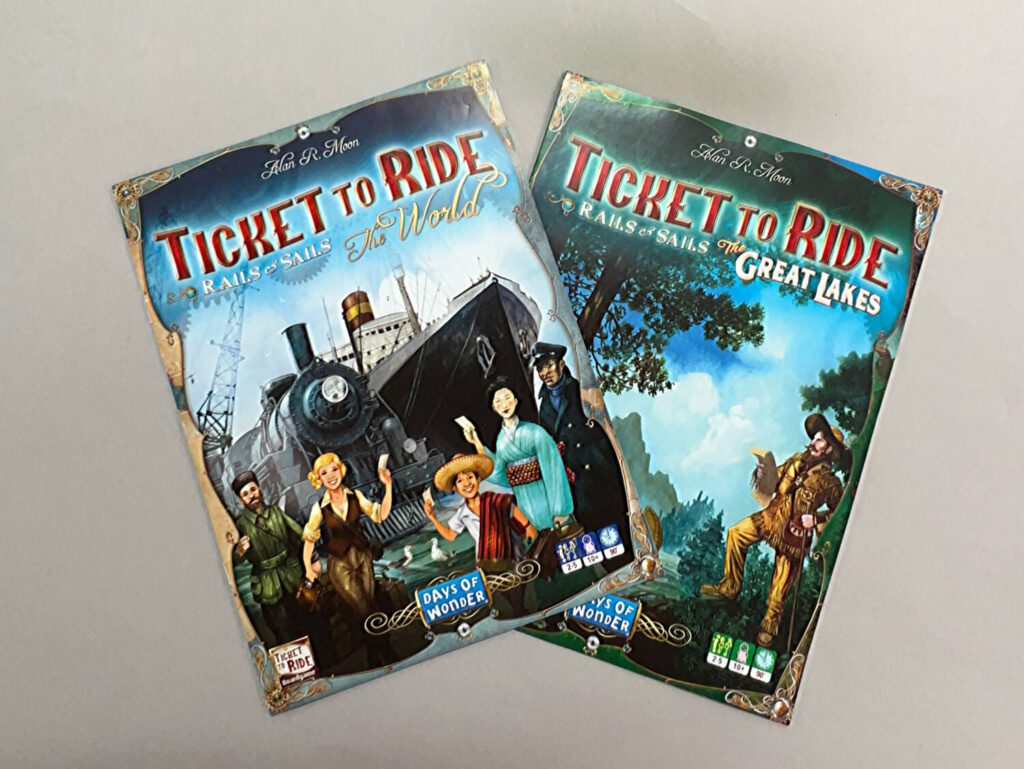
Ticket to Ride: Rails & Sails (shortened to TTR:R&S from here) comes with a two-sided game board that lets you choose to either play across The World, or in a section of the USA and Canada surrounding The Great Lakes. To do so, you’ll use familiar train cars to move across the land to port cities where your new ships will continue your path across waterways and oceans.
As with my reviews of other Ticket to Ride editions, I’m going to skip the How to Play section of this review. If you haven’t played Ticket to Ride before, check out my colleague Kevin Brantley’s great review of Ticket to Ride to learn how.
What’s New?
The first thing you’ll notice when opening the box is that there are two sets of rules: one for The World side of the board and a second for The Great Lakes.
You’ll discover one of the biggest changes before the game even begins. During setup, instead of only getting a set number of plastic train cars in your chosen color, you’ll receive 25 train cars and 50 ships. This may seem great, but you can only play with your choice of a number of pieces as determined by the side of the board you are playing. (60 for the World; 50 for the Great Lakes.)

You will receive five Route ticket cards and must keep at least three. Taking a look at the number of train spaces versus the number of shipping spaces on those tickets might help you decide how many trains and ships should make up your total of 60 pieces.
Instead of a single Train Deck of cards, you will now have two decks to choose from: a Train Deck and a Ship Deck. Players can choose from three face-up cards from each deck, or draw the usual two cards, either two cards from one deck or one from both decks.
There are only six colors of train and ship cards to collect (red, yellow, green, black, white, and a shade of purple that everyone I’ve played with calls pink). Since there are two modes of transportation here, a wild combination Locomotive and Ship card replaces the wild Locomotive cards of other versions of the game.

The ship deck cards include 36 double-ship cards (6 in each color) that count, you guessed it, as two ships. (There are no double-trains, however.)
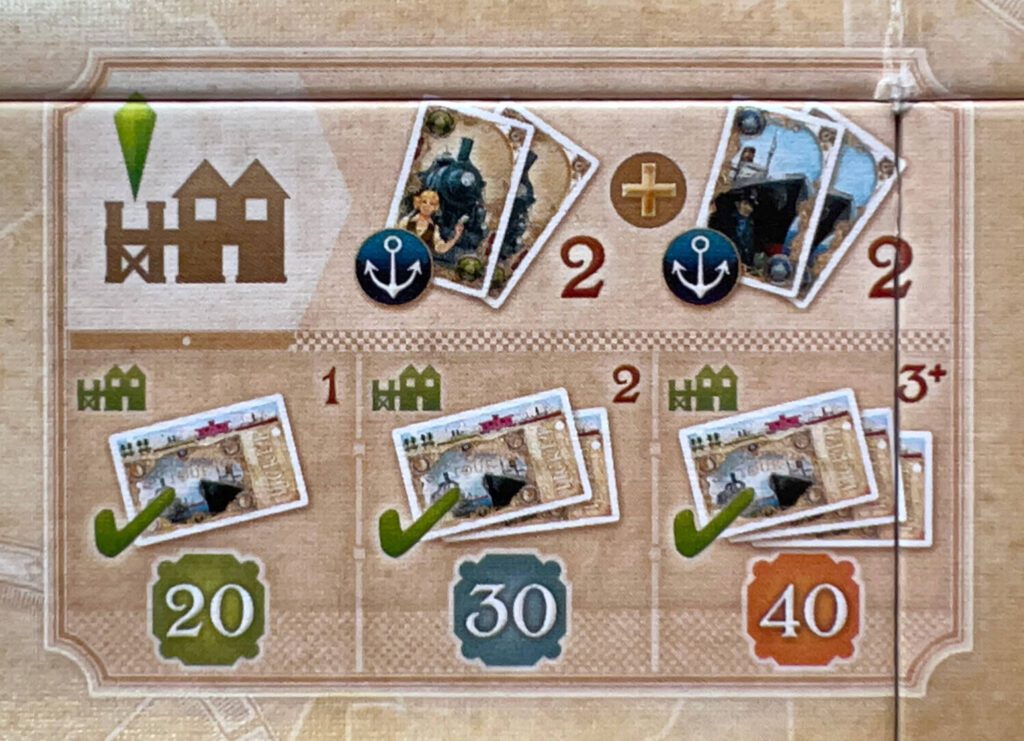
 You will also receive three Harbors. One of your new turn actions is to place one of these in a coastal town that links a train route with a shipping route and a harbor symbol next to the city’s name. To place one on the board, you must pay two train cards and two ship cards, all with matching colors (or wild train/ship cards) and each with the Harbor anchor symbol at the top of the card.
As my group discovered, getting Harbors to the board can be a pain but the points they provide make them worth the trouble.
At the end of the game, you’ll score each Harbor based on the number of routes you have going into the Harbor’s city. The more routes you have completed that go through a city with your Harbor, the more points you’ll earn. However, since the points vary by the side of the board you’re playing, I’ll cover the specifics when I discuss each game.
At some point late in the game, you might realize you guestimated your ships to trains ratio incorrectly and have run short of one or the other. On a turn, you can choose to take the Exchange Action, which allows you to exchange one mode of transport for another at a rate of -1 point per piece you traded in. When you use the Exchange action, you can trade as many of your pieces as you need.
While these similarities are essential, the two sides of the TTR:R&S board really represent two different games, as signaled by the two rulebooks. Each side requires a separate approach, given the differences in the individual games. So, let’s look at The World and The Great Lakes games.
The World

The World side of the board encompasses more area than The Great Lakes side (surprise!), meaning you’ll definitely need those extra 10 train and/or ship pieces. Your Route cards will often be longer and worth more points than in other versions of Ticket to Ride.
In fact, your global routes can stretch from one side of the board to the other. Along either edge of the board, you’ll find Shipping Routes that indicate they continue on the opposite edge.
Along with the standard train routes, there are now Pair Routes to consider. The rulebook claims these paths “cover very difficult terrain” and, therefore, each space requires two cards of matching colors. Interestingly, you don’t have to have the same color of cards for each Pair Route space.

Harbors are worth more in The World game. Have one route going to a city where you have a Harbor and it’s worth 20 points; have two, and it’s worth 30 points; three gets you 40 points. Definitely worth the effort, if possible.
Finally, there are 8 new Tour Cards in The World Route deck. Where standard route cards show a connection between two cities, Tour cards show an ongoing route between 2 to 5 cities, in a specific order. If you complete the tour card in the proper order, you’ll earn the number of points in the bottom left corner of the card (9 to 34 points). If you complete the tour but not in the order shown, you’ll get the number of points next to the bottom-left number. And if you fail to complete the tour, you’ll lose points as shown in the bottom right corner (-15 to -40)

Tour cards can be risky, but if you get one in your initial hand of five routes to choose from, it might be worth the gamble.
The Great Lakes

In terms of ground covered, The Great Lakes side is less complicated. The routes are covering land in both Canada and the US surrounding and through The Great Lakes. Although your Route Cards stick to standard point-to-point connections (no Tour Cards), you’ll need to pay close attention to the limited shipping routes over the lakes.
The rulebooks recommend playing your first game of TTR:R&S on The Great Lakes side of the board as this gives you an experience closer to the original Ticket to Ride. Many of the extras I wrote about in The World version of the game are missing from The Great Lakes; however, there are two features to consider.

First, there are two pairs of cities on the board that can be reached either by a train line or a shipping lane. These are not considered Double Routes, those side-by-side routes that can only be used when there are more than three players in the game. Each route can be claimed by different players.
Second, the scoring for Harbors now offers fewer points. For each city where you’ve placed a Harbor, having one completed route going to it is worth only 10 points at the end of the game. Having two routes is worth 20 points, and three routes are worth 30 points.
Thoughts
In general, The World has longer overall routes and, specifically, longer sailing routes, while The Great Lakes has shorter shipping channels and longer land routes. As well, there are fewer alternative routes to destinations on these maps than there are on the original Ticket to Ride map.
This means playing TTR:R&S requires long-term planning, starting with claiming key shipping or overland routes early. Also, the earlier you start planning locations for your Harbors, the better.

To prepare for this review, I played both sides of the TTR:R&S board with a group of five people and then again with three people. I found that the player count matters. A lot.
Consider this: There are 11 train cards in each of the six colors used in the game, as well as 14 wild (Locomotive and Ship) cards, for a total of 80 cards. There are 4 single-train cards of each color and 6 double-ship cards in each color, making 60 cards. Admittedly, 140 cards sounds like more than enough cards for the game.
 However, in my five-player games, we ran aground with everyone drawing cards in search of the exact cards they needed. This meant large hands of cards for each player. These cards were unwanted by the players and unlikely to return to the game where other players could use them.
Before that first five-player game, I had read the BoardGameGeek.com Forums for TTR:R&S and found an excellent suggestion by Ted Dornbos (BGG username: @CountKarnak. Hi Ted!) where he shared two house rules he plays with. To summarize:
- Once per turn, before drawing train/boat cards, you may turn in three cards from your hand to draw three cards from the deck. Doing so, however, means you cannot claim a face-up Locomotive/Ship wild card.
- When claiming either a land/sea route or building a harbor, you may turn in five cards of your choice to be used in place of a single Locomotive/Ship wild card to be used in that turn.
This was a game-changer for us. Instead of five frustrated people not finding the cards they needed, we saw promise in more cards entering circulation. When individual decks ran out, other players, who previously held cards they couldn’t get rid of, seeded them with potentially helpful cards that had been stuck in hands around the board.
 I had expected the same to be true in my three-player games, but the problem never arose. Each group was made up of experienced Ticket to Ride players; all had played the many variations of the game I’ve reviewed here on Meeple Mountain. In all games, turns were played fairly quickly. TTR:R&S claims to play in 60-120 minutes. One of those five-player games lasted close to four hours–which is way too long for any Ticket to Ride game. My three-player games with my weekly review crew, however, only took 90 minutes each and never needed Ted’s House Rules to be added.
After finishing a game on The Great Lakes side of the board, both groups were eager to play The World the following week. They all enjoyed the new elements TTR:R&S brought to the table and were glad we had started with The Great Lakes game first. With my review crew, the scores in both games were competitive, with the point spread staying within 20 points of each other. (This despite three separate strategies/approaches to the game.)
 Although they would welcome a chance to play the game again, I need a break from TTR:R&S before returning. One of my lasting issues has to do with your hand of cards. At one point, I counted over 30 cards in my hand with both groups. Thirty cards would be a lot in a standard version of Ticket to Ride, but it’s much more complex in TTR:R&S.
This isn’t simply because you have to manage both Train and Ship cards in your hand; you also need to manage single and double ships, as well as Train and Ship cards with the anchor symbol needed to build Harbors. This makes five different types of cards to manage. I tried keeping my hand well-organized; my review crew each built small piles of cards in front of them for specific routes/Harbors. (When I tried this, I quickly forgot about the pile of cards.)
 Ticket to Ride: Rails & Sails is a solid game. If you’ve played other versions of the Ticket to Ride series and are looking for something more challenging, Ticket to Ride: Rails & Sails is definitely the game for you. However, if you’re new to the series, I’d recommend this as the third or fourth Ticket to Ride game to add to your collection. Start with Ticket to Ride: Europe and/or Ticket to Ride Northern Lights as good second game choices to build rule change expectations. Otherwise, Ticket to Ride: Rails & Sails may have too much going on..
I will play Ticket to Ride: Rails & Sails with anyone who asks to play—but in a few months. Meanwhile, four games in as many weeks will do me just fine.
Besides, I still have other games on my To Be Reviewed shelf to get to the table.