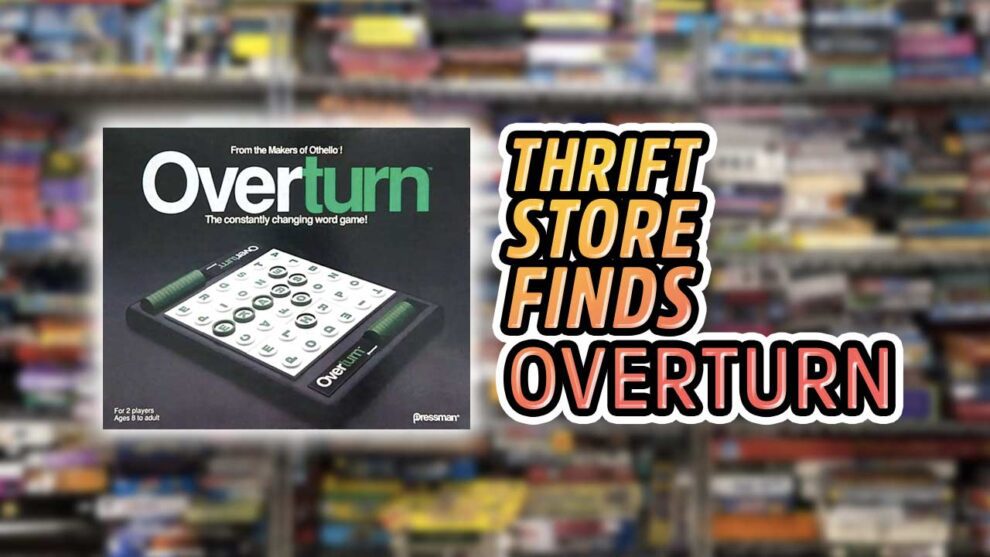

As someone who frequently goes to thrift stores, I’ve seen some games so many times they barely register in my mind. I’m referring to games like, The Game of Life, Battleship, and multiple editions of Trivial Pursuit. Occasionally, this board game treasure hunting uncovers a game I’ve never heard of that is both complete and sounds interesting. This series is about those rare finds, the ones that interested me enough to risk a few dollars on and have made their way to the gaming table. Have I found an overlooked gem? Or was one person’s junk now my junk? Read on to join in the hunt!
Playing the Game
You play Overturn on a raised black frame featuring 18 white square tiles, each with 9 letters printed in green on raised circles. These are mixed up, facedown, and then assembled in two layers, one on top of the other. This allows you to play two separate games, one after the other, by removing the first set of tiles and revealing the second set of tiles below.
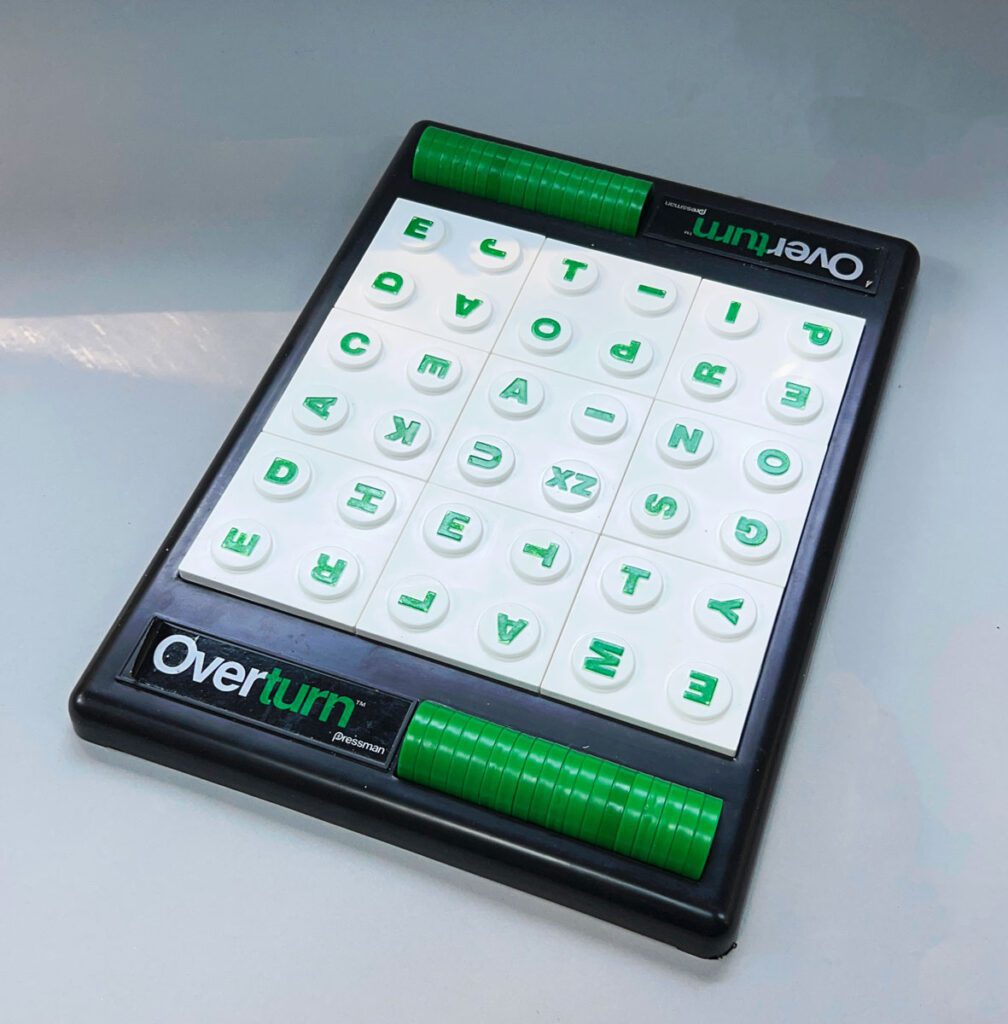
Each player gets 18 green rings that rest in a semi-circular inset on either side of the board (just like how an Othello board holds each player’s pieces). These rings fit over the raised circles with the letters on the board. To distinguish one player’s rings from another’s, Pressman painted one flat side of each ring silver and left the other green.
The randomly chosen first player scans the board and finds a word that crosses at least two tiles and places rings on each of the letters, with their color of the ring facing up.
On each turn, players will repeat this process, with one important distinction: if you use a letter in your word that already has an opponent’s ring around it, you don’t add your ring, instead you flip that ring over to your side. (And there’s your Othello connection)
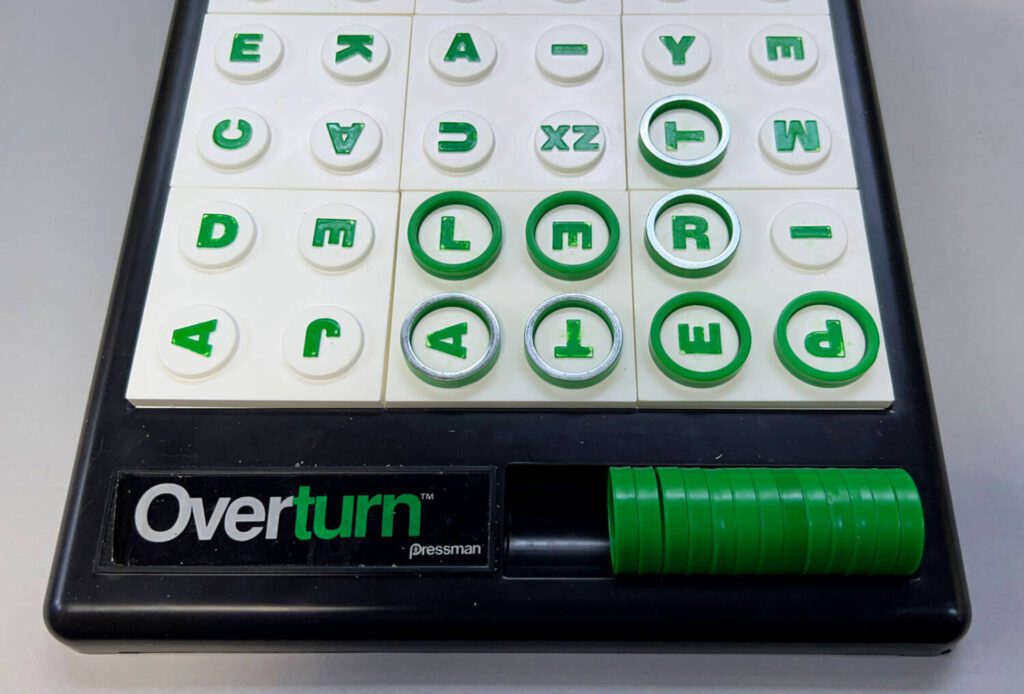
Often, one person finds a great word only to have many of the letters they claimed overturned by another word on the next turn. Consider how words like S P A N S reverses into S N A P S and how much of E L O P E can be reclaimed by P O L E and you have an idea of what’s in play.
House Rules
The official rules state:
When all 36 rings have been used or when neither player can find another word, the game is over. The player with the most rings of his color face up on the console is the winner.
We found this led to games that were overly long and seemed to have no end in sight. There were inevitably dead pockets on the board with no usable vowels or unworkable letter combinations. One player may have used all their rings, but we agreed there were no words the other could use their last rings. Was it fair, then, to score a player with unused rings against someone who had used all theirs?
After much consideration, we decided it was not. We tried several house rules to bring some balance to the game and have settled on this:
If the second player to place their rings uses all their rings first, the game is over. If first player uses all their rings first, their opponent gets one last turn to even up the number of plays. This means the second player has one last chance to win the game.
As the starting player, this means you have to count the number of your rings vs those of your opponent and then calculate the difference (a) the second player’s final word may affect the board including (b) the number of your rings that your opponent might flip over.
Personally, I find that going second has the greater advantage, but given that we switch who plays first (or second) after every game, I have learned to wait to use my last rings until I have a substantial lead. The few games I have lost have come from miscalculating these numbers.
The endgame is a tight back-and-forth, with each player trying to overturn as many of their opponent’s letters as they can. If they can claim letters in areas that cannot be overturned, all the better.
Final Thoughts
Pressman originally released Overturn in 1987. By 1993, Overturn won a Mensa Select award. That alone would have been enough for me to give it a try, had I looked up the game on BoardGameGeek when I picked it up. (I have since learned to do so with every thrifted game up for consideration.)
And speaking of BoardGameGeek, according to my tracked games there, we have played Overturn over 100 times since bringing it home. It’s a word board game that rewards strategic thinking, as well as creative ways of looking at words and their connected letters on the board tiles.
While the official rules say, “There are thousands of random combinations” to the tiles, we’ve become familiar with the tiles as established. It would be great if someone could 3D print the tiles in such a way that the letters were interchangeable from tile to tile.

I don’t foresee a time when we won’t be playing Overturn in the future. It’s a unique word game that changes from play to play, challenging our knowledge of words and encouraging us to build our vocabulary to find playable words.
(NOTE: We each have our iPhones nearby to consult before and after a player plays a word. I’ll leave it to you to set your own boundaries for those words that are allowable and those that are not.)
If you like word games, Overturn is one you should keep an eye out for. It will both entertain and challenge you.