
Disclosure: Meeple Mountain received a free copy of this product in exchange for an honest, unbiased review. This review is not intended to be an endorsement.
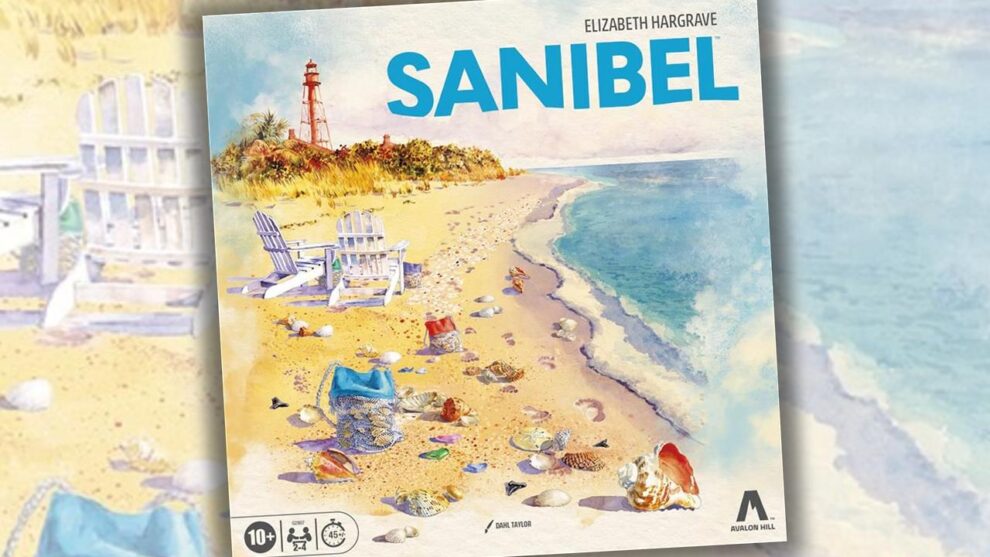
In Elizabeth Hargrave’s latest game, Sanibel, players take turns walking down the beach and stopping to collect a variety of shells and shark teeth. You’ll score points by dropping these treasures into your bag so they ‘fall’ in alignment with other items already there. Have the most points at the end of the walk, and you win the game.
Setup
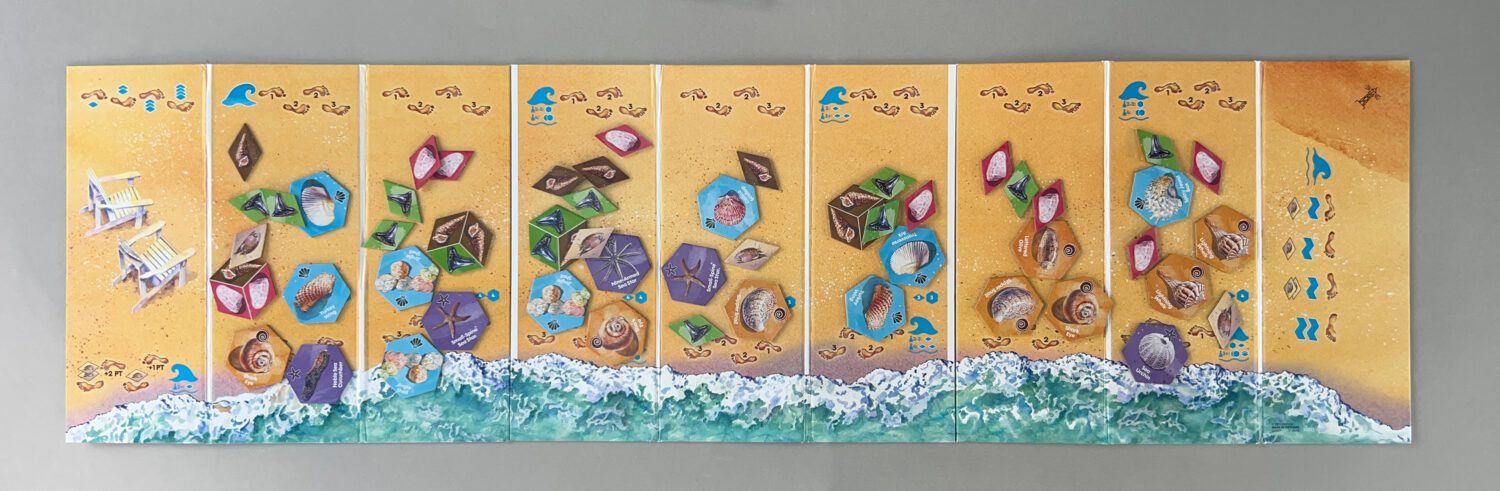
To start, unfold and line up the three sections of the board. On the left, place the section with the beach chairs; to the right, place the section with the lighthouse. The section without a special area at either end goes in between these two.
Players then take a token of their chosen color and the corresponding board with a bag printed on it. You’ll place everyone’s tokens in random order in the upper left corner of the central board on the right, just above the beach chairs. Place the Wave token to the far left of the player tokens.
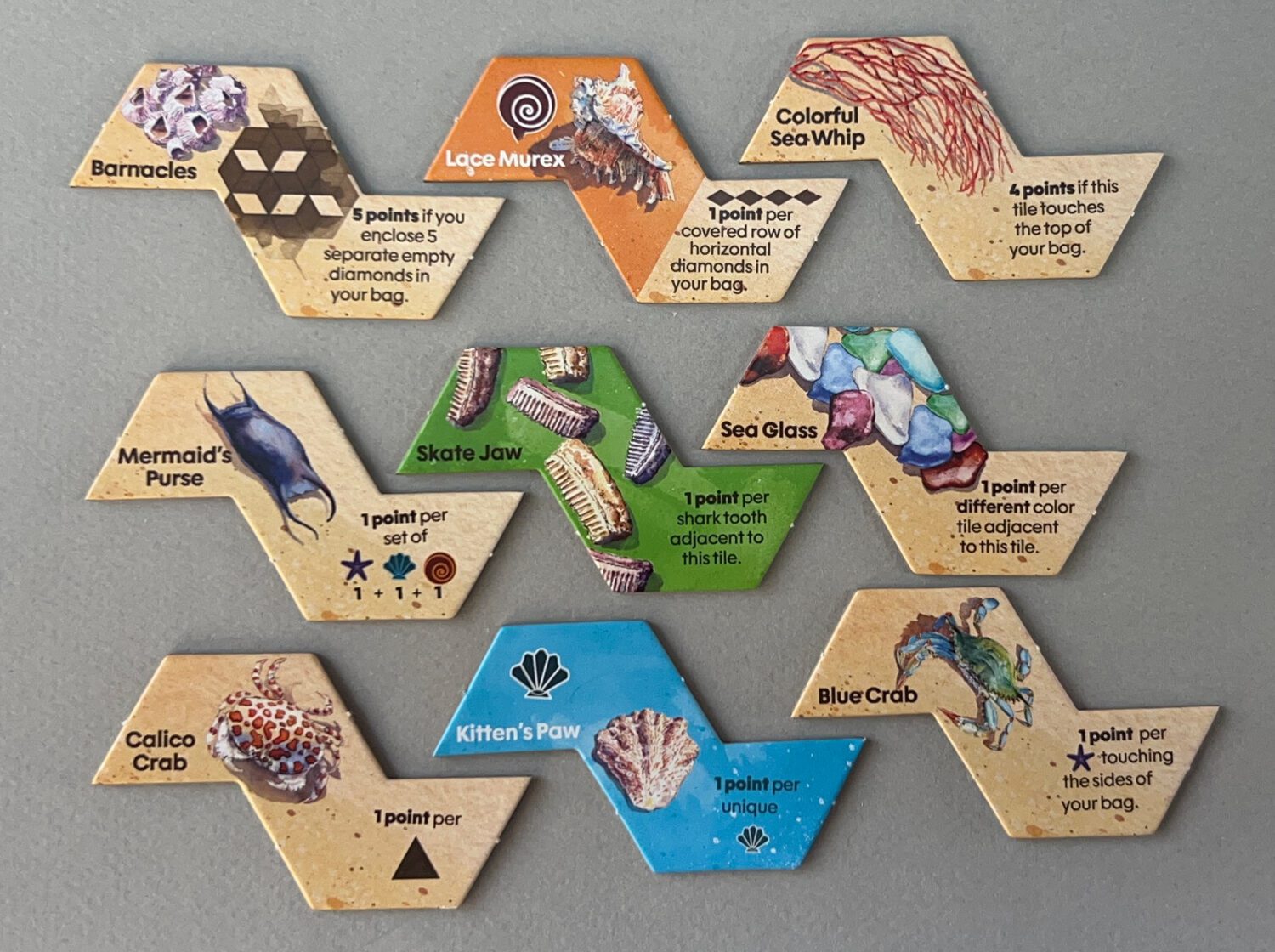
Shuffle the zig-zag-shaped pieces and deal two to each player. These are your Lighthouse tiles and will offer additional scoring opportunities once you reach the Lighthouse midway through the game. Read these carefully, as they may help you determine which shells you want to concentrate on.
Above the shoreline in some sections of beach, you’ll see a hexagonal shape or a diamond shape, or both. Depending on the number of players, you’ll place a certain number of shell tiles, either hexagonal, diamond-shaped, or both, into each thin section. You choose these blindly from the two cloth bags provided with the game.
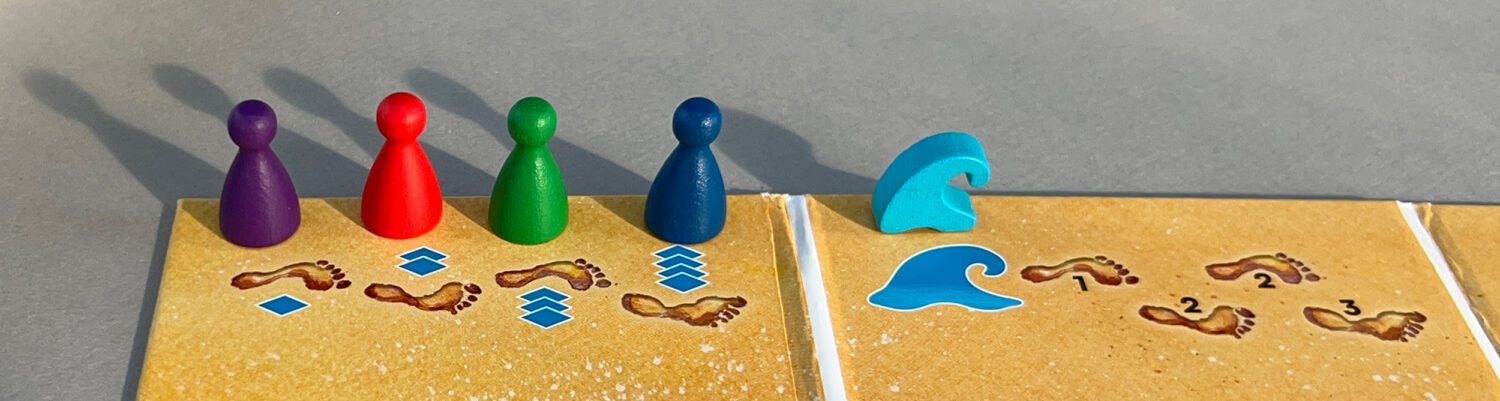
 Each section of the board (along the top for the first half of the game and along the bottom for the second half) has a series of four footprints. The player at the end of that line will always go first, with the next player in line going next. The player at the head of the line will always go last.
Playing the Game
Starting at the far left of the board, where the beach chairs are, you begin your walk down the beach and back.
Moving into a new section of beach is how you gain shells; where you place your token in order determines how many shells you’ll be able to collect within that section. Choose the footprint furthest to the right, and you’ll be able to claim three shells—but it also means you’ll be going last in turn order for the next move. Taking the footprint farthest to the left means you’ll move first in the next turn, but you’ll only claim one or two shells.
If there’s a shell you really need from a section further down the beach, you can choose to skip entire sections and land elsewhere on the board. You’ll certainly get first choice of shells there, but you’ll have to wait until all other players catch up with you before you can take your next turn.
There is a space for the Wave token to the left of the footprints. This means the Wave moves first that round and the ocean has returned to the shore. As it does, new shells tiles are pulled from their respective bags and added to the proper beach sections. Then move the wave to the next wave marker.
If you claim a diamond-shaped tile with a Sand Crab on it, you discard it immediately and choose any tile from any beach section. (Sand Crabs are very cool.)
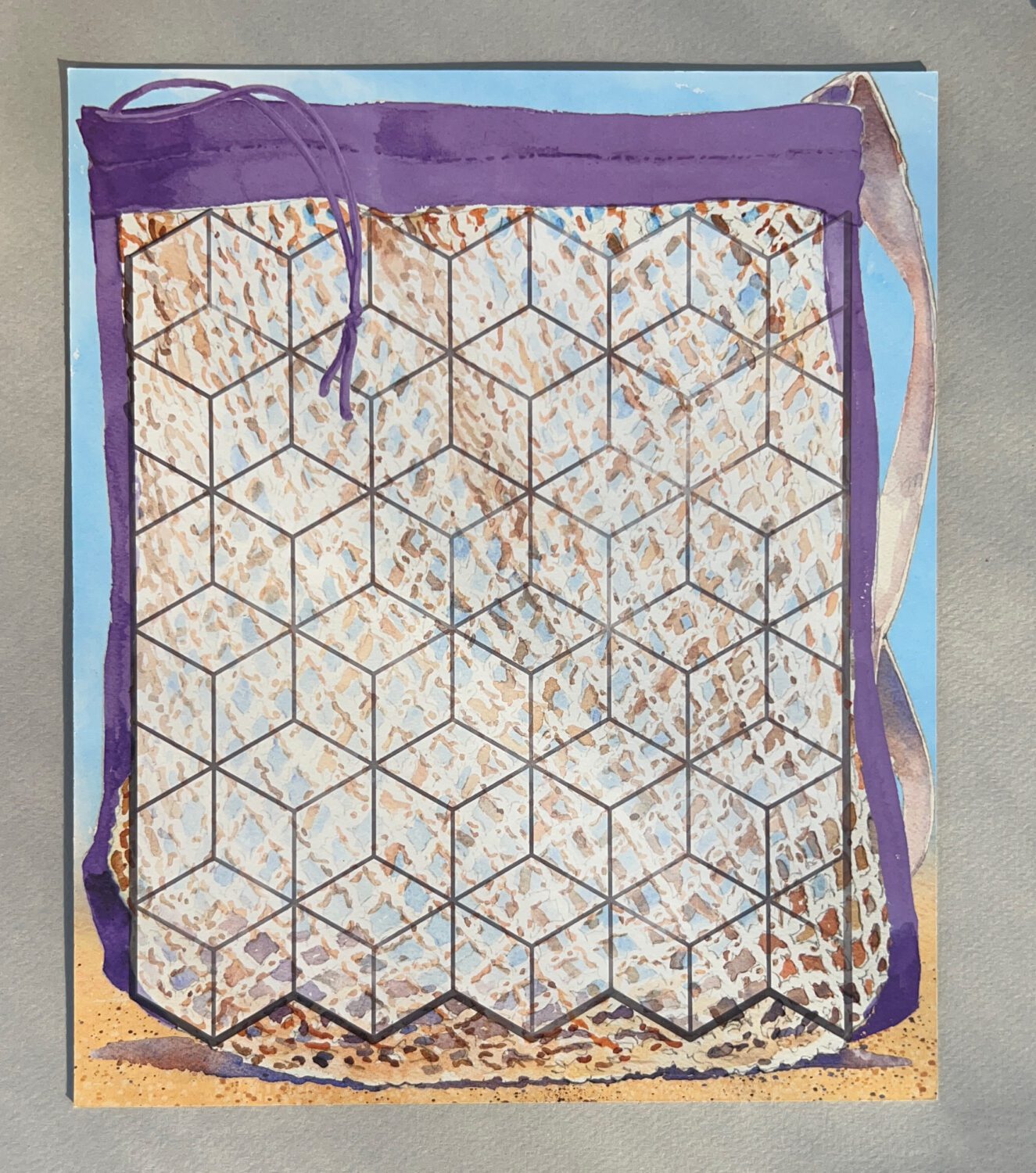
After claiming a shell from the beach, you’ll place it at the top of your player board and move it down. As long as a piece can naturally sink and fit into a gap, you can place it there.
To the far right side of the board, you’ll find the Lighthouse. The first player to arrive there will have several options to choose from, including placing both of your Lighthouse tiles into your bag, or only placing one while gaining the power of a Sand Crab or two. Play stops here until all players have reached the Lighthouse. Also, don’t forget to place your Lighthouse tile into your bag before you leave.
When you leave the Lighthouse, you’ll continue your walk heading back to the beach chairs. The only difference in play is that you’ll now move your tokens from right to left on the board along the bottom (shoreline) edge of the board.
Scoring
Not surprisingly, each shell you find on the beach scores differently. While this might be a hindrance in some games, the excellent player aids show exactly how the different beach finds will score.
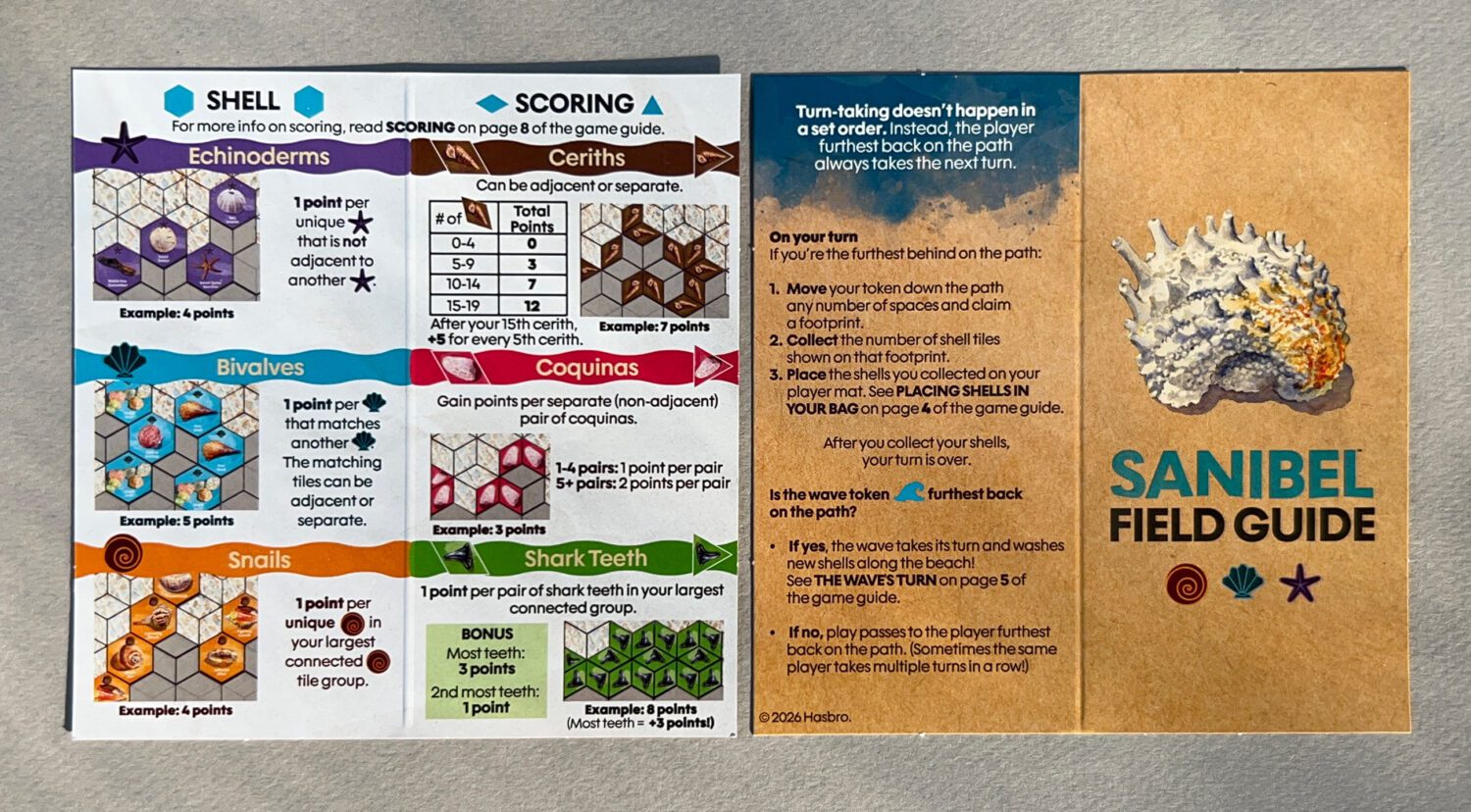
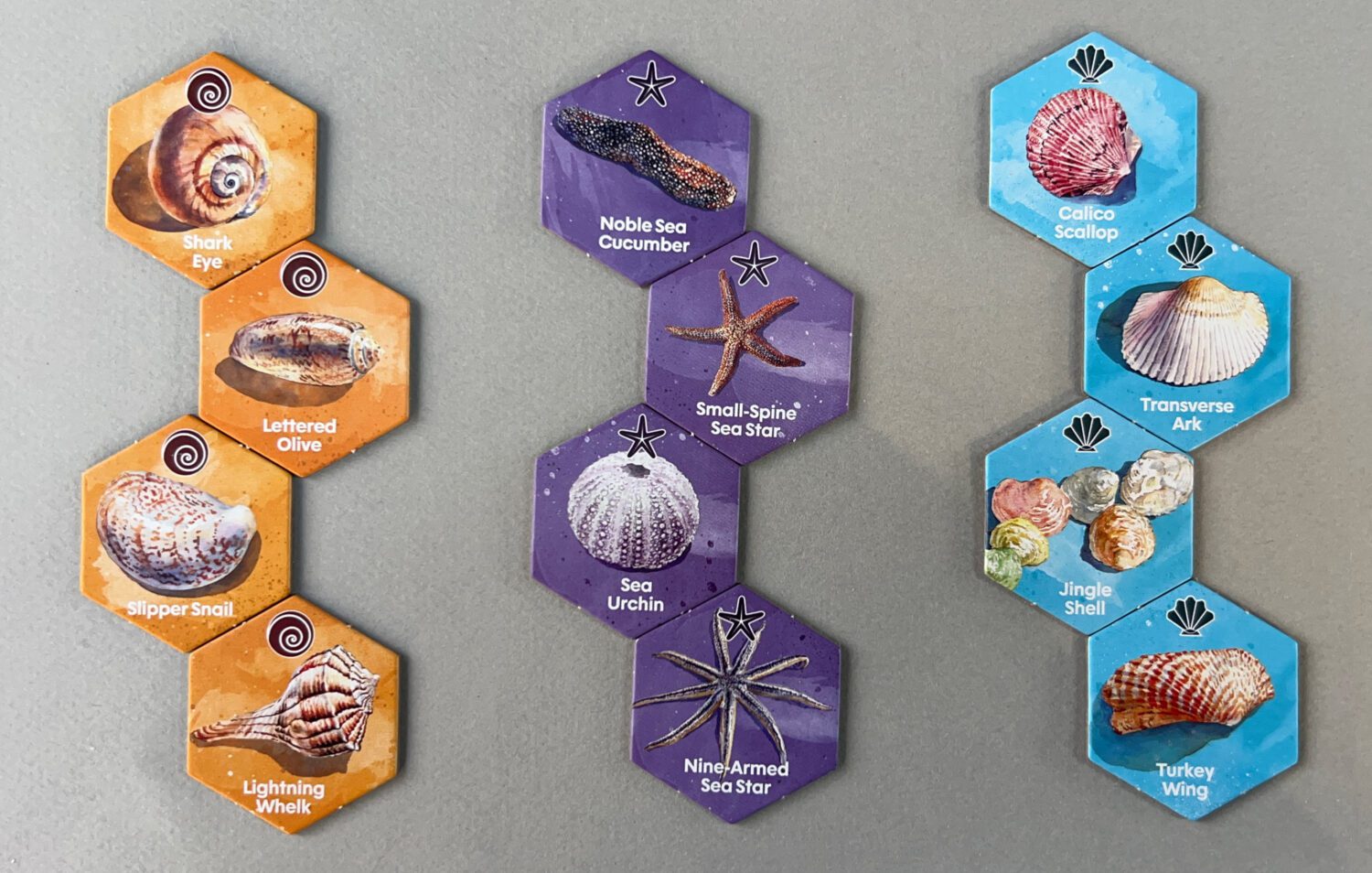
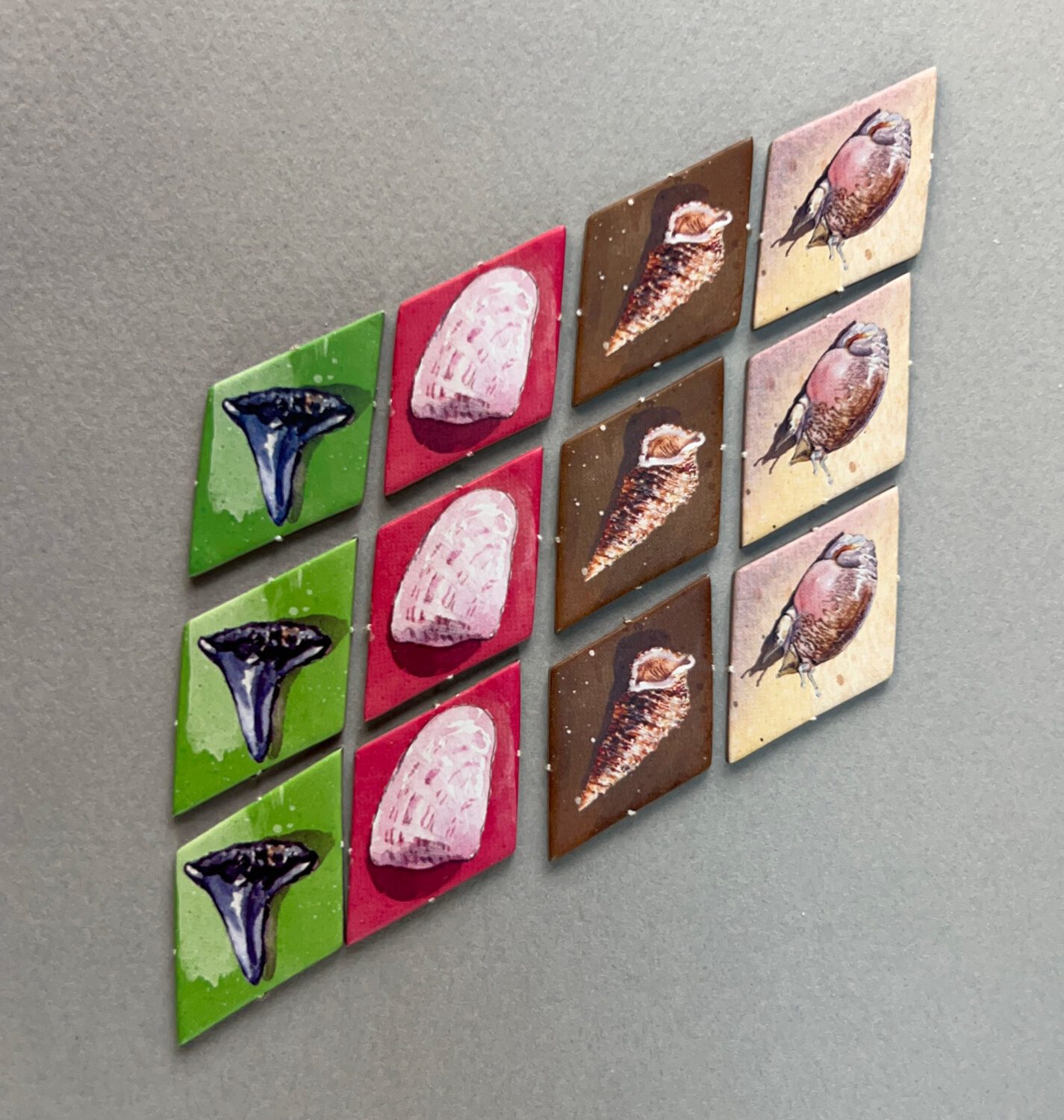
Purple hexes (Echinoderms) score when they’re not adjacent to each other; blue hexes (Bivalves) score for each matching pair in your bag; orange hexes (Snails) are one point per tile in your largest connected group; brown diamonds (Ceriths) score in groups of five; pink diamonds (Coquinas) score in pairs, green diamonds (Shark Teeth) score for the biggest connected group.
Use the included scoring sheet to list all your points, then add them up to see who wins.
Thoughts
Overall, Sanibel is a fine game. There are no crunchy decisions to make, so the game plays well within the listed 45 minutes. This is also family-friendly, one where kids can play alongside adults and could do well enough to win.
The sand crabs, with their choose-from-anywhere rule-breaking ability, were as sought after as you might expect. We each strategically placed our tokens in a beach section at least twice to claim one and use its ability. I don’t think they swing the game to any one player, but it’s always nice to break the rules.
Having the player last in line go first is a rule that is necessary in this type of set collection game. There comes a cost with going last (picking up only one or two tiles from a section of beach), but that decision gets rewarded on the next turn.
My disappointment with Sanibel comes from those same qualities that make it such a breezy vacation game. Your turns are each much the same: move your token, collect some shells, place them at the top of your bag and move them into place. Rinse and repeat.
Despite the point salad scoring, you’ll need to focus on only a few shell types. This is usually determined by your first turns, as you’ll settle into a strategy based on the shells you have already claimed. While likely good for kids and newish gamers, I wanted to see something more. Maybe a different set of tiles could be added to the bags at the Lighthouse,
I need to point out the fantastic job the design team behind Sanibel did in creating a concise aid that shows how each type of beach item scores. In our first game, my review crew listened to the rules overview and had some scoring questions. I reminded them of their player aid card. That card answered all their questions and allowed them to choose their separate strategies. This added so much to their enjoyment of the game.
As creative as Sanibel’s player aid is, the game’s board needed a bit of this creativity, too. The beach scene is bland; the three sections move if someone bumps the table—also causing the shell hex and diamond-shaped tiles to move into different sections. (I’m still looking at you, Terraforming Mars) Giving the three board sections a puzzle-piece locking shape would have been a big help. Widening each of the three sections would be helpful if future editions are planned.
If your family is going to the shore this summer, Sanibel is a game you should bring along. It’s as light and breezy as a perfect day at the beach.