Disclosure: Meeple Mountain received a free copy of this product in exchange for an honest, unbiased review. This review is not intended to be an endorsement.

Last Light is a 4X game designed by Roy Cannaday and published by Grey Fox Games. The premise is simple: the last sun in the universe is dying, and it’s your job to harvest the most Light. Be the first to collect 20 pieces of Light and you’re the winner.
The Board & Setup
Last Light is likely to be one of the most impressive-looking games you’re going to see for a while. Seeing it on a table at Tantrum Con for the first time, I immediately felt drawn to it. Rotating circles of outer space, small plastic spaceships in three sizes (the game being set up was an upper-tier Kickstarter edition with 3D ships and Resource tokens; my review copy is the standard, cardboard-only release) and the planets.
The marble-like 3D planets, each rising from the board on its own stand and featuring swirls of colors, made me willing to sit down for a teach and a quick few rounds. Had the setup just featured flat cardboard with drawings of planets, I would have kept walking.
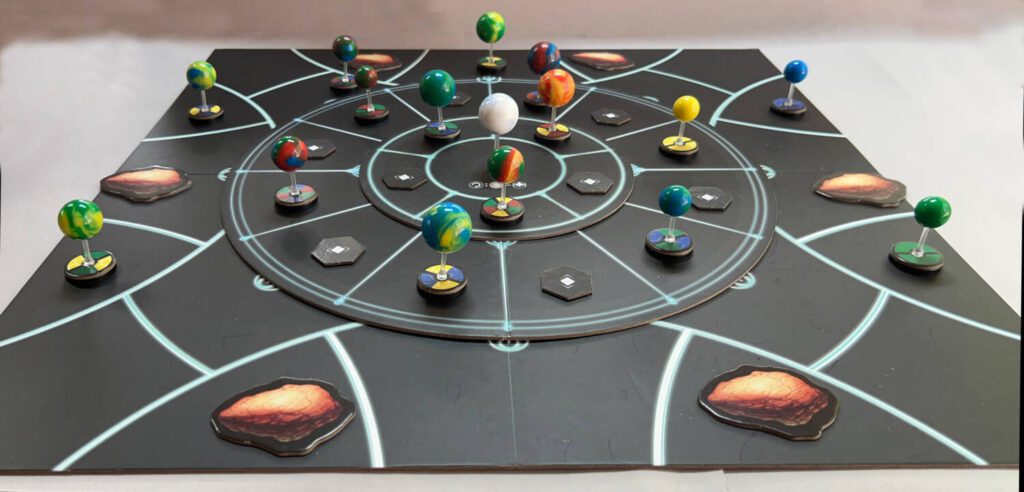
The board itself comes in three pieces: the large flat cardboard of space, a medium-sized outer ring, and a small inner ring. These are all held in place by a plastic tube that houses the stand for the White Dwarf Star to preside over the gaming firmament.
The fairly sparse rulebook has the distribution of planets, asteroids, Deep Space Exploration Tokens, and starting station locations for each player. (While the rulebook shows the setup for 2-8 players, you’ll need the Last Light: Infinity expansion if you want to play with more than 4.) Each player count setup balances the distribution of pieces.
At the base of each planet, you’ll need to insert a disc with colors that match those of the planet they’re paired with. Cover the black and gray half with either a red or blue semicircle. More on this later.
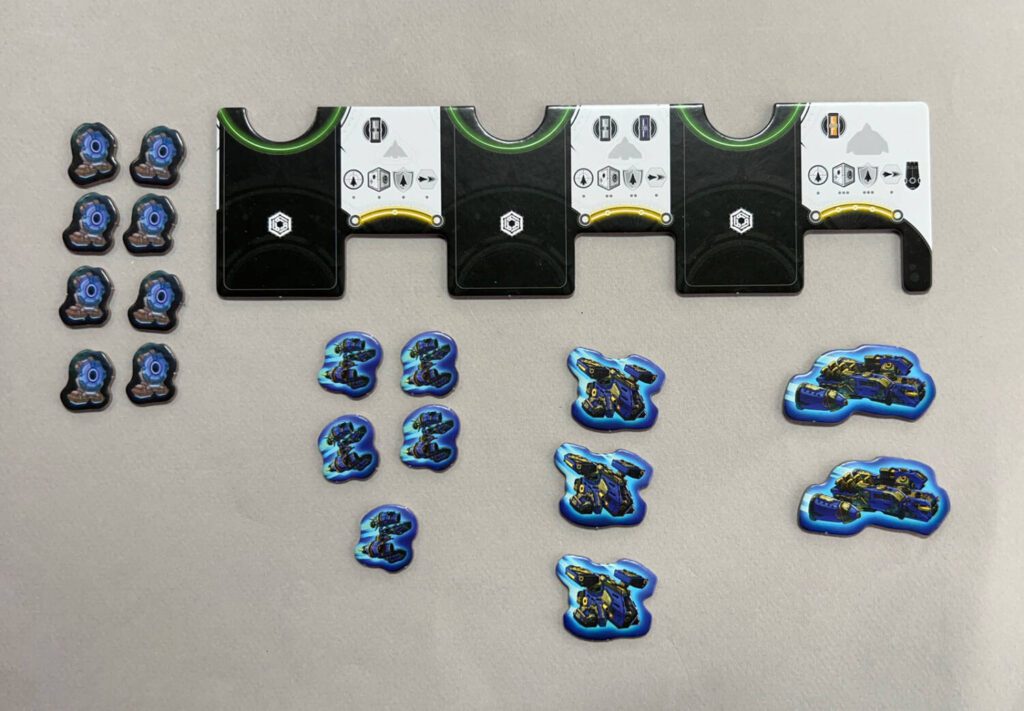
Each player takes the round Colony Ship tile in their color and all the matching spaceships—5 small, 3 medium, and 2 large—and small ringed Extruders. Each player gets a player board to track the growth of their Technology and spaceships. Finally, give each player a set of the six Action cards they’ll be using throughout the game.
Playing the Game
Each round, turns are determined by a player’s Action cards. The six cards cover everything you’ll need to do in the game: Research new technologies; Mine resources from extractors; Construct ships and extractors; Trade your resources for other resources; Command your ships to move/attack; Refresh to bring all the cards back in your hand.

Part of the way Last Light speeds up gameplay is by having all players simultaneously reveal the card showing which action they’re going to take. Players can then take their actions at the same time as well. Then, once all players have completed their actions, you’ll choose your next action from your remaining Action cards in your hand.
Eventually, you’ll need to take the refresh action to regain all your Action cards. When all players have played their refresh action, the current round ends. Then the universe spins.
Before the next round begins, the two circular rings in the center of the game board will each rotate clockwise—1/4 turn for the inner ring, 1/8 turn for the outer ring—at the end of each full round of play. This allows players on the far side of the galaxy (e.g., across the table from you) to access the areas that you had early access to, and vice versa.
At the end of each round, players will count the number of Light tokens they’ve collected. The first to reach 20 is the winner.
Another Look at Those Action Cards
How well you’ll do in a game of Last Light will come down to how well you play your Action cards, as well as outguessing what your opponents are doing with their cards. As such, they deserve a bit more attention.
Your player board has three sections, one for each type of spaceship you command. When you take the Research action, you’ll draw three cards from the research deck. Examine the cards and choose two to keep.

Research cards will either help advance your civilization or upgrade your spaceships. Place ship ability cards to the left of the bottom slots on your player board where they provide a bonus to one of your three sizes of ships. Ship modification cards go into a slot to upgrade the abilities of that size of ship. Note: Small ships can only have one ship modification, while medium ships can have two, and large ships can have three.
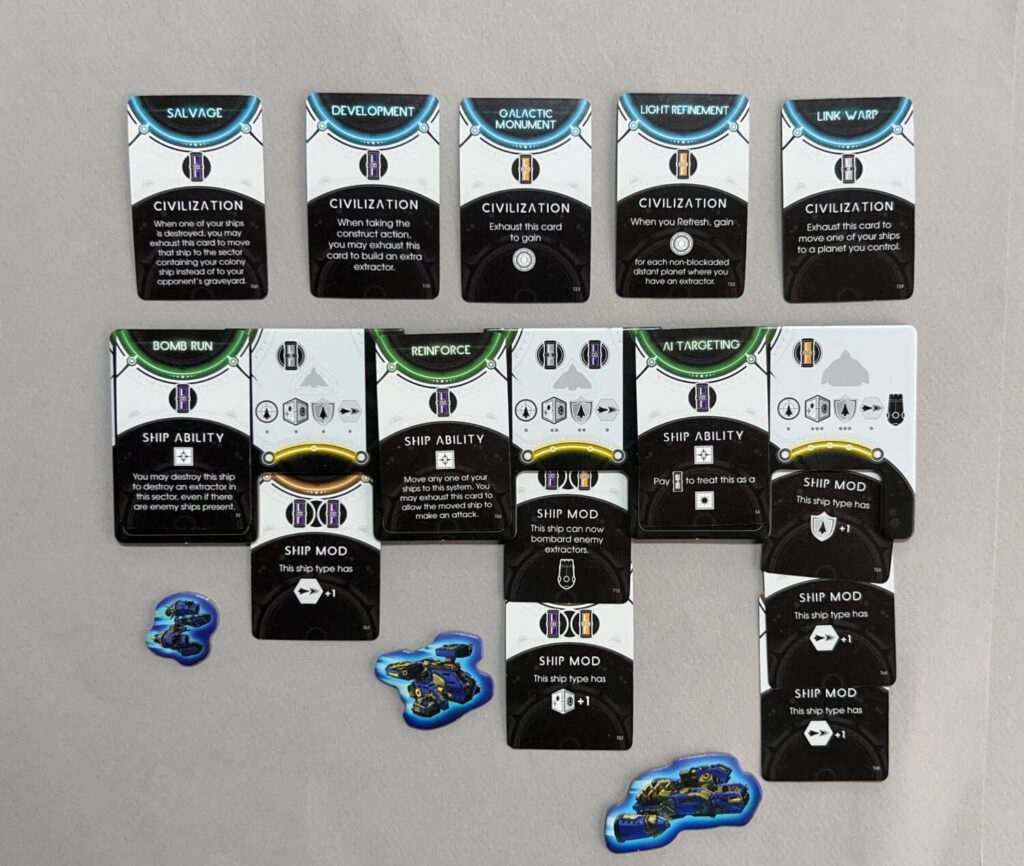
Of course, you’ll have to pay the cost to research each one before adding it to your player board.
When you Construct, you pay the exact costs in resources to build either a new ship or an extractor. Ships start out next to your Colony Ship; Extractors are built next to planets where you are the only occupant of the planet’s sector. Extractors allow you to gain the resources of the planet they’re attached to when you take the Mine action.
Trade allows you to gain a common resource and trade several lesser resources for better ones. When constructing a spaceship or fulfilling a research card, you must pay the price exactly as stated. Two common resources equal one uncommon; two uncommons become a rare; two rares become a Light.
Last Light starts off with a scattering of bonus resources that are claimed by the first player to move one of their ships into the same sector as the bonus token. You might claim 2 or 3 of these in a game; after that, you must depend on your Extractors to get better resources.
However, even at three players, the number of planets you can plant Extractors on gets very tight, very quickly. This brings us to the heart of Last Light: attacking your opponent’s ships and Extractors with the Command card.
Command allows you to move all of your spaceships up to their movement limit (starting at one sector at a time, but can increase with the right Research card) and then attack any opponent’s spaceships within firing range (starting with the sector you’re in, but can also increase with the right Research card).
You manage attacks with a roll of the combat dice, with larger spaceships rolling a base of three dice and small spaceships rolling only one. If your opponent didn’t play their Command card, you get a free shot at their ship(s)—although expect them to play their Command card on the next turn to return the favor if you didn’t blow them up.

I Can See a Little Light
Last Light’s designer states that players can finish his game in approximately one hour. This means players need to accumulate the winning 20 Light quickly.
For instance, at the end of each round, players can:
* Return four of your opponent’s spaceships you destroyed in battle for one Light.
* Every Extractor on a planet on the outer ring with no enemy spaceships in the same sector gains one Light; similar Extractors in the inner ring gain two Light.
* Each of your spaceships, regardless of size, in the center-most ring with the White Dwarf Star gains one Light.
When playing your Research card, you’ll be able to gain one Light for every four Research cards you have in play. You can also trade in certain Research cards for one Light.
My group has yet to finish a game in only 60 minutes, but my friend and Meeple Mountain colleague, Justin Bell, has. A few years ago at Dice Tower West, he played an 8-player game that included the designer. Their game finished in exactly one hour.
Lasting Light Thoughts
After my first full game of Last Light, I came away feeling that it was just a simple Destroy All Other Spaceships game. After additional plays, however, I realized it was more than that.
Last Light is a game about timing: when to play which action card, what order to play them in, and when to Refresh.
After all players have played their Refresh cards, the current round ends. The planetary discs turn, players gather Extractor resources, collect Light, and reclaim their Action cards. However, you don’t need to wait until you’ve played all five of your other cards to Refresh. You can play your Refresh card at any point to reclaim all your previously played cards. Your Refresh card stays on the table, but you have a chance to re-play actions you’ve already taken this round.
Have you already taken the Command (move/attack) action and need to retaliate against someone who just blew up one of your spaceships? Refresh. Need to mine again to collect the resources to replace a destroyed spaceship? Refresh. Have eight Research cards in your tableau? Refresh to get another two Light.
Refresh is where the strategic part of Last Light’s gameplay shines.
Unfortunately, there is a conspicuous lack of Player Aids. Many of the game’s graphics explain the rules/requirements, but these weren’t as obvious as perhaps the graphic artist expected. The game does provide player Reference Cards—cards that explain some of the game’s iconography, but even with that, we had to reference the back of the rulebook for full explanations. We spent too much time doing just this during our first game.

Another odd point: is it truly a 4X game? Clearly, there’s an eXpanding of your fleet and sending that fleet out to eXplore. Extruders take care of the eXploit requirement. But eXterminate? That’s missing here. Even if you destroy all the spaceships and Extruders belonging to a player, wiping them off the board, the rules state you cannot destroy a player’s Colony Ship. From there, you can try to rebuild their spaceship fleet. If you can live with that, Last Light might be the game for you.
Last Light will stay in my collection for a while. There was enough to like about the game to make me want to explore it further. From my experience, that’s a good trait for a game to have.
Last Light details
- Designer: Roy Cannaday
- Artists: Christian Strain, Clark Miller, Jose David Lanza Cebrian
- Publishers: Grey Fox Games, Mosaico Jogos
- Release Date: 2023
- Player count : 2 - 4
- Age range : 14+
- Time range : 45 - 75 minutes
- Mechanism(s): Action Retrieval, Area Majority / Influence, Dice Rolling, Grid Movement, Hand Management, King of the Hill, Simultaneous Action Selection, Solo / Solitaire Game, Variable Phase Order, Variable Player Powers
- BGG Geek Rating: 7.37466 - converted to Meeple Mountain scale: 3.5.
- More articles about Last Light.