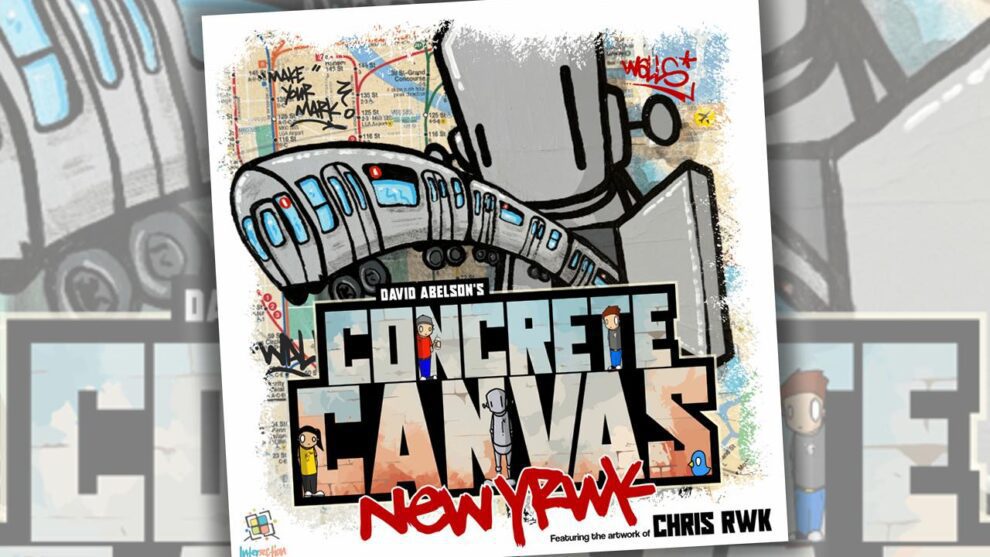

Disclosure: Meeple Mountain received a free copy of this product in exchange for an honest, unbiased review. This review is not intended to be an endorsement.
Disclosure: Meeple Mountain was provided a pre-production copy of the game. It is this copy of the game that this review is based upon. As such, this review is not necessarily representative of the final product. All photographs, components, and rules described herein are subject to change.
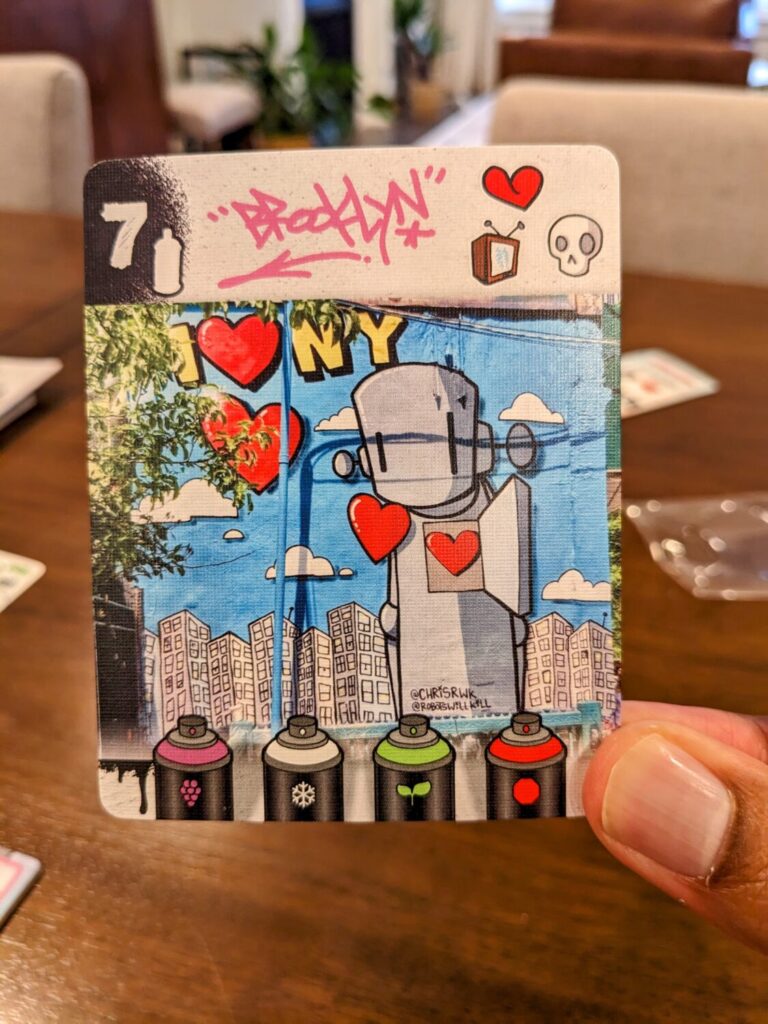
“I LOVE the style of this artist,” my 12-year-old said while admiring some of the painting cards from the upcoming limited movement and order fulfillment game Concrete Canvas, available on crowdfunding right now.
I had to agree. The art, by real-life street artist Chris RWK, is fantastic, and this style carries into the playable character tokens, the subway tiles used to dictate each player’s movement, and the milk crate player boards used to store paint cans as players move their tokens around New York City in an attempt to tag more locations than their opponents.
Designer David Abelson’s game does a great job of capturing the look and feel of something straight out of Beat Street, or any of the other break-dancing, street jive 80s films I grew up on. Even video games like Jet Grind Radio (or Jet Set Radio, depending on where you grew up) feel like an influence here.
Then the game starts…when Concrete Canvas reveals itself to be the opposite of dynamic.
Up and Down
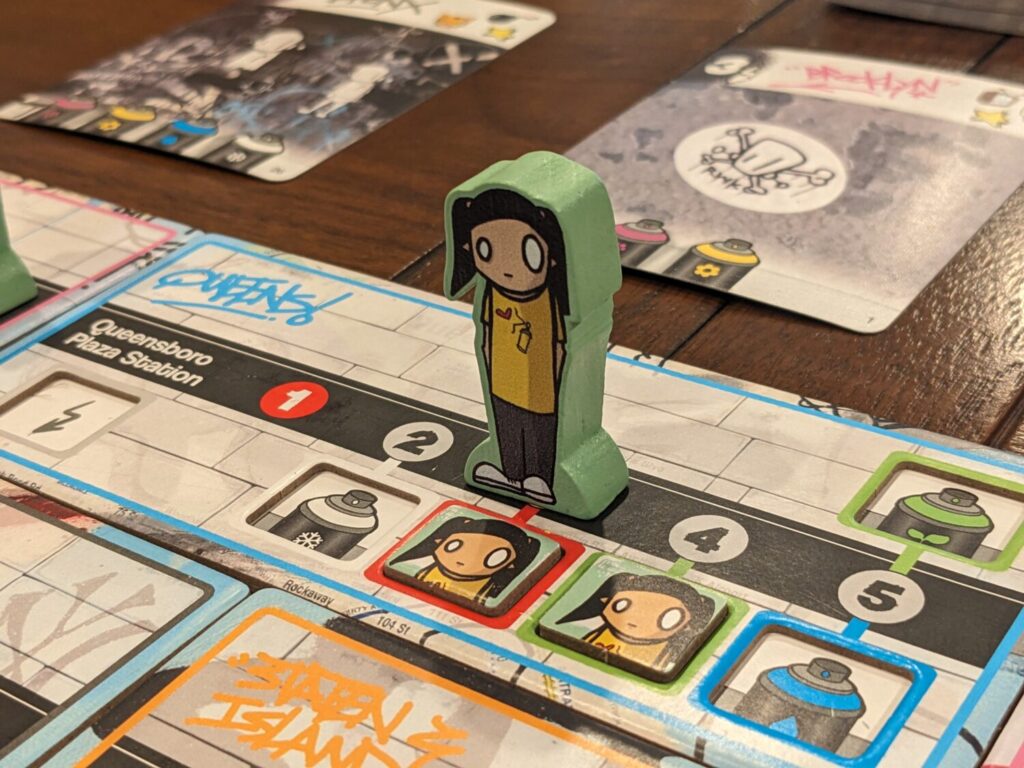
Concrete Canvas is an order fulfillment, area majority game for 2-4 players. Players will spend most of their turns moving one of their two character tokens through different parts of New York via subway tiles that are adjacent to other subway tiles. Players can only move to untagged, open spaces where no other player has a standee. Once a player has moved, they collect one spray paint can matching the color of the space landed on, then fill that space with a tag token matching that player’s image, blocking it for all players for the rest of the game.
(For reasons that I still don’t quite understand, each player is represented by the same image of their character on two different standees, which are always on different spaces of the map. While I would have just had two different character images in, say, purple outlines, the team behind the game went in a different direction!)
If a player decides not to move, they can spend spray paint from their milk crate to “paint” one of the cards in the market, as long as they have the matching combination of paint needed to fulfill that card. These cards, which range from 3-9 points in value, comprise a solid amount of a player’s end-game scoring. Each painting card has three tags in its upper-right-hand corner, helpful because at the end of the game, each player reveals one of their two secret Collection cards and will score three points per icon found on their tableau of paintings.
When one player can no longer move either of their two characters, each other player gets one more turn before the game wraps up. (Another weird twist: each player has a once-per-game Metrocard that can be used to teleport to any space on the map during a move step. But…Concrete Canvas appears to be a game where characters were already using the subway on every action of the game, because they have to move to a different subway station tile each time they move. Again, games can be confusing sometimes!)
Beyond the points gained for the secret milestone card and the paintings, players will also earn points based on the number of tags they have spread across the subway tiles, with first- and second-place points awarded based on both tag tokens in each subway’s borough designation, as well as for painting cards and their second milestone card that lists each borough.
“I’ve Seen It All”
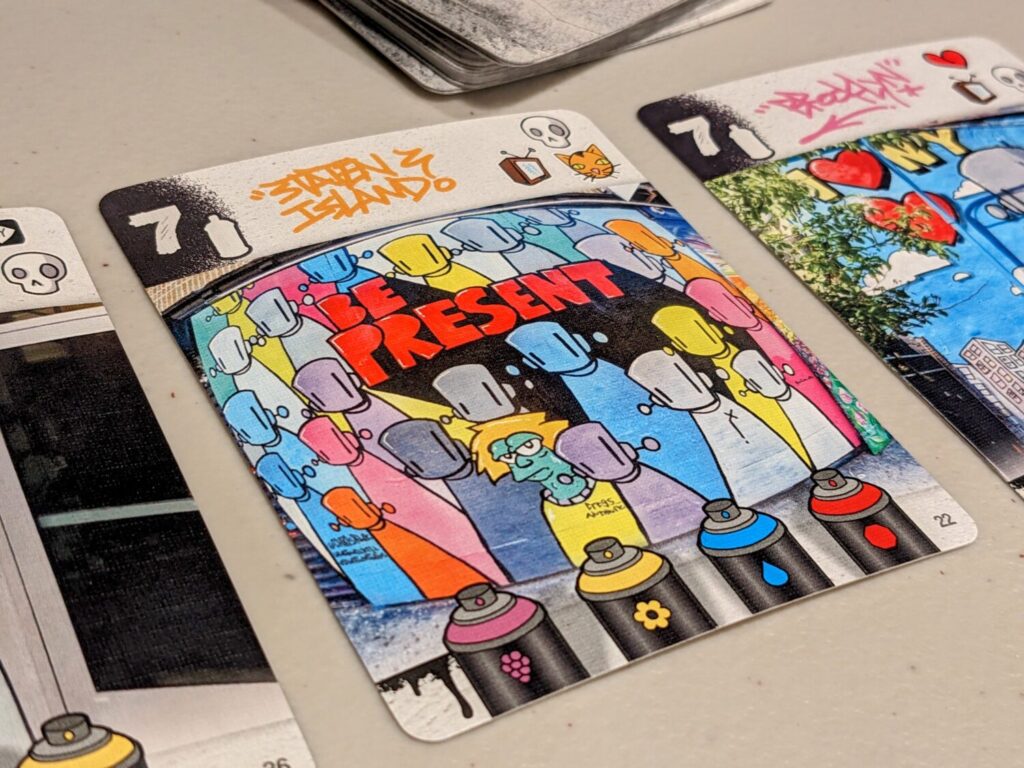
The painting cards, and just the general style, of Concrete Canvas is great. Each time I’ve wrapped up a game, I was surprised to find myself going through the deck of painting cards again to look at all the cool images.
But the gameplay here is pretty bland. “I feel like I’ve seen it all,” said one of the guys in my review crew after my first three-player game of Concrete Canvas. “Walk around the tiles, get paint, fulfill contracts [our group’s term for anything that requires us to spend resources to fulfill contracts, orders, or in this game’s case, paintings], drop tokens to influence area majorities. And I’m not sure about that last point.”
This last point was interesting to everyone who sat down with me for plays. Concrete Canvas rewards players for having the most tokens or influence in each borough, but there is not much strategic intentionality to the placement of tag tokens. For the most part, I’m walking around the subway tiles to get the paints I need to fulfill the painting requirements. I’m not that caught up in having a majority in, say, Staten Island’s subway tiles. I have a character near there, and there’s a green paint space open, so I’m going there, whether it is Staten Island or Brooklyn or anyplace else!
That made the area majority scoring feel VERY random, and in a game where winning scores usually ended in the low 90s to high 100s (again, based on player count), someone winning three majorities might net them 40 points. Something feels off with that mechanic here.
Turns are snappy, because there’s not much math that needs to be done. There are five number spaces for character standees on each subway tile, and a player can only move to a space that is one higher or lower (with the 5 space wrapping to the 1, as an option) than the number that standee began its turn occupying. The rules also force a player to move to a different subway tile when doing this. So, there’s a little nuance to trying to keep characters moving by picking spaces that set up their next turn. Not bad.
The card market almost always has something you can fulfill. Plus, any two spray paint cans equal any other single color, and any three can always be turned into a single color as well. When a player’s milk crate fills completely, they have to buy a painting, and there’s always something to buy…so there’s never much tension to finding just the right mix of paints, either.
This leaves Concrete Canvas in a tough place. It’s not a very fun game, but it is a very pretty product. Graffiti/street art fans who enjoy area majority games might find some value here, but after my second play, I had seen everything Concrete Canvas had to offer. Also, I would stick to two- and three-player counts with this title; at four players, even with low downtime, there’s nothing interesting to do while waiting for players to decide which space to move to next, on a board that can be somewhat unwieldy thanks to the increased number of tiles used in a four-player game.