The Crew: Mission Deep Sea – Joseph Buszek
Despite my aversion to both cooperative and limited communication games, I really enjoyed The Crew: The Quest for Planet Nine when it was released, mostly because I love new innovations on the trick-taking mechanic, and it definitely delivered in that aspect. However, I didn’t get it to the table that much because, despite the clever gameplay, I found it worked best when you could play through several missions with the same group of players, following the recommended mission difficulty progression. For me, trick-taking games are usually more enjoyable as a quick filler game. Once you pass a half an hour, most at the table have had their fun and are ready to move on. This is where The Crew sequel, Mission Deep Sea, comes in.
While The Crew: Mission Deep Sea still has a mission-based logbook and follows the same standard rules as its predecessor, it’s the task cards for each round that are, literally, game-changing. In the original, the task cards were all the same difficulty: some combination of color and number, which you had to win in a trick. The difficulty was ramped up by the number of tasks and task tokens (which changes the order to win that task) handed out to each player, to achieve the team victory. In Mission Deep Sea, each task card has a different difficulty level, which means you can still follow the recommended mission order or simply choose your own difficulty level from the task cards and ignore the logbook completely.
Not only does this allow you to play any number of missions out of order while retaining the same level of amusement, there is now variety in the tasks themselves, making each mission more strategic. In addition to the simple color-number combo, which are still in the deck, the tasks are upgraded and treated more like goals (I will win none of the first 5 tricks, I will win more pink than blue cards, I will win fewer tricks than anyone) and so which task you choose before a mission becomes critical. It fixes the biggest pitfall of the original game, where tasks get a little predictable after a few missions. I’ll likely still keep Planet Nine around for those times when I want a longer, progressively challenging game, but Mission Deep Sea will most certainly get more play overall, as it’s a big improvement on the singular experience of The Crew.
Ease of entry?
★★★★☆ – The odd bump or two
Would I play it again?
★★★★★ – Will definitely play it again
Read more articles from Joseph Buszek.

Fantasy Brewers – Justin Bell
Sometimes, you play a game once and realize…that the game is a pile of dung. A dumpster fire, if you will. Fantasy Brewers (2025, Grail Games) is a bad game, in a year where bad games have almost literally come out of the woodwork to attack for me building up years of goodwill with members of the tabletop industry.
Designer Michael Schacht has given us a game that offers almost too many issues to be fair. The rulebook is bad. One of the board’s main issues is tied to a major mistake: the symbol for one set of cards is listed as four coins, but the other is listed at 10 coins. The expensive cards are shown to be ones that offer few points and minor powers, while the cheap cards are tied to end-game scoring. The rulebook and the board differ. How did the game get through any version of quality assurance before reaching my hands? There aren’t nearly enough actions to do anything meaningful with two, maybe three, worker placements per round in a five-round game. There are costs to do things, but too much money with which to do those things. The board is way too large for something that has miniature meeples the size of your thumbnail. Worker cards are used to pay for resources, but those cards don’t have the same iconography on both sides.
I got a little lucky; my first play of Fantasy Brewers was with just two players, and both of us wondered how bad Fantasy Brewers would have been with a full player count of four. Actually, I think I know the answer: worse. Much worse.
Ease of entry?
★★★☆☆ – There were a few questions
Would I play it again?
☆☆☆☆☆ – No chance
Read more articles from Justin Bell.
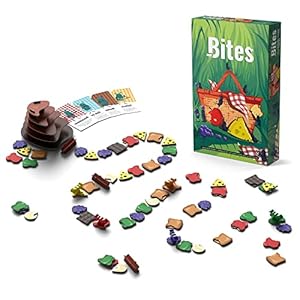
Bites – K. David Ladage
The game Bites has been around a while.I am not really sure how I missed it. Meeple Mountain did a review of the game in mid-2021.Reading that review, it is obvious that Mr. Becker was not a fan. It also means that he and I had very different experiences.
I will leave game play to the review, but I can tell you that I found the early game and late game decision making quite satisfying. I felt that, at each stage, I was able to look at the board and have two or three decent options and had to figure (based on what I had and what my opponents had) which was the optimal move. Heck, I even had to look at what moves that ant might be able to make in prior to my next turn. I get the appeal of the Double Bites option (playing with double the food; my group and I played it both ways), but I sort of prefer the punchier, shorter version.
This is a game my friend Steve introduced us to. I have already ordered my own copy.
Ease of entry?
★★★★★ – No sweat
Would I play it again?
★★★★★ – Will definitely play it again
Read more articles from K. David Ladage.
Ace of Spades: Call of the Zombie – Justin Bell
While Ace of Spades (Devir, 2025) certainly saw its fair share of controversy last year, none of that was due to its exceptional “poker attack”-style solo gameplay. More and more, I’m finding these types of games—which include tabletop games like Regicide and video games such as Balatro—to be somewhat bulletproof. I’ve never had bad bacon, and I’ve never played a bad poker attack game.
Ace of Spades: Call of the Zombie introduces a new play format with a deck of 12 expansion-specific enemy cards. Now, when players defeat Goons and Villains, they have to sacrifice one of the poker cards used during the final defeat of an enemy. Each sacrificed card is slotted beneath the defeated enemy, and in a nod to all things zombie, the Villains (essentially mid-level bosses) come into play alongside 2-4 of the previously defeated Goons, back from the dead to haunt you an additional time. Players have to get crafty to take out these hordes by playing cards in their poker hands that match either the number or the suit of the slotted cards beneath those zombified Goons to take them out a second, and final, time.
Ace of Spades: Call of the Zombie still offers both solo and co-op play in a tidy 30-to-40-minute time block. The base game enemies are used in a fun way, by offering bonuses when Goons are defeated, so the integration of the old and the new is seamless for seasoned players. I did three warm-up plays of the base game before tackling the new stuff, and the wrinkles offered by permanently sacrificing cards adds a subtle layer of strategy as players get into the final third of the game. And the ace of spades card is still required to deliver the final killing blow to this game’s boss, the Hellbilly Zombie Master. Call of the Zombie is priced just right and gives players another reason to bust out the base game.
Ease of entry?
★★★★★ – No sweat
Would I play it again?
★★★★★ – Will definitely play it again
Read more articles from Justin Bell.

Ready Set Bet – K. David Ladage
Congress of Gamers is a place where I often find games that are new to me. This latest session was no different in that regard. My friend, Steve, picked this up and we played it with six players – five of us placing bets, and Steve acting as the house.
The game felt like an odd marriage of Can’t Stop and Craps. In other words, although I am not familiar with the ins-and-outs of betting on actual horse races, I do not imagine that things operate the same way as the betting spaces on this board. The game is going for a feeling more than a simulation.
The house player is rolling dice, moving (tiny, tiny) horses along the track, and announcing the results at a fairly quick pace while the other players watch the betting board and the horses, knowing that once a third horse crosses a line on the track, no more bets are allowed. And this would be a bad thing, because the way this game works, there is far, far more upside to these bets than downside. If you miss a bet, you have truly missed an opportunity.
We had a good time, overall. But this is not a game I feel compelled to add to my collection and play more often.
Ease of entry?
★★★★☆ – The odd bump or two
Would I play it again?
★★★☆☆ – Wouldn’t suggest it, but would happily play it
Read more articles from K. David Ladage.