
Disclosure: Meeple Mountain received a free copy of this product in exchange for an honest, unbiased review. This review is not intended to be an endorsement.
Disclosure: Meeple Mountain was provided a pre-production copy of the game. It is this copy of the game that this review is based upon. As such, this review is not necessarily representative of the final product. All photographs, components, and rules described herein are subject to change.
I think many of us in the tabletop media space have a particular set of rules when it comes to reviewing games; everyone takes a different approach.
One of my big things is to get my three, maybe four, plays of a review copy with different groups as often as I can, ideally at different player counts. This is especially true with new game properties (expansions are a little easier to cover, and usually I have superfans of a base game who are better equipped to share their thoughts on an expansion if they know the original game).
I played the upcoming Mighty Boards game Yotei (up on crowdfunding now) with three different groups: my review crew on a Monday, then three friends from my Wednesday gaming group, then my nine-year-old on Saturday. That meant three plays with three different groups spread across six days in the same week, thanks to a tighter-than-normal turnaround time to get this review up.
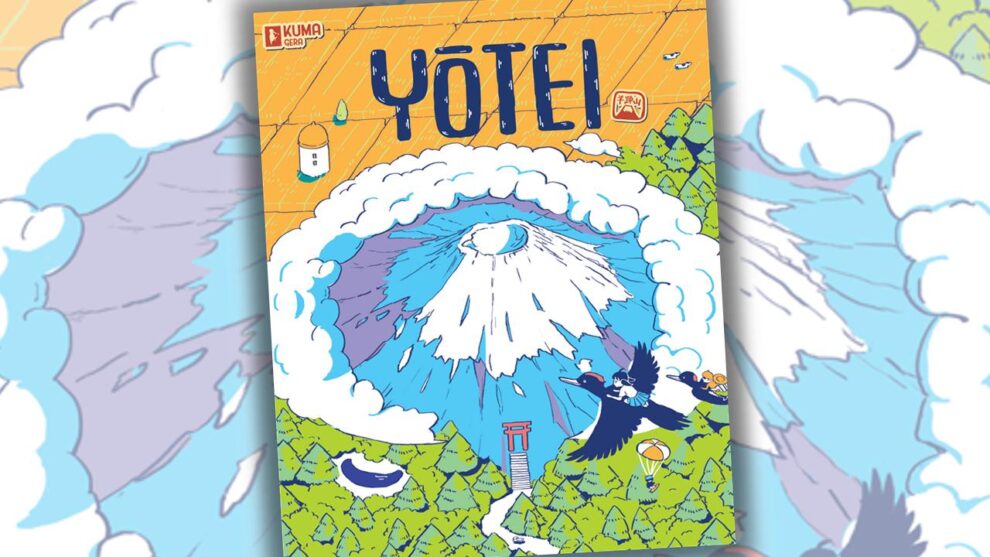
As a result, I had a range of opinions to measure against my own. Here’s the only thing everyone agreed on: the card and token illustrations by Maria Kato are absolutely gorgeous.
But after that?

Please Pass the Potatoes
Yotei is a tableau-building set collection game for 2-4 players. The playtime ranged wildly; the side of the box says Yotei plays in about 45 minutes, but in my experience, the game plus the teach was always done within 45 minutes. One of my games almost ended at the 10-minute mark, that second four-player game, until one player decided to literally waste his turns to keep the game going by making it his mission to stop me from winning.
In Yotei, players take on the roles of town builders “at the foot of Mt. Yotei, Hokkaido”, per the instruction manual. It’s time to build up this town by adding cards to your tableau, and in the spirit of games like Splendor, 7 Wonders, or Century: Spice Road, your job is to collect cards with the right symbols which will then grant you the opportunity to acquire better cards thanks to the symbols spread across your tableau.
Cards across three Tiers are available from the middle of the table. Tier I cards feature environments—farmlands, forests, and mountains. Tier II cards, and even some of the Tier 1 cards, require a player’s tableau to meet certain conditions; say, two forests and a mountain. Tier II cards—local produce, “forest bounties”, and tourism developments—are usually the requirement to buy the Tier III cards, which celebrate food, the wilderness, and ski resorts.
Each round is split into two phases: placement and harvest. During the placement phase, the active player must place one of their 2-3 character tokens on a card. They could place a token on a face-up card, which claims it for the harvest phase. They could, instead, flip any face-up card and claim its face-down side—generating a free forest card, two potatoes (the game’s currency), or spending two potatoes to score a point.

The claims on face-up cards are mostly vanilla—pay a potato or two during the placement phase, get a card that will help for later. In these cases, only one player can claim each card. However, some cards have a bidding symbol in the bottom left corner. This means a player has to secretly bid a number of potatoes from their inventory (hidden behind a somewhat flimsy screen, but we’ll forgive this because it’s a prototype) and place those into a cute wooden bidding box that is placed on the card, alongside that player’s character token. (A player may choose to bid zero potatoes, if they want.)
Additional players can try to outbid opponents on bidding cards during future placements in the same round.
During the harvest phase, all cards are resolved in turn order. This also allows a player to use the first part of their harvest action to claim a card that they would need in order to qualify for their second or third card of that same action. In this way, players can get creative in ensuring they can afford to take cards that they qualify for, based on certain conditions, by retrieving cards from the market in an order of their choosing.
Bidding cards that have multiple bidders are resolved, with winners paying their bid in potatoes and claiming those cards. Losers (with ties going to whoever bids on a bidding card first) get their potato bid back, but no card; losing even two bids like this in such a short game can be fatal, based on my experience.
Play continues like this for a number of rounds, until one or more players claim their second Tier III card. After that round, each player counts up their “charm points”, represented by heart symbols on the cards. Also, every three leftover potatoes counts as a point. The player with the most charm points wins, with ties broken by those leftover potatoes.

“Is That It?”
About a year ago, Alex from BoardGameCo did a video called “New Games Are For New Gamers.” That quote, something I had heard prior to the video’s release and since repeated by others in the media and content creation space, bounced around in my head quite often during my plays of Yotei.
That’s because if you have played—heck, even heard of—Splendor, that’s the better version of this system. Yotei is so short that you might be able to knock out a three-player game in 20 minutes or less, especially if everyone knows what they are doing.
That’s because the card claiming system is a bit too straightforward for a seasoned hobby player. Even by my second game of Yotei, I found myself gravitating towards cards that don’t cost any potatoes, or ones that grant the owner multiple “element” symbols (farmland, tourism, etc.), or cards that I could get for bids of zero if I was the last player in a round and a bidding card had no bids yet.
The game state is very easy to parse. And, players looking for something light and breezy would be hard-pressed to find something lighter and/or breezier than Yotei.

This also means that Yotei is an excellent choice for a new player, someone who has never heard of Splendor or its peer group. It should also be a great fit for families, younger players (my nine-year-old picked up the game’s rules within minutes), and maybe even your “muggle” friends who don’t play games very often.
Yotei’s a great looking production, led by Kato’s strong sense of style, and the bidding boxes—while feeling much more like a novelty item than a useful way to convey the bidding mechanic—are cute on the table. The game’s use of laser-cut wood sourced from Hokkaido is a nice touch, and the metallic close on the box rounds out a handsome table presence.
But as a game? Reviews were very mixed. A couple players adored Yotei. One thought it was OK. (That someone is me.) The folks in my Wednesday group—seasoned players, one and all—finished our 20-minute game of Yotei and all asked about the price…because while they didn’t think they would play it again, they would consider buying it if the price was reasonable.
Personally, I enjoyed my first play and the discovery of Yotei’s systems much more than my second and third plays. Turns feel a bit too “draw by numbers”—each turn, without a strategy, I reacted to the cards currently in the market and tried my best to secure at least one new card every turn, sometimes two. The bidding mechanic never led to these massive “whoa” moments from players; usually, a player would bid enough to ensure they would get a card they really wanted, but in other cases, bid reveals were mostly a letdown.
Yotei isn’t really a deep strategy game, because the available card market might change too much from round to round. Going hard on, say, forest-themed cards from Tiers I and II won’t work out so well if there are no wilderness cards in the Tier III market when you go shopping. The game is so short that players have to start buying Tier II cards by their second or third turn, because they’ll need 2-3 of those to buy one from Tier III.

There are some systems that didn’t work for me here, chief amongst those the very small deck of cards for each Tier. There is no natural way to clear the cards in any market row; the only way new cards enter the game is when current cards are purchased or discarded for potatoes. The only exception to this are two card types from a deck of Mystery cards, which are sometimes awarded to players who acquire certain Tier cards.
The range of these Mystery cards also feels a bit off. One of the Mystery cards actually can clear the market, limiting a market refresh to a randomly-generated card power. One lets a player steal two potatoes from an opponent. That’s right, friends: this peaceful little game featuring “charm points” has a “take that” element, which feels very off for a game of this style. (And this is coming from someone who loves a good “take that” game!)
One other issue did not surface until my third play, with my son. He took an interesting approach: he used every turn to get 4-6 potatoes from the market by taking flipped cards from the second tier, which meant he ended the game with 26 (!!!) potatoes. That translated into eight points with two potatoes left over, which was enough to tie my score.
We both realized later that a very viable strategy in Yotei is to simply spend every turn getting 2-4 potatoes from flipped, face-down Tier II cards, and at least one face-down card from Tier III every round. 10 points in Yotei is a lot of points, and a savvy player might be able to help buy out the Tier III cards before anyone can even trigger the game’s natural end state, which left me with a different question: what’s the back-up rule for the end of the game if there aren’t enough cards for anyone to have two face-up Tier III cards?
Yes, this means that a player doesn’t even have to engage with the game’s main interaction points of securing cards by outracing or outbidding others…they could just gather a boatload of potatoes and buy face-down Tier III cards. I don’t think that was the intention behind the design.
All this leaves Yotei in a challenging spot. No one was sold on the game regardless of price, so I think players should try Yotei before making a commitment. (The first time I played Rebel Princess Deluxe Edition with a group, one player bought a copy online during final scoring. When it was first published, Rebel Princess was pretty pricey for a deck of cards with character tiles, but no one cared…the game was that good.)
Yotei’s artwork is its major standout feature. Otherwise, it is a game in a sea of better choices. For a new gamer looking to build out their collection, Yotei is worth a look. For tableau-building veterans, look elsewhere.