
Disclosure: Meeple Mountain received a free copy of this product in exchange for an honest, unbiased review. This review is not intended to be an endorsement.

It’s still early in 2026, but I think I’ve already played the game that will end the year with the widest array of opinions within my review crew.
Wunderwaffen was one of my targets at SPIEL Essen 2025, so I was eager to get it home and put it in front of my team. I was attracted to the game for a few reasons, chief amongst them the game’s publisher. Ares Games has done great work in steadily tight packages, from the Quartermaster General series to family-friendly fare such as TEDOKU and Builders of Sylvan Dale. Ares’ reprint of the Mega Civilization series, Mega Empires, didn’t hurt the cause.
Wunderwaffen is a fragile system, one that worked wonderfully for some players while landing badly for others. But as a very straightforward game that plays in about an hour at its full player count, it is certainly worth a look, especially for wargame lovers looking for a weeknight game they can table with both hobbyists and casual players.

Nazis, You Say?
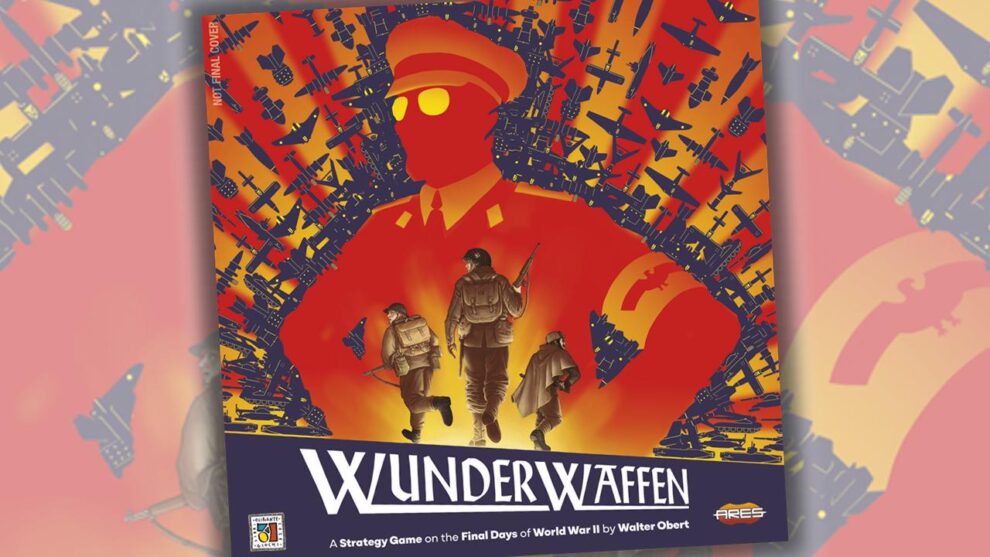
Wunderwaffen looks, on the surface, like a one-versus-all wargame for strictly two OR four players. There are four playable factions in the box: Germany, the United Kingdom, the United States, and the Soviet Union. It’s the endgame of World War II, with Allied forces working their way to Berlin; the Nazis are putting up a last-gasp effort to keep the Allies out of their capital city.
Over the course of about 10 rounds, players use a series of double-sided tokens to take their actions, with three tokens (out of a pool of 18) available each turn. Here’s the twist: the player can only use two of their three tokens each round for themselves. Each token’s backside features a symbol that must be given to a specific opposing faction, so the choices on each turn require the active player to help an opponent every turn.
Here’s another twist: players don’t initially know which symbol is on the back of their tokens, because they aren’t allowed to look at them until they are placed in their “start”, or ready, area. The start area is basically the on-deck circle for each faction in Wunderwaffen. So, you know that you want to slot an infantry, armor, and artillery token for your next turn…but you don’t know which of those has which rewards for your opponents until you can peek at them during your turn.
These gameplay elements built intrigue across my plays and is the main reason I recommend trying Wunderwaffen, even just once. The tension is fun here because the game only produces one winner…meaning that even though the game’s setup makes it look like each Allied faction is working to stop the Nazis, the reality is that the Allies want to make it tough for the Axis powers to do anything, but to keep their Allied “friends” in check, too. Spreading the love across your opponents with token distribution becomes a key strategic component of how the game plays.
Outside of this, Wunderwaffen is mostly an area majority/captured territories game. There are 22 regions on the map (and a 23rd representing Berlin), and each region besides Berlin has three open spaces for player tokens. When all three spaces are filled, the faction with the majority (or the Allied faction with the stronger token, in the case where two Allied and one Axis token reside in the same region) controls the territory.
Of course, the beauty of this mechanic is that a player can only play two of their own tokens each turn…so, sometimes, you’ll rely on the kindness (or forced kindness) of opponents to close out a region.

That’s most of the upside of Wunderwaffen. The other highlight here: playing as the Germany faction…as long as the Allied players leave you alone.
Here’s what I mean. The Axis power has access to a deck of superpowered effects known as the Wunderwaffen cards, tiered by level. By taking research actions, the Germany player might be able to acquire a bunch of really sweet cards that can help swing the battle in their favor. (The Germany players gets 1-2 Wunderwaffen cards to begin the game, from a pile of 24 different cards.)
The game’s rulebook highlights the fact that the Allied players need to work together well enough to nerf the German research engine to acquire those special cards. In our first four-player game of Wunderwaffen, I played as Germany, and the Allied players made it their life goal to ensure that Germany never got access to additional Wunderwaffen cards…and it was absolutely miserable to play the game as Germany. Never got any cards after the setup phase. Targeted all game long. When players had to give one of their tokens to another player each turn, they always chose tokens that rewarded an Allied player if they could. At times, I took actions mainly to watch Allied players undo my turns.
In our second game, the Allies mostly kept to themselves. There was an occasional moment of negotiating with their fellow Allies, but usually, Allied players helped Germany as often as they helped anyone else. And for most of that game, Germany looked like they would run away with the game. While Germany ended up losing by a single point to the UK in that game thanks to a massive end-game spike in scoring, the UK and Germany mostly took care of each other as they left the Soviets and the Americans in the dust, with a score that was 40 points higher than the last-place player.
But the person who played as the Germans in that game, fellow contributor Joseph Buszek, had a blast playing as the Nazis. Bought four Wunderwaffen cards, one of which allowed him to spend a morale track move at the end of each turn to score five victory points, netting him at least 20, maybe 25 VPs by the end of the game. He had cool one-time powers. He had fun ongoing powers. He took time out of his busy day to force each Allied player to discard a token one round, meaning that each Allied player had one turn to only take a single action for themselves.
So, there’s gold to be found in Wunderwaffen. But I usually didn’t see it.

An Acquired Taste
For the Allied players, there are no special actions, faction powers, or unique tokens to play, so each turn plays out mostly the same—play a couple tokens, try to minimize the rewards you give to your opponents, and build up enough regional control to ensure that you’ll score a decent amount of points during the mid-game and end-game scorings (there are two in total each game). Keeping the Nazis at bay is an important shared goal for the Allies, but as we found, even that isn’t really important as long as some players work on squeezing the Krauts while one player goes rogue to take care of themselves (like the UK did in winning our second play).
Now, to its benefit, I was surprised to find Wunderwaffen to be so swingy for a game that looks like it will play out the same way each time. The way each scoring round works, mixed with the points tallied during the game, might lead to a very tight ending. It might lead to a massive runaway leader problem, to the point where two of the four players in my second game had nothing meaningful to do for their final three turns of the game.
Heck, Wunderwaffen might even rub it in differently—in the back half of the game, players might not have enough tokens left to even take turns by the tenth and final round of the game. That’s due to the way players will have some of their gifted tokens used to close out captured territories.

It was wild to hear the opinions of each player after each play of Wunderwaffen. Three of us played it twice, and all of us admitted that our first play made us hesitant to even play this game a second time. One guy liked it enough to play it again, but not to buy his own copy. Two players loved it, but only after seeing it a second time as a different faction. I was torn about the game after my first play, and hated my second play (a word I don’t normally employ about any game, really). As the lucky winner of the USA sweepstakes in that second game, I still have no idea how I ended up 40 points off the lead and completely out of the game by the first scoring phase…and that definitely colored my experience with the game.
If players don’t ever hand you useful tokens, you are going to lose, and you are going to lose badly. Like almost every game in history, taking more turns is better than taking fewer turns. And if players never gift your faction with tokens, you are likely to go down in flames.
Wunderwaffen is a game that has an audience, but I’m not sure how wide that audience really is. With a dedicated group I think this could be pretty interesting, but it’s a game I have no desire to play again. The turn-to-turn actions really fell flat for me by my second play, and it’s not something I expect to come to life in plays 3, 4, and 5.
One other note: the game has a two-player variant…where one player plays as both Germany and one of the Allied factions against an opponent who has to manage two Allied factions. I can’t even figure out why that was the final call; to me, Wunderwaffen is a four-player-only game. I’m guessing this variant was added to boost the game’s marketability, as selling a four-player-only game is a tough one. Designer Walter Obert discusses this and much more in the Designer Diary for Wunderwaffen that recently posted on BGG.
Wunderwaffen is a tricky one. If this sounds like something for you, give it a look!!
WunderWaffen details
- Designer: Walter Obert
- Artists: Alan D'Amico, Danilo Moretti
- Publishers: Ares Games
- Release Date: 2025
- Player count : 2 - 4
- Age range : 13+
- Time range : 90 - 150 minutes
- Mechanism(s): Area Majority / Influence, Hand Management, Semi-Cooperative Game, Simulation, Tile Placement
- BGG Geek Rating: 8.055 - converted to Meeple Mountain scale: 4.0.
- More articles about WunderWaffen.