Disclosure: Meeple Mountain received a free copy of this product in exchange for an honest, unbiased review. This review is not intended to be an endorsement.
Disclosure: Meeple Mountain was provided a pre-production copy of the game. It is this copy of the game that this review is based upon. As such, this review is not necessarily representative of the final product. All photographs, components, and rules described herein are subject to change.
About four years ago, I wrote a negative review of the game Lacrimosa. I’d never written a major pan before and, while I stand by the diagnoses in that review, I have come to believe that the review itself was too much. In trying to capture the feelings of exasperation and bloat that Lacrimosa brought up in me, the review itself became exasperating and bloated.
I’ve played more than my share of unsuccessful games in the years since Lacrimosa, but Whisperwood is the first to evoke similar negative feelings. They are not similar games: Lacrimosa was dry as could be, an efficiency Euro with combos galore. Whisperwood, with its massive table presence, multiple tracks, and plurality of tokens, gives off the impression of a sandbox game. I think that was the goal, anyway.
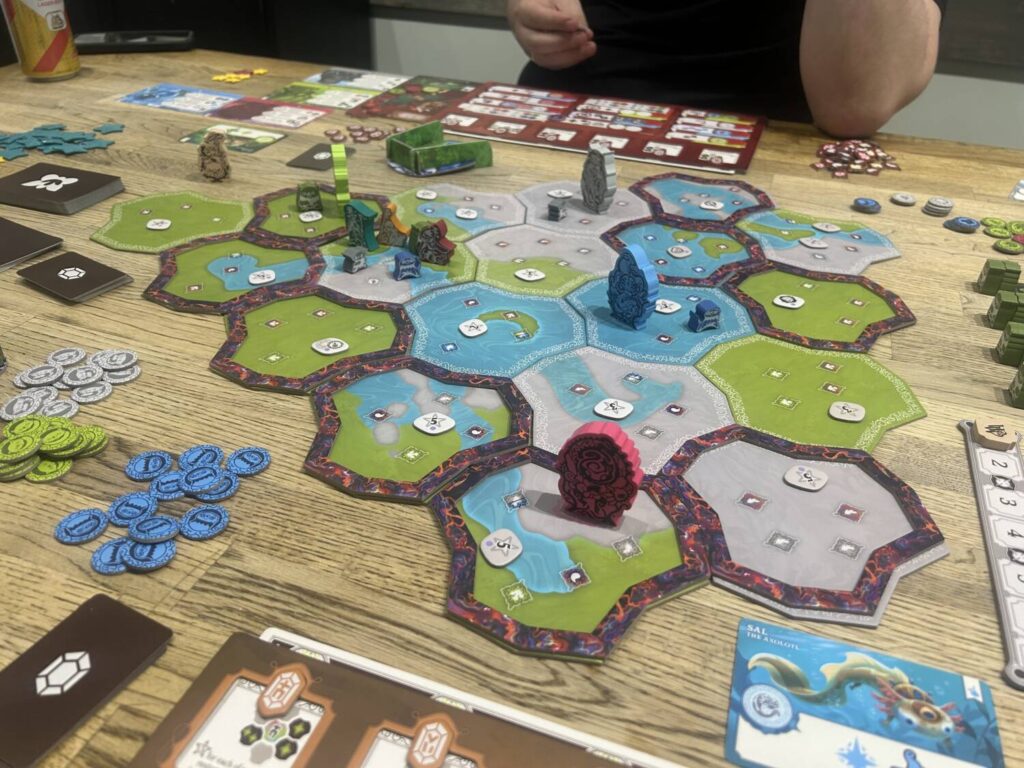
If designers Brad Brooks, Erin McDonald, and Christian Strain had pulled that off, it might have suited the setting. As members of the Council of Druids, players compete to best restore the magical Whisperwood, clearing away Corruption and gaining the favor of ancient Golems. That made manifest as a wide open space in which you can more or less do what you want would make a lot of sense.
Instead, Whisperwood comes down to tile placement—where you cast spells—and set collection—talking to any one Golem enough times unlocks a big, juicy scoring bonus. Mechanically, it’s a bag-builder, with the different magical elements you use to cast spells going into your bag. The flow of play will be familiar to anyone who’s enjoyed Orléans: draw tiles at the start of the round, assign them to different actions on your player board, then take turns resolving one action at a time until everyone has passed.
Given the setting, it’s all very pleasant, provided you don’t have AP. No direct player conflict, the reptilian thrill of improving the spells on your player board by flipping them over, and a sense that it’s all low stakes. Epic cozy gaming, you might call it. It would be hard to argue that Whisperwood is anything less than a 100% functional design. But—and this is the problem—Whisperwood takes far, far too long to teach and to play for what it is.
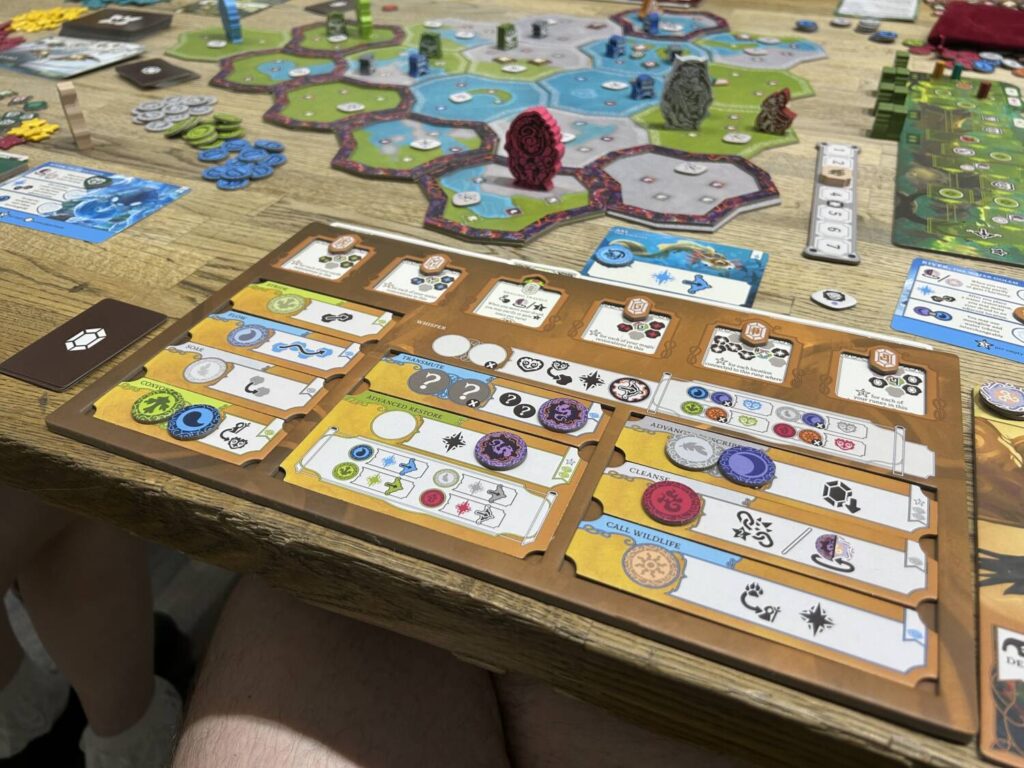
My first session, which included teaching straight from the manual, took 3.5 hours. I thought this was aberrant. It included an hour of teach and setup, after all. But then I noticed that the side of the box says 120-180 minutes. And then I learned that a Meeple Mountain colleague’s reservation to demo the game at GenCon, where the teach would presumably be off book, was three hours long. That first game wasn’t aberrant. It lasted almost exactly as long as Whisperwood wants to last. This game wants to be three hours. Subsequent plays bore this out.
I don’t mind a long game. Gibberers took three or four of the best hours of my life, for example. But I do ask that a long game warrant that time, and Whisperwood simply does not. For how long it takes, for all the switches there are to keep track of, it offers a decision space with all the depth of a puddle. For two and a half or three hours, you too can play a game mostly free of player interaction, tough choices, or surprises. As a sandbox, it is too small, despite its superficial breadth. It boils down to a protracted tile-laying game with a lot of ancillary bits. There might be an audience for that, but I cannot imagine it.
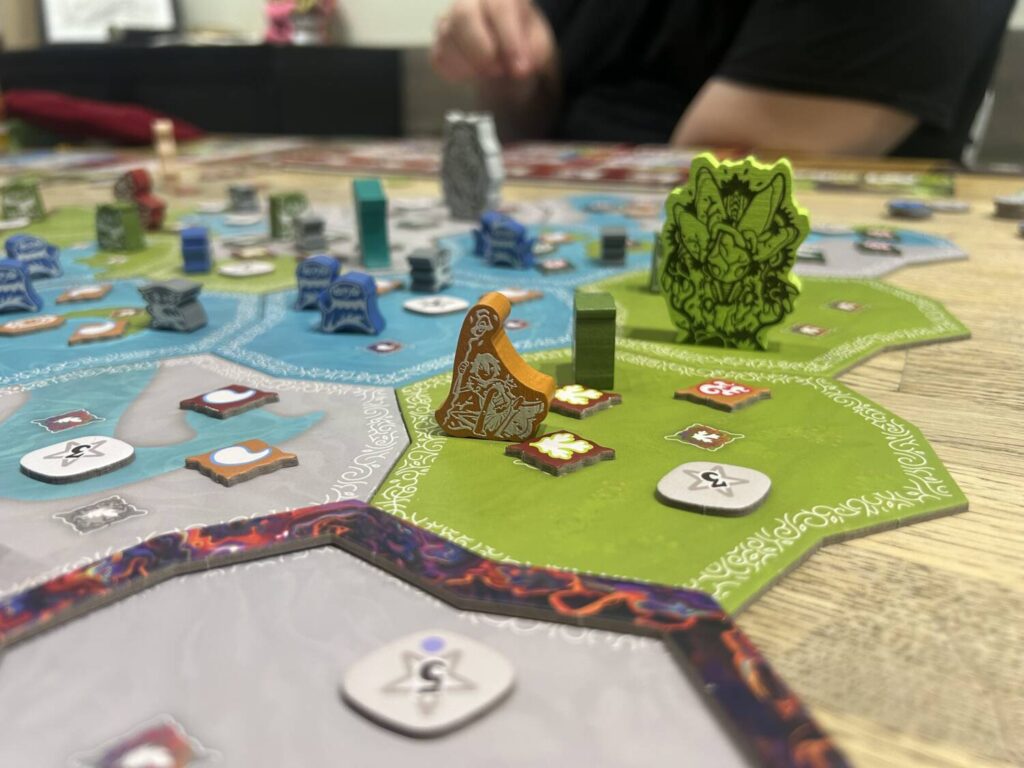
Whisperwood feels in many ways representative of where the hobby seemed to be heading before tariffs. It’s a beautiful production with loads of art assets, terrific chunky wooden player tokens, and a slew of player powers to access, all in the service of a slight game that is asking for a tremendous amount of your time. That’s why it made me think of Lacrimosa, whose central sin was turning what could have been a tremendous and focused email into a sprawling and tedious meeting. Whisperwood has the opposite problem; it is fundamentally uninteresting. It is milquetoast decisions that take hours you’ll never get back.
I’m happy to play a rules-dense game, and I am happy to play a long game, but in both of those cases, I ask that the juice be worth the squeeze. A game justifies its rules density and length by providing players with rich decisions that wouldn’t be possible with less of either. The shorter or lighter a game is, the less it demands of me, the less I will demand of it. Whisperwood, with its cumbersome rules and its two-and-a-half hour runtime, offers all the decision-making of a game of Cascadia, with about 400% the complexity and in about 500% the time. Doesn’t seem worth it to me.