Disclosure: Meeple Mountain received a free copy of this product in exchange for an honest, unbiased review. This review is not intended to be an endorsement.

The Fox in the Forest predates the contemporary trick-taking craze by a few years. It was an early harbinger of what was to come, of the deluge with which we have subsequently been blessed, and it proved successful. Successful enough that now, almost a decade after its initial release, Joshua Buergel’s two-player trick-taking game is getting the Deluxe treatment.
For those who’ve never played, The Fox in the Forest distinguishes itself from the bulk of trick-takers in two ways. Way the first: all of the odd-numbered cards in this non-traditional deck have special powers that trigger when played. Normally, I try not to get bogged down in the weeds when reviewing a game, but I do think the powers here are illustrative: The 1 in each suit lets you lead the next trick even if you lose, the 3 lets you change the trump suit, the 5 lets you draw one of the cards that weren’t dealt that round before discarding any card from your hand, the 7 is worth a point for whoever wins it, the 9 is always considered a trump card, and the 11 forces your opponent’s highest card in the same suit.
If you are at all familiar with the ebb and flow of trick-taking games, you can imagine well the sorts of shenanigans these powers let you get up to. You can bob and weave your way through a hand, making the sorts of plays that would reduce a spades player to tears.
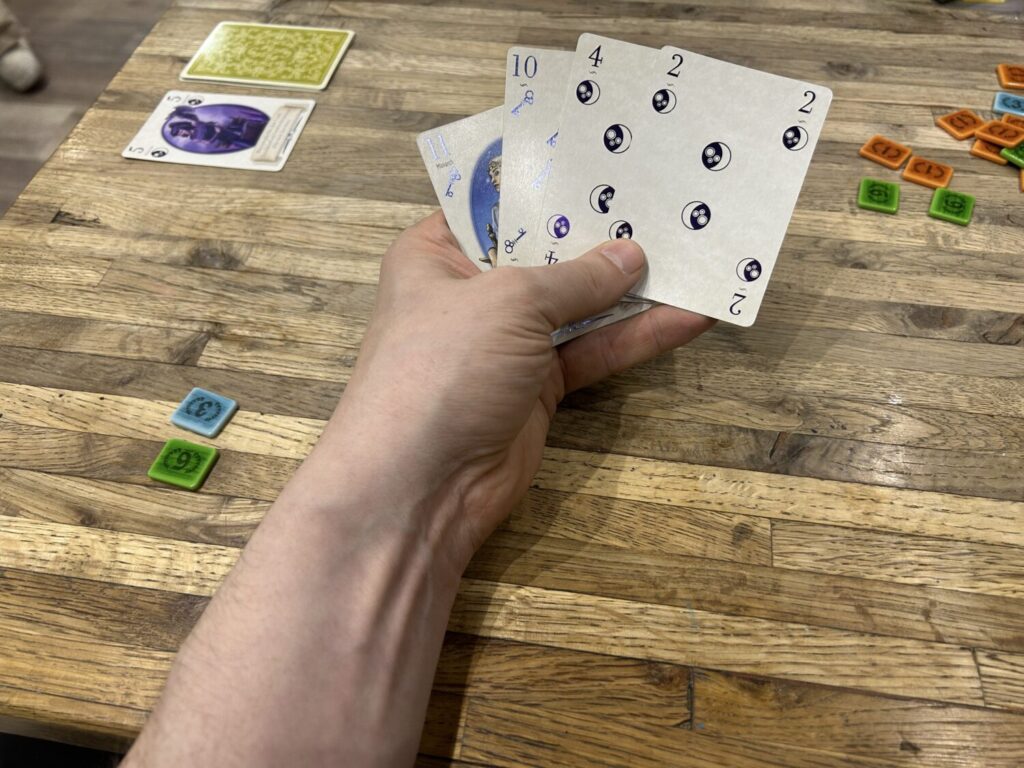
The second manner in which The Fox in the Forest distinguishes itself is the scoring. One of the reasons trick-taking games struggle at two players is that one of the players will often have a stronger hand, and it is difficult for the other player to do much of anything about it. The Fox in the Forest is designed to make stronger hands a liability. If you win 7-9 tricks out of the 13 in a given hand, you get a whopping 6 points. If you win between 4 and 6 tricks, you get 1-3 points respectively. But if you manage to avoid winning more than 3, you get 6 points and your opponent gets a big, fat, foxy 0. Everything in moderation, then.
Punishing players for winning too much has always been my favorite thing about this game. That system pushes against our natural instincts. It makes hands that would normally be greeted with jubilation into tricky problems to be solved. That, of course, has not changed with this deluxe edition. That would be crazy.
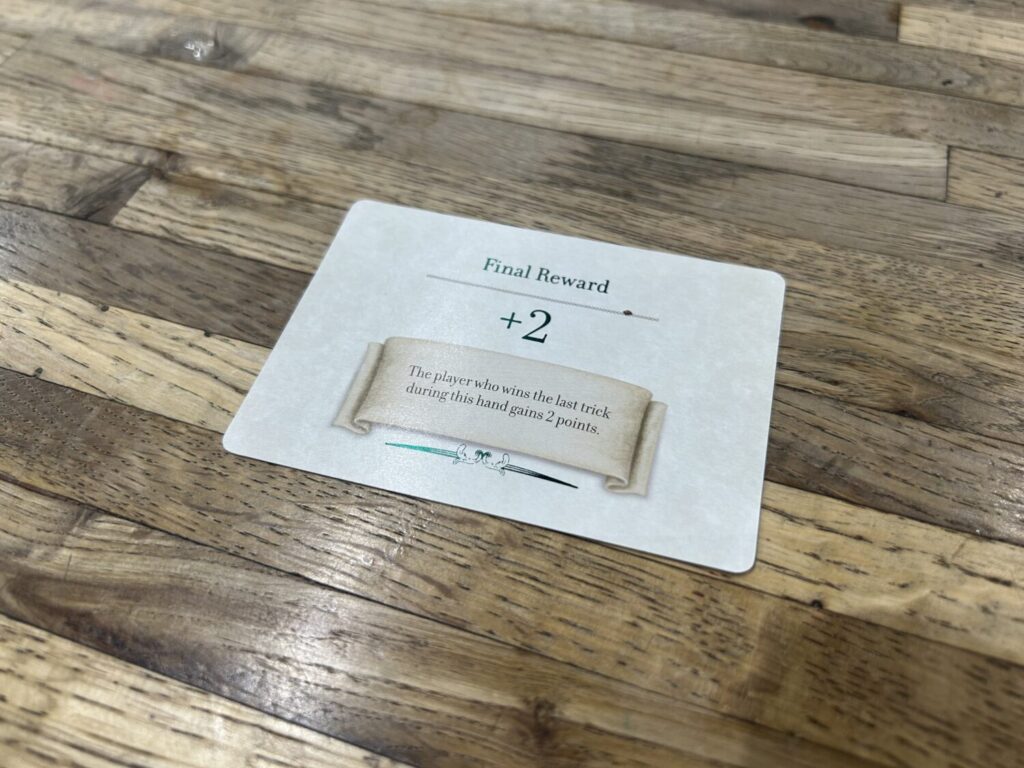
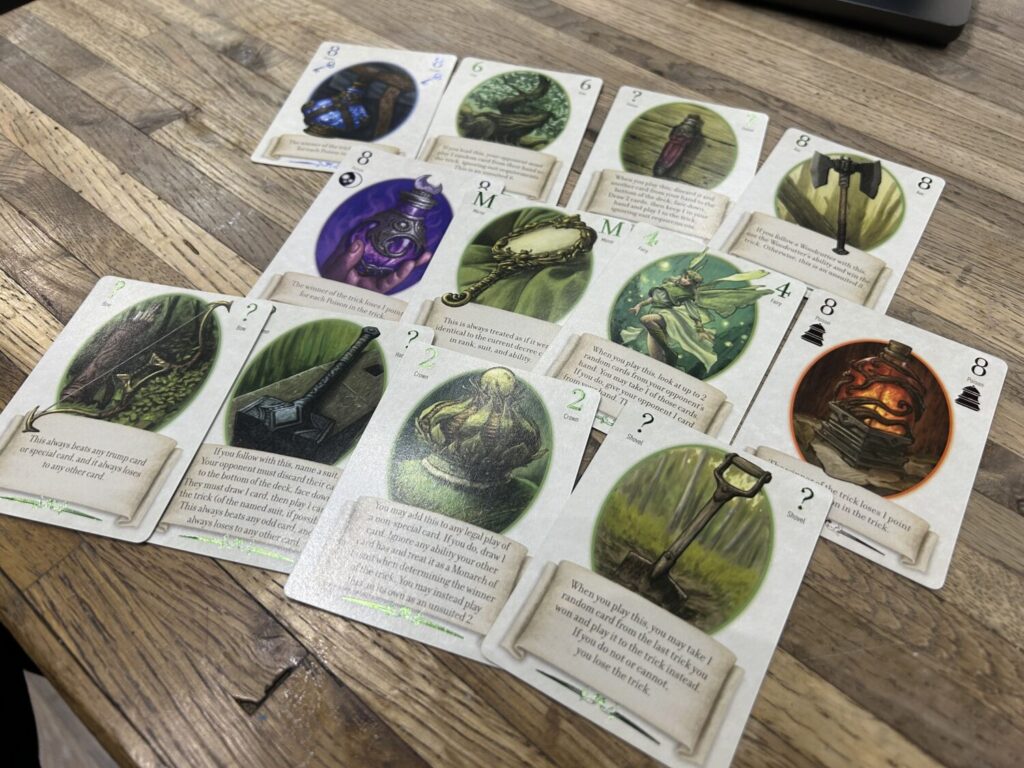
What has changed? The scoring tokens are now bakelite instead of cardboard, and the cards are of nicer stock. There are also a number of modular power cards that can get shuffled into the deck if you want them, and a whole separate module that introduces achievements. I admit that I am not swayed by any of the (entirely optional) gameplay adjustments. The new power cards feel out of place, unnatural. They aren’t that complicated, really, but they feel complicated. They don’t integrate well. They exist on a level of involved that’s forever just out of The Fox in the Forest’s reach. I would have assumed that they grated because I am so familiar with this game, but even first-time players I introduced to the game with some of the new cards included would ask about them.
A fun idea that works half as well as you’d expect, or at least as I’d expected, are the new 8s, Poisons. While each 7 is worth a point for the player who claimed it, these new 8s do the opposite; if you win one, you lose a point. This sounds so fun that I made a gleeful noise when I first opened the box and saw them, these beautifully-illustrated bottles of liquid suffering. But a first play immediately reminded me that it is almost always a bad idea to create mechanisms that allow for player scores to drop. In practice, the 8s lengthen every game of The Fox in the Forest by two or three hands, making what should be a quick filler of a game into a little too much of a main event.
The achievements, a fun idea, feel more like busy work than any kind of enhancement. This game already involves enough contingency planning that the addition of one or two more conditions to each hand is not a welcome change. That just about everything added to this box ends up feeling like too much is funny given that The Fox in the Forest itself, which used to be a strangely difficult teach, has aged into a breeze of a thing. All of these ideas make me feel like it’s 2018 and I’m teaching the game to a date. It’s nice to feel that young again, I suppose. A lot of good ideas were tried in the process of deluxifying The Fox in the Forest. I’m not sure any of them worked all that well.