
Disclosure: Meeple Mountain received a free copy of this product in exchange for an honest, unbiased review. This review is not intended to be an endorsement.
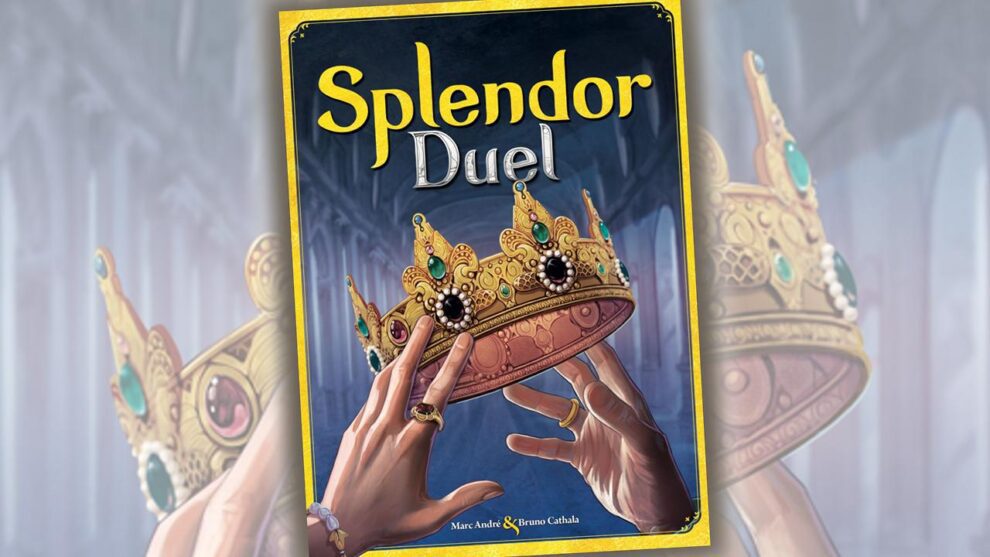
Splendor is over a decade old at this point, but it still ranks in the top 250 on BGG. Despite playing well at its advertised player counts of 2-4, designers Marc André and Bruno Cathala saw the potential for a new game made specifically for two. Enter Splendor Duel, a game that Splendor aficionados will find familiar while tweaking the gameplay just enough to give a source of tension between players. But are these changes good, or are they just changes for the sake of change?
Splendor Duel Overview
The setup for Splendor Duel is nearly the same as its predecessor—at least initially—with a few extra components tacked on for good measure. The three decks of Jewel cards are arranged to form a pyramid of revealed cards that become the available card market. These are the cards that players will be buying with their hard-earned gems, working their way up to the higher-costed cards on the top of the pyramid as the game goes on. So far, it looks like Splendor, but it’s time for the twists.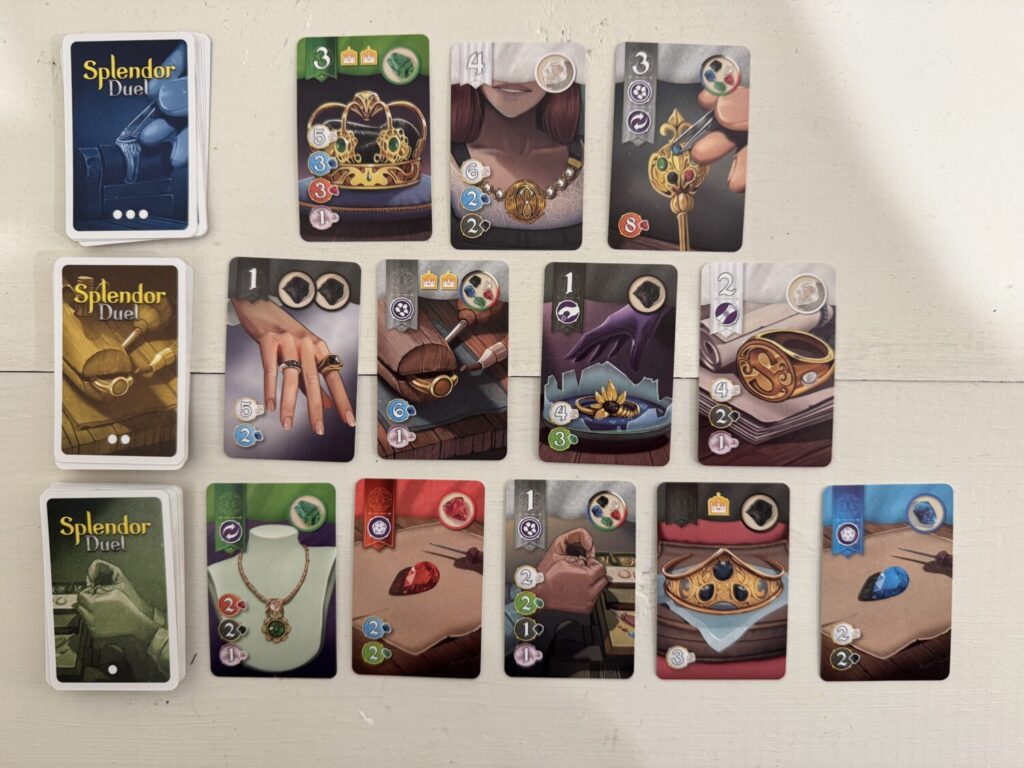
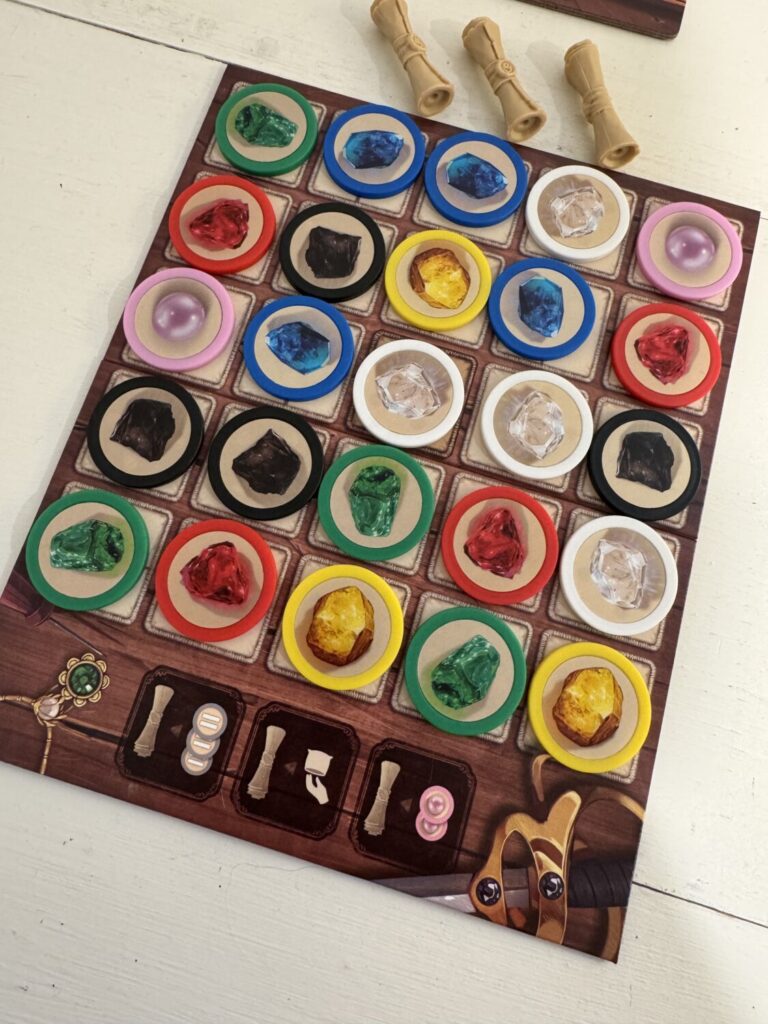
All of the gems get randomly placed on the game board, starting with the center space and rotating around in a clockwise fashion until all twenty-five spaces are occupied. Three Privilege scrolls get placed above the board and four Royal cards are placed nearby as well.
On a player’s turn, they can take up to three tokens from the board, take 1 Gold token and reserve a Jewel card, or purchase a Jewel card from the market. Gold tokens can be spent as a ‘wild’ gem of any color. Again, very similar to Splendor.
When taking tokens from the board, they must be connected in an unbroken line. Those spaces are then empty until the board gets refilled. If three tokens of the same color or two Pearls are taken during this action, your opponent gains a Privilege scroll. Privilege scrolls are optionally used at the beginning of a player’s turn to take a Gem or Pearl token from the board.
As Jewels get purchased from the market, the Gems used to purchase them get placed into a bag. At the beginning of a player’s turn, after deciding to use a Privilege scroll, a player can replenish the game board by taking the gems from the bag and refilling the empty spaces in the same spiralling pattern used during initial setup. However, doing so awards your opponent with a Privilege scroll, so it becomes a central point of contention in the game.
Just like Splendor, purchased Jewel cards can be used as a ‘free’ Gem when determining how many Gems need to be spent to purchase a Jewel card. Additionally, cards will sometimes have abilities that activate upon purchase, such as taking a token matching the color of the card from the board or even taking another turn.
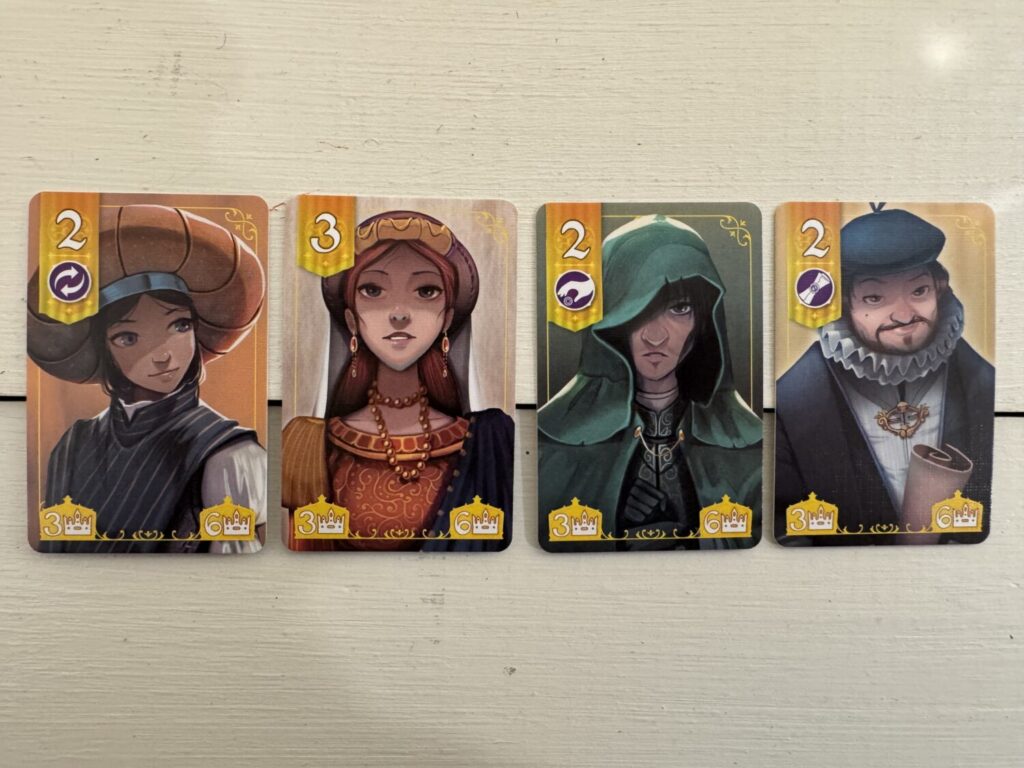
Jewel cards may also have a crown icon. Gaining three of these crowns awards the choice of a Royal card which gives 2 points and an instant ability. If you manage to gain six crowns, you get to take a second one of these Royal cards.
The game ends when any of the following conditions are met: a player reaches 20 points, a player possesses 10 crowns, or when a player has 10 points with the same color.
Splendor Duel: More Facets than the Original
Whereas Splendor‘s gameplay loop was simple in the way you could just choose the gems you wanted to take, Splendor Duel ratchets up the number of inputs to make the game more reactionary than its predecessor. Instead of merely adjusting strategy based on the available Jewel cards, players must now also weigh their ability to get required Gems from the board. It creates a certain kind of artificial resource scarcity because it’s easy to feel like you are falling behind if you only manage to snag one Gem of a high-demand color with your action.
The introduction of the pink Pearls as a token are another consideration when it comes to token selection. Some Jewel cards have a Pearl as a required Gem, and the only way to get one is to either spend a Gold token or a Pearl token. Jewel cards will never offer a Pearl bonus, so players are constantly fighting over the two available Pearls lest they have to spend a precious Gold token for one instead.
And then the crowns! In my plays I found myself pushing to get three of them just for that initial bonus royal card, but reaching ten always seemed like a mountain that’s too tall to climb. It’s much easier to work towards points in a specific color or the old standby of hitting that 20 point threshold.
If you’re looking for a snappy game experience, Splendor Duel isn’t the answer. The first few turns go quickly but then the game board is a barren desert wasteland with a meager selection of Gems. Nobody wants to give their opponent a free Gem, so the board languishes in an unreplenished state until somebody is forced to fill it because they can’t do anything else. Even if you can still take Gems from the board right after replenishing, you’re left with a sour taste knowing your opponent got something for free and still gets a decent selection of Gems to choose from.
The Gold tokens on the board function like roadblocks, as they can only be acquired when reserving a card. This makes it more difficult to snag three uninterrupted tokens with your action, because those pesky Gold tokens get in the way.
One of the main differences between Splendor and Splendor Duel is that it’s more challenging to plan ahead in Duel. You flit from turn to turn hoping that your opponent’s acquisition doesn’t create a gap in the board, forcing you to change which tokens you take. Again, it’s this idea of scarcity that lengthens the game through increased thinking time and recalculating options.
The recent rush of popular games receiving a two-player variant is a zeitgeist that I generally don’t feel like the industry needs, especially in the case of a game like Splendor that plays perfectly fine at two players; just ask resident editor Tom about his love of Splendor. In a cutthroat industry where it’s hard to be the cream that rises to the top, I understand why publishing a Duel version of a successful game is a sound financial decision. It’s only a matter of time before we get something like Toy Battle Duel; peak board gaming by creating a two-player variant of a two-player game.
Splendor Duel has much more going on, often distracting from the simplicity of the original, but that doesn’t make it a bad game. In fact, I found myself enjoying the constraints of Gem choice more than I expected. The push and pull of replenishing the board, the fighting over Pearls…am I just a masochist?
This is a game that doesn’t really need to exist, but I’m glad that it does. Puzzling out what route to take on your turn exercises the brain more than just deciding to take a blue, black, and red gem from the supply. Splendor will give you more flexibility if you plan on occasionally playing with a full table of four, but I’m inclined to recommend Splendor Duel for those who might be more inclined to play with two people frequently. I’m a believer in the adage that constraints breed creativity, and in that way Splendor Duel grants me the opportunity to parse the variables and derive my own strategy on the fly.
Both games are diamonds, it’s just that each has its own cut.
Splendor Duel details
- Designer: Bruno Cathala, Marc André
- Artists: Davide Tosello
- Publishers: Belleville (Бельвіль), Galápagos Jogos, Gém Klub Kft., GoKids 玩樂小子, Hobby Japan, Kaissa Chess & Games, Korea Boardgames, Lifestyle Boardgames Ltd, Rebel Sp. z o.o., Space Cowboys
- Release Date: 2022
- Player count : 2
- Age range : 10+
- Time range : 30 minutes
- Mechanism(s): Contracts, Open Drafting, Race, Set Collection
- BGG Geek Rating: 7.89795 - converted to Meeple Mountain scale: 4.0.
- More articles about Splendor Duel.