
Disclosure: Meeple Mountain received a free copy of this product in exchange for an honest, unbiased review. This review is not intended to be an endorsement.

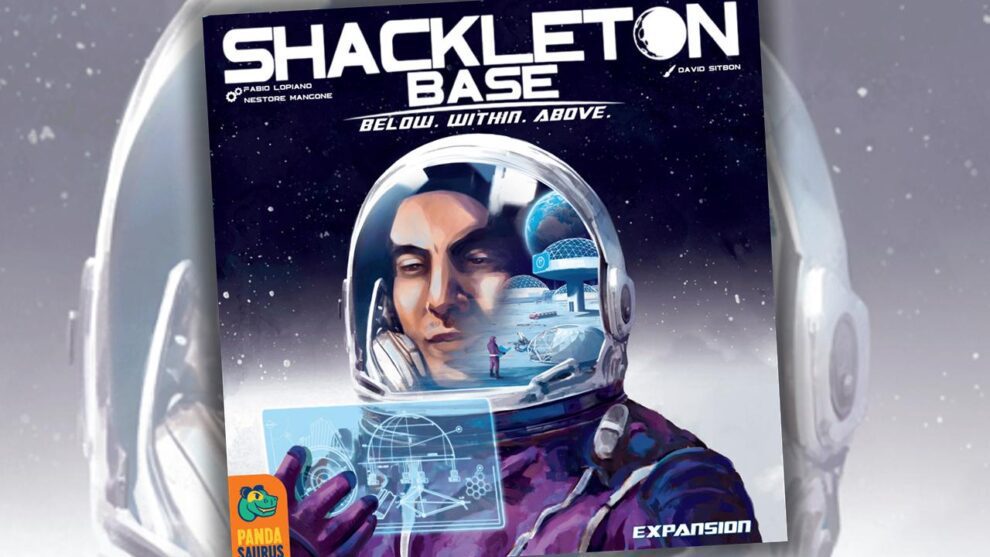
No upcoming expansion had me more excited than the arrival of Shackleton Base: Below. Within. Above., the first expansion for one of the five best games I played in 2024, Shackleton Base: A Journey to the Moon.
“Shack Town”, as it is known in my circles, has hit my tables a whole lot since the late summer of 2024, thanks to receiving an advance copy from the team at Sorry We Are French (from overseas, no less, in the Before Tariff Times). The medium-weight Euro is a crowded field, and Shackleton Base stood out because it does a lot of things right, thanks in part to the seven different corporations included in the base game.
Almost any number of extra corporations would spice up the base game for me. I’m not exhausted with any of the base game corporations yet, but the mix can always get sweeter with more set-up options that shake up the meta.
Let’s talk about the new stuff. (For anyone new to Shack Town, you can check out my review of the base game to learn more.) Also, please note: the new stuff barely—and I mean, barely—fits in the base game box, assuming you keep the cute tuckboxes that make setting up the game a cinch.

OK, OK…You’re Right. First We Gotta Talk About That Price
There are two main reservations I have with this expansion:
- I still think the base game has my least favorite post-colon subtitle of any game in my collection, and it is easily the worst of the titles for games I played in its release year. (There’s really no “Journey” involved. When the game starts, you’re already on the moon.) Somehow, I am even angrier at the team behind this expansion because I cannot fathom how “Below. Within. Above.” was the final choice for the subtitle. Like, what the hell is going on here? I have some friends that have openly laughed when they saw the full title on the expansion box. There’s no way this sounds sexier in, say, French or Spanish, right? Even the order of the words feels off…why not start with “Above”? Why all the extra periods? This is why I’m not getting phone calls to help market new games.
- There’s no getting around the elephant in the room, because everyone in my Shack Town network has complained about it and forums collectively threw up their arms when this expansion was first announced: the manufacturer’s suggested retail price, or MSRP, for this expansion is FIFTY US dollars.
That price is no bueno. (It’s not “raise the pitchfork” ridiculous, like the $15 price for the six cards in the Rebel Princess expansion Happily Never After…but it’s close.)

For $50, you are getting three new corporations. (For this price, I was expecting at least five new corporations.) In addition, you are getting a single, double-sided Space Agency tile (the tiles represent individual player powers, added to the four included in the base game), a pool of minor bonus tokens when players reach the 10 VP and 25 VP spaces on the scoring track, and solo cards for each of the game’s three new corporations.
The base game (the ENTIRE base game!) can be found for $50 online. I know that, because after my first play with the expansion content, one player loved Shackleton Base so much he literally bought a copy of his own on Amazon. To only get three new corporations, one new player power, and a couple cardboard bonus tokens for $50? This has not landed well with players in my network.
The 10 VP and 25 VP tokens don’t represent new powers; they just boost the game’s early economy. The 10 VP tokens include getting small amounts of cash, titanium, reputation, or points. The 25 VP tokens offer a one-time bonus on a future turn. One of those bonuses is so minor—one extra Corporation action when taking the Visit the Lunar Gateway action—that it has always become the last one players take in a four-player game, and it was the only one that was not selected in my three-player game.

One of the 25 VP bonus tokens is so juicy that it is always the first one taken: a one-time doubling of the bonuses a player gets when collecting rewards gained during a single “Exploit the Crater” action. I used that in my second play of this expansion to net 24 credits (money)…which turned out to be massive. In fact, it’s easy to just rank the four 25 VP tokens because they have always been taken in the same order: the one I just described, then one that grants a three-credit, three energy requirement discount during a project card funding action, then the one that grants a slight building discount. Those are all better than the bonus during the Gateway action.
The MSRP puts Shackleton Base: Below. Within. Above. in a specific place: Shack Town superfans only. If you’re like me and Shackleton Base comes out at least once a quarter, buy this expansion despite its high price. If Shack Town only hits the table once or twice a year, I would hold off…the base game has so much variety packed in that you might not ever need to explore new corporations, at least not right away.
Let’s talk about the three new corporations. For this review, I did four review plays with the following setups:
- Selenium Research (base game), Undermoon (expansion), Lunar City (expansion), with four players
- Artemis Tours (base game), Lunar City (expansion), Zenith Works (expansion), four players
- Zenith Works (expansion), Moon Mining (base game), Evergreen Farms (base game), solo play (solo simulates a two-player game)
- All three expansion corps–Zenith Works, Lunar City, and Undermoon–for a three-player game

Undermoon
The Undermoon corporation adds a small side board for each player, with a digger token that looks a lot like the buggy from the classic arcade game Moon Patrol. The side board is known in-game as the “Drill track”, and that digger token is moved forward one space every time a player activates a blue Undermoon corporation token.
Some spaces on the Drill track are blocked by red, blue or yellow “fracture” tokens. When these tokens are reached by a player’s drill token, they generate an instant bonus for the player who triggered the fracture—cash, resources, or a corporation token—then the token is placed on the main map of the crater, in or adjacent to a hex that has at least one of the active player’s buildings.
Until someone takes an action to repair these fracture tokens, no one gets the matching bonuses in that sector when exploiting the crater by placing astronauts on a crater space.
Suddenly, other players care about working together to clear out these tokens, which adds an interesting element to sending astronauts to the map to “Exploit the Crater.” I liked this change, particularly because there are rewards for clearing the fracture tokens (for any player, even ones who don’t bother to invest in funding Undermoon project cards), as long as a player sends an astronaut to exploit the crater that matches the color of the fracture token. Clearing a fracture also gains the active player two reputation, important for invested Undermoon players because Undermoon is all about maintaining a high level of reputation.
That’s because players LOSE reputation during the corporation maintenance phase based on how deep into the moon their digger token has progressed on their side boards. By the end of the Drill track, the corporation maintenance phase might turn ugly, with players spending as much as six reputation at the end of a round.
But wait, there’s more!

During setup, 18 “Underground Hall” tokens are placed on the Undermoon corporation board, shuffled randomly with six tokens in each of three different rows. Undermoon’s corporation action allows for a player to take the leftmost Underground Hall token and place it face-up in a vacated Drill track space. Each token is double-sided; one side shows an income bonus, while the other is worth six points at the end of the game.
In both cases, these Hall tokens are only active if an astronaut is placed in the space next to that token, so aggressively moving the Drill down its track becomes a fun minigame. The rewards are spectacular—the Hall tokens all offer income that is juicier than most other elements in Shackleton Base, from higher VP totals, to bigger cash outputs, to tokens that offer both titanium and rare earth. In my first play with Undermoon (and I went pretty hard on Undermoon in that game), I was earning 13 credits, two titanium, a rare earth, and two VPs by the end of the second round’s income phase!!
Undermoon is my favorite of the new corporations. It has a “complexity” rating of three (out of four dots), which I think is tied to maintaining a relatively high reputation in order to manage the downside of Undermoon’s bonuses. But tying project cards from Undermoon to taking lots of Undermoon actions is such a blast. In that first play, I had a card that gave me a credit every time the drill moved, another card that bumped the drill down the track one space each time I took a construction action, and Emergency Drill, which let me gain the bonus of two Underground Hall tokens once per round…and I got that card in the first round of the game.
The glory of the Shackleton Base combos, baby!

Lunar City
Lunar City introduces a new astronaut type, civilians. Lunar City corporation tokens grant the active player one of these new civilian meeples to go into an empty spot on their base…but only if the player’s current reputation rating is high enough, based on the tier of the civilian being removed from Lunar City’s corporation board.
Depending on player count, a number of civilian tokens (purple, to distinguish them from the “tourists” tokens used by the Artemis corporation from the base game) are placed on the Lunar City corporation board in tiers, with reputation requirements of zero, four, eight, and 12. Civilians are drawn from left to right, lowest rep tier to highest, so late in the game, players have to keep their rep high in order to continue adding civilians.
Without any project cards, civilians are actually a bit worthless; because they are not red, yellow, or blue, they can’t be used to trigger anything on a player’s base for income, effects, or end-game scoring. (They can, however, trigger Underground Halls for income and end-game scoring, making this pairing with Undermoon quite handsome.)
At the end of the game, civilians in a player’s base are worth one point each. With project cards, things change fast, and leaning into Lunar City’s cards could be a gold mine here, as civilians can become very useful based on which structure’s spaces they occupy after a player begins building different structures. (For example, one card makes civilians wild, as long as they are placed in empty dome spaces.)

The real wrinkle comes when players use their civilians to take corporation actions. For the cost of one reputation, a player can send a civilian to a space along the crater, to exploit a single hex (sector), gaining bonuses if they have presence as usual. (If a player uses a civilian to trigger a sector where they have no presence, they still have to pay the player with the largest structure there instead, but I’ve still not seen anyone do that.)
This wrinkle becomes an interesting path players used to cherry pick ways to get that civilian back during maintenance. I regularly put civilians out in the rows where I had a structure majority, so that I both got an immediate bonus during placement and the civilian back on my board at the end of a round.
Lunar City does one other thing that I think can really spice things up, particularly at lower player counts: it creates a somewhat larger crowd of astronauts around the crater, even in the early rounds of the game. I still maintain that Shackleton Base is just a better game at higher player counts, but Lunar City does create more opportunities for all players to gain more astronauts during maintenance, which triggers a lot more action during income for everyone.
One player compared Lunar City to Artemis, in part because both corporations use standalone meeples to trigger actions and cards. After using both of these corps in one of my plays, I’m excited to share that both can coexist and create lots of different opportunities for players who lean in to either or both corporations if they are included in the same game. Having both in a single game also creates a lot more crowding in base spaces, which forces players to plan a bit more than with the base game.
The main downsides with Lunar City were always tied to cards. There is no way in Shackleton Base to cycle project cards, so in one of my games, the first two cards available made everyone shy away from using Lunar City bonuses. And depending on player count, it can be hard for multiple players to make a run for the top scoring goals for this corporation.
When Lunar City and Undermoon were not included in the same game, players tended to ignore Lunar City versus the other corporations in those games. I’m curious to see if that stays consistent as I try Lunar City with other corporation variations.

Zenith Works
The third and final new corporation is Zenith Works, a construction corporation that made one new player feel like Zenith Works was its own game…in a larger game that already has three different mini games going on each time the game is set up.
In that way, despite the fact that it has a “complexity” rating equal to that of Undermoon, Zenith Works really is the only corporation that I would say is not for a brand-new player of Shackleton Base, especially if this corporation’s larger utility buildings are in play. Sure, anyone could learn on the fly. But I found that even nine or ten plays into my Shack Town journey, it was hard to plan around the benefits of what Zenith Works can offer.
That’s because Zenith Works adds two new layers that really open up the game.
The first is the concept of overbuilding. Zenith Works grants players one blueprint token each time they trigger its corporation token on the map. These blueprints can be spent as a corporation action to build a smaller structure on top of a larger structure…so, a player could build a Workshop (size two building) on top of one of their Labs (size three) by spending blueprints equal to the size of the new build.
That also means the building cost is blueprints, NOT titanium and rare earth. This lets a player skip out on needing things like, you know, resources all game long!
Of course, this can hurt a player when it comes to the area majority/astronaut retrieval process during maintenance, because an overbuild does not add to the size of a player’s spread on the map. Only the size of the bottom-most building in a player’s stack counts for majorities.
It does, however, grant players additional VP income at the end of a round; a fully built-out structure that includes an HQ, Lab, Workshop and Dome generates nine points for that player. And, buildings like the Labs or Domes still trigger immediate bonuses when built, so you don’t lose out there, either.
Overbuilding was fun, even though it took a number of actions to get my four-level structure. I’m still not sure that’s going to be worth it for all players, but it was a fun mechanic. This is another corporation that I’m curious to see when mixed with different corporations, but in the mixes I have seen so far, overbuilding leads to a good time and anyone who leans in will likely be able to build all of the buildings on their player mat.

Where Zenith Works really comes alive—or, not, which we’ll come back to—is with the six new building types that are featured on the corporation board. These new buildings are tied to the project cards; six of the nine project cards have a letter in the upper right-hand corner. When the matching card is acquired by a player, they become the owner of that building and can usually get these buildings on the map as an immediate bonus.
The new buildings here are a neutral color, black. The benefits of the buildings are handsome, and reward both the owner and any players who interact with them. Take the Power Plant, Building E, for example. When the card is purchased, the Power Plant goes into a powered sector and covers five of the six spaces in that hex. Any player can spend credits to lower the energy requirement for any applicable action…by spending the credits and placing them on top of spaces on the Power Plant. At the end of each round, the Power Plant’s owner collects that cash.
These new buildings also disrupt the area majority balance in each row, because they don’t factor into those races. I used a couple of the Zenith Works buildings to close off sections of the map, ensuring that my largest buildings would have majority control for the rest of the game. In other cases, players used their own building to generate a small drip of passive income while boosting their end-game scores by strategically placing Zenith Works buildings in spots advantageous only to themselves.
This element of Zenith Works was a lot of fun. And it, like Lunar City and even Undermoon at times, helped boost the action on the crater in ways that were not always apparent with the base game. This makes the expansion feel like it is pushing hard on making the Exploit the Crater action a lot juicier than it was previously.
Now, in certain plays, Zenith Works won’t have some of its biggest buildings come out, depending on how the project cards are shuffled. In one of my plays, none of the lettered/neutral buildings were on the first two cards, and no one bought any cards from Zenith Works for the entire first round. By the end of the game, only two of the buildings had come out, and no one really engaged with those that hit the map.
That makes Zenith Works very swingy. When the three biggest neutral buildings come out, there’s a very rich environment created by these buildings, with lots of “win-win” interactions that spice up play. Also, the owners of those buildings are constantly selling, reminding opponents about their benefits. If no one engages, the owners can still do so, which usually forces other players to recognize some of the best benefits on offer.
But when the neutral buildings don’t come out, that leaves Zenith Works in a less valuable place. Overbuilding is always worth a look, but the real spice comes with the utilities.
One negative that I’ll call out about Zenith Works: the goals. The top-level goal, where a player can earn the most points, is tied to placing size 7+ structures from Zenith Works on the map. This seems incredibly arbitrary; in one of my plays, the size-six structure was available amongst the first two project cards, so someone just bought it on their first turn. Then, they just built the next available structure to trigger the top-level bonus.
When combined with the 10- and 25-VP bonus tokens with this expansion, this goal stacks in the worst possible way. Even if a player hasn’t advanced on the reputation track early on, that’s still 12 free points…then getting a player a free bonus with a 10 VP token can get one player’s engine moving a little faster than others, quite possibly based on the card flop and turn order.

Again, Shack Town Superfans Only
Shackleton Base: Below. Within. Above. is worth a look if the base game hits your table a lot (knowing that the term “a lot” is a moving target). The base game is one of the best Euros I’ve played since the pandemic, and this expansion offers more options during setup. The 10- and 25-VP tokens are an automatic yes, and the additional player power is always going to be included moving forward.
For someone who is always looking for a new mix of three corporations to try, this expansion is a no-brainer. And the expansion is very blatantly pushing players to take the Exploit the Crater action more with this new content…and I think it mostly works. I love Undermoon and I like the other two new corporations. The new Agency Leader tile, India, is tied very closely to managing reputation, so if that’s your jam, India paired with the inclusion of either Undermoon, Lunar City, or any base game actions that carefully monitor reputation levels will make India feel like a worthy inclusion.
There’s no getting around the price here, and that’s as a person who received this expansion as a complimentary review copy. It would really sting to pay for this content, even as a hardcore Shack Town junkie. For better and for worse, the range of play in the base game box is really, really good. Still, if you are like me and waited almost two years for more goodies, run out and buy Shackleton Base: Below. Within. Above. right now. It’s not essential, but it’s still pretty good.