Disclosure: Meeple Mountain received a free copy of this product in exchange for an honest, unbiased review. This review is not intended to be an endorsement.
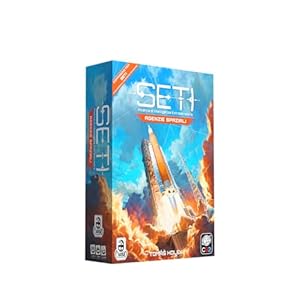
I’m not saying that Czech Games Edition (CGE) team members necessarily read my review of SETI: Search for Extraterrestrial Intelligence. BUT, after re-reading my review, then doing three plays of the new SETI expansion, Space Agencies, it sure feels like CGE read that review and put everything into the game that I asked for in an expansion.
Between that, and my interview with designer Tomáš Holek during Gen Con 2025, one thing is very clear: the intent with Space Agencies is to provide the kind of experience that Terraforming Mars: Prelude gave to that game a few years ago. The result is so similar between the expansions that you can’t help but respect the acknowledgements here: SETI, the base game, is a bit too long, could use a quicker and more resource-rich start, needs more ways to introduce asymmetry into its engine, and needs a boost to the Scan action, particularly at lower player counts.
SETI: Space Agencies answers almost every minor flaw I found with the base game. If you like SETI, Space Agencies is a must. If you were lukewarm on SETI, I don’t think the expansion will bring new players into the fold.
No matter where you land, one issue remains: SETI should be avoided at all costs with four players.

“Sorry, Is It Round Four or Five?”
SETI: Space Agencies is an expansion that requires the SETI base game to play. If you need a refresher on how the base game plays, check out my previous review.
Space Agencies introduces four new elements to gameplay: organizations, “quick start” cards (I think this name was chosen because “Prelude Cards” was, ahem, already taken), single-use scan tokens, and three new alien species.
However, the biggest change on paper is the one that ended up not being a big-enough change during my plays (once each at solo, three-, and four-player counts): Space Agencies makes SETI a four-round game instead of a five-round game.
When the round change format was pitched to me at Gen Con, I was pretty thrilled. Five rounds is way too long for SETI, especially because the first round is so bland. Every player is badly resource-constrained in the first round, and the first round only serves to whet the appetite of what comes in rounds 2-5. So, Space Agencies just cuts out a round.
However, in a twist so strange I’m still not sure why this was implemented, Space Agencies is now a four-round game…that starts in round two. (Bold print, page four of the manual: “Play only rounds 2, 3, 4, and 5.) I guess the first round is now the setup round?
Regardless, players now get four rounds to play—but for the reasons we will describe, Space Agencies still feels like it is one round too long. Don’t get me wrong: the first round is much more exciting, in part because the game kicks off by feeling like base game SETI feels in rounds two and three, with a whole lot more to do right out of the gate.
But when you are not playing, you are watching, and with four players, downtime is still a massive killer. My three-player game took about two-and-a-half hours, and my four-player game stretched to three hours. I’ve spoken to other friends who have played the expansion, and in the wrong hands, Space Agencies—like the base game—could easily become a 4+ hour game.
So, the main strike against this expansion: it juices up the game’s start, but it doesn’t do anything to streamline turns. For particularly patient players, this won’t be an issue. I’m not a particularly patient player, so Space Agencies is a two-, max three-player game.
Let’s talk briefly about the other bits in the box.

Organizations
Space Agencies includes 11 asymmetric factions known as organizations. These organizations feature a range of different starting resources, ongoing income, permanent powers, and once-per-round powers, the latter of which I would frame as “interesting”, and not much more.
Organizations replace the base game’s starting income card and now that I have seen eight different organizations in my plays (my own, plus other players), I am very happy with how organizations change up the SETI formula.
The permanent powers are situationally awesome, particularly because SETI’s system is so tight in terms of its two main resources, cash and energy. It didn’t sound like much when I drafted the Fenwick Research Center organization, but using their ongoing power (a permanent one-publicity discount on new techs) led to a tech bonanza that I have never seen in a SETI play before. Ditto for Deep Sky Survey, which grants the owner zero-cost Analyze actions. A savings of even one energy was situationally massive.
I also love that the corporations are ranked by difficulty level, so that new players can gravitate towards easier-to-manage factions if desired. Leaning hard into a faction’s power is vital, and I think corporations achieve the intended result of giving each player a different way to attack the game’s systems. Just the differences in starting resources and income has me really excited to try all the organizations included in the box. (And it won’t surprise me if we will now get a few new organizations in each new SETI expansion. No, CGE did not show their hand on this topic, I just know that most companies like money—and if Space Agencies sells like hotcakes, we’ll be getting more expansions.)

Quick Start Cards
In Terraforming Mars: Prelude, the Prelude cards dealt during setup feel almost game-breaking, but in a great way. It also gets players right into the heart of the game quickly. I think Prelude is still the best “fix” to a game of any expansion I have ever played.
The Prelude-adjacent cards in Space Agencies are called quick start cards. Players are dealt three during setup and must play two of them. None of the quick start cards are crazy; most reward a few points, maybe an extra resource, maybe a signal or two in different sectors. (However, again, even two extra coins in the SETI universe can be massive.)
The best thing about the quick start cards are the cards that force a player to put an orbiter over a planet. The player doesn’t get any rewards for doing this, but all players enjoy the benefit: suddenly, it is cheaper to land on a planet or two based purely on the setup.
That means that your first round (which, again, is called round two!!) is gonna be a lot more interesting. In all three of my games, players went harder on the Lander tech that makes landing on planets cheaper if there is an orbiter from any player present. That, in turn, pushed out more yellow alien samples (“traces”) faster. In each of my Space Agencies plays, at least one alien was discovered in the first round. This expansion really pushes up the ability to spend most of, if not the entire, game exploring and interacting with each species.

The New Aliens
For two of my plays, I intentionally used two of the three new factions: Arkhos and Glyphids. Then for my final review play, I put the final new alien, Amoeba, into the first slot and then did a random draw of aliens for the second spot, which ended up being the Mascamites. (I’m sure there’s a website that tracks the feelings of players on this, but I still think the Mascamites are near the bottom of the popularity list. Just meh.)
I’ll start with the Amoeba, which quickly became my favorite of the three new aliens. I wouldn’t call the Amoeba special, but for a gamblin’ man who likes games with an active and volatile resource market, I was surprised how much I loved how the Amoeba works. Basically, the Amoeba has a small pool of five reward tokens—a mix of points and resources—that move around its species board any time a player interacts with it. At varying times, players can get rewards for 1-3 of the five tokens based on the color of the trace they mark on a species, but that market is always in motion.
That left all players excited to time a move based on when they could cash in on the most stuff. None of it was game-breaking—there’s no 26-point moon like Triton on this species board—but it made everyone constantly excited to time an action to just the right moment.

The other two alien species? Arkhos has an interesting setup. Players are each given three security cards, one for each trace color (red, yellow, blue). When players dump a token into the overflow discovery area of the matching color, they unlock their security card and can flip a card for a big bonus after paying for the security card’s cost. But placing trace tokens normally on this species board required players to flip a card for a “minor” security bonus, which usually was as advertised: minor.
So, there’s an element of gambling with the Arkhos as well, because all the rewards here come from a small deck of five cards, out of a pool of nine. I used Arkhos twice in the hopes that it would seem more interesting the second time around. It was not.
The Glyphids offer players an element of set collection scoring, based on the seven different colors of tokens that are scattered across the solar system and planet boards when discovered. Players can mark trace spaces, visit planets, or win area majority scanning sectors to collect tokens, with a 20-point bonus awarded to anyone who collects all seven colors. (Extra tokens can be scored as a separate set as well.)
The Glyphids were fine. Players can seed tokens into a rewards area that make the rewards in the upper-left corner of their alien card deck variable. But, overall, the Glyphids didn’t light the fire that a couple of the factions did from the base game.

Variety is the Spice of Alien Life
SETI: Space Agencies does the job—this is required viewing for anyone who enjoyed the base game, and I can’t imagine playing SETI without it. Space Agencies comes with about 50 new cards, bringing the total to nearly 200 unique cards. The asymmetric factions add spice to the setup, then the quick start cards boost the initial turns into orbit.
One other thing Space Agencies seems to focus on—boosting the value of the Scan action. While I think scanning, as an action, is not very interesting (particularly in a solo or two-player game), Space Agencies includes cards that grant players temporary, spendable scan tokens, used to boost the number of sectors that can be scanned on a single action. That might mean a player could scan as many as six different sectors in the same turn if they have filled out their Scan tech area, very useful when other players do not engage with that function of the game’s mechanics.
The designer himself believes players don’t use the scan action enough, as some of the highest scores he has seen come when a player goes pretty hard on scanning in the base game. In Space Agencies, scanning gets a nice boost and now it’s pretty hard to imagine players skipping that action and still finding ways to consistently win.

Speaking of winning, Space Agencies scores seemed to be a little higher than what I saw with my plays of the base game. In my three plays, the winner always scored at least 200 points, sometimes a lot more. (I am aware that top-level SETI players regularly top 200 points with just the base game; I’m not banking on a pro career with this title.)
I don’t think 300 points is possible across four rounds of Space Agencies, but that won’t stop competitive players from trying.
My main beef with Space Agencies is that it does nothing to shorten or streamline the combotastic nature of a player’s turn. As a result, these plays can really run long, and deep in my four-player game, I saw signs of fatigue as players worked their way through some pretty epic turns. I’m likely to house-rule the round count if I am ever silly enough to try Space Agencies with four players again. I only need to see three rounds at four players to have a great time and avoid the kind of runaway leader problem that surfaces in some SETI plays.
SETI: Space Agencies made me happy. I still think of SETI as a solid, medium-weight Euro with fun mechanics, exceptional card play, and the best player aid I’ve ever seen. I can see why it has shot all the way up to a top-25 game on BGG and you know we are gonna get more expansions. Jump on the bandwagon!
SETI: Space Agencies details
- Designer: Tomáš Holek
- Artists: Jakub Politzer, Jiří Kůs, Jiří Mikovec, Ondřej Hrdina, Petr Štich
- Publishers: Cranio Creations, Czech Games Edition, DSV Games, Gém Klub Kft., HeidelBÄR Games, IELLO, MINDOK, Rebel Sp. z o.o.
- Release Date: 2025
- Player count : 1 - 4
- Age range : 14+
- Time range : 40 - 160 minutes
- Mechanism(s): End Game Bonuses, Income, Multi-Use Cards, Resource to Move, Solo / Solitaire Game, Turn Order: Progressive, Variable Player Powers, Variable Set-up
- BGG Geek Rating: 8.74862 - converted to Meeple Mountain scale: 4.5.
- More articles about SETI: Space Agencies.