Disclosure: Meeple Mountain received a free copy of this product in exchange for an honest, unbiased review. This review is not intended to be an endorsement.

I have played my fair share of Root games, lord knows. I have no official play count. I respect the impulse of those who track their plays, but board games are one area of my life where I don’t do that sort of thing. Some back-of-the-envelope math tells me I have played well over 50 games of Cole Wehrle’s juggernaut since I first bought a copy back in the summer COVID lull of 2020. It quickly became, and has remained, one of my favorite board games.
Root’s status as a personal all-timer has never been threatened, but I have found myself moving away from it over the last few years. Since the release of The Marauders Expansion in 2022—an expansion of which I am very fond—I’ve found myself less and less interested in playing. This has nothing to do with the quality of the game. It hasn’t worn on me, nor has it grown tired. If anything, the fact that I haven’t played Root as much as I used to is Root’s fault; it offered early instruction in the idea of board games as strange and ungainly, and I’ve spent the last few years eager to explore new designs, new spaces, and tracking down new experiences. Root became the kind of game I would happily play if suggested, but would rarely suggest myself.
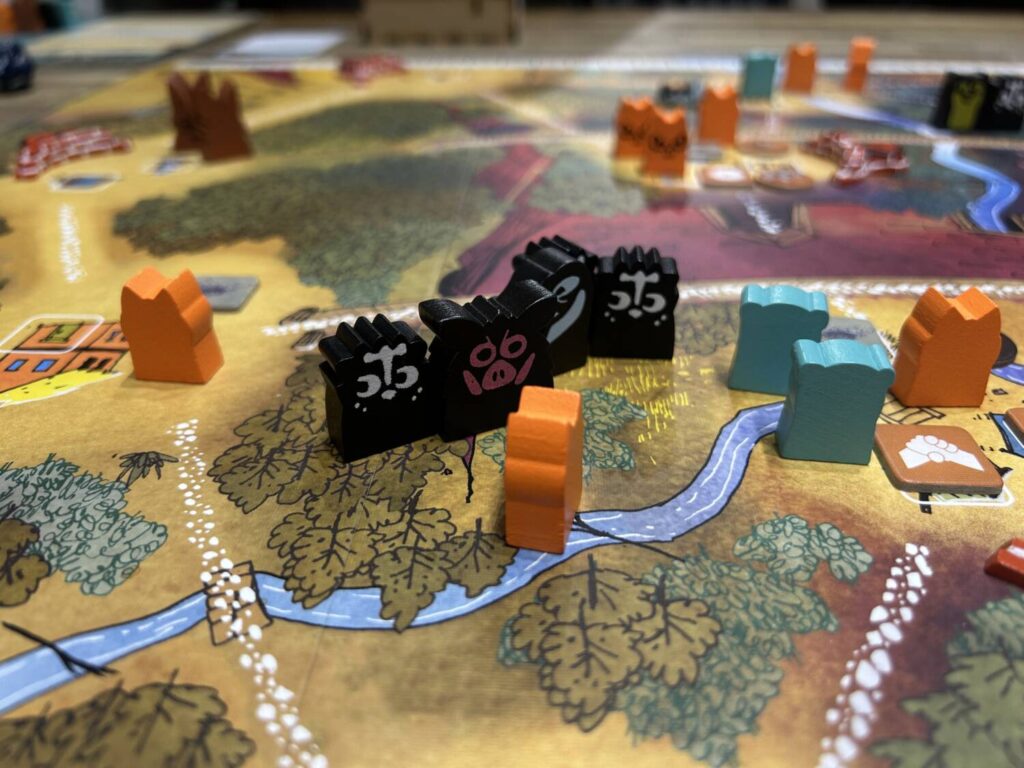
With the release of The Homeland Expansion, that has changed entirely. I can’t get enough. I’m packing games in left and right. I’m cancelling plans, dodging work functions, and turning off my phone. Whatever it takes to get more Root. I keep going back for seconds or thirds from this, the fourth full-size offering of factions in an increasingly crowded woodland.
And what an offering it is. With three full factions—each of the previous expansions included a measly two—and two new maps, Homeland is the most generous portioning of Root material outside of the base game. It is also, in my opinion, the best. All three factions in this box rank among my favorites, joining the Woodland Alliance and the Lizard Cult up on the podium.
I particularly adore the Lilypad Diaspora, which tracks. I generally prefer the factions that get to be little stinkers, that get to poke and prod their way to victory, and the Lilypad Diaspora offers a whole new way of sticking your finger in someone else’s pudding and/or eye; they can change the suits of clearings on the board, stripping away the familiar fox, mouse, and rabbit suits while adding their own frog suit. The Lilypad Diaspora are also—or at the very least can be—a large army that threatens to fight more than it actually does. They even have a fascinating set of frog-suited cards that can lead to some very cool crafting shenanigans. They are a challenge to play well without being punishing, and the constant dangling threat of a clearing changing suit requires increased flexibility and planning from every player at the table.
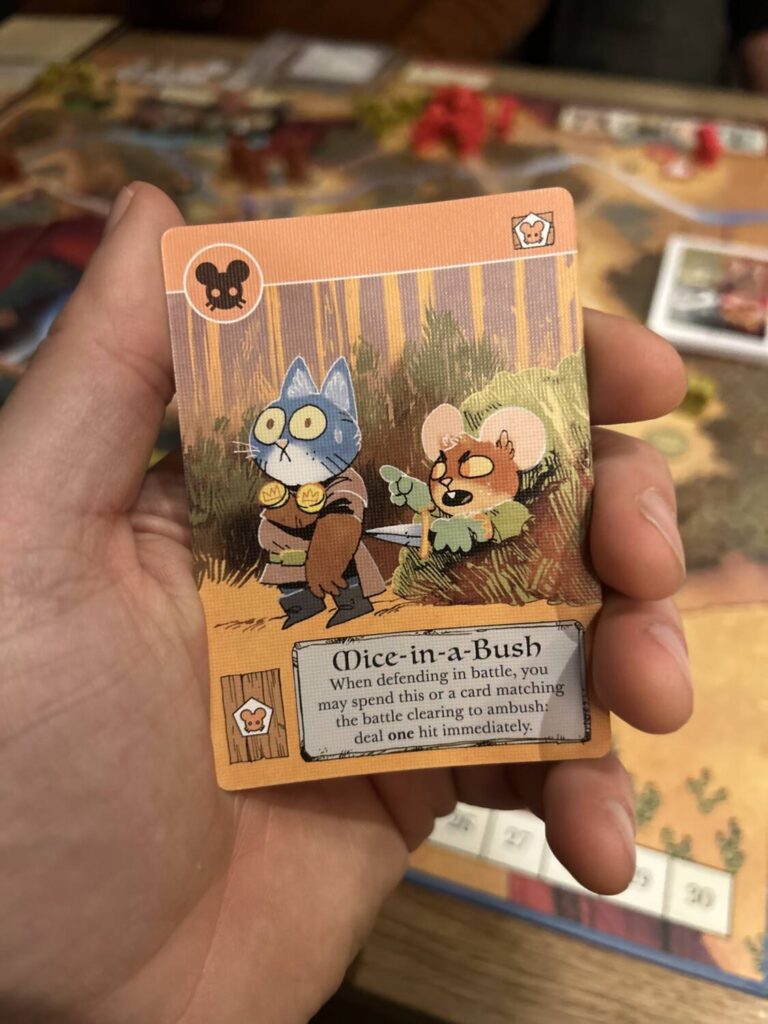
That’s the best thing about The Homeland Expansion: not only are all three factions fun in their own right, they are a blast to play against. They force players to break out of their comfortable patterns with older, familiar factions without turning the game upside down. Somehow, Joshua Yearsley found gaps in the space and filled them with joy. The Knaves of the Deepwood, three Vagabonds in a trench coat, take enemy Warriors hostage, so large armies have to rely on other tactics to dominate. The Twilight Council, those crazy bats, have the ability to more or less lock clearings down. They appear out of nowhere—they have wings, after all—and their Councils can make it impossible for other players to Build, Recruit, Spread Sympathy, and so on.
Even if the factions were middling, The Homeland Expansion would be a commendable addition to the Root canon for one simple reason: designer Joshua Yearsley has finally solved one of Root’s most contentious issues.
Talk to any seasoned Root player and they’ll have strong thoughts about player count. Not just optimal player count, but functional player count. While originally marketed as a game for 2-4—and even then really only a game for 3-4—the introduction of The Riverfolk Expansion meant Root could theoretically accommodate up to 6. It was marketed as such, with the rulebook providing all the necessary information to play with up to half a dozen players. In practice, results were mixed.
No matter the combination of factions, and no matter the map, the board was too small. It became impossible for anyone to do anything, and, what’s worse, the board would change so significantly between your turns that meaningful planning was impossible. If everyone locks in, a 4-player game of Root with experienced players can take a comfortable 80 minutes. At six players, no matter their level of experience, games quickly ballooned to north of 3 hours.
The new swamp map solves these issues. 6-player games are now functional, comfortable, and fun. I, a player who refused to play Root at more than four, might now prefer it at 6. It’s fun to chuck a bunch of factions in the blender and see what comes out. At last, you can indulge your curiosity without suffering for it. The secret was to add more clearings. Go figure.
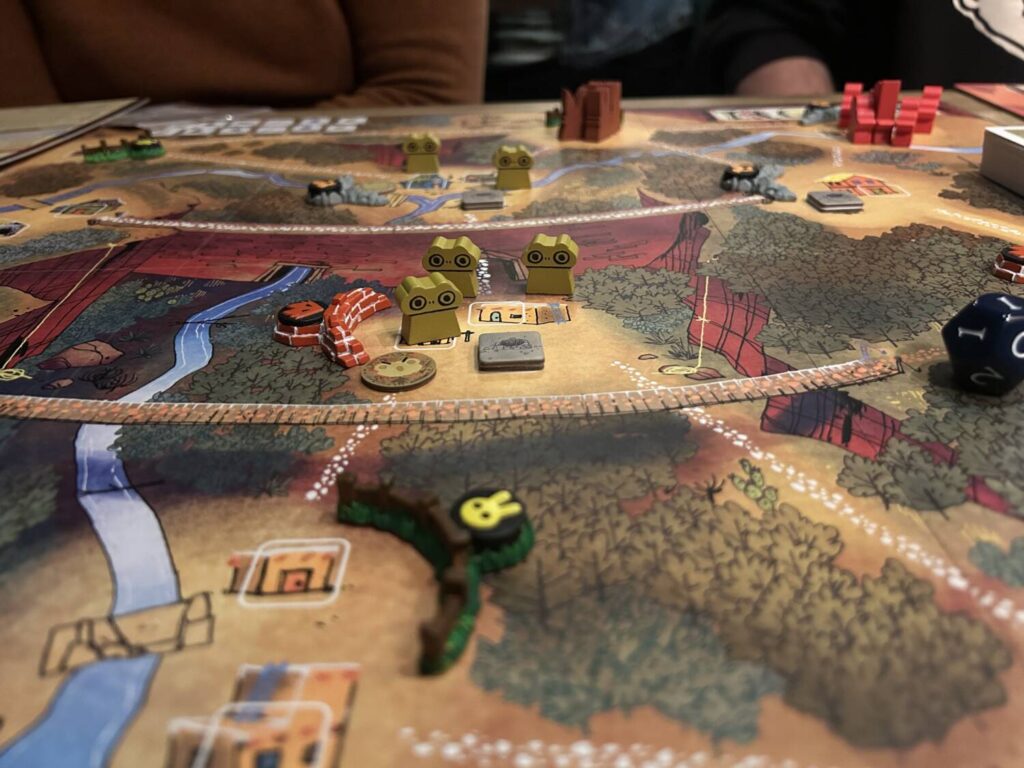
The other side of the board, the gorge map, shakes up Root’s typical cartographic logic. Created by S.W. Smith, best known as leading Root YouTuber Lord of the Board, the gorge map features unusual connections between clearings on opposite ends of the board. Because physical adjacency in the gorge doesn’t always correspond with connective adjacency, it requires players to pay a bit more attention. Experienced players seem to get tripped up more than newbies, but that makes sense. The newer players aren’t drawing on muscle memory to make assumptions. To me, the most exciting thing about the gorge is the pair of ensconced clearings in the middle. They present new tactical opportunities for one of Root’s most maligned big army factions, the Marquise de Cat. Cats benefit from turtling. Who knew?
I am fascinated by expansions to open systems, to designs where the mechanical boundaries are particularly porous. The sandbox for Root is so enormous that, like an open-ended writing prompt in English class, it makes the act of design more difficult. You have too much freedom and too little to guide you. Now imagine that the essay you’re writing also has to work cohesively with all the other essays you and others have written over the past six or seven years. Adding a new faction isn’t as simple as adding a new faction; you have to think about how that faction impacts everything that’s come before. The factions in Root form an ecosystem. The three new factions here have cleared out the weeds and the pests, allowing everything to bloom anew.
This is masterful stuff. The Homeland Expansion addresses issues I knew were there and issues I didn’t. It adds to the richness of the whole. This is the first expansion I would recommend to anyone looking to add to their roster, and it is a must-have for players who already have other expansions. What’s the point of having all those factions if you can’t play a viable six-player game, I ask you? This expansion is so good that it has brought back the feelings of joy and discovery that used to accompany every game of Root. How rare and fortunate a thing, to be able to get something like that back. It feels, dare I say it, like coming home.
Root: The Homeland Expansion details
- Designer: Joshua Yearsley, S.W. Smith
- Artists: Kyle Ferrin
- Publishers: Leder Games
- Release Date: 2026
- Player count : 2 - 6
- Age range : 10+
- Time range : 60 - 90 minutes
- Mechanism(s): Action Points, Action Queue, Action Retrieval, Area Majority / Influence, Area Movement, Dice Rolling, Hand Management, Multi-Use Cards, Negotiation, Point to Point Movement, Sudden Death Ending, Take That, Variable Player Powers
- BGG Geek Rating: 9.07202 - converted to Meeple Mountain scale: 4.5.
- More articles about Root: The Homeland Expansion.