
I’m tailor-made to enjoy “weeknight” 18xx-style economic route building games.
I heaped praise on the game Railways of the Lost Atlas in my 2024 review, with the (at the time) new publisher Asterisk Games doing yeoman’s work with a system some people think of as stodgy, tired, and certainly bland-looking. “ROTLA”, as it is known here at home, is one of the best-looking productions in my collection and comes with a heaping amount of variety thanks to its flexible player count, short and long-form play format, and a hex map that is literally built by the players each time the game hits the table.
If you haven’t heard of Railways of the Lost Atlas, please read my previous review. When the game’s first expansion, Landmarks of the Lost Atlas, was announced, I didn’t even reach out for a review copy…I ponied up the cash to get the expansion along with updated versions of the game’s base rules and a solo mode rulebook, developed after the release of the base game.
If you liked Railways of the Lost Atlas, you have already backed and are working through the goodies in Landmarks of the Lost Atlas. And if you have not tried either, my feelings haven’t changed: for anyone who loves a good Euro and wants to wade into the 18xx waters, the Lost Atlas system is a great way to start.
The Production
First, a note about the look and feel of Landmarks of the Lost Atlas. I’ll sum it up with the first things my buddy Rex said during one of our multiplayer review plays of the new stuff:
“This game is gorgeous. This might be the best-looking rulebook I have ever seen!”
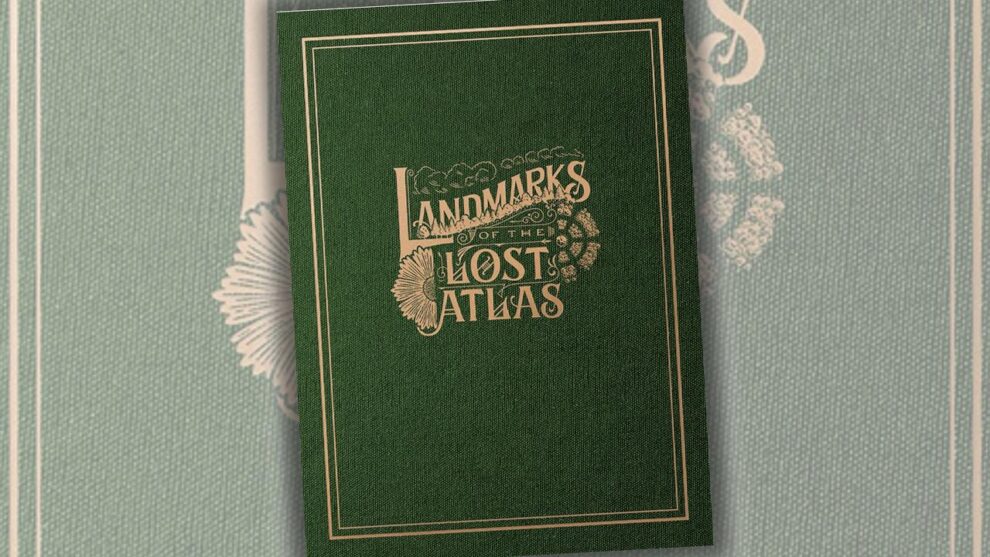
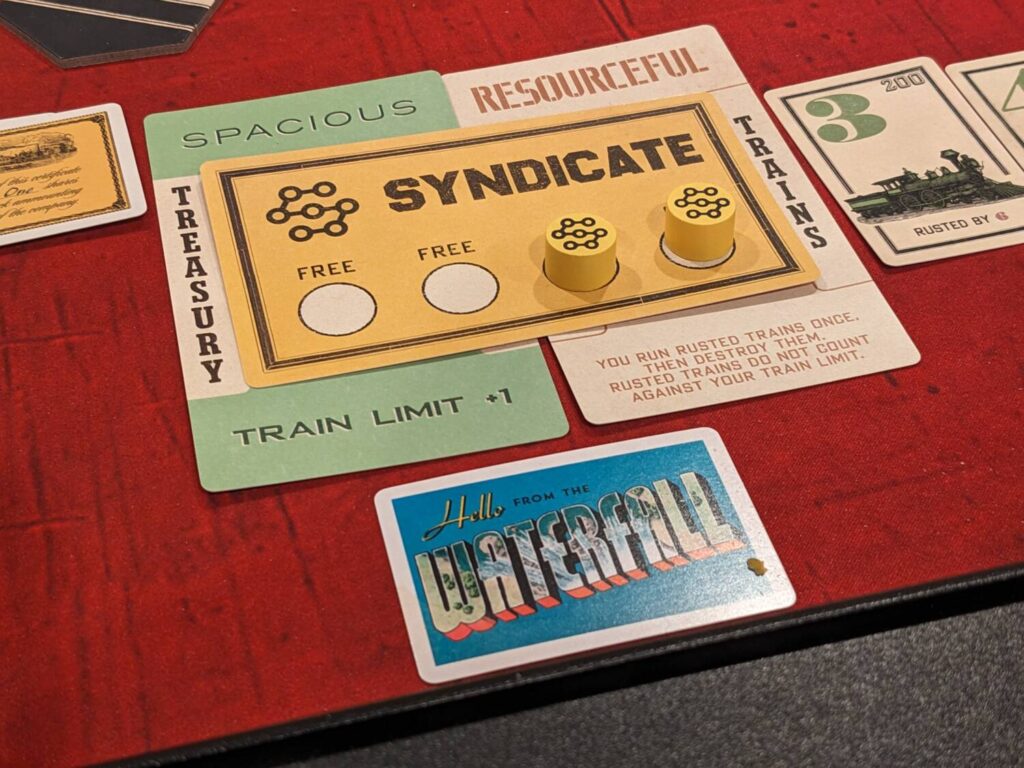
It’s clear that Asterisk went out of their way to ensure players took one look at this box and said “I must have you.” The bookshelf-style look of the packaging is a knockout. The rulebooks for the Lost Atlas games are the cleanest set of rules I’ve ever seen. I keep looking for the right term to call out their style, but I am still stuck on “a font type from the 1950s, with language just sparse and direct enough to tell you only exactly what you need to play.” There’s no fluff. The margins call out special exceptions, typically to address unique rules tied to the powers of each minor company. The rules are a pleasure to read.
That extends into the easy descriptions of everything you need to play. This is the rulebook I want people to see when they are frightened by what traditional 18xx rulebooks look like. The manual for 18RoyalGorge: The Rails of Fremont County and the Royal Gorge Wars was a step in the right direction, by incorporating plain English into how traditional 18xx systems (rust events, priority deal, operating rounds, etc.) work. But the Lost Atlas rulebooks are borderline inviting, which is weird to say about a train game rulebook.
The graphic design and limited illustrations (of things like trains on train cards, or sketch illustrations of trains on corporation share cards) land well too, and nothing beats the moment when someone places a corporation card across their two merged minor company tarot cards. It’s simple, it’s gorgeous, and always elicits a positive reaction. Many a publisher could take notes from the good looks of this game!!
New Minors
Now that I’ve done three plays of the new stuff in Landmarks of the Lost Atlas, I am really excited about the four new minors included here.
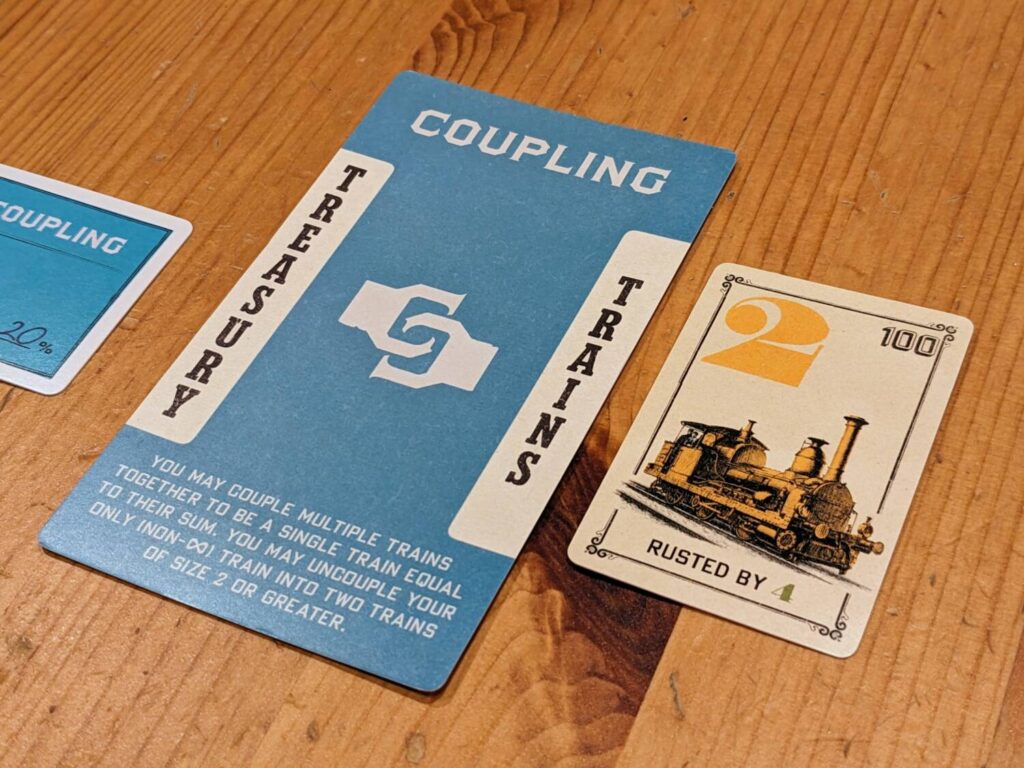
While I’m enjoying the ways the new minors change up gameplay—Twin Cities, Coupling, Circus, and Manufacturing—I’m particularly fond of Circus. Circus gets to double the revenue from a single stop, by counting it as two stops on a train’s route. (So, a 3 train could be used to hit two unique locations, but double the value of one of those locations.)
In one of our games, Circus had a hub next to an offboard location, and in the green and purple phases, that paid out handsomely. With a 3 or a 4 train, that turned into a payday for the Circus owner, and that continues to be juicy later in a game where Circus is merged into a major corporation and its powers remain intact.
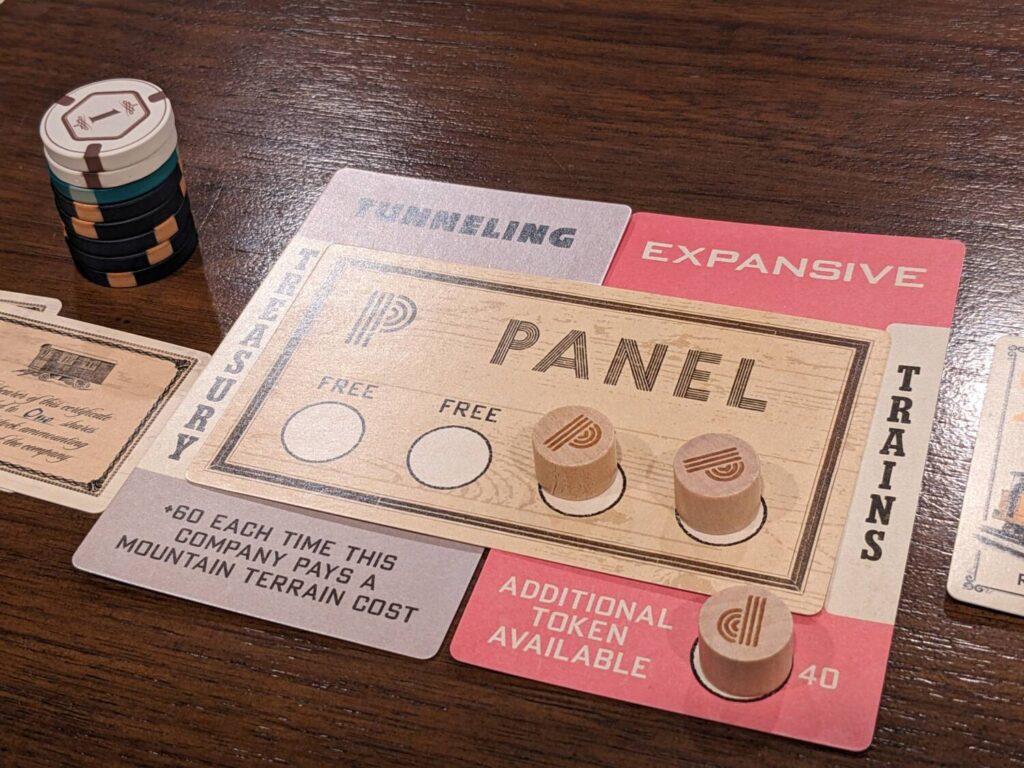
The Manufacturing minor automatically becomes valuable in the early game because it comes with a permanent two train, although that train counts as one of its owner’s train slots. Coupling feels like a train for advanced-level players, and I haven’t yet been able to take advantage of its powers in a meaningful way (I have only had Coupling in a single game, however). Twin Cities looks fantastic, and even if it never merges, Twin Cities gets two home tokens. Twin Cities is exactly the kind of minor that feels right for this expansion.
Events
Although regular readers know how much I hate event cards in most games, I was surprised to find that I enjoyed the events on display here.
In Landmarks of the Lost Atlas, one event card is flipped at the start of each cycle and its rules preside over an entire cycle. Many events here are simple to integrate and are not game-breaking. We had one, “CEOs Get Rich!”, where a company/corp president can withdraw $20 (the game doesn’t use the dollar sign, but I do) from that company’s treasury to pocket it for personal wealth. That $40—across two ORs—can be huge when it comes to buying one additional share in the next stock round, but everyone can do it, so it is a nice advantage if you have taken care to manage the treasuries of your companies/corporations.
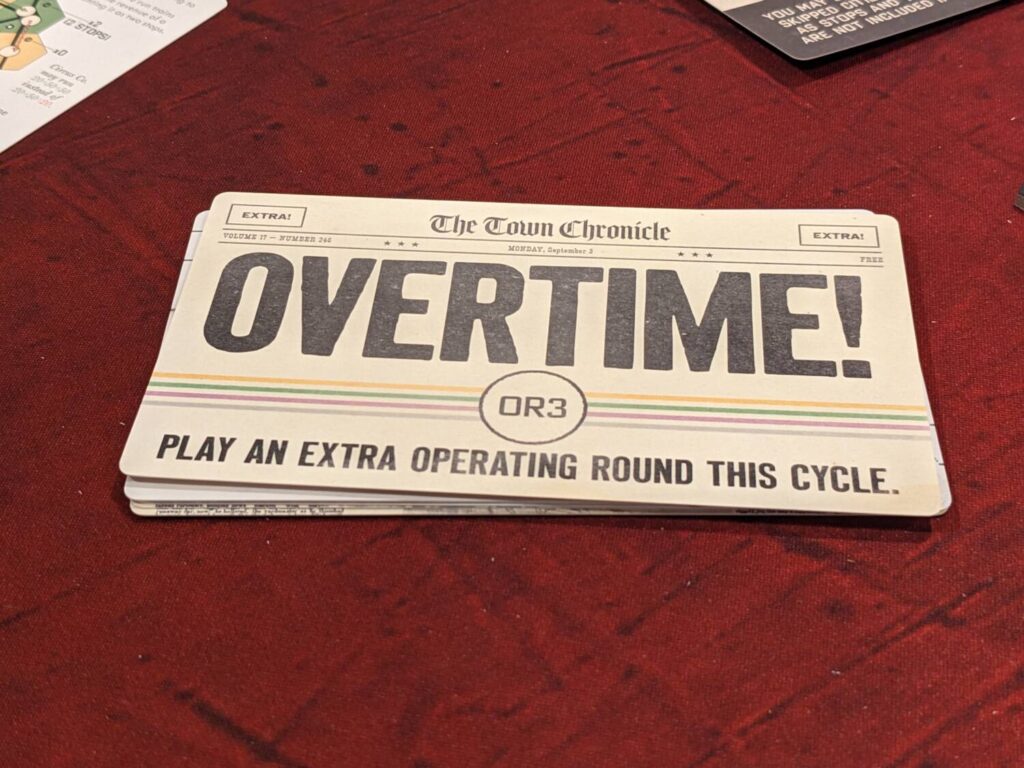
“Overtime!”, though, felt like a miss. We drew that in the fifth cycle of a “long” game format, which made a relatively long three-player game boost into a third hour of play. That’s because Overtime! requires players to do a third OR in a game that happened to already have two long ORs and a merger round.
Incorporating these events was pretty easy, and I’m really happy none of them fall into the “for players who happen to meet a strange qualifying criteria, you get $100 for free” category. We happened to get the “Train Auction Today” event, which immediately sets off an auction for the right to double the value of the highest stop on a company/corp’s run of one train. It came up late in our game, but the juice of this event is mitigated by the fact that someone has to bid for the right to get it.
Special events, balanced by players having to pay for it? All good.
Landmarks
The landmarks in the title of this expansion are the reason to drop the cash.
14 different landmark tiles—ranging from 1-7 hexes in total landmass—come with this expansion, and some of these puppies are juicy. A max of three landmarks are added to any single game, so it would take players quite a while to see all the possible combinations.
Some landmarks are very simple to integrate, such as Wildflower Valley, which just adds $20 to a route run as long as Wildflower Valley is included. Cave is another easy one that simply adds the value printed on that landmark if players include it as the start or end of a train’s route.
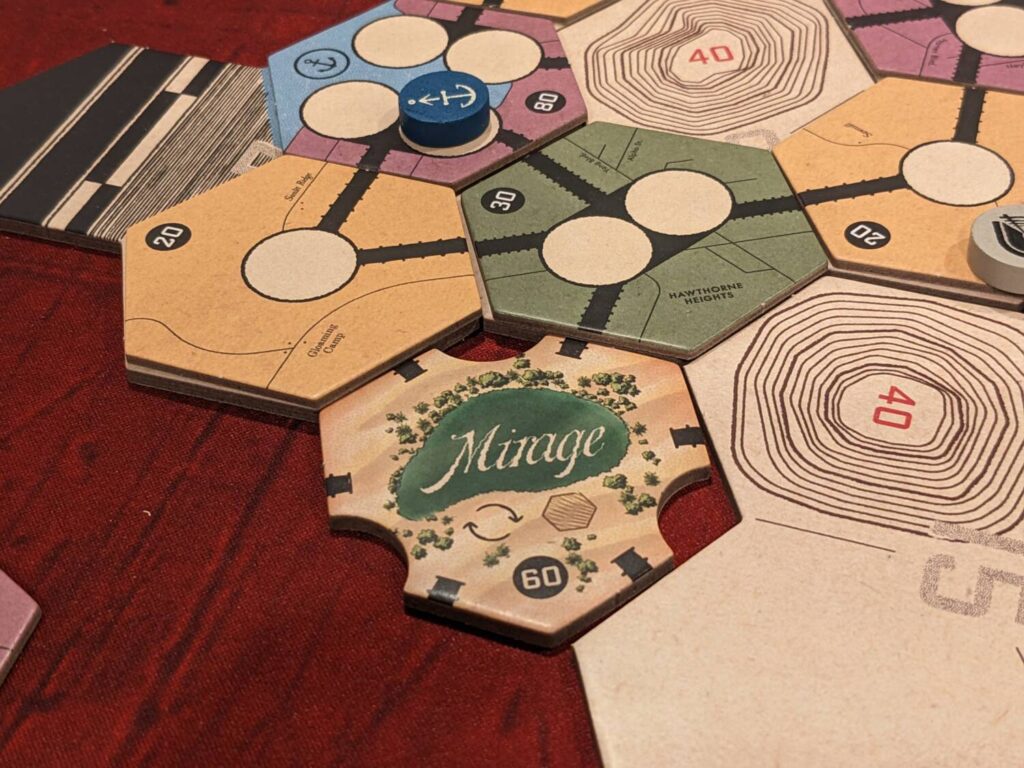
Mirage is my favorite of the landmarks I have tried so far, because of its movement mechanic. Mirage comes with three single tiles (a Mirage and two Desert tiles) that are added to various edges of the constructed map during setup. When a player includes the Mirage tile in their run, they get a $60 bonus…then, the tile teleports to, then takes the place of, a Desert tile, based on the type of train used to reach the Mirage.
In our play with Mirage, one player happened to have two companies in range of the Mirage and the odd-numbered Desert location. They hammered the Mirage with a 3 train to massive effect. I love Mirage…and I hate that one player was able to take advantage of the privilege! That also means Landmarks of the Lost Atlas gives experienced players even more reason to take things like this into consideration during the map setup and when bidding for minors.
The landmarks I have not tried yet have me super excited. Void is essentially a space-age warp tile that allows a president to run their trains into the Void tile and out of any unblocked city location. Cliff lets you trade in a train run into its location for what feels like insurance money, paying half a train’s value into that company’s treasury in exchange for losing the train…helpful, if I want to dump my 3 train to add that to my treasury to afford a 4 train, rusting everyone else’s 2 trains.
Rock Formation was a blast, too…easy to incorporate, and a two-bump share price increase is always going to be attractive, even if a company/corp can only earn that bonus once per game.
And That’s Not All!
Landmarks of the Lost Atlas delivers on the only thing I needed it to do: giving me more reasons to whip out the base game and dive into the goodie box. Playtime remains consistently in the 2-3 hour range, making the Lost Atlas titles something that I can comfortably table with friends on a weeknight. Plus, any reason to bust out the poker chips is a reason I will take when it comes to a train game.
The only major addition I haven’t tried yet might be the most promising: The Metropolitan Transit Department, which adds a neutral corporation that players can use to help or hurt other players. Other 18xx games have used this idea before, but I’m curious to see how it lands in Landmarks of the Lost Atlas. When I get a more experienced group around me to try this out, I’m excited to see what the MTD adds to the gameplay.
Other concepts, like “Direct-to-Major” corporations and increased options with Distant Destinations (the offboard locations in Railways of the Lost Atlas), are available here as well. And now that solo play is integrated into the Lost Atlas system, there’s always someone available to play the games with me…although I am the first to admit that I prefer 18xx games with higher player counts, so going against a bot is a little less interesting.
It’s not clear if Landmarks of the Lost Atlas is the final piece of the Lost Atlas puzzle. If it is, the design team at Asterisk, Kevin Delger and Jacob Schacht, has done exceptional work with their first two releases, and my sense is that these guys are just getting started with other designs. Add Asterisk to your watch list!