
Disclosure: Meeple Mountain received a free copy of this product in exchange for an honest, unbiased review. This review is not intended to be an endorsement.
From the rulebook: “Shadera is no ordinary world. A great cataclysm has shattered the world of the fairy creatures. Where once there were no borders, an impenetrable veil now divides the home of the gnomes, wolper-squirrels and mermaids into many different Shard Worlds. In order to be able to continue to exchange raw materials, make trade agreements, and visit old friends, the Portal Guild was created — an association of all those magicians who can use their magic to open portals between the worlds.
You are part of this guild: adepts who, after long and thorough training, have come together today to prove their skills. Your master has decided that you will compete against each other in a duel to show that you can gather enough energy to open portals through the veil to the Shard Worlds. The first person to complete 20 tasks will be awarded Shadera’s highest honor, the title of Portal Guard.”
If, having just read all that, you’re crossing your eyes trying to make sense of it, you’re not alone. The story is nonsensical. Somehow, though, it seems appropriate because Portals is a game that defies easy explanation, especially if you try to attach a story to it.
How It Works
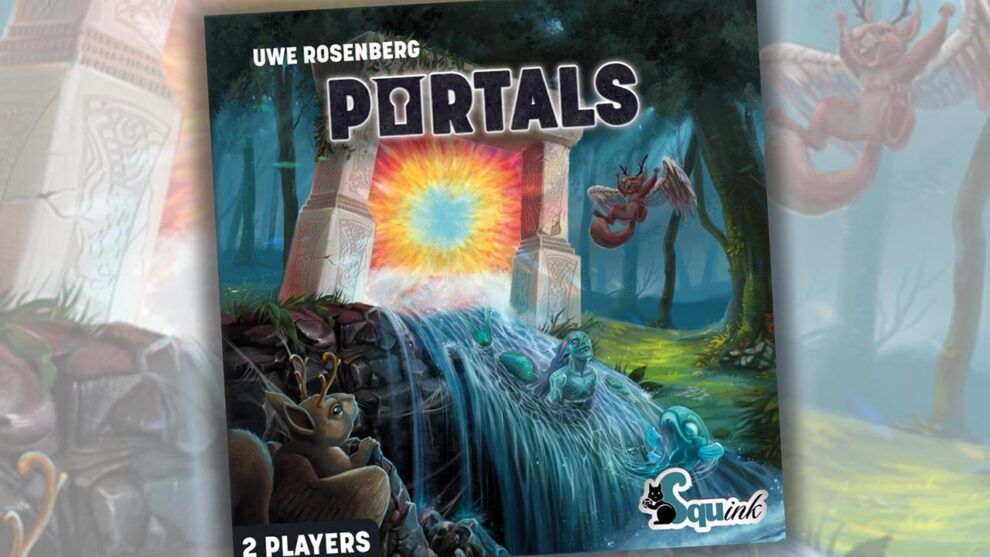
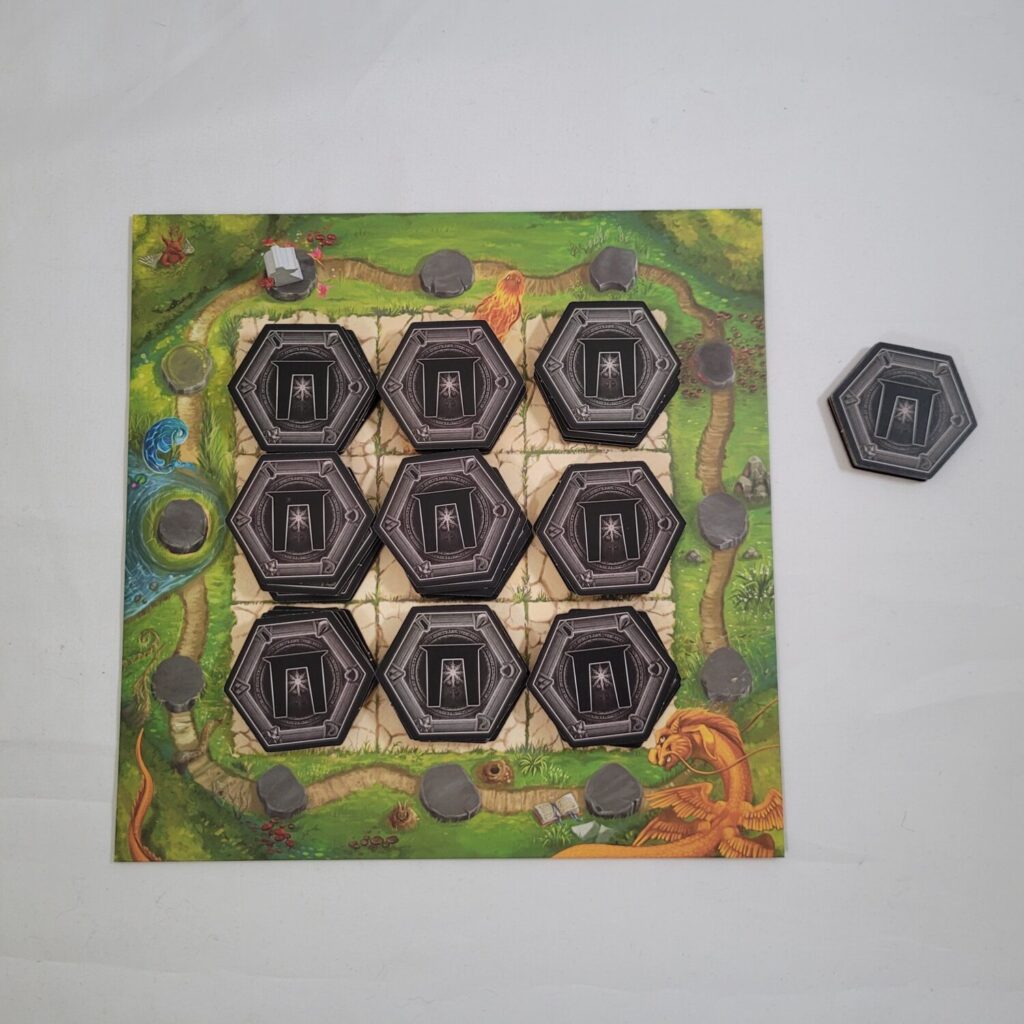
Published in 2024, Uwe Rosenberg’s Portals puts the players in the roles of Portal Guild adepts as they try to open portals to other worlds. At its heart, Portals is a two-player tile-drafting and tableau building game. In between the players is a board divided into a 3×3 grid. Each square in the grid is populated with a number of face down Portal tiles. Along the edge of the grid are a series of circles connected together to form a path around the edge of the board. The Master figurine begins the game on the topmost left of these and will move clockwise around the board as the game progresses.
When the Master moves, all of the tiles in its column or row will be turned to their face up side (if they aren’t already), and the active player will choose one of these to take and play into their tableau. Each tile features a Shard World symbol at its center, surrounded by one or two colored fields. The colors of the Shard World symbols correspond to the colors of the fields (green, orange, purple, yellow, or blue), but no Shard World symbol will be in the center of fields matching its own color. For instance, there will never be a Portal tile containing a purple Shard World symbol AND a purple field.
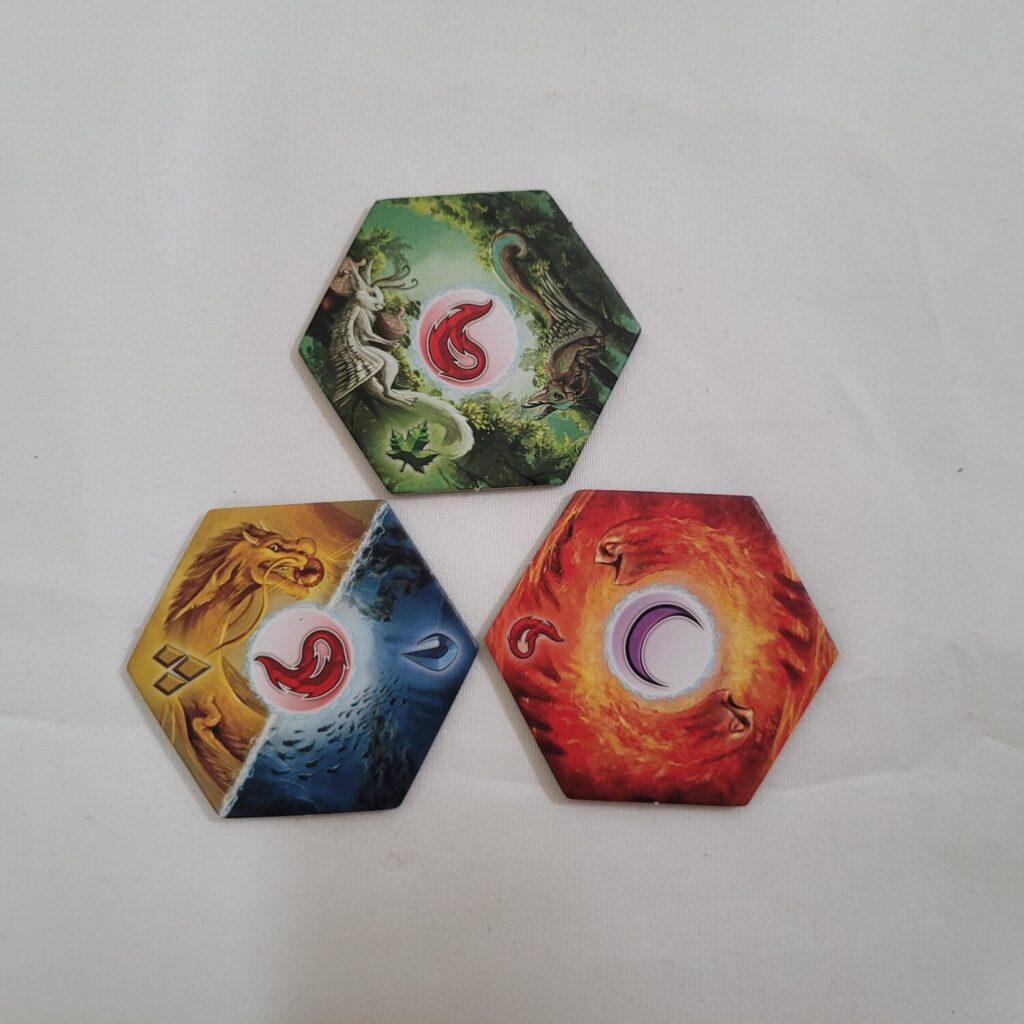
When a player places a Portal tile into their tableau, they are attempting to connect their Shard World symbols to an area of at least four fields of a matching color. An area is defined as a collection of Portal tiles where the same color field is touching. If you have managed to create an area of at least four fields, and one of these fields abuts a Portal tile with a matching colored Shard World symbol in its center, then you have successfully opened a portal to that Shard World, and you place one of your Portal Stones (of which you will have twenty, redolent of the stones used in Fairy Trails) on top of the Shard Symbol to signify this. Placing out all of your stones is one way for you to win the game. The game can also end if the Master figurine is ever looking down an empty row or column after its movement. In this case, the person who has gotten rid of the most Portal Stones wins.
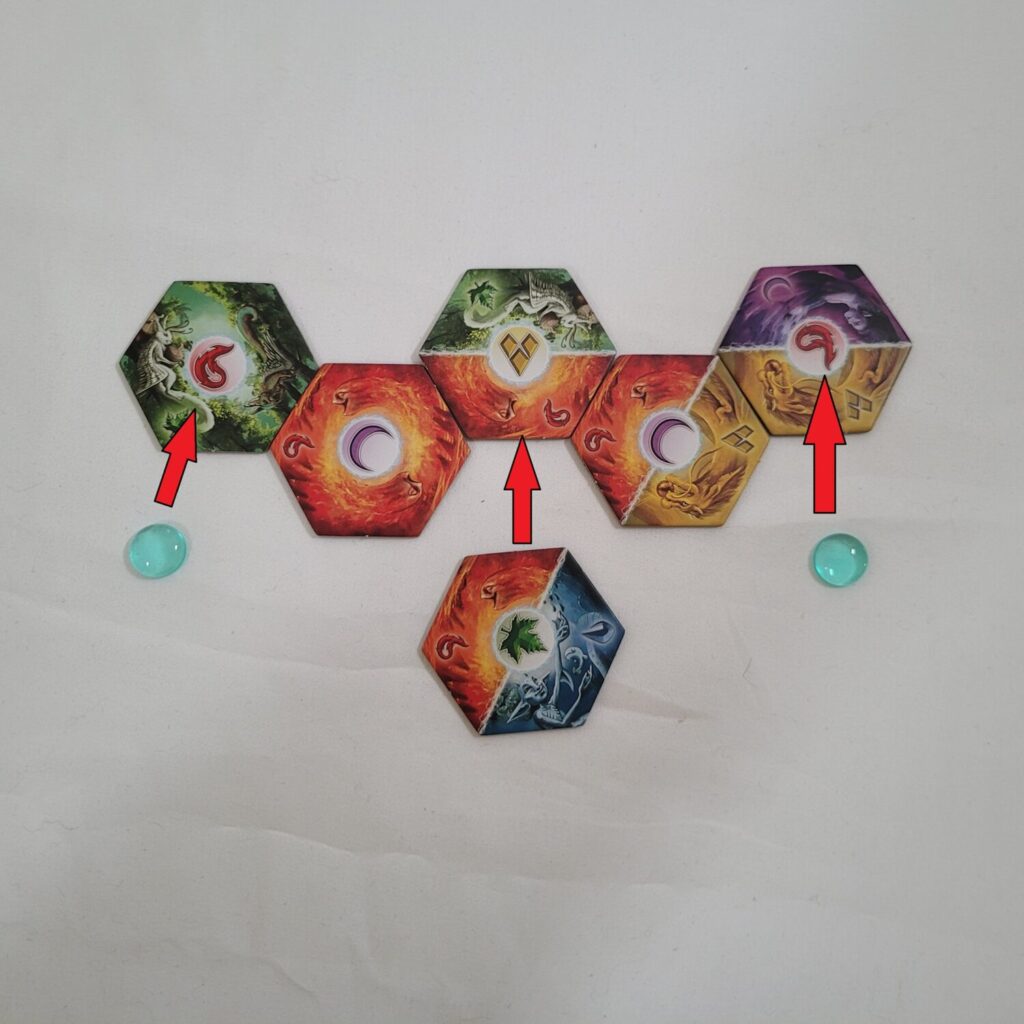
There is one additional method of getting rid of your Portal Stones: casting spells. After you have drafted your tile for the round and placed it into your tableau, you will check your Spellbook (a.k.a. your player board) to see if you are able to cast one of the five spells found there. Each spell corresponds to one of the colors. In order to cast it, you must have either created an area of six fields of matching color (six fire fields would allow you to cast the Fireball spell—the red spell, for instance) OR have created a closed area of at least three fields of matching color (that is, the area is encircled by areas of other colors).
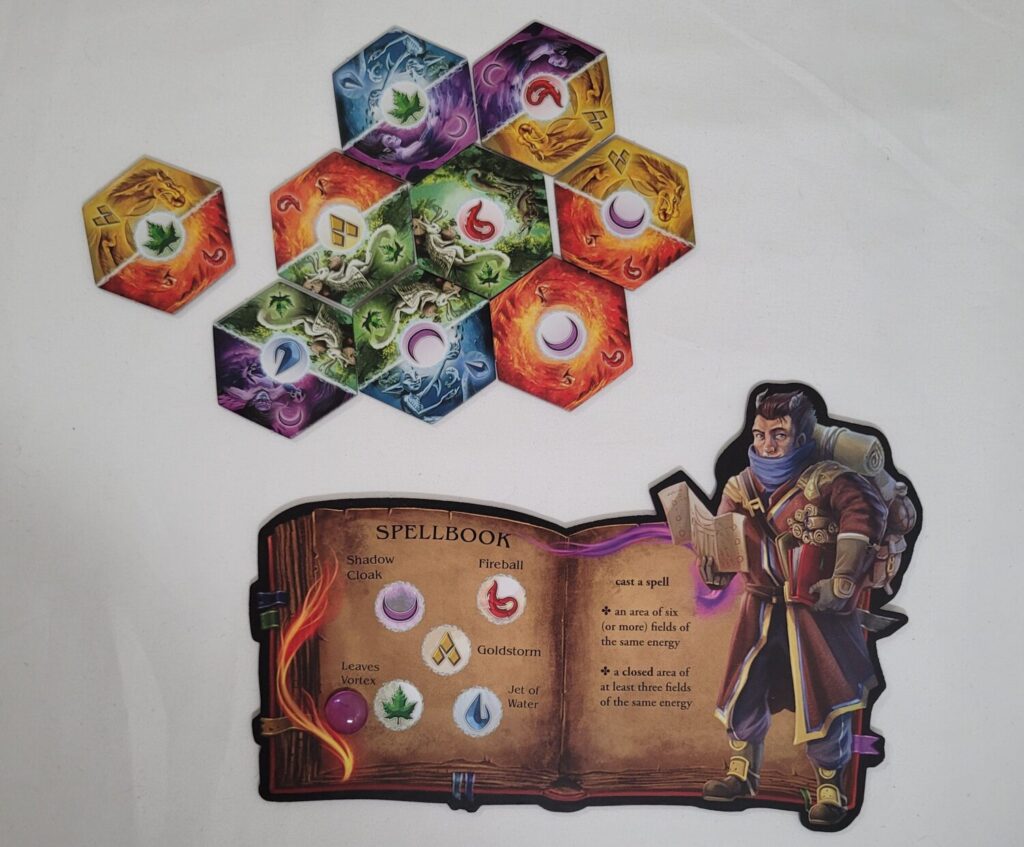
If a spell is cast, then you may place one of your Portal Stones on top of it. Each spell can only be cast once per game. So, if you’re able to cast all five of them, then you’ll have to open at least fifteen portals in order to have a chance at winning.
Thoughts
I’ll get straight to the point: Portals is one of the most confounding Uwe Rosenberg games I have ever played. It isn’t because the rule book is bad. It’s not. It’s fine. It isn’t because the story is weird. It’s also fine. It comes down to the gameplay and how you’re forced to rewire the way your brain works in order to play it.
When placing one of the Portal tiles into your tableau, your natural instinct is to match up the colors of the fields on the tile with the tiles that are directly adjacent to it. However, that’s not how things work in this game, at least not entirely. Your main focus should be on the icons at the middle of each tile in your tableau. It doesn’t matter that the tile you’re looking at has a solid green field and that you’re holding a green field in your hand because the Shard World symbol in the middle of that tile you’re looking at is not green. If that Shard World symbol is yellow, for instance, then you’re going to want to connect tiles with yellow fields to it, if possible. So, that green tile you’re holding is completely useless when it comes to activating that yellow portal. The tile in your hand is a tile you DO NOT want to connect to the tile on the table.
Yet, at the same time, you DO want to connect the tile in your hand to it, specifically because it IS green. That is because creating areas of color is just as important as connecting those areas to tiles containing the right color of Shard World symbol. It creates a weird puzzle wherein you simultaneously loathe, but also love, every tile that’s available for drafting.
This is the kind of thing at which Uwe Rosenberg excels, taking a seemingly simple principle, and turning it into something wickedly complex. The decisions you have to make in Portals are freaking hard, but the rules governing those decisions can be taught in mere seconds.
I really like this game. But, in a world where a game like Patchwork exists (by the same designer) that asks you to perform similar feats without feeling like your brain is melting, it’s a tough sell to get to the table. Patchwork feels elegant and streamlined. Portals, on the other hand, feels insane and chaotic like the end of a Beatles tune. It’s a great game, brilliant in its conception, but I can’t see it hitting my table very often. It’s like durian fruit, delicious but malodorous, making you question whether the end product is worth all the trouble of getting there.