
Disclosure: Meeple Mountain received a free copy of this product in exchange for an honest, unbiased review. This review is not intended to be an endorsement.

My man Andy Matthews wrote a review of the Mountain Goats base game a few months ago. After trying the base game on Board Game Arena, I mostly agree with his summary. Mountain Goats is a very simple dice chucker with just enough strategy to warrant your attention when it is your turn. You roll four dice, then use the pips on each six-sided die to move goats in your player color up one of six different mountain tracks to score points. Only one player can have a goat at the top of a mountain; when another player’s goat arrives, your goat moves to the bottom of that hill, and it might take a couple turns to crest again later.
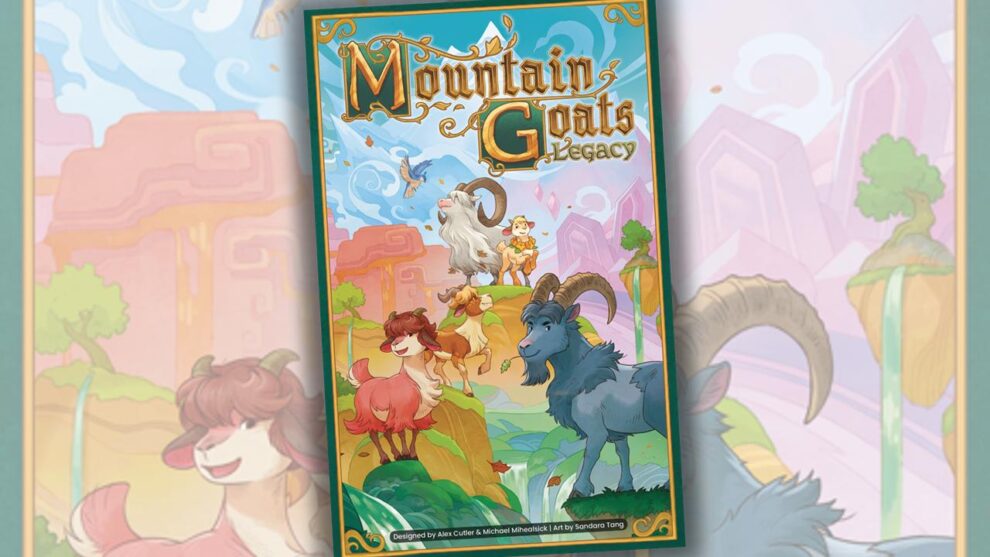
The base game takes about 20 minutes to play. Mountain Goats: Legacy is the new version of the game, and it has ten chapters, a very family-friendly Storybook that is used to provide just enough flavor text to get players from one chapter to the next, a couple of main characters to follow through a story, and almost the exact same gameplay experience offered by the base game.
And, that’s the problem.

For this review, I completed six of the ten chapters; five with my nine-year-old son, and one with the two of us plus my wife. That’s right: my wife saw just the first chapter of this game and immediately hit the eject button.
“How’s that Mountain Goats business going?” she would snicker, each time she saw my son setting up the legacy game for another play.
She was right to jump off the bandwagon created by our son. That’s not because Mountain Goats is a bad game; in fact, I highly recommend this game if you have a couple of younger kids (younger than my nine-year-old) and need a way to keep those kids engaged during a series of short play experiences anchored around a very, very simple premise.
My issue with Mountain Goats: Legacy is the severe lack of evolution across the game’s journey. I wish designers Alex Cutler & Michael Mihealsick pushed more interesting elements of progression into this legacy game.

My Mountain Goats: Legacy experience reminded me of the initial issues I had with the first season of the now-classic AMC TV series Breaking Bad. No, not because I wanted to see more meth labs in this game…my issue was the show’s slow start.
Breaking Bad’s first 4-5 episodes were pretty “samey” and didn’t get the hooks in me at all. I actually bailed on Breaking Bad halfway through season one until friends convinced me that season two of Breaking Bad really amps things up a bit…and the final three seasons are some of the best seasons a show has ever had.
The first chapter of Mountain Goats: Legacy is basically the base game. Totally get that. The one change here: the four dice have a goat face in place of the one-pip die value, and that goat die face now plays the role of three potential faces: a one (and that’s true even in later chapters), a two, or a three. The two and the three are represented by cards pulled from the first deck of legacy cards, and it becomes clear immediately that the goat die face is a big opportunity for fun changes to the gameplay. This is probably the only element of the game that was truly interesting: which cards will we use in later chapters to represent the die’s goat face? The designers came up with some fun bits to keep that creative.
So, the goat face is an upgrade. But the rest of Mountain Goats: Legacy is never really that thrilling. In the next couple of chapters, new tiles are used to entice players to visit—or avoid—certain mountains with small bonuses. The player who wins a chapter gets to pick from two different scenarios for the next chapter, with rules updates so minor that you’ll wonder why the game is taking so much time to drip new goodies out of the box.

By the end of the sixth chapter, almost nothing really mindblowing happened. I’ve opened other boxes of content, I’ve punched a couple more tiles, and we’ve added the ability to mitigate die rolls a bit differently with a resource unique to this legacy version of the game. But absolutely no “wow” moments have hit across six chapters!!
“Justin, why do you keep playing a game that you clearly think is so average?”
Great question. Here’s the simple answer: I love playing games with my kids. I love spending time at the table laughing with my son about other life things we have going on while rolling the dice and moving the goat on the 5 mountain up three times. We have named a couple of the goats. We keep wondering what’s going to happen with the goat characters in the Storybook. One of the four boxes of cards hasn’t been opened yet, and we are both wondering what’s inside.
Mountain Goats: Legacy isn’t a great game, but it is a great way to get kids to play a game. I would never, never in a million years, play Mountain Goats: Legacy with other adults, certainly none of the hobby players in my networks. I’m not sure I would even play this game with my “muggle” adult friends.
But as a family title? Give Mountain Goats: Legacy a look. Like other Allplay products, it’s a handsome production with a very well-written rulebook and a playtime that never reached even 20 minutes across my plays with my son. The price point is very fair, too.
I was just hoping for more big surprises here. Those surprises have not arrived. My son wants to finish the campaign, to see the story through to the end. I’m not excited about that possibility. But I’m excited to share a moment with the boy when—if—we reach the mountaintop.
Mountain Goats: Legacy details
- Designer: Alex Cutler, Michael Mihealsick, Stefan Risthaus
- Artists: Sandara Tang
- Publishers: Allplay, OSTIA Spiele
- Release Date: 2026
- Player count : 2 - 5
- Age range : 7+
- Time range : 20 - 45 minutes
- Mechanism(s): Dice Rolling, King of the Hill, Legacy Game, Race, Roll / Spin and Move, Set Collection, Track Movement
- BGG Geek Rating: 7.79903 - converted to Meeple Mountain scale: 4.0.
- More articles about Mountain Goats: Legacy.