
Disclosure: Meeple Mountain received a free copy of this product in exchange for an honest, unbiased review. This review is not intended to be an endorsement.
Disclosure: Meeple Mountain was provided a pre-production copy of the game. It is this copy of the game that this review is based upon. As such, this review is not necessarily representative of the final product. All photographs, components, and rules described herein are subject to change.
I was first introduced to the design sensibilities of Pete McPherson after playing Tiny Towns, a pattern-matching game about building structures for woodland creatures. Because I enjoyed Tiny Towns so much I also reviewed his game Wormholes (a route building and resource collection game set in outer space), and Fit to Print (a realtime tile laying game in which you’re building the front page of a small town newspaper). We’ve also interviewed Pete twice (Feb 2019 and Jan 2022).
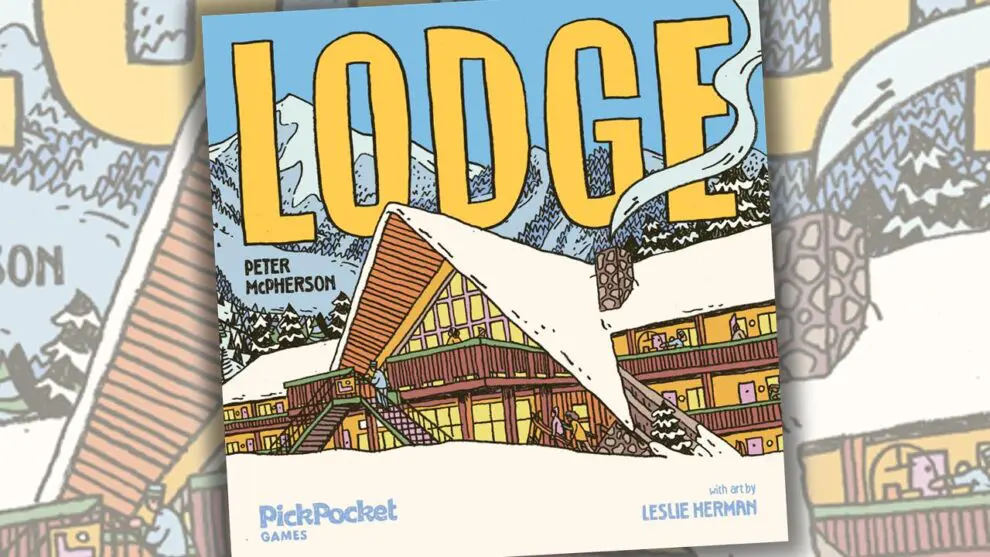
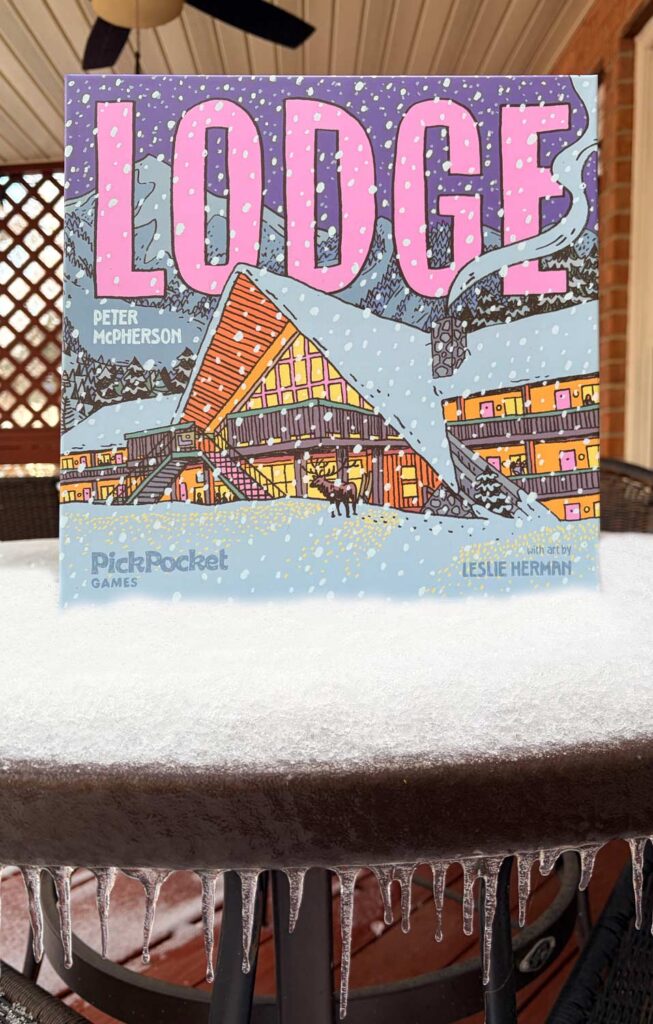
So when Pickpocket Games told me about an upcoming Pete McPherson title called Lodge, I reached out and requested a review copy without any knowledge of the game other than the cover (which is gorgeous). And now that I’ve played it several times, I realize that it fits right into Pete’s catalog like it was born there.
Take a walk in the snow with me to the front door of Lodge.
“With luck, it might even snow for us.”
In Lodge, players run competing ski lodges, set high in the mountains. Over the course of the game, players add rooms and amenities to their lodges, then entice guests to stay in those rooms. Ah, but the guests are picky, and as guests do, have their own preferences. And let’s be honest, the type of guests who can afford to stay at a lodge high in the mountains generally get what they want, no?
Each guest token has 2 pieces of information critical to their placement: a pair of colored icons and a number. The icons come in 5 different shapes/colors and dictate what room color they must stay in. The number on the other hand is their floor preference, and is not required.
Placing Room & Amenity Tiles
Back to the rooms for a moment. You select room tiles from a central 4×4 display, and on your turn you can either select a room tile from that display, or from a face-up set of 4 amenity tiles (more on that in a bit). When selecting a room tile, you must follow these requirements.
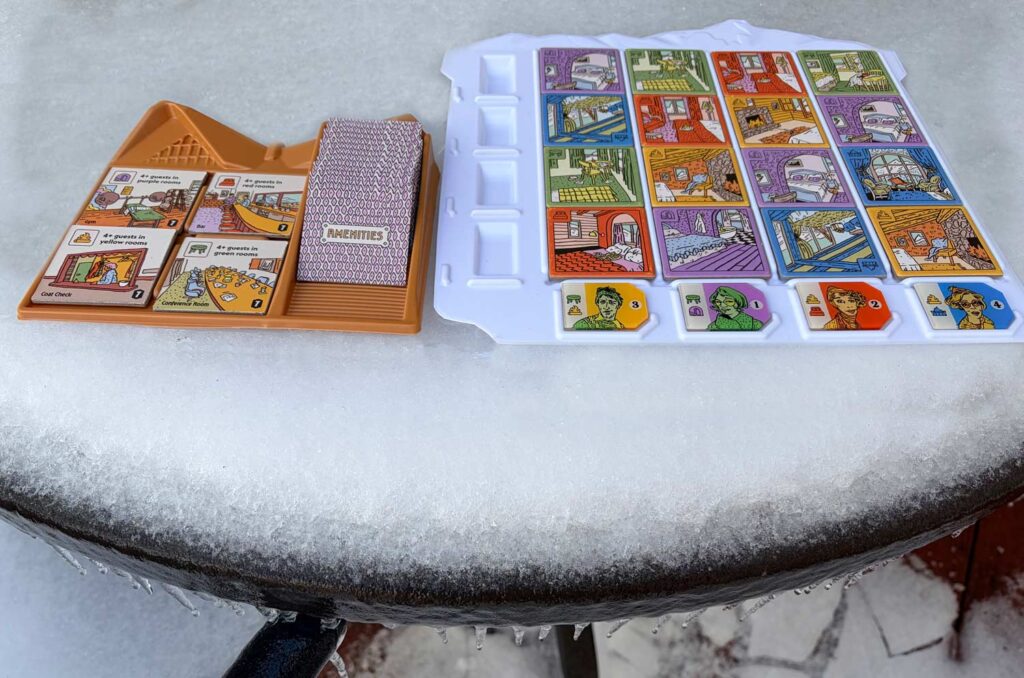
A room tile must be placed into your lodge at the same level it occupied in the display. That means a tile pulled from level 2, must be placed in level 2 in your lodge.
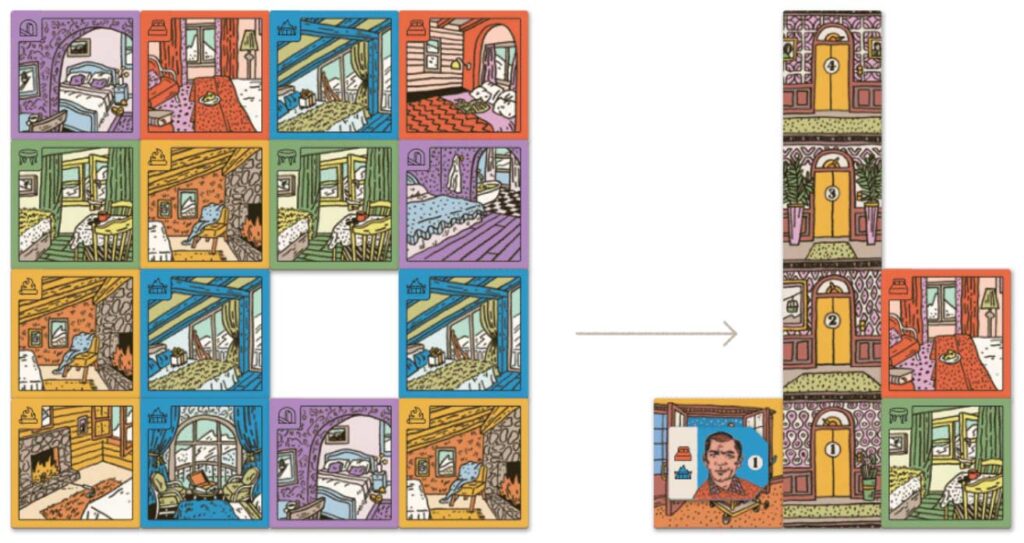 A room or amenity tile placed on the 2nd, 3rd, or 4th floor must be supported by a tile below it.
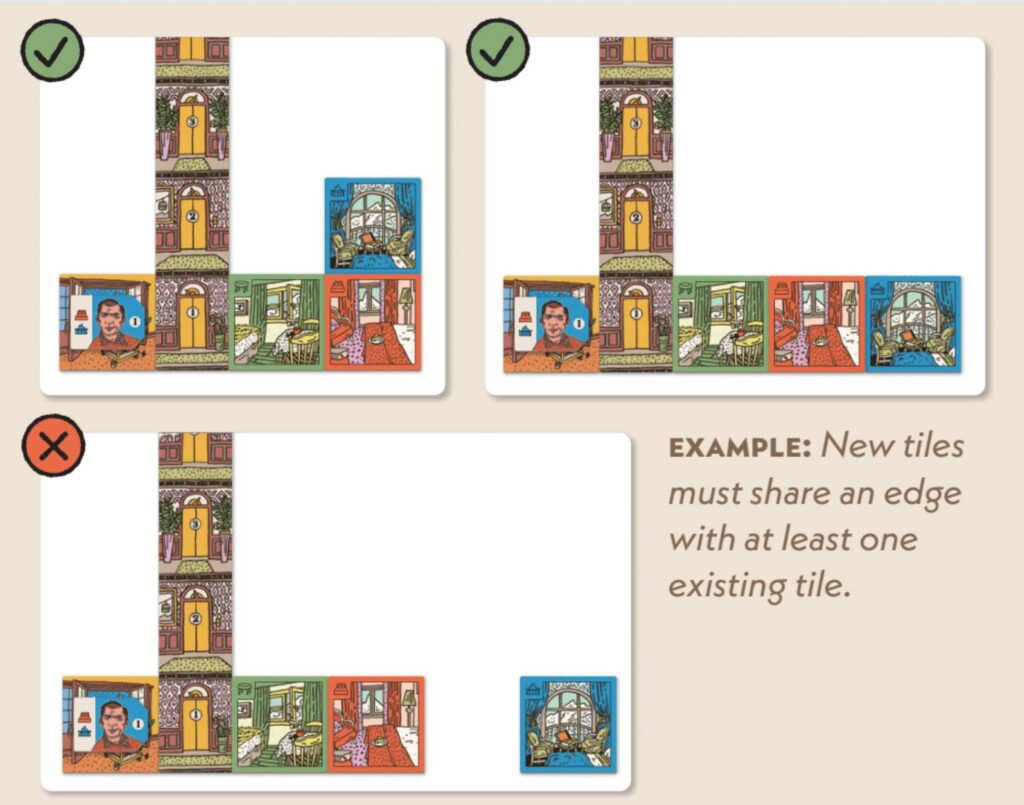
A tile must share an edge with at least one tile.
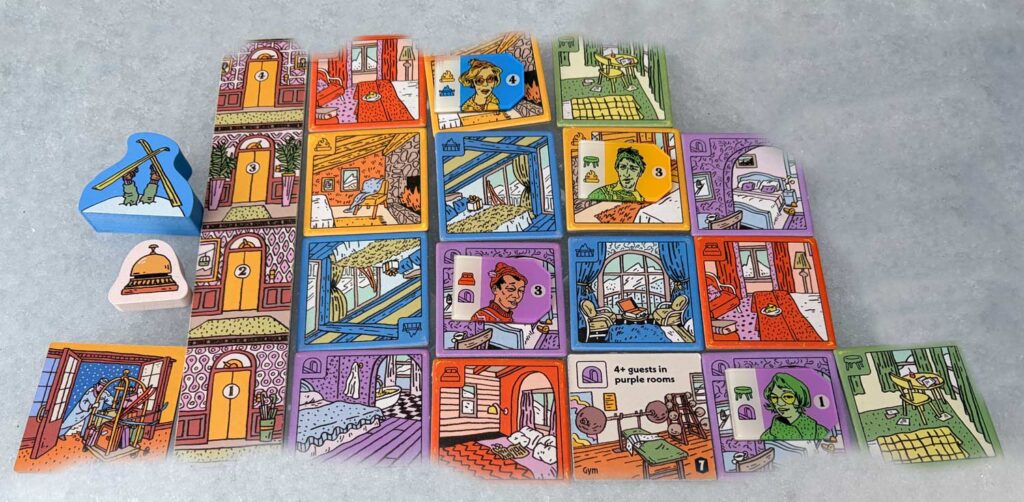
Room tiles do not directly score you points, but amenity tiles do. Each of the 21 amenity tiles confer some end game scoring condition: 4+ guests in blue rooms, 3 green rooms in this column, 5 different colored rooms around this tile, etc. Amenity tiles do not have a floor requirement like room tiles do, but the other placement requirements are the same.
Placing a Guest
Okay, back to guest tokens. After placing a room or amenity tile, players can place guests into rooms. Players start the game with a reserved guest and can place that guest, one of the 4 publicly available guests, or both. When placing a guest, keep these things in mind:
- You must have one unoccupied and adjacent room of each color shown on the guest token. If your token shows red and blue icons, then you must have an empty red and blue room right next to each other (not diagonally).
- You may place a guest on a floor which matches the number on the tile. Every placed guest will earn you two points. But if their floor number matches their preference, you’ll also earn additional points matching that number (this is called a “room bonus”). If you place a guest with a 1 on the 1st floor you’ll earn 1 point, while a guest with a 4, placed on the 4th floor will earn you an additional 4 points.
During our plays we determined there were some optimal strategies for placing guests. Try to arrange your rooms such that you can place guests starting from the bottom left corner. This not only helps you achieve maximum room density (something every good hotelier is concerned with), but also ensures you don’t have a room that is ineligible for a guest because it’s trapped between guests.
Pro Tip: we discovered that there are exactly 5 guest tokens for each color combination. One token each for floors 1, 3, and 4, and two tokens for floor 2. Because guest tokens are public knowledge, you can look around at what other players have and determine the odds in getting the exact token you need.
Refreshing
Guest tokens and amenity tiles are refreshed after each one is taken, but the room display is not. As room tiles are claimed, the display will contain more and more open spots. Once one entire row of room tiles has been claimed, the display is tipped forward, allowing rooms to slide downwards to fill the empty spots. You then refill the open slots at the top from the bag of room tiles.
Pro Tip: pay attention to the room tile display. If there’s a tile you really want at the top, make sure you give yourself time to get it before the refresh. That yellow tile you want for the 3rd floor is worthless once it slides down to the 2nd level of the display.
Each player is given a refresh token at the beginning of the game. This allows them to completely remove a row from the room tile display, triggering a refresh. However, it can only be used once per game, so choose wisely.
The refresh aspect of the game can be really helpful, but you’re still at the whims of chance. Since the tiles are pulled randomly from the bag, even if you refresh the display, you might not get the tile you want.
In all our games, we also wished we could use the refresh token on the amenity tiles or guest tokens. Pete, please consider this as an addition to the use case for the refresh token.
Scoring
Scoring is simple. 2 points per guest. Add their room bonuses. Tally up the scores from the amenity tiles. Add them all together and whomever has the highest score wins. In our games, scores ranged from 50 to as high as 73, although the solo rules indicate that scores could go higher than 75.
“The first fall of snow is not only an event, it is a magical event.”
Before I talk more about the gameplay, I’d like to gush about the artwork. Illustrator Leslie Herman has done a masterful job of putting a unique face on Lodge. The cover, the room tiles, and especially the guests give this game a Wes Anderson feel (beautiful when viewed from a distance, but slightly manic and off-kilter up close). My game group and I had a fun time trying to compare guest’s faces with Hollywood celebrities (who we’re positive were the influences behind the characters). We found Andy Samberg, Bill Murray, Steve Buscemi, Ellen Barkin, and Andrew the Giant. Who do you see?
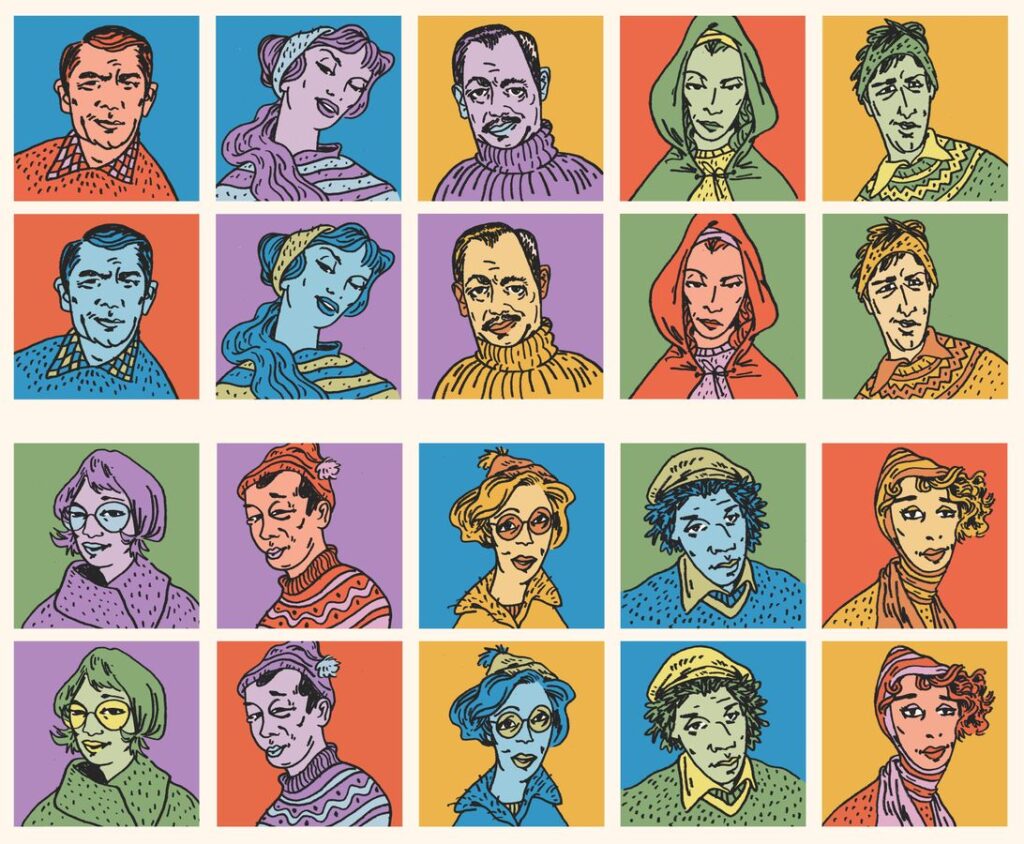
While the artwork is fantastic, we’re here for the gameplay right? Everyone who played Lodge enjoyed themselves and commented that they really appreciated the spatial puzzle it presented. It’s not just enough to place room tiles, they have to match the level they’re pulled from. You can’t just leap ahead and place a tile on the 4th floor, you must slowly work your way there by placing tiles on lower floors. Your lodge must have two adjacent rooms of the right color in order to place a guest. While I’ve played games that have these mechanisms before, Lodge combines them all to make something distinct. And while it might not feel “brand new”, it is interesting and enjoyable.
We did have a few stumbles that I wanted to mention. The room tiles are about 2 inches square, and the provided bag, while fairly large (and beautifully patterned), still felt just a bit too small to allow us to properly shuffle them around.
We lamented the fact that we couldn’t use our refresh token to clear out guest tokens and amenity tiles. In two different games, we had amenity tiles that simply couldn’t be picked because there weren’t enough colors of tiles, or we didn’t have time to finish them, etc. And the same with the guest tokens. If, at the beginning of the game there are four 3rd and 4th floor guests, there’s nothing you can do about it but wait. That makes the game take longer and adds a bit of frustration to what is otherwise a very pleasant experience.
And because the game tended to run a bit longer than the box indicates (most of our plays were over 75 minutes as opposed to 60), we all wished we had 2 refresh tokens instead of just one. in my last game, players were forced to pick suboptimal tiles because all of us had used our refresh tokens, and no one wanted to be the one to take a tile that cleared the display, giving the next player wide open choices.
But honestly, those are minor things that didn’t prevent us from really enjoying our plays of Lodge. As you read this review, in January of 2026, Lodge is already being crowdfunded, and you should really consider backing it.