

Frescoes, or watercolor paintings over plaster, date back to ancient Egypt, Rome, and Greece. Perhaps the best-known fresco is the ceiling of the Sistine Chapel in Rome. Micelangelo’s masterpiece is an example of Buno Fresco, or “True Fresco”, process. Before beginning work, the artist applies a rough plaster layer. Once in position (high above the ground, on his back) the painter would apply another, finer wet plaster layer. Then, working quickly before this new layer dried, he applied the pigments. In this way, the colors became a permanent part of the plaster.
To create such grand works, the painter prepared only as much plaster and pigments as he could use each day. This meant working in small sections, or giornata, meaning “a day’s work”. The size of a giornata varied based on the complexity, both in design and colors of the scene depicted.
Over the centuries, the Sistine Chapel fresco darkened and was damaged by environmental elements. Whenever cleanup and repairs took place, fresco repair specialists did so, giornata by giornata.
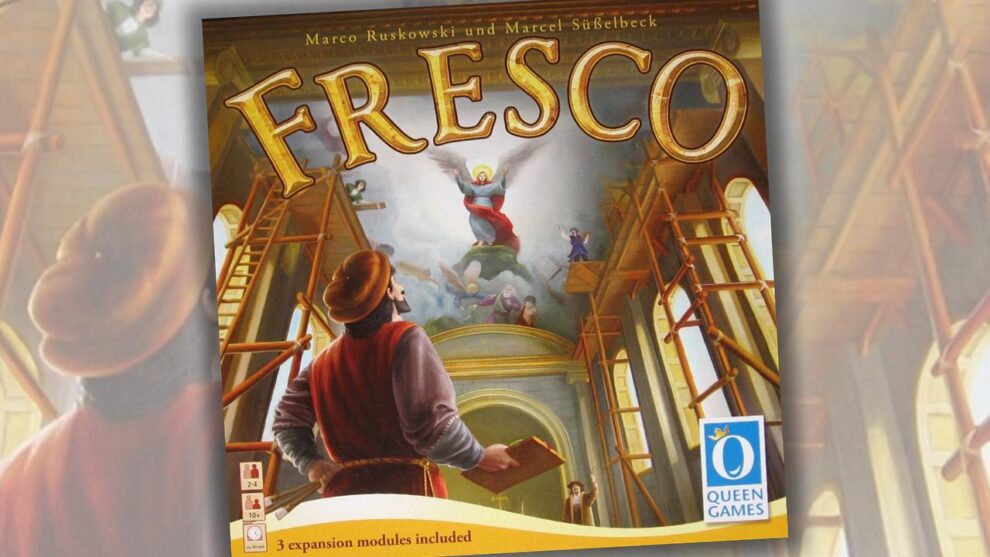
In Marco Ruskowski and Marcel Süßelbeck’s 2010 release Fresco (Queen Games), the Bishop has summoned you and your fellow players to repair the church’s prized fresco. Be the artist to best manage your workers, create the greatest selection of pigments, and repair the right giornata, and the game is yours.
The Creation of Adam
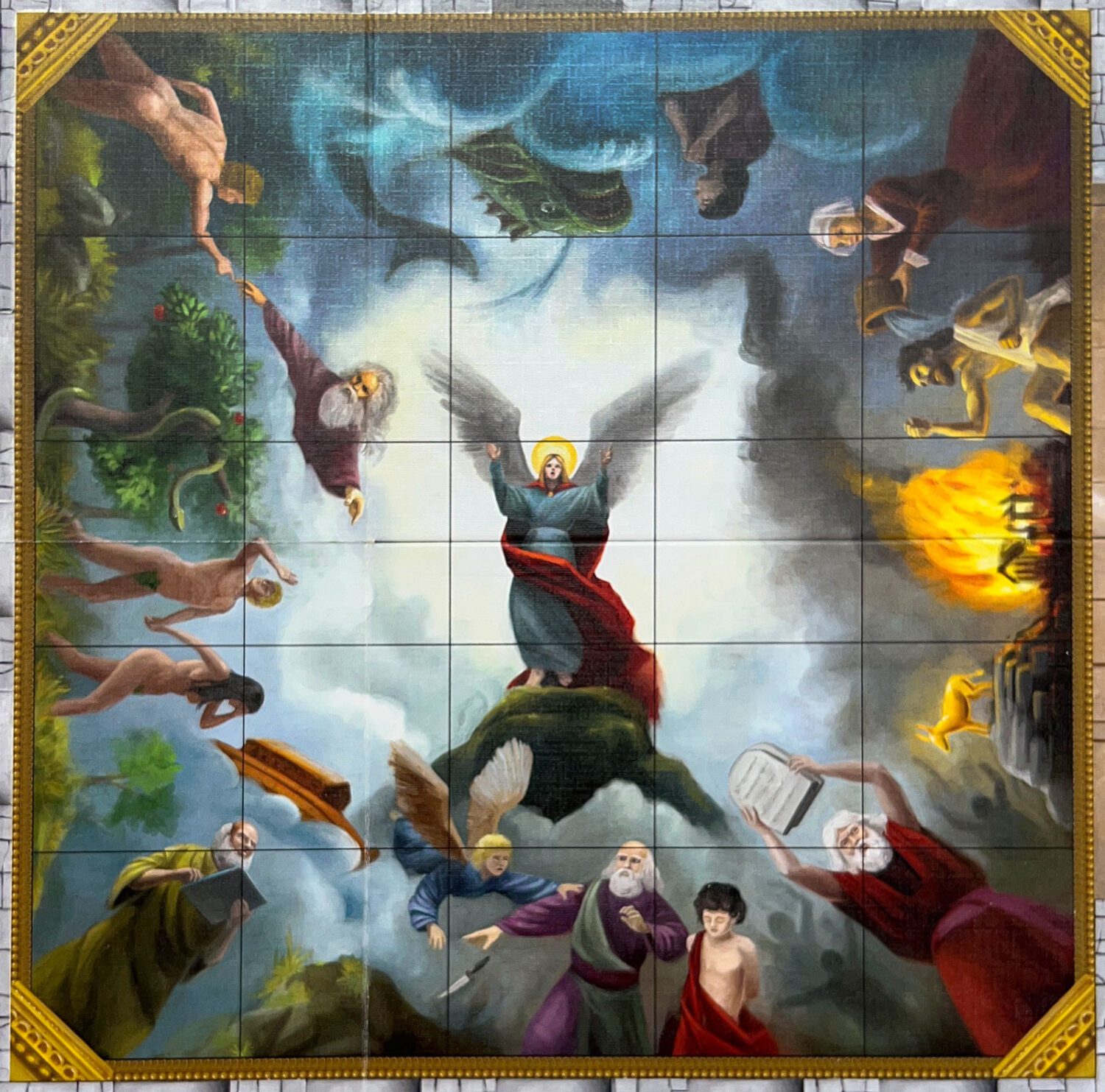
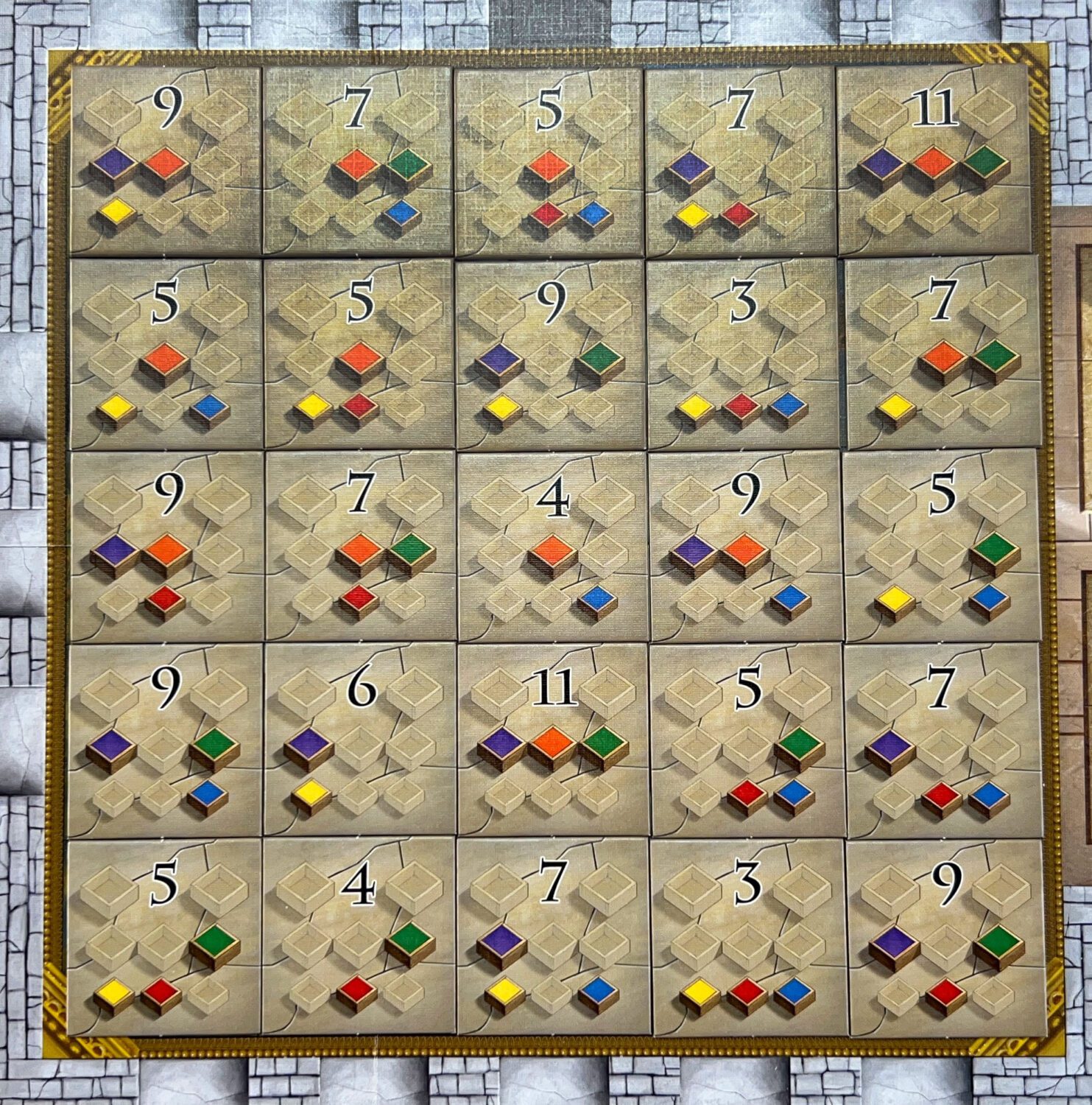
You’ll start by randomly placing the 25 paint tiles atop the fresco in the center of the board. These tiles will show the colors needed to repair/claim that tile, and the endgame points awarded for doing so.
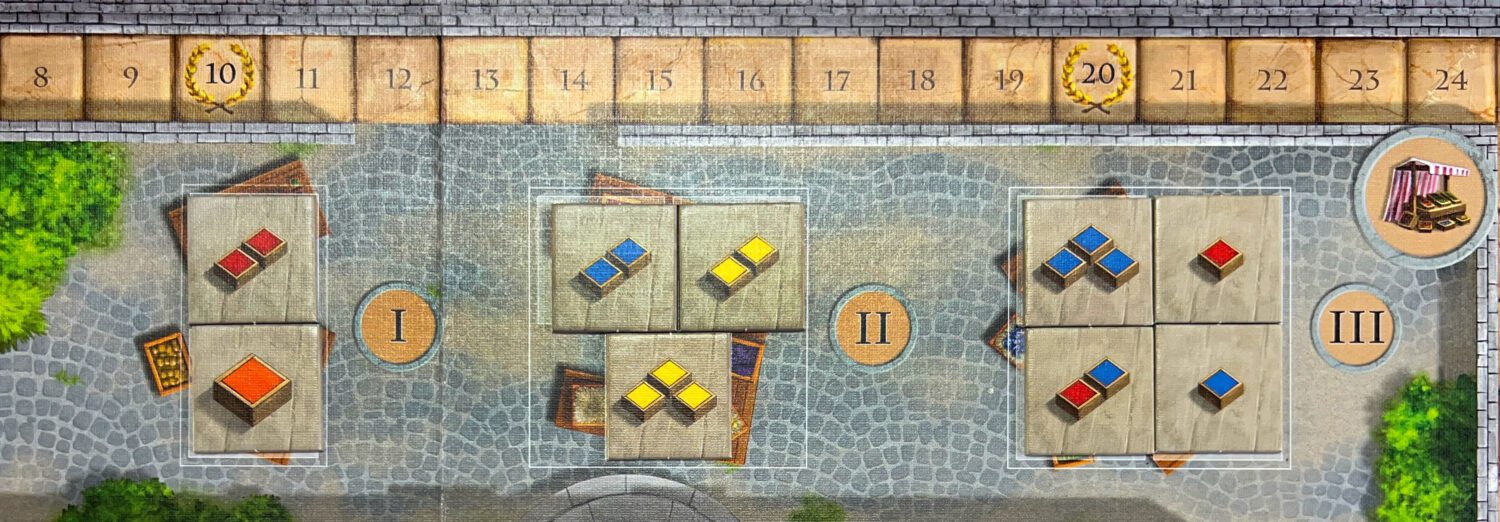
Then, place all the paint squares in the linen bag and mix them up well. Fill the open market stalls along the top of the board with these tiles, placing them face up.
Players each receive five apprentices, twelve money, a blue, a yellow, and a red paint piece. They also receive a small action board and a screen to place in front of it to hide their chosen actions.

Each player takes their three Master Painters and places one in the pre-scoring area beneath the 1 square of the scoring track, another at the top of the Hostel and one in the middle row of the Mood chart.
Place the painted cubes representing the primary colors (red, blue, yellow) and secondary colors (green, orange, purple) in the workshop area, along with the bank’s money.
Choose a starting player at random, and you’re ready to get to work.
The Meeting of Leo the Great and Attila
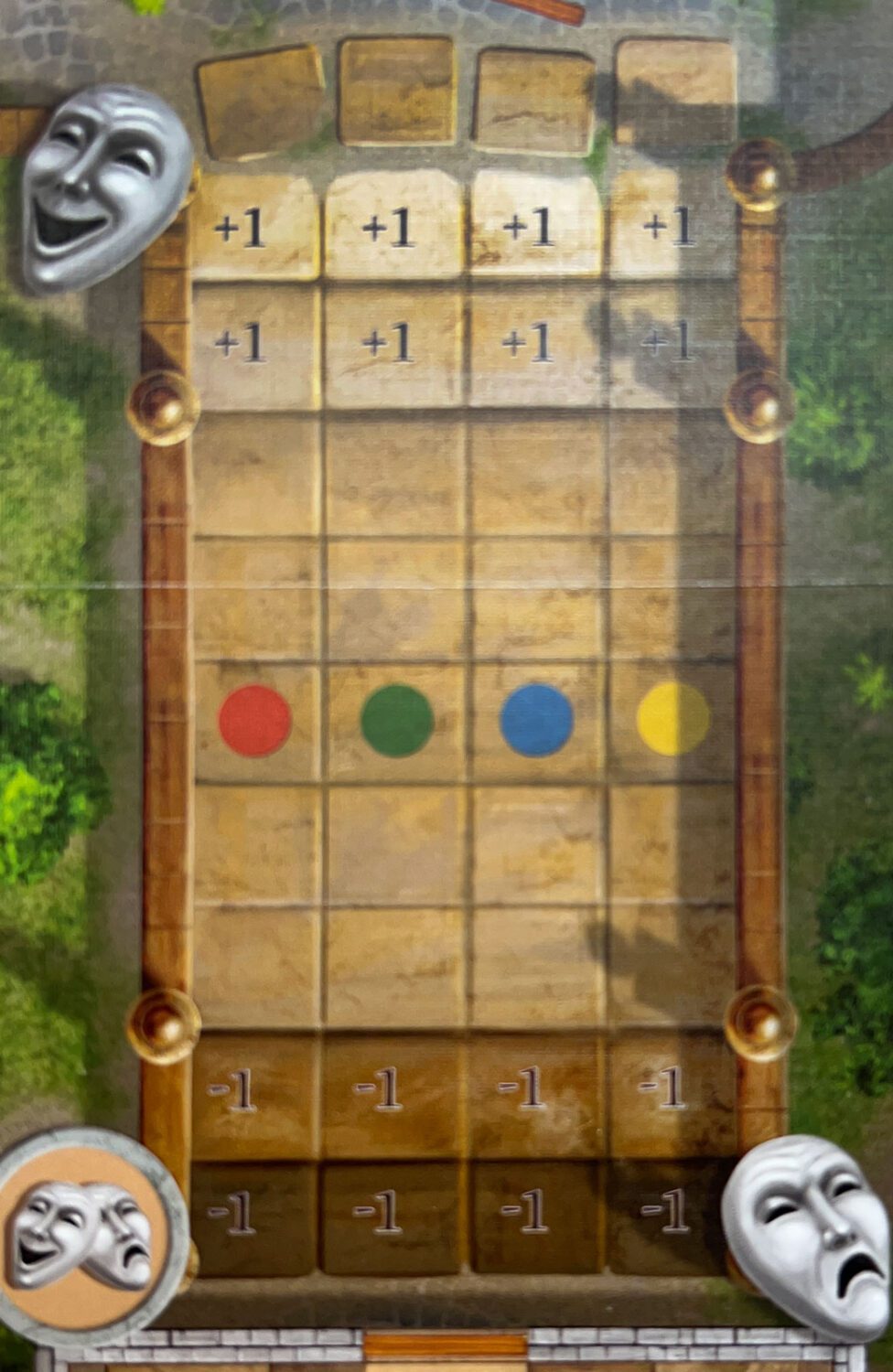
The crunchy joy of Fresco comes from determining how you’ll approach each turn. In turn order, you’ll take your Master Painter Meeple from atop the Hostel and decide how early you want to wake your apprentices up to start work. The earliest time slot on the Wake Up chart means you’ll get first choice of available paints at the market, but it also displeases your underpaid novices. Grumpy apprentices change the mood of the work, as depicted in the Mood Chart just below the Wake Up chart. Annoy them too much and you’ll lose one of those valuable novices until you show them all you’re a nice boss by taking them out to the theater at night.
On the other hand, let them sleep in and maybe take in a show or two and they’ll recruit one of their friends to help out.
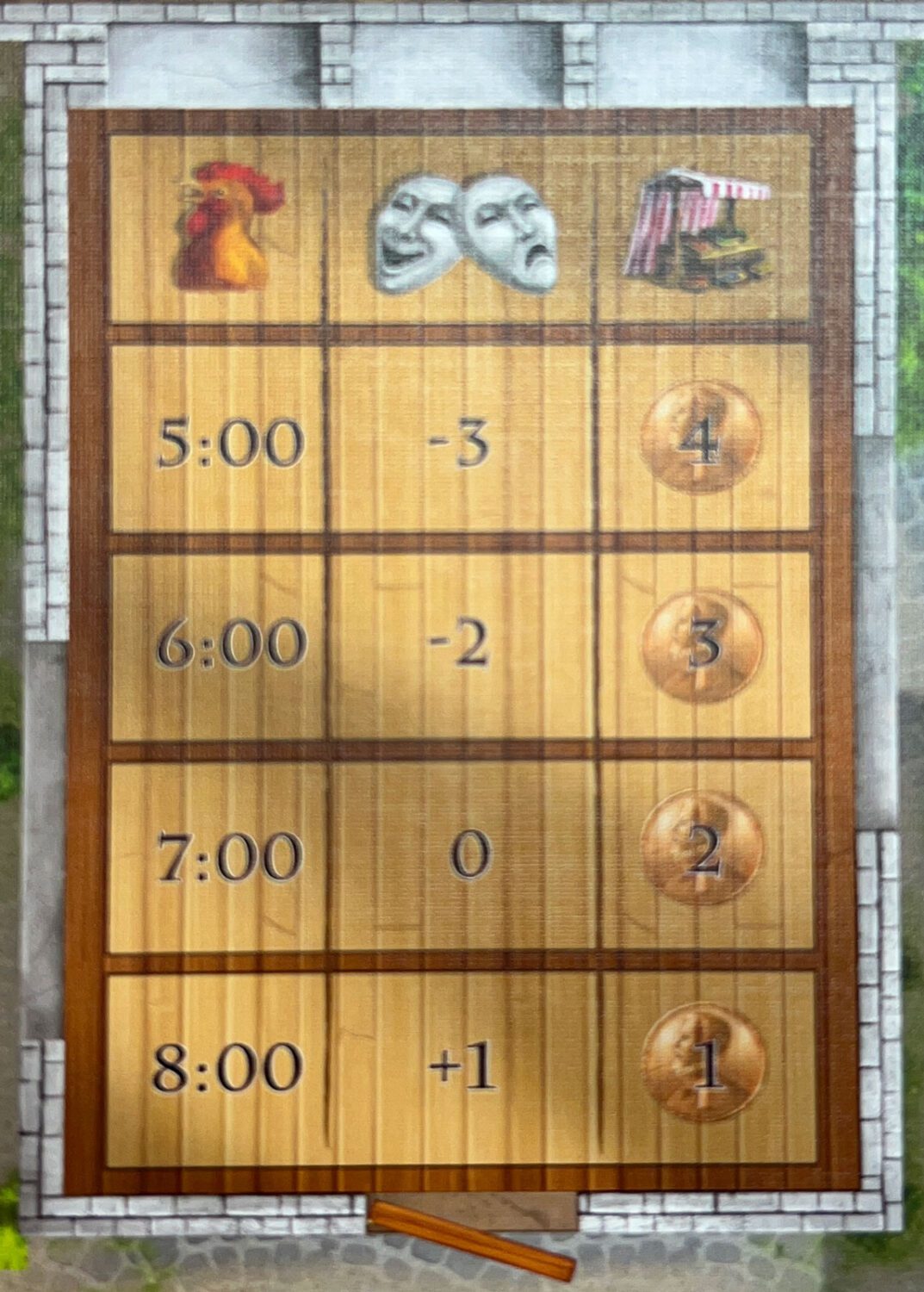
Wake up times also affect the amount you’ll pay for your paints. Get there early for the best selection, and you’ll pay top dollar. Get there a bit later and the prices drop a bit, hour by hour.
Once you’ve decided when to get up and moving, you’ll need to decide how to deploy those apprentices.
Behind a small screen, you’ll take your workers and place them on an action chart. You can send apprentices (up to three per turn) to the market to buy paint, to the cathedral to use those paints to repair a giornata back to the studio (to earn $3), to the workshop to blend paints to create new colors, or to the theater to make them happy.
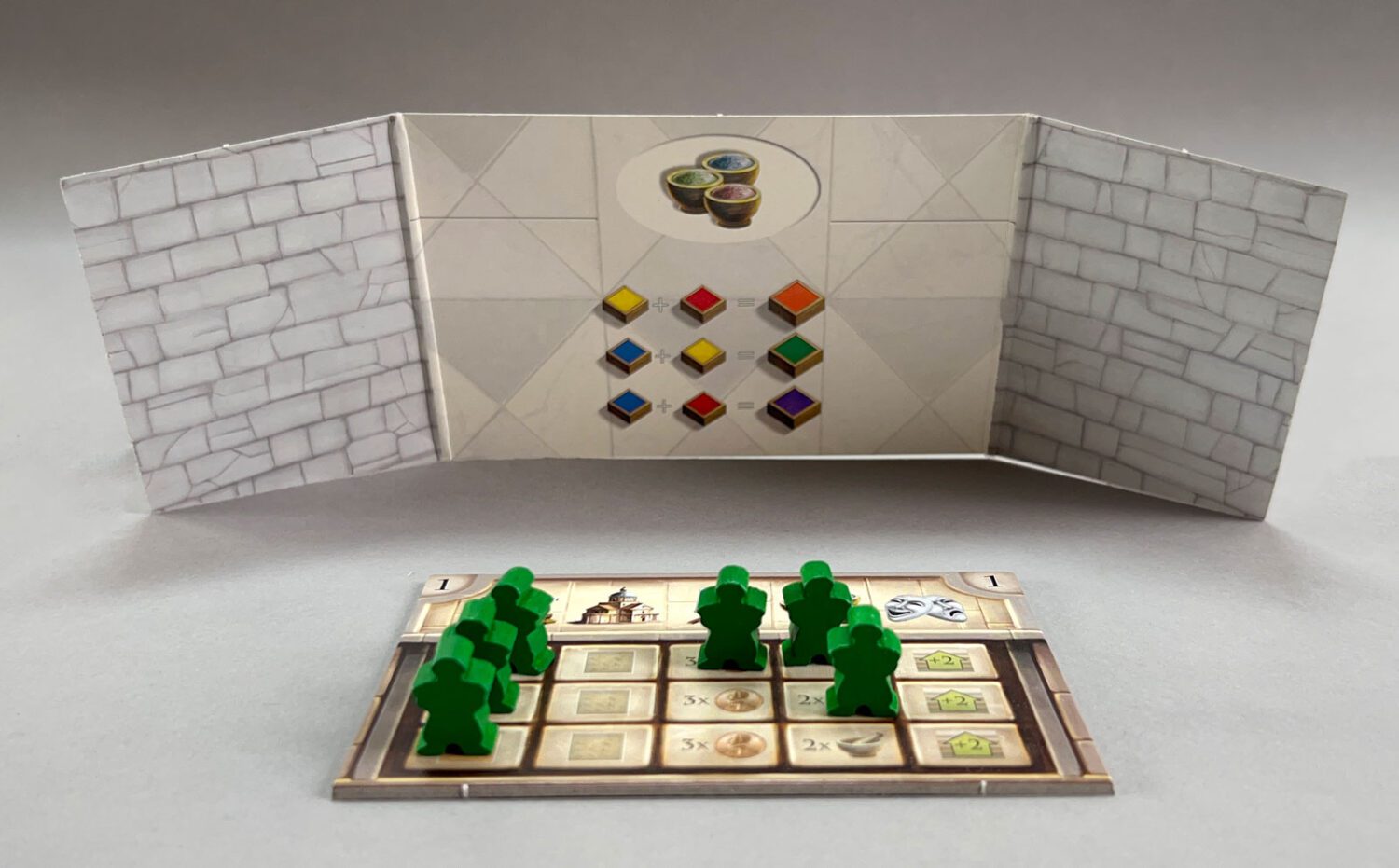
If you’ve awakened your apprentices too early, your position on the Mood Chart moves down the column. Do so too often and an apprentice will leave your workshop in disgust, giving you only five meeples to assign to daily tasks. In a tight, action-oriented game, this is a genuine handicap.
Players reveal their chosen actions at the same time. The first player sends his Market apprentices to the Market. Market stalls are equal to the number of players, but the number of colored dyes available varies: some have two spaces, some have three. The first player can visit any stall they wish, but can only buy one dye per Apprentice assigned to visit the Market—providing they have the money.
Market prices are determined by how early your Apprentices arrive. The earliest Apprentices pay the most, while later Apprentices pay less. Money is, of course, in short supply throughout the game.
Once the first player completes their purchase(s), the player with the next Wake Up time goes to the Market and purchases dyes. This continues until all players who have chosen to visit the market do so.
Next, players, in the same player order, go to the Chapel to repair a giornata, provided they have the proper dyes—or mixed dyes—to meet the requirements shown on the giornata. They’ll claim that tile, scoring the victory points shown.
Any giornata worth more than a paltry few points requires secondary colors (orange, green, purple), which requires sending an Apprentice to the Studio to mix the proper two primary colors (red, blue, yellow) to create them. The more complex the colors needed, the more points that giornata will be.
You may also assign your Apprentices to do Portraits (to earn 3 money) and the Theater (to raise the moral of your Apprentices +2 on the Mood Track).
Play continues until all giornata have been repaired. Points are totaled, and the player with the most points wins.
Assumption of the Virgin
Fresco is a blend of worker placement, set collection, and turn order mechanics. It creates a game greater than the sum of its parts. There are tough decisions to be made on every turn, starting with the Wake Up time. Going first certainly has its advantages, but doing so will mean your dyes are more expensive. Continue this, and eventually one of your Apprentices will leave.
Each giornata tile requires at least two colors to repair; most require three. The more mixed secondary colors are required, the more victory points that giornata tile is worth. With values ranging from 3 to 11, you need to go after the high-point tiles to stay competitive. With only 25 tiles to complete over, that means you’ll need to plan accordingly from the earliest rounds.
Fresco also comes with 3 mini-expansions. The Portraits allow for bonuses to the player who claims them; The Bishop’s Request has players flipping certain completed giornata tiles to claim additional victory points; Special Blend Colors adds pink (purple + red) and brown (orange + green) to the mixed dyes. These two new colors remaining in your studio at the end of the game, unlike all other colors, are worth additional victory points.
The game is easy to teach and learn. The early rounds ease new players into the game, allowing the complexities of the game to emerge naturally. When players start staring at the Wake Up options in the Hostel, balancing their options and the ramifications of their choices, I know they’re hooked.
Unfortunately, Fresco went largely unnoticed by gamers when it was released in 2010. Should you find yourself looking for a good medium-weight game with crunchy decisions and some unpredictability, find yourself a copy. It will be a worthy addition to your collection.
Fresco details
- Designer: Marcel Süßelbeck, Marco Ruskowski, Wolfgang Panning
- Artists: Oliver Schlemmer
- Publishers: Arclight, Competo / Marektoy, Devir, Piatnik, Queen Games
- Release Date: 2010
- Player count : 2 - 4
- Age range : 10+
- Time range : 60 minutes
- Mechanism(s): Action Queue, Grid Movement, Market, Set Collection, Simultaneous Action Selection, Turn Order: Stat-Based
- BGG Geek Rating: - converted to Meeple Mountain scale: .
- More articles about Fresco.