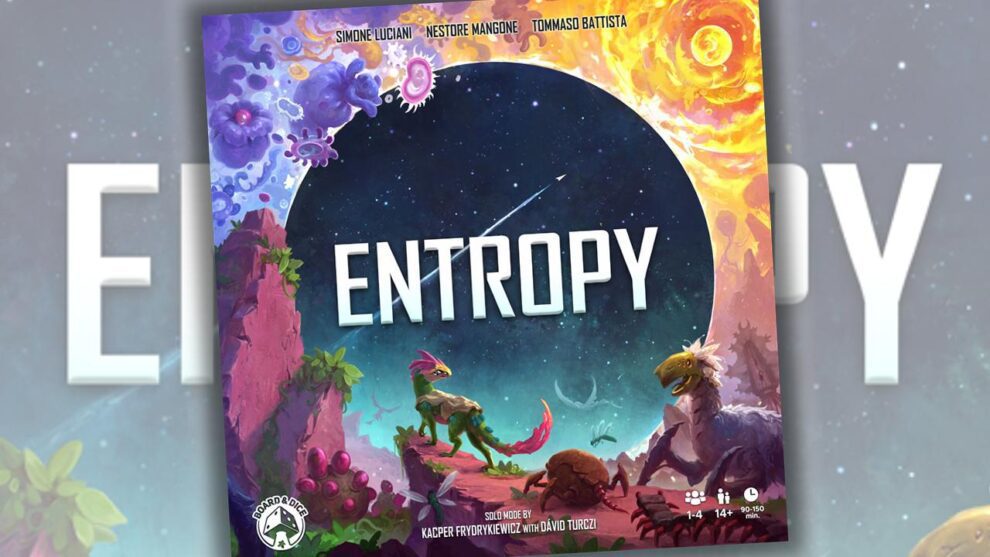

Disclosure: Meeple Mountain received a free copy of this product in exchange for an honest, unbiased review. This review is not intended to be an endorsement.
Normally, when I’m sitting in meetings with our publishing partners at shows like Gen Con or SPIEL Essen, I ask about the games that are on the horizon. And, normally, we buzz through that part of the conversation with ease, since there’s not much in the way of real, earth-shattering news: another expansion for that popular title from a year or two ago is underway, or a new animal-themed trick-taker is set to hit the following summer. My brain says “ho, hum” and I quietly move through my meeting schedule.
But during the Board&Dice meeting at SPIEL last fall, it was hard to believe how many perfect-for-Justin products I saw on their 2026 dance card. Nucleum: Gibraltar, with the game’s third map and more goodies in a game system that I have fallen for over the last couple years. The crowdfunding campaign for The Voyages of Marco Polo, a classic game I’ll be backing whenever the project goes live. One of the designers of the Rats of Wistar-adjacent game ANTS, Andrea Robbiani, had a new title on the way called Maestro.
Board&Dice shared one other 2026 release. That game was Entropy, a new strategy title co-designed by three of the foremost game designers of our time: Tommaso Battista, Simone Luciani, and Nestore Mangone. Between the three of them, these Italian designers have worked on some of my all-time favorite games: Grand Austria Hotel, Tiletum, Nucleum, Lorenzo il Magnifico, Railway Boom, Autobahn, Barrage, both Marco Polo games, Darwin’s Journey, Mesos, and Shackleton Base: A Journey to the Moon.
My eyes popped when the Board&Dice marketing team shared the news of Entropy. It was like the Super Friends—that old 1980s TV cartoon featuring a bunch of DC Comics heroes—decided to make a board game. I had to know if Superman, Wonder Woman and Batman had birthed a baby that would end up being one of the greatest games the world has ever known.
But, after three review plays (one each at solo, three-, and four-player counts), I have somewhat disappointing news to share. Entropy isn’t bad. Often, it’s not bad at all, rising to the rank of…good? But it never approaches the innovative genius of some of the other titles these three men have cast into the world. And that’s a shame, because even after I lowered my impossible expectations for this game, Entropy still found a way to fall just a hair or three short.

Let’s Get to Class
Entropy is a worker placement game for 1-4 players. It plays in about 40 minutes per player. Each player takes on the role of…well, that’s tricky. The game’s intro gave me Civolution vibes, with a setup that seems to hint at people building universes in simulators using a small console to outperform other “apprentices”, maybe in a classroom or a performance chamber, but even that is pretty vague. (If I’m being honest, the whole rulebook intro is really vague. Do I have powers? What caste am I trying to join by outperforming these other apprentices? The player board console doesn’t have any buttons at all!)
So, for a themeless Euro, Entropy does a great job of leaning into being a themeless Euro. Each player has a scientist meeple, and that meeple will be placed on one of 12 spaces—across two rings, an inner circle and an outer one—to take actions. The inner circle actions are duplicated twice each at opposing ends of this action rondel, with six unique, minor actions scattered across the six outer ring spaces.
On a turn, players move their scientist 1-3 spaces clockwise around the rondel to take actions. When they reach a section of the ring, they have to choose to take the inner action or the outer action.
Because the game grants a “traffic bonus” for moving fewer spaces, almost everyone who tried Entropy found themselves moving a single space as often as possible. Fewer moves, better bonuses. The traffic bonus is harder to achieve if there are any other scientists on a space when you arrive, so that ended up being the main way to shake up the way players kept following each other around the board.
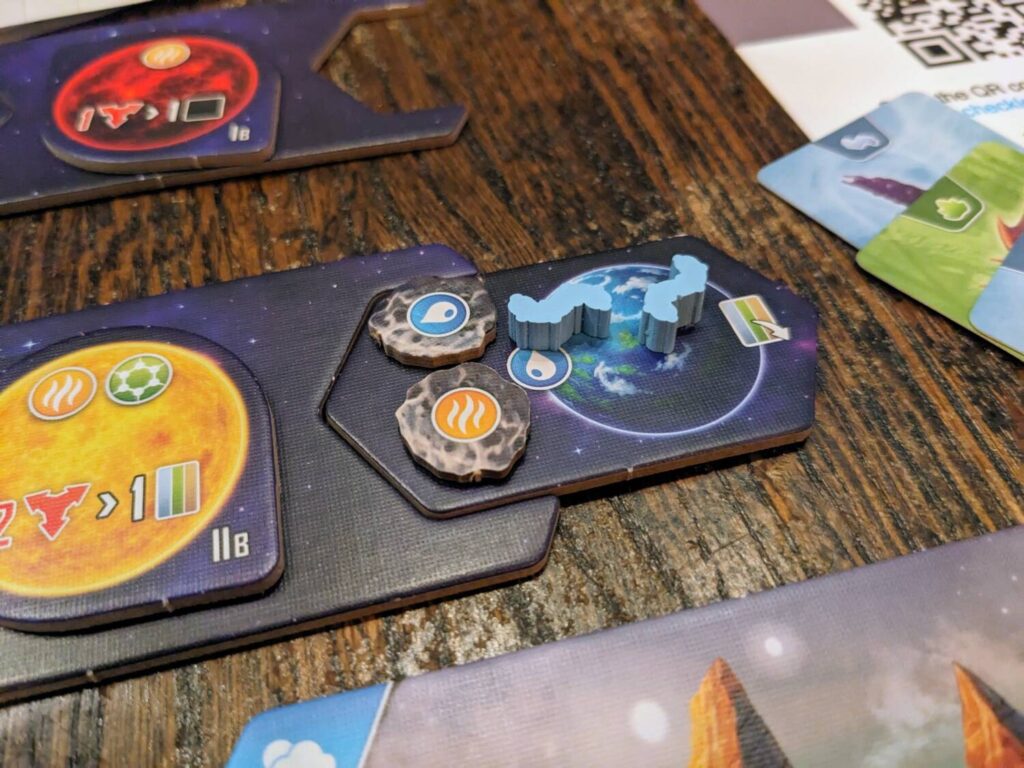
Inside the two action rings, the main real estate of the board is a marketplace, including new planets, new stars, “Life” cards, asteroid tokens, and biome tiles, which players use to build up solar systems. Sneakily, Entropy is a tableau builder, with players having full control on how to build out their console area: stars provide icon tags and actions, biomes give players access to minor bonuses when they place their scientist token on a matching space, and planets have both tags and actions, the latter of which can be triggered when placing new tags (asteroids) on those planets.
This gives players a lot of latitude to build up the engine of their dreams, but it’s a bit of a grind to get that engine humming in Entropy. Everything in the game is a race to place lifeform tokens (bacteria, plants, and animals) by playing up to three life cards aligned against each planet. By building up lifeforms, players are racing to complete public milestone challenges tied to each lifeform type, which awards victory points in tiers based on who completes each challenge first.
There are also three public objectives, and progress against those objectives also factor into end-game scoring. As players upgrade their star tokens or flip their biome tiles to juicier, upgraded sides, that increases the multiplier for each of the three end-game scoring conditions.
Each player’s console has a unique special power that can be built, then upgraded, for each of the three major actions in Entropy: buying planets, buying stars, or playing life cards to a planet. This is the closest Entropy comes to having some spice, by replicating the Experiment powers in Nucleum or player powers in Barrage to add asymmetry to the game’s systems.
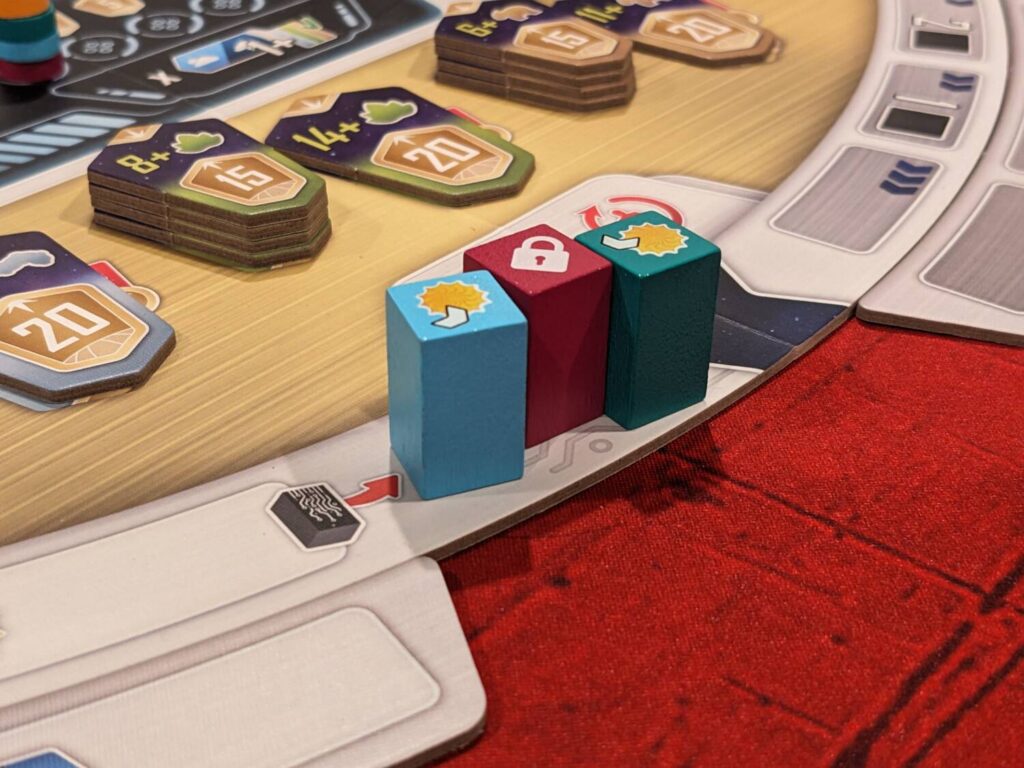
The outer ring actions mostly fall into the category of grab some extra stuff, grab some extra cards, or add new tags to a solar system by taking the “Catch an Asteroid” action. (No, I was not consulted prior to the game’s release.) The inner ring actions are the core of the game, and Entropy handles spamming a single action the right way by forcing players to leave a large action pillar token on an action space in the inner ring. If you don’t begin your turn with that pillar on your console, you can’t take the action, and because of the movement restriction, you’ll usually have to wait 2-3 turns before taking a matching action again by moving over an action pillar to retrieve it.
When two major objectives are completed, the current game round finishes (to ensure all players take equal turns), then all players get one more turn. Most points wins.
Let’s Start with the Positives
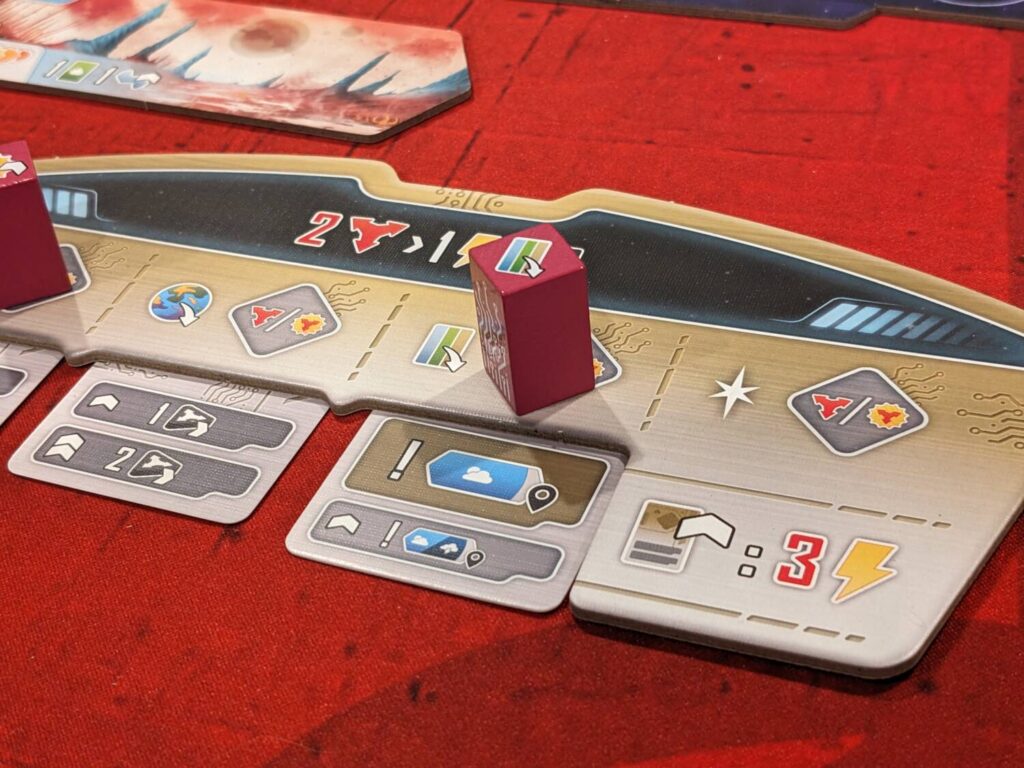
Entropy is a tidy production, with a relatively easy-to-learn system and a production that makes it plain to see how to progress. The game’s player aid is excellent. I taught the game twice using only the player aid, and I was happily surprised at how often I pushed back on players with questions to review the player aid first…and nine times out of 10, the player aid did the job. The game’s icons are all listed on the back of the rulebook, and that was a handy feature when a life card or a space on the board created questions.
Entropy badly overstays its welcome at four players, so I don’t recommend it at that count. However, at three players, Entropy was borderline perfect in terms of its pacing, with players able to have a few moments to think about their next turn and having other players wrap up turns that ended with shopping for new cards on the market or updating their console with new powers.
Using the base game objective scoring, it is very easy to tell what a player needs to do: upgrading stars ties directly to acquiring a large volume of similarly colored planet tiles. Since each player gets one planet to begin the game, I used that planet’s color to base my decisions on which other planets I should buy later. Adding and then evolving new stars to levels three and four (these are the best stars in the game and provide the best actions for their owners) made for a very straightforward goal-setting experience. The other two objectives make clear what players should focus on, and from a competition vantage point, I could always tell how well others were doing against those goals, even if I couldn’t math out their exact score during the game.
In the right hands, turns are snappy, and there are no wild combos on display in Entropy. You move your scientist, take a couple resources, and play a card or grab something from the central markets. While the overall game length might run about two hours, you are likely going to take a lot of turns in Entropy, unlike some of the other Euros these designers have given us over the years where there might only be 10-12 turns but each turn is a bonanza.
Ultimately, A Lack of Wow
“Fun, but I wouldn’t buy it,” one player offered following our three-player game. “If anything, this has me excited to play Shackleton Base again.”
Remember my Super Friends analogy earlier? That’s my big issue with Entropy. Three of the greatest minds in gaming worked on this for some number of weeks and months, and what we have is a game that is completely and totally fine. It’s never special. You play cards with tags that match the stars and planets in the tableau in front of you to add small plant tokens and take a minor secondary action. Sometimes, you move two spaces on a rondel to buy a face-up planet tile. Entropy has mid-game “Mission” cards that provide a decent, but certainly not game-breaking, bonus when played based on a condition that most players found easy to meet.
At four players, Entropy is not recommended. The downtime isn’t too bad—although it was rough during my four-player game, because two of the four players at that table are typically the most deliberate “AP” players in my network—but the high volume of turns and the slow initial pace of seeing any real development in a player’s solar system tableau makes for a tough sit.
Entropy sits in a tough spot. Board&Dice has made so many incredible, medium-weight Euro bangers over the last five years that I would recommend all the following games over Entropy, some from the same designers: Nucleum, Tiletum, Reef Project, Teotihuacan: City of Gods, Origins: First Builders, and last year’s Tianxia, which is getting an expansion any minute now. That’s because each of those other titles had more “wow” than Entropy did.
Entropy is good in a lot of areas—the cardplay isn’t bad, and it is fun to build out a system that works for your playstyle, even though I think that will be harder for new players to visualize initially. I tried three of the four Focus card systems—each player’s set of console powers tied to major actions—and each set felt meaningfully different.
Entropy is solid, but it isn’t special, and I was badly hoping for something special. As it is, Entropy is worth a look if you are a superfan of one or more of these designers, but I think you’ll ultimately land where I have, by following a play of Entropy with setting up plans to run Grand Austria Hotel or Shackleton Base on another game night.