
Disclosure: Meeple Mountain received a free copy of this product in exchange for an honest, unbiased review. This review is not intended to be an endorsement.
One of my big things as a reviewer is actually not tied to total play count, although I try to get three, maybe four plays in with a game before I pass judgment on a game’s quality.
The thing I prioritize more than anything else: getting as many plays in with the same game at different player counts. If a game says that it accommodates 2-4 players, I try my best to play at two, three, and four players. (If a game says it plays 1-4 players, I try my best to get in plays at all four counts, but a game typically plays almost the same way at one player as it does with two, since the solo usually mimics a two-player experience.)
Encyclopedia of Monsters is a new family memory game for 2-4 players. Designed by a pool of the same people who designed my game of the year pick for 2024—Dead Cells: The Rogue-Lite Board Game—I had Encyclopedia of Monsters on my radar as soon as the team at publisher Scorpion Masqué showed me a mockup at SPIEL Essen last fall.
Encyclopedia of Monsters is a fully resettable campaign memory game, spread across five volumes (here known as continents) and three chapters (countries) per volume. That means you have 15 short games included in the box, all of which are memory games that progressively get a little harder with each outing.
For this review, my family played all of the first nine chapters, which took us 11 plays to get through: Europe, the Americas, and Africa. Because games are so short, even our failures only took a few minutes, and on average, each game took 15-20 minutes.
That’s a pretty easy investment for a game that looked like it would be bigger…and after Dead Cells (a game we have tabled more than 30 times), I think my wife and our kids (ages 12 and 9) were thinking Encyclopedia of Monsters would be a little chunkier.
This ended up becoming our overall review of the title. For a family with younger children (kids in the 5-7 range) who plan to play Encyclopedia of Monsters at its full player count, I recommend buying a copy as soon as you work through this mostly spoiler-free review. For anyone else, hold your horses, because the game experience was very different for me based on player count and the age of my kids.

Candles, Burning
Encyclopedia of Monsters approaches its memory game format the same way regardless of the chapter you are playing. A very small deck of cards (often as few as eight) are spread as evenly as possible across the players in the game, with each card representing one of the monsters you are trying to find scattered across a series of face-down tokens. Normally, the rules dictate that a player plays one of their hand cards, then successfully flips a token on the board hiding that monster (“monster” is the catch-all term here used for things ranging from spirits to creatures to dastardly beings who need to be corralled in order to bring peace to an area).
Many of the cards grant a power or a condition that must be applied before or after a player reveals a token, but all of it is very easy to parse. If the active player succeeds in flipping the monster on their card, the next player tries to do the same thing, until all players have played all their hand cards. Fail, and players return all played cards to their hands, then all tokens are flipped back over, forcing players to remember where previously-flipped monsters reside. Players get a number of chances to beat the chapter based on the number of candle tokens established during setup; on a failure, a candle is flipped from its lit side to its exhausted side, and play continues until all candles are extinguished, or players complete a run when they find all monsters successfully.
The variety of the memory games is interesting, and each chapter has a few base monsters that give players chances to peek at tokens or show tokens to their fellow monster hunters. At the end of each volume, a “boss” character appears, creating special win conditions that are a little harder than the first two chapters of a volume. In addition, each chapter lays out a pattern for how the tokens must be placed, so the game isn’t as easy when the tiles are a bit of a puddle. (This also means that when the tokens are placed in a standard grid format, or shapes like a pyramid, clever players have a much easier time remembering where certain monsters are!)

A Very Uneven Ride…
With four players, and a tile pattern that can best be described as “soupy”, Encyclopedia of Monsters was a very interesting memory game. Many of the monster card effects are more interesting when you get to work with a full table to players to figure things out, and we found it to be a harder game with more people playing. That’s because other players cannot just tell you where certain tokens are; communication is limited, and that’s a great way to go through the experience.
As the table’s shared information about flipped tiles grows, failures make for more fulfilling successes as a game goes along. Even by our second game, we found ourselves using the Ghost and Skeleton monster powers to flip tokens and gain information (either for the entire group, or just the active player) in the right ways to make turns right after failures more fruitful. A dog token, used as a wild for success criteria when looking for any monster, became a key component of leveraging an out whenever a player couldn’t exactly remember where the monster was that they were really looking for.
For two players, Encyclopedia of Monsters was so easy that it made my 12-year-old not want to play the game any more.

While we did a mix of players for our first four chapters (so, all of Europe, then the first chapter of the Americas), my 12-year-old and I tackled the final five chapters…and, save for one of those five chapters, we were able to succeed each time while losing not more than three “lives” in each chapter.
Here’s my big issue with Encyclopedia of Monsters at two players: the other player knows exactly which cards you are holding, because all of a round’s cards are distributed equally. Knowing what the other player is looking for (exactly looking for!) makes the game a bit too simple. Now, that issue might go away in a two-player game when one is a parent and the other is a six-year-old…maybe.
But the intrigue level goes way down at two players, and that’s before simple token layouts make it easier to remember where certain tokens are. One chapter, for example, uses a token setup where all of the monsters are face-down but in a circle that is broken up every 2-3 tokens with a candle. Using a clock-style orientation, my kid and I were easily able to figure out where certain tokens were because of the orientation alone, and we simply flipped in clockwise order to knock out what we needed.
That chapter did have a condition where one needed to occasionally swap the location of a token, but we did that from a counterclockwise rotation, so that we never really had to worry about flipping a tile that was in a “new” position, per se.

…in a Very Efficient Car
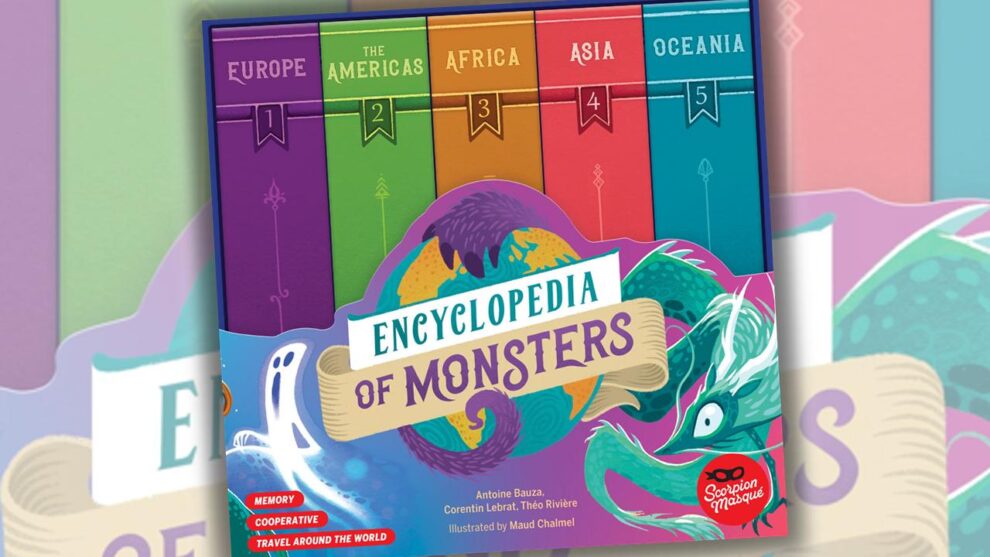
Regardless of how you play Encyclopedia of Monsters, one thing is clear: as a production, Scorpion Masqué knocked this out of the park. It’s a handsome production, but it’s not full of bling; it just does a great job as an economy product by arriving housed in a five-box set that looks like it would on a real bookshelf.
The tokens, nor the cards, are fancy. But each box’s discoveries make it a blast for kids in the same way that games like Little Alchemists did for kids a couple years ago. Even compared with Dead Cells, Encyclopedia of Monsters is a dandy for a price point that made me blush when I saw it: $30 is the list price on the publisher’s website.
$30 for 15 games in a fully resettable box is a heck of a deal. For a family, I think this one of the best packages of 2026.
My family has aged out of this one a bit, and now that I’ve tried it at two players, I would never play Encyclopedia of Monsters again at that lower count…but it is sometimes challenging to get all four of us to sit at the same table together. If you and your family fit the bill, Encyclopedia of Monsters is a solid deal.