

Disclosure: Meeple Mountain received a free copy of this product in exchange for an honest, unbiased review. This review is not intended to be an endorsement.
There’s quite a bit about Castle Nightingale to catch the attention of the discerning gamer. That box, with its palette of dark blue and warm orange, stands out on a shelf. As you get closer, the colors organize into three mangy cat ninjas and a game red panda samurai, all charmingly rendered by Vincent Dutrait. That one cat making eye contact more or less dares you not to be interested. As you pick up the box, which you inevitably will, you might notice the “B. Cathala” listed alongside co-designers Eliette and Jérémy Fraile. Only then might you notice the logo in the lower left corner.
You don’t often get to say, “Sand Castle Games has a new game out.” Prior to Castle Nightingale, you’d have said it twice. There was the 2019 release of Res Arcana, and the 2022 release of First Empires. Three games in eight or so years—I’m including production work on Res—is a slow, considered pace. And to think that people used to marvel at Days of Wonder’s approach of only one title a year.
Even if they only have a 50% hit rate, Sand Castle’s pace suggests that they only release the games they really want to release. It’s clear from their production choices that they pour all of their attention into each game. That alone makes their imprimatur mean something. If their name doesn’t pop up again until 2029 or 2030, I’ll be curious then too.
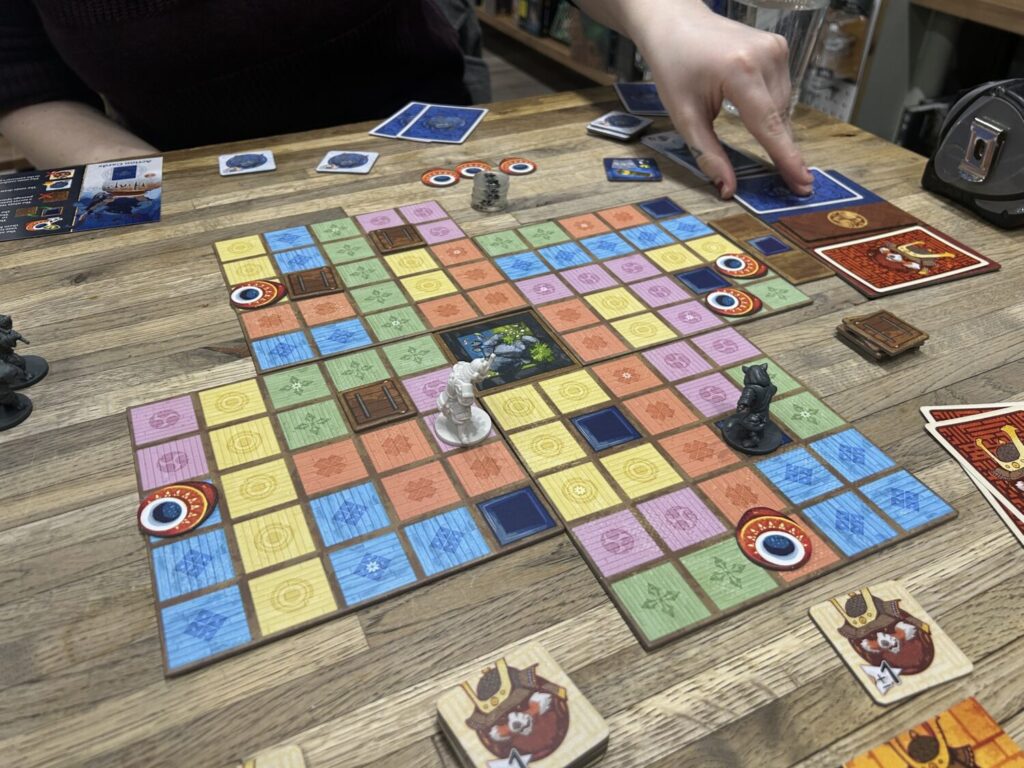
Sing Sweet Nightingale
We got off to a rough start, Castle Nightingale and I. By dint of its thoroughness, the rulebook makes the game seem more difficult to understand than it is. It took a few minutes to get settled. At one point during the teach, my friend said, “This seems like it might be more than it’s worth.” That didn’t last. Within a turn or two of starting, it was smooth sailing.
This is an asymmetrical hidden movement game for two, a tense dance between those three thieving cat ninjas and that grumpy red panda samurai. The poor man just wants to sleep, but he can’t, because these ninjas keep trying to steal the relics he has hidden in vases around the house. If they manage to snag five be-reliced vases, they win. If he manages to snag all three ninjas, he wins.
Each player has a deck of cards showing movement values and actions. At the beginning of each turn, both players choose a card to place facedown on the table, locking in what they will do that turn. The samurai also places a Nightingale Tile, which we’ll come back to in a moment.
Movement works differently for each player, as you might expect. The ninjas, the hidden movers in this hidden movement game, use clear plastic discs to log their movement. On their first turn, they place a disc on one of the trapdoor spots, then place discs one at a time on orthogonally connected spaces, equaling the movement value on their card. After a movement of 3, for example, there will be three discs on the board. At the start of the next turn, the current ninja mini is placed on one of those spaces, and movement continues from there.
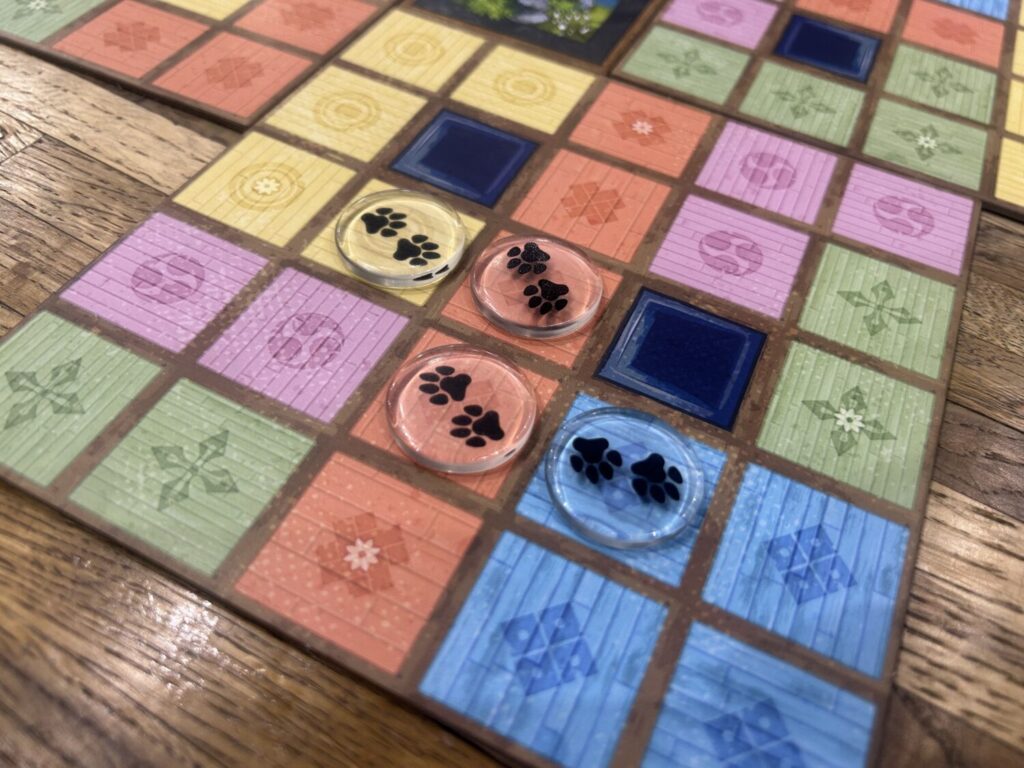
I’ve written before about hidden movement and how it is not, generally, my favorite, but Castle Nightingale works like a charm, and I think this particular hidden movement system is why. Most hidden movement games use a separate board or piece of paper to track the hidden party’s movement. The unhidden players have little to go on. Here, while the current ninja may occupy any one of the indicated spots until their next turn, at least I can see the options. I have an idea of where you are, and always will. The ninjas exist in superpositions.
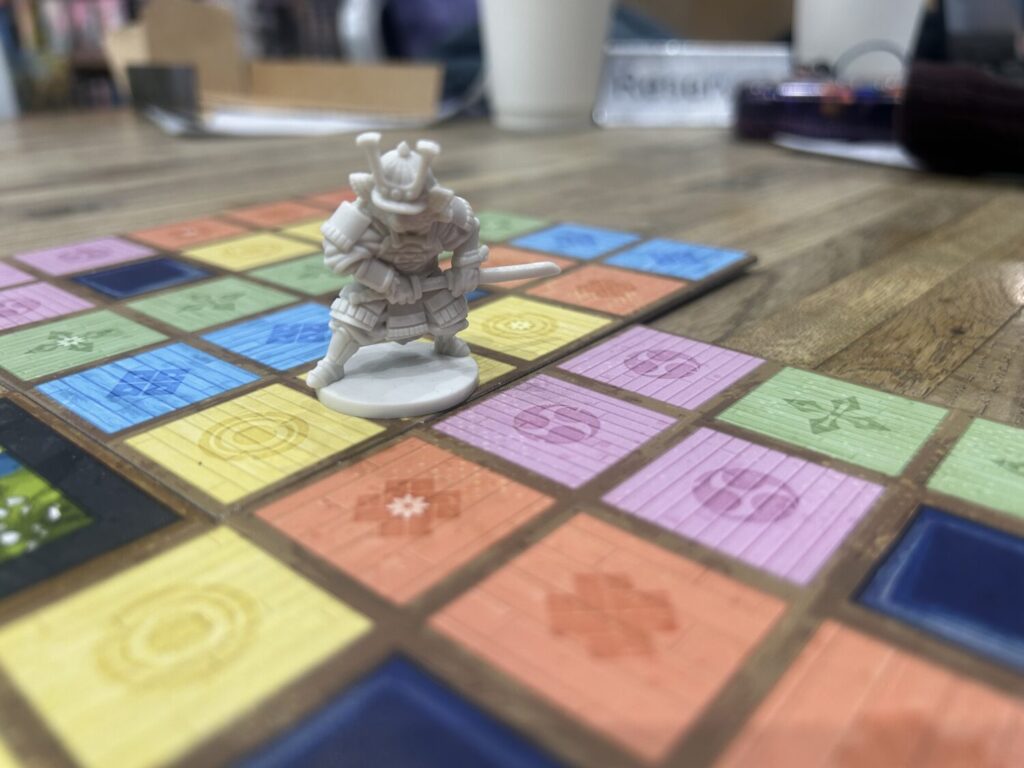
To compensate for the increased amount of information, the samurai has difficulty moving around; all that heavy armor, y’know. The board is divided into many oddly-shaped colored regions. When the samurai moves into a new region, he can pick any square within that region to land on, but his next move is restricted to entering any of the regions adjacent to the square he picks. This can create some funny dynamics. If I’m trying to clear away some movement discs, narrowing down the spaces where the ninja can go next, two adjacent squares in the same color region are usually a whopping three spaces apart.
The aforementioned Nightingale Tiles also do a brilliant job of making the movement phase itself more interesting for both players. The samurai has one Nightingale Tile for each region color on the board, and picks one at the start of each round. If, during movement, the ninja ever steps onto a matching region on the board, the samurai immediately reveals the tile. The ninja has taken a false step, and the floor squeaks beneath them. The ninja places their mini on the space in question and immediately ends their turn. To capture a ninja is “as simple” as being in the same color region as their mini. They are now a sitting duck. A sitting duck cat ninja.
The same Nightingale Tile cannot be chosen two turns in a row. The tile from the previous round sits on the table in plain view of both players. The ninja knows some spaces are safe for the time being. If the ninja is clearly headed for a vase on a yellow space, they can choose to spend a turn circling, under the assumption that the samurai has rigged yellow as a trap. When yellow is indeed revealed as having been the Nightingale Tile for that round, the ninja can safely swoop back in and snag it on the next turn.
But what if yellow isn’t revealed? That’s when things get really good. It’s all mind games, that Castle Nightingale, and wonderful ones at that.
Oh, there was another reason I personally was curious about Castle Nightingale: It has been getting, as far as I can tell, absolutely zero (0) press in advance of its release. The market is choked with new titles, it’s impossible to market everything, but it feels strange for a new Dutrait/Cathala joint to drop without any fanfare. Is it getting more press in Europe? Can anyone report back on this? Will there be a big poster for it when I go to Essen in October?
There should be. Castle Nightingale is tremendous.