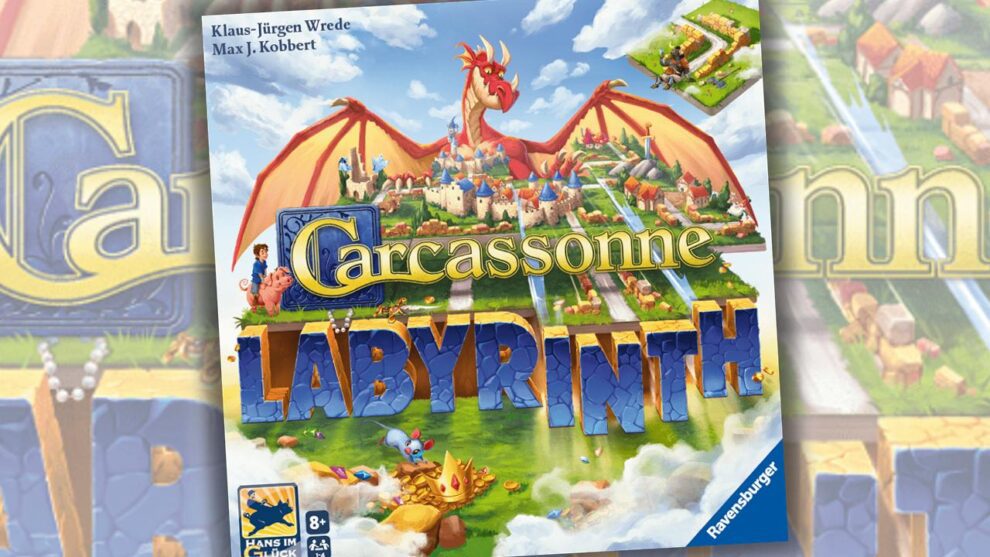

Disclosure: Meeple Mountain received a free copy of this product in exchange for an honest, unbiased review. This review is not intended to be an endorsement.

Mashup? Remix? It’s hard to put a finger on what I would call the new Ravensburger title Carcassonne Labyrinth, because three plays in, I’m still amused that someone behind the scenes was sitting in the Ravensburger design lab one day and had some version of the following conversation.
“Here’s what I’m thinking,” Sally said. “We reach out to the guy who designed Carcassonne, Klaus-Jürgen Wrede, and see if he would be willing to put a new spin on our game Labyrinth by working with that game’s designer, Max Kobbert.”
“Sally, that’s ridiculous. Who’s looking for a game that takes the tile-laying magic of Carcassonne and smashes it into the tile-pushing, luck-driven treasure-hunting mechanic we already have with Labyrinth?” responded Teddy.
“And what’s the market for that?” screamed Hal. “Are people looking for another version of titles that have sold well for 20–”
“–I think you mean 30–”
“–actually, 40 straight years???”
The three imaginary design lab techs probably looked at each other at that point. “Wait,” they must have all thought, “this idea is bulletproof, because a new version of Carcassonne comes out almost every year, and we’ve been slapping popular licenses on Labyrinth for decades. That clown from Meeple Mountain even wrote about the one we did with Nintendo!!”
From this conversation—or something very, very similar—Carcassonne Labyrinth was born. And while I still have no idea why we have yet another version of a game that really has been entertaining family-weight gaming audiences for 40 years, this is the best version of Labyrinth I’ve tried. That’s because it retains all the things that make the original a family game night legend, and it adds a fun and very manageable puzzle element for players both new to and familiar with the gameplay of Carcassonne.

It Really is Carcassonne AND it Really is Labyrinth
Carcassonne Labyrinth is a tile placement game for 1-4 players. If you are a seasoned hobby gamer and you have heard of neither of these two games, I will first point you to our overwhelming praise of Carcassonne and my review of Super Mario Labyrinth, the Nintendo reference I made above. For context, there are currently 100 versions of Labyrinth listed on BGG, so even if you haven’t heard of this game, I can assure you that much of the gaming world has!
I mention this because most of the rules for both games are intact in this combined product. The gameplay starts as Labyrinth—players have to track down one of eight treasures, based on one of those treasures serving as the current item of pursuit. On a turn, players draw a tile with branching roads and have to push it into the 5×5 grid at an entry point, sliding all other tiles in that direction and pushing one off the map. That allows a player to move their pawn (here, a meeple like the ones used in Carcassonne), and if a route allows the player to reach their current treasure item, they claim it and end their turn. Players can still move to a connected tile and not collect any treasure if they choose.
In this version of Labyrinth, those pushed-off tiles allow a player to create their own Carcassonne map, complete with shields to score, cities to enclose, and roads to cut off, which may help with endgame scoring based on one of the 10+ quest cards that are also in play for each game. This does a masterful job of giving a player something to do while they wait for their next turn. Things change so frequently in games of Labyrinth that it’s hard to map out your next move until it is your turn anyway.

And the Carcassonne Labyrinth personal tile-placement puzzle is much less complex, because some of the traditional scoring elements from Carcassonne have been removed (the placement of personal meeples beyond the one on the Labyrinth grid, for example, or having to worry about surrounding certain symbols on a shared map).
Yes, some of my major Labyrinth complaints still exist, because the luck-based nature of pulling a tile that happens to be two tiles away from a player’s current treasure target is still a thing. But the addition of Carcassonne adds something here. I didn’t mind the luck-based nature of things because the skill element tied to scoring still exists here thanks to the Carcassonne tile placement process.
That leads me to my favorite part of this version of the game. At the end of the game, each player takes everything they have taken and scored from the game—tiles, treasures, shields, and meeple tokens—and stacks them up. The player with the tallest stack wins. So, capturing more treasure certainly helps. But a player who builds a Carcassonne map that captures a lot of those shield tokens could also win. And the player who acquires the most shields gets to use a different pawn, a large crown, to add to the top of their end-game scoring stack instead of their meeple. And that crown is a little taller than the meeple!

The Definitive Labyrinth
I’m not about to tell you that Carcassonne Labyrinth has suddenly turned Labyrinth into an all-time classic. But I am going to tell you that, as a core hobby player, if you were lukewarm on Labyrinth before but really love Carcassonne, you should absolutely check out Carcassonne Labyrinth. I’m not a fan of the Labyrinth base game, but Carcassonne Labyrinth IS the version I would play if someone else wanted to table it.
The solo play, in particular, is a highlight here. A solo play ruler that can measure a player’s final scoring stack turns the game into a high-score challenge, and with so many different quest cards included, there are plenty of ways to play Carcassonne Labyrinth as an interesting 15-minute puzzle that can be set up and played over lunch. Even for players who have never tried Carcassonne nor Labyrinth, teaching this game can be done in minutes. It’s still very satisfying to find a path for your pawn to connect to a treasure on a turn.
And as a family-weight puzzle, Carcassonne Labyrinth lands nicely. Parents could even dump the tile mechanic and stick to the base Labyrinth gameplay, where the player who finds the most treasure across their ten turns wins.
Carcassonne Labyrinth was a big surprise. I still don’t know how or why this game exists, but as a mashup, the game has some fun ideas.
Carcassonne Labyrinth details
- Designer: Klaus-Jürgen Wrede, Max J. Kobbert
- Artists: Franz-Georg Stämmele, Marcel Gröber
- Publishers: Hans im Glück, Ravensburger AG
- Release Date: 2026
- Player count : 1 - 4
- Age range : 8+
- Time range : 30 - 0 minutes
- Mechanism(s): Enclosure, Map Addition, Map Deformation, Modular Board, Network and Route Building, Pattern Building, Slide/Push, Square Grid, Tile Placement
- BGG Geek Rating: 7.71748 - converted to Meeple Mountain scale: 4.0.
- More articles about Carcassonne Labyrinth.