

Mechanics are the engine of board game design. While many are straightforward and use limited or similar ideas to support the gameplay, more and more modern games are fusing together seemingly disparate mechanics in an attempt to create something fresh. In some instances, these mechanics wind up fitting together perfectly (the good), in others, the concept looks interesting but the execution just falls flat (the bad), and sometimes, it can feel like jamming two incorrect puzzle pieces into each other (the ugly). Today, K. David Ladage and Joseph Buszek each look at three games trying to mix it up, with varying results.
K. David Ladage

The Good—7 Wonders Duel (with both expansions)
Set Collection + Tug of War + Sudden Death + Once-per-game Powers + etc. = Awesome!
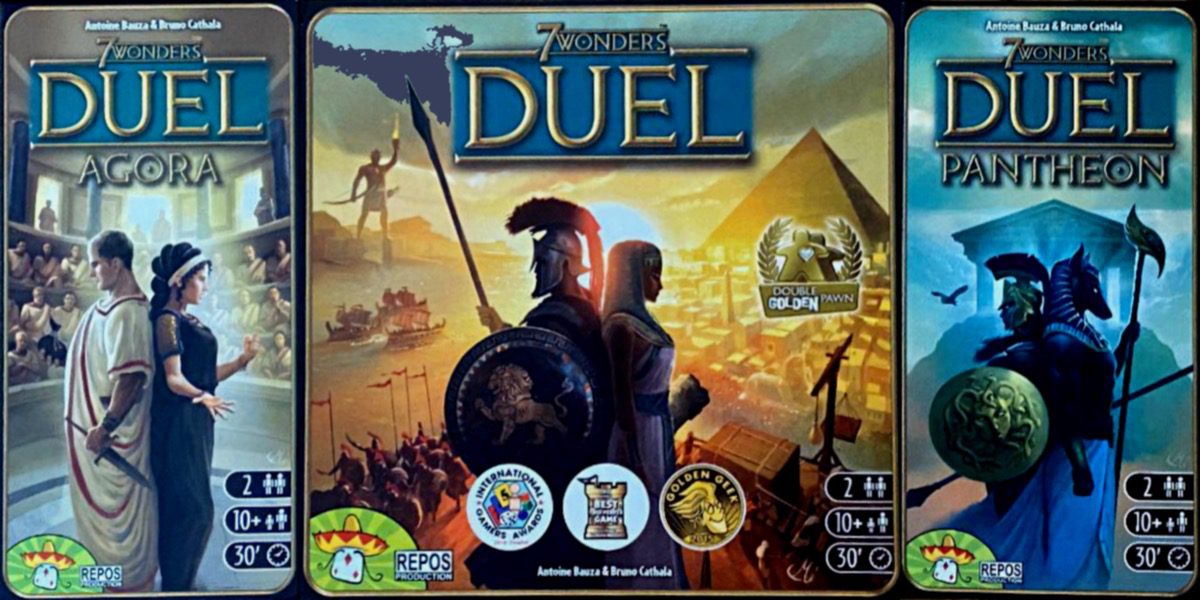
The first article in this series was The Good, The Bad, and The Ugly – Two Player Adaptations. I said that a good example of such an adaptation was 7 Wonders Duel. I was confident in my choice as I am in good company: my colleague, Justin Bell, agrees. I pointed out that one of the things that makes this game so amazing is the understanding that, with the shift from three plus players to just two, the game did not attempt to walk down the same road it had with the multi-award winning 7 Wonders. It understood that with the shift in player count came limitations and opportunities.
The base game is, like its older cousin, a set collection game. Where the original used a drafting system, the new game used various shapes of card tableau, with some cards face up at the start, while others are face down. The arrangement of these cards changes from Age to Age, making each a different puzzle when attempting to gather cards needed to complete your Wonders (plural). Each card taken from the center “card board” (as Mr. Bell described it) can be used as a building, a wonder, or to gather funds – and the yellow cards (financial) make a lot more sense and are far more useful long-term in this adaptation than they ever were in the original. The same is true for military cards, which rather than being point based, are used in a tug-of-war where military-might alone may be able to provide you with the sweet taste of victory. Add in the fact that the science cards have six symbols and gathering all of them can also provide a victory, and things start getting tense. So yeah, the base game has an exquisite combination of multi-use cards, open drafting, set collection, two different sudden-death endings (one of which is a tug-of-war), and a variable setup.
But where 7 Wonders Duel truly shines is when you add in the two expansions!
Pantheon adds in the gods. During the first age, there are mythology tokens on certain cards which, when gathered, allow players to pick from a selection of deities from one of five pantheons. Those deities are then placed on a divinity expansion to the main board and can be called upon in future turns starting with the second age. These gods often cost a lot of coin to use, but can be worth it for their effects. But even if you do not want the effect, the ability to not select a card from the tableau can be a wondrous thing. In the third age, their are temples which (if you get more than one) are worth a lot of points. Pantheon adds once-per-game powers to the game in a beautiful and elegant way.
Agora adds the senate and political intrigue. New political cards are added to the tableaus which include standard senators and conspirators. Senatorial cubes are added to chambers of the senate expansion to the main board. Senators can work within one of six senatorial chambers, each with bonus points and a random power assigned at the start of the game (some known at the onset, some not known) granted to whomever controls that chamber. Senators can do a number of actions (depending on the number of civic buildings in your empire) but are limited to two chambers where they can work. Conspirators can only do one action, but they can operate in any of the six chambers… but their true abilities can be seen in the conspiracies they operate! Agora adds in-game bonuses, area control, and more once-per-game abilities in a flavorful and strategic manner to shake things up.
7 Wonders Duel is a great game by itself. Add in either of the two expansions, and the game is elevated to new levels, having more depth than the original. Add in both, and the game transcends all expectations. Why? Because all of the mechanics fit together as beautifully as the three parts of the main board when they all come together.
The Bad—U-Build Monopoly
Monopoly + Variable Setup = Wasted Potential
When I was a kid (between the ages of 8 and 11, I think), I created a Monopoly board where, at the start of the game, all of the spaces – save the four corners – were blank. As you went around the board and landed on these blank spaces, you would draw from a deck of cards that were the size and shape of those spaces. Drawing three cards, you would pick one and place it on the board in that spot, transforming it into Marvin Gardens, or Park Place, or Community Chest, or what have you. Put the other two at the bottom of the deck. That would be the location for that piece of property (or special space). Buy it or let it go up for auction; build houses and hotels; play Monopoly just as you are used to. That game, conceived of and built by a pre-teen, is far better than the oddity that is U-Build Monopoly.
Lego is a great company. They created a series of build-your-own games with Lego pieces back in the day. These were actually quite clever! From Frog Rush, to the whole Heroica line, these games embraced everything there was about the modular ‘toy’ aspect of Legos and showed kids not only how to make a particular game, but how to customize it, make it their own, or even create whole new Lego board games from scratch. You knew that this was a truly inspired concept when Reiner Knizia got into the fray and created Ramses Pyramid and Ramses Return for the line.
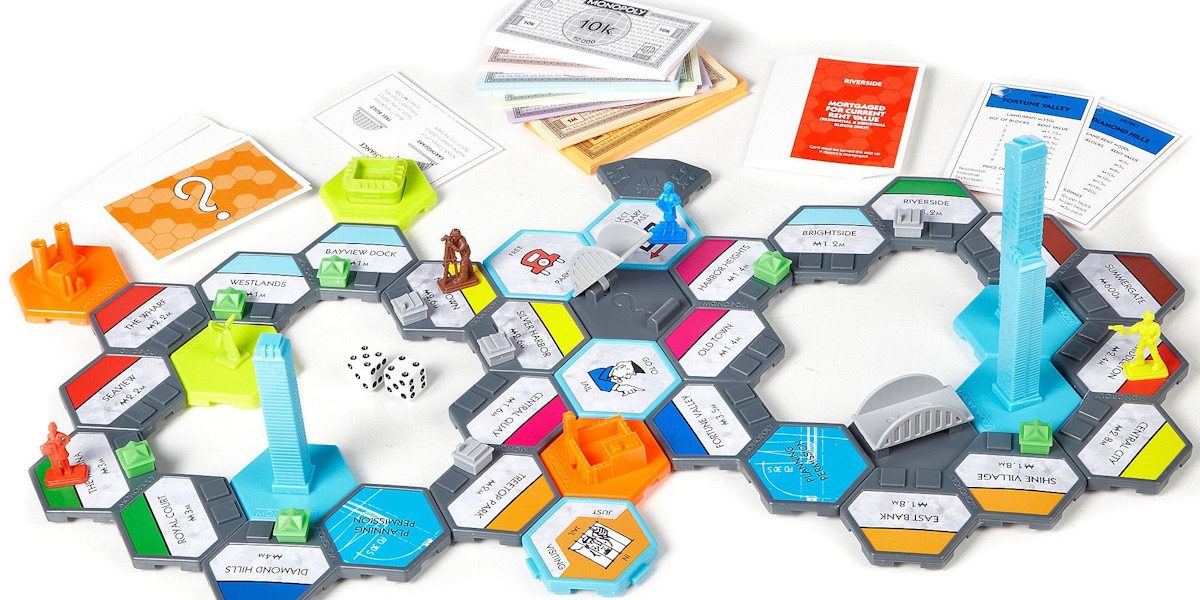
When Hasbro tried to cash in on this line, they went cheap and without consideration. U-Build Sorry was not customizable, nor was it clever, or fun. U-Build Monopoly, however, was near the bottom of this particular barrel scrapping line. The game has a hexagonal modular board that is built at the start of the game. Most of the decision space that exists in the original (what little that is) is stripped away, with the addition of “hazard” spaces and “skyscrapers” placed in some locations to add to the visual appeal.
But in the end, like U-Build Sorry, it is not nearly as customizable as it wants to be, claims to be, or should be. The mechanics of this game are such that it is little more than a roll-and-move with very little else going on. In fact, building the board is more fun than playing on it. And that is just sad.
The Ugly—Noonka Bored 4D
(something-somthing-mumble-mumble-whatever) + 4D = Don’t try this at home, kids!
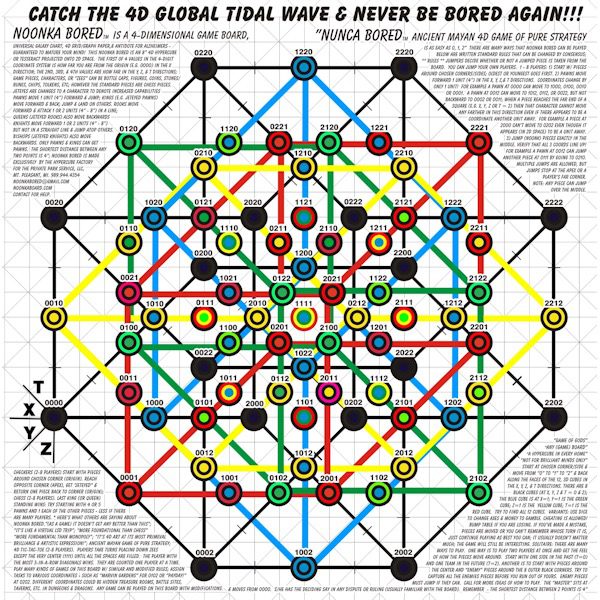
I figure, somewhere in the depths of the nearly incomprehensible mess that is a Noonka Bored 4D grid, there is a half-way decent game. Perhaps it is checkers- or chess-like. Perhaps it is something else entirely. I will never know. I played this “game” twice with a guy at a local game convention in Iowa City, IA one year and, after his explanation of the rules and getting thoroughly stomped both times, while having no idea if this guy was actually playing by any actual rules, I gave up.
He gave me a copy of the board. I took it home and studied it for a while. A couple of times, I came close to having a spark of understanding as to how a game might be played on this thing. But, if I am being honest with you and myself, I have to ask: “why would you?”
The issue here is dimensions. We live in a world where we can perceive three physical dimensions: height, width, and depth. We cannot “see” a fourth (or higher) dimension. On paper, in a two-dimensional representation, we can use perspective or shading to simulate a third-dimension. In theory, we could use similar tricks if we were in a one-dimensional world to simulate two dimensions. But such simulations, as far as our brains are able to easily grasp, are limited to +1 dimension in these simulations.
What I am trying to say is that in a two-dimensional space, trying to simulate four dimensions becomes a muddled mess (see the image below). Sure, the coordinate system and the color-coded lines help, but your brain will not “see” this transformation. You might be able to intellectualize it to some degree, perhaps even play blind by simply knowing the coordinate of each piece. But attempting to add “4D” as a mechanic to anything is, well, just ugly.
Joseph Buszek
The Good—Imperial
Investment meets area control in a battle to become the richest tyrant among all the empires
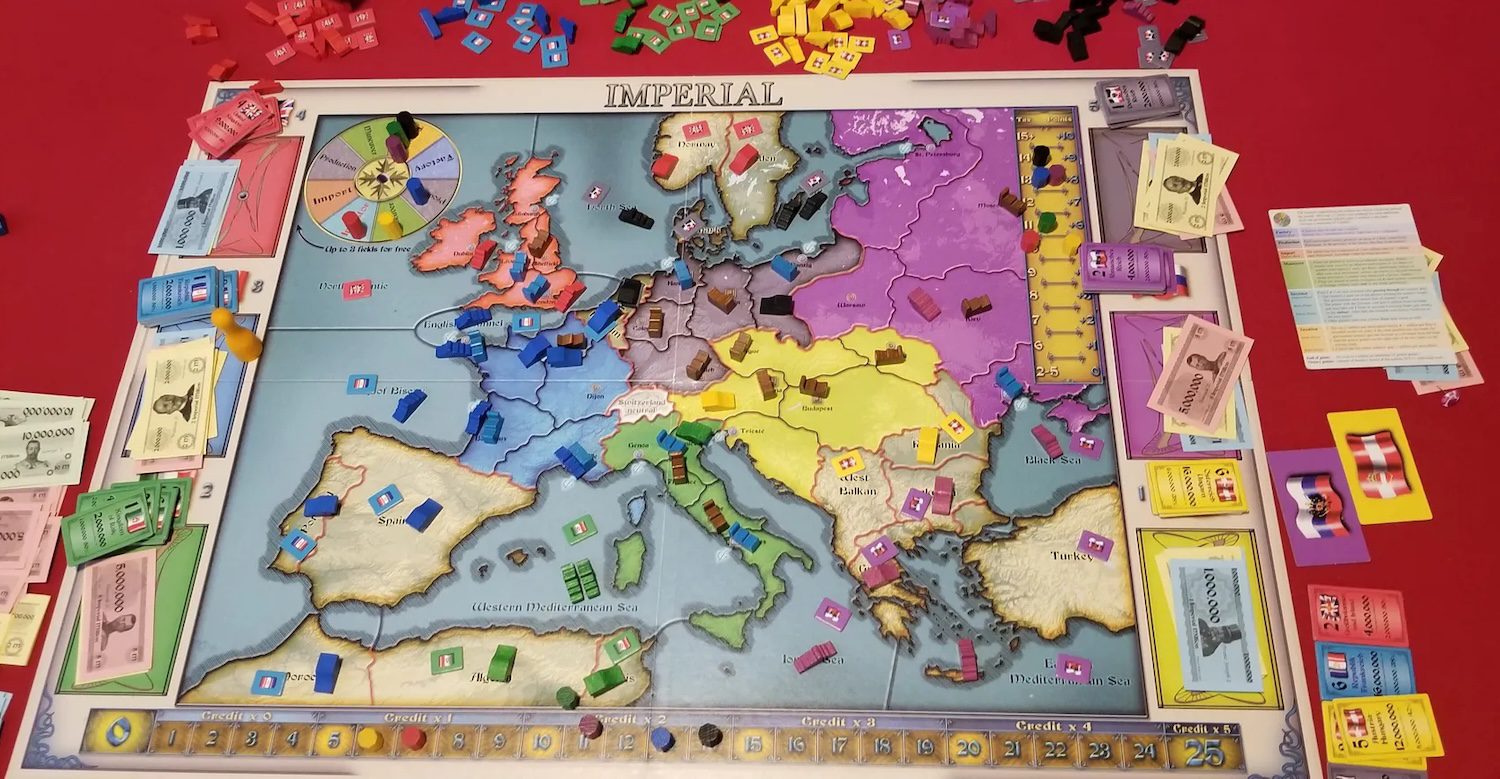
Board games about investing generally don’t compel me. I just don’t have whatever Capitalist bone drives one to get excited about stock trading, and prefer to gamble in other, more exciting ways: cards or dice over companies. Most of the investing games I’ve played usually revolve around trains (18xx) or other route-building mechanics, which have never been of particular interest to me. When one of my friends turned up with Imperial, an economic game by the designer of one of my favorite games, Concordia, I was skeptical but willing to give it a try. By the end, I was searching for used copies of the 2006 game online.
Mac Gerdts has created something ingenious by integrating the investment mechanic into the framework of an area-control wargame. Instead of taking the usual role of a single nation, like in most wargames, the control of each nation’s actions is taken by the majority stock holder, so in one round you might be performing actions for one country and the next, it could be three. While you need other players to invest in each nation’s economy that you control, in order to build more factories and military units, you’re at risk of losing the ability to spend that money towards your own strategy when they do, if they invest enough to wrest control from you.
What makes the entire engine run is yet another one of my favorite mechanics: the action selection rondel. This forces you to make some really tough decisions, using your own personal wealth (not the country’s money) to move further ahead if you want to do certain actions. This same personal wealth is how the winner is determined at the end. It’s no wonder that Gerdts uses this same type of rondel in his other designs, such as Navegador and Hamburgum, as it really ratchets up the decision space.
A couple updates to Imperial have been released; Imperial 2030 is essentially the same game on a larger map, allowing you more easily avoid military conflict if you prefer, and 7 Empires, which curiously removes the rondel and many other key elements—I would avoid this one. For me, the original Imperial is a near-perfect game because the smaller map means there’s nowhere to hide, and it expertly blends combat, politics, and investing in equal measure.
The Bad—High Frontier 4 All
Civilization + route building + 4X + engine building + kitchen sink. All on the busiest map you’ll ever see.
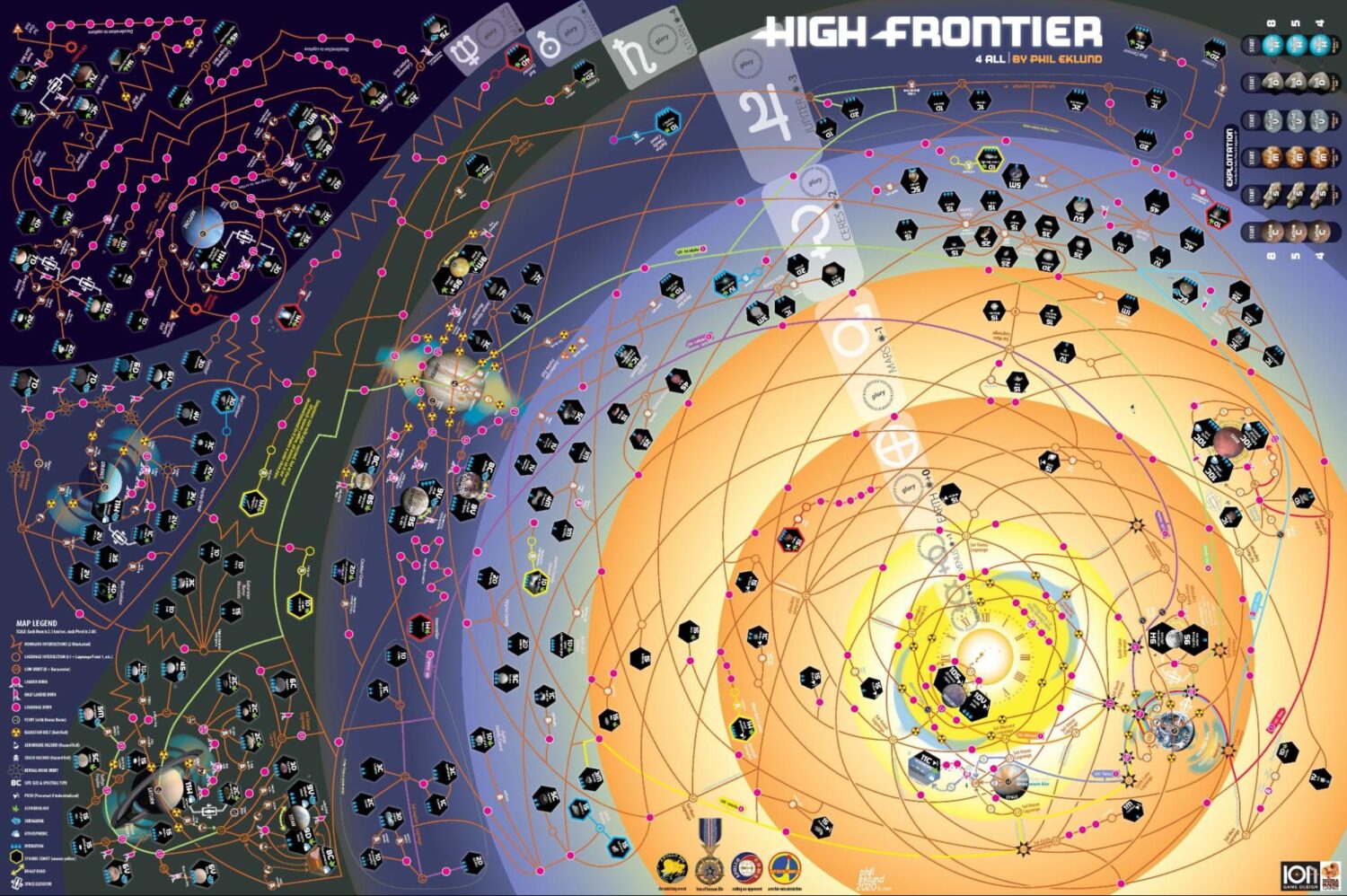
High Frontier 4 All is trying to be so many things. It’s a civilization game. It’s an economic game. It’s an engine builder. It’s a negotiation game. You’ve got pick-up-and-deliver and card drafting. There’s variable player powers and exploration and route building. For so many things that it does, it doesn’t do any of them particularly well. I know many super fans of designer Phil Eklund will say that I just need to put in the time and “get good”, but it’s not like I haven’t tried in the plays that I’ve had. I absolutely don’t mind games that punish poor decisions or have tight resources. I play tons of heavyweight wargames, so I’m also not scared of dense, 50+ page rulebooks. This game is something different altogether. The term “needlessly complicated” gets thrown around a lot but this game earns it and more.
In one playthrough, I bid for the right cards that really leaned into my strategy and set my goals just high enough to reach, only to run out of fuel while attempting to pick up a single item. All my cards spent and resources gone. Ship wrecked. Go back to the start. At this point, I had spent two hours playing the game, only to be right back where I began, penniless with a destroyed ship. Not on account of poor planning or execution but from a die roll. There are so many mechanics stuffed into this thing that the full picture gets really muddled. Generally, with games that I don’t really enjoy, I try to find one positive element or gameplay mechanic that really stood out which makes me want to get back on the horse and try again. Here, every element felt like a chore and the rewards just never felt worth it. Also, good luck reading anything on the map without a magnifying glass.

The Ugly—Arcs
Trick-taking + wargame. A clever concept that misses the mark
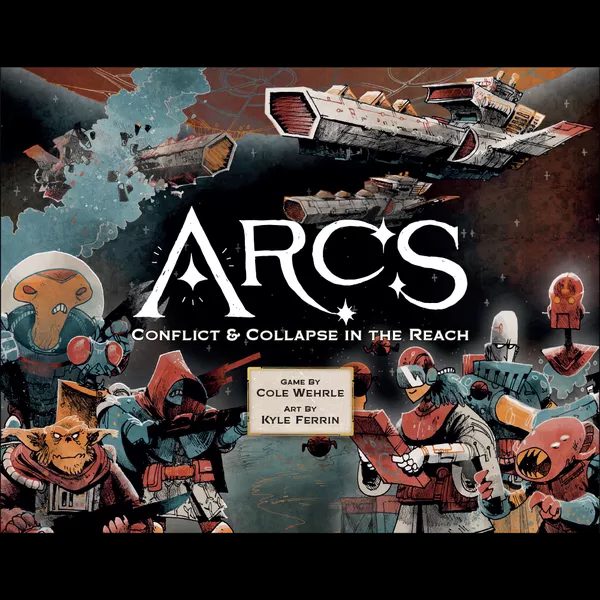
Arcs was a game I was sure I would love. It is an excellent production, made by an acclaimed designer, and had a really intriguing concept, combining gameplay mechanics that I absolutely love: an area-majority, dice-chucking battle game that uses trick-taking to determine actions. You can even steal things from other players–a personal favorite. It had more hype before its release than any game I can remember, including one very influential reviewer calling it “the best board game I’ve ever played”. I was psyched. So, after my fourth play, I was still trying to make sense of why I found it so dull.
While it contains so many elements I enjoy (and I was impressively shocked that they all even work together as seamlessly as they do) each one felt like the watered-down version of itself. The combat felt like an afterthought, the strategy mostly revolved around rewarding ganging up on the player in last place, and the trick-taking came off more like a gimmick than a highlight. I’m not one to be a hater just because a game or designer is popular–quite the opposite in this case. Cole Wehrle’s Molly House is an incredibly unique experience and was on my shortlist for the “Good” section of this article precisely because it blends trick-taking so well with set collection and negotiation. It’s possible that my expectations for Arcs were so high that my disappointment was more outsized than normally would be. I was really bummed that the game was just mediocre.
Final Thoughts
Although we cannot recall who said it, there is a line that goes something like: “Few endeavors are as difficult and as rewarding to the soul as the creation of games for the enjoyment of others.” That hits hard. That goal, that seeking of the soulful reward, drives many a game designer. It must, because very few individuals can afford to do this as a full time occupation.
The problem is that game design can be tough. Very tough. The temptation to put everything you have ever loved into a creation can be overwhelming. When it works, wonderful! When it doesn’t, well… you need to have the discipline to know that stripping things away is just as important as the creation. This is a tug-o-war and game design is art: one has to see it as such. Consider:
- The famed video game designer, John Romero, once said of the game DOOM: “We decided to make this game the best thing we can imagine playing. We have to think of all the amazing things we’ve never been able to do and put them in this game.”
- The famed renaissance-man, Michelangelo, is quoted as saying: “The sculpture is already complete within the marble block, before I start my work. It is already there, I just have to chisel away the superfluous material.”
Having the desire to include everything and the kitchen sink is not a bad thing! One just has to carefully craft each element in such a way that they all flow seamlessly from one thing to the next. But more importantly, one has to realize that often—most of the time—the art of game design is knowing when to remove elements from that original, perhaps overly ambitious design. If you are so inflexible as to not realize this, refusing to trim things down to a manageable form, what you will end up with is a hot mess that feels and plays the way the game boards for High Frontier 4 All and Noonka 4D look. And nobody wants that.
There are games that can take a few dozen mechanics and do it well. We list a couple here. Long time fans of Star Fleet Battles can attest to the fact that, done well, you can have literally hundreds of mechanics in the same game that flow together seamlessly. But more often than not, one has to embrace their inner Knizia and work toward the depths that can be mined from utter simplicity.