The Old King’s Crown – Will Hare
As we put away The Old King’s Crown, there were two seemingly incongruent but true sentiments coming from my play group. The first is simply… that first play was a mess. Total mess. Constant takebacks and missed triggers, being blindsided by some shocking thing you didn’t know your opponents could do, or having your carefully planned turn totally upended by some bonkers, cartoonishly evil play made by another player. The second sentiment, however, was that we all wanted to play again immediately.
Almost everyone agreed that playing with the full four players really escalated the hijinx, so I’d be curious what a three player game would be like. The teach was shockingly smooth, though the real complexity and weight of this game lies in the overwhelming number of abilities and effects printed on the 50-something Kingdom cards, 20 special faction cards, and 16 tactics abilities. I am immediately smitten by this game and want to peel back the layers, while also fully aware that nobody’s first game of this is going to feel super great.
Ease of entry?
★★★☆☆ – There were a few questions
Would I play it again?
★★★★★ – Will definitely play it again
Read more articles from Will Hare.
Tycoon: India 1981 – Thomas Wells
Justin reviewed this one awhile back, I was a Kickstarter backer because I love games that have oblique rulesets. I’m five plays into this one, and it’s a keeper. If I had to describe it, it’s like a Power Grid descendant with bizarro-world shareholding and a goofy resource payment mechanism. All of this comes together for me in a potent mix of wildly sharp decisions peppered with just enough random output from the game system.
The game alternates between different auctions and and an action selection mechanism. There’s a blind bid that comes as close to fixing blind bidding problems as I’ve found, where winner pays the “tycoon” (first player) and everyone else puts their bid currency in a secondary pool to take powerful actions with later. There’s also a twice-around auction to win “industries” that are built using a later action and move you up one of six tracks when built. Building the industries requires resources that are abstracted by the tracks, so if you need oil and steel, you pay the leading player on their tracks. On top of it all, the game has two victory pathways, and if you’re highest scoring on both you win outright at the end, going to a third pathway as the tiebreaker.
I love this game, it’s sharp as hell, and there are no meaningless decisions. The little event deck rocks, it adds just the amount of craziness to the game so certain critical victory paths don’t solidify. I also use a variant for the merit cards that’s talked about here. Really excited to see where the designer goes next with both this game and the sequel, and this one has become a mainstay with my gaming groups.
Ease of entry?
★★★☆☆ – There were a few questions
Would I play it again?
★★★★★ – Will definitely play it again
Read more articles from Thomas Wells
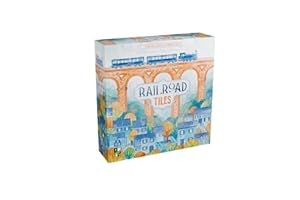
Railroad Tiles – K. David Ladage
I have been playing Railroad Ink (and Railroad Ink Challenge) ever since they came out. I have all the base sets, and every single expansion. I have played all the ways it can be played multiple times – it is a great game. When Railroad Tiles was announced, there were things going on in my life that prevented me from buying the Collectors Edition (or the equivalent in the individual products), so I missed out.
Not long ago, a local game store (Games and Stuff) held a huge outdoor sale. As I was browsing, I saw five of the expansions for Railroad Tiles and asked if the base game was available inside. It was. And so I parted with a bunch of my hard-earned cash. I purchased the base game, and the expansions Desert, Energy, Forest, Lakes, and Monuments.
My wife and I have played the game a few times now and we love it. It is just the right amount of thought and tension for an end-of-a-long-workday game, and we can generally get in 2-3 plays. The game functions like the roll-and-write without the need to be an artist. The game takes advantage of the size of the tiles (adding in cities) and a wonderful mechanic for putting together rail and road networks, as well as combined networks for passengers.
I truly wantneed the rest of the expansions (or the Collector’s Edition). If anyone knows where I can get those, let me know in the comments!
Ease of entry?
★★★★★ – No sweat
Would I play it again?
★★★★★ – Will definitely play it again
Read more articles from K. David Ladage.

Pax Emancipation – Justin Bell
What if the most interesting person at the party speaks a language different from your own?
I considered this idea dozens of times as I tried to learn, then solo, the 2018 Ion Game Design release Pax Emancipation. That’s because Pax Emancipation is almost certainly the hardest game I have ever tried to learn; this, coming from the person who has played more than a dozen games from Ion’s catalog along with other beefy titles ranging from On Mars to Voidfall to Ion’s own High Frontier 4 All. That’s because Pax Emancipation has a rulebook for its “basic” game that I will politely call dense, with a capital “D”; it’s a language so foreign that I read this rulebook maybe a dozen times before trying to play the game. The setup and the turn structure should be very straightforward, but a reliance on terms ranging from “hate rolls” to “manumissions” to “gunboat diplomacy” mean that even people who play a lot of games will have to learn a very unique in-game language just to get through 41 pages and more than 80 massive thematic footnotes.
That’s too bad, because the game itself—like other Pax games I have tried, from Pax Pamir 2E to Pax Hispanica—has the ability to create an exciting narrative around the attempts of various parties to free slaves around the globe in the late 1700s and 1800s through a variety of means aligned with real-world history. I’m guessing Pax Emancipation was quite a story when it hit the market, because I’ve never played a game this ambitious around an area of the world’s history that was so dark. That means the execution is not perfect, because Pax Emancipation is the classic gaming example of biting off more than it can chew, as players take on tasks ranging from taking out slaver ships to installing Marines to freeing millions of slaves in all corners of the world. My solo play told me all I needed to know: I absolutely love that this game exists, and as much as I’d love to play it again, I know I never will because the rules density creates such a high barrier to entry.
Ease of entry?
★☆☆☆☆ – Rough
Would I play it again?
★★★☆☆ – Wouldn’t suggest it, but would happily play it
Read more articles from Justin Bell.
Tembo Tiles – Kevin Brantley
This charming little tile-laying animal game can be explained in about a minute and fully played in five to ten. I’m not usually a fan of real-time games because of their chaotic nature, but this one seemed approachable enough, so I figured, why not?
Each player receives a secret animal and color, scoring points for the largest connected cluster of each at the end of the game. In real time, players draw and place tiles onto the shared play area. Every new tile must connect to an existing one and match either its animal or its color.
There are also rare shiny lion and alligator tiles that shake things up. The alligator is placed on top of an existing tile, nullifying it and potentially breaking apart a cluster. The lion acts as a wild tile, allowing it to connect groups that might otherwise remain separate.
It’s a decent little game that feels perfect for kids or families who may have just returned from a day at the zoo. Speaking of zoos, the entire package looks like something you would find in a zoo gift shop. It comes in a colorful cylindrical tube that would fit perfectly on the shelves of nearly any animal-themed attraction. I don’t mean that as an insult, as I imagine that is exactly the intended audience, but the awkward shape certainly doesn’t help it fit on my Kallax.
The highlight comes at the end, when everyone reveals their secret animal and color. Throughout the game, there is a small element of mystery as you try to figure out which clusters the other players are building. You may even discover that you have accidentally created a massive group that greatly benefits someone else.
There is a light deduction element to the experience, although the required placement rules mean clusters often form naturally. You can watch where people place tiles and try to guess what they are collecting, but the game moves quickly enough that there is rarely time to overthink anything.
Overall, it’s a fast and easy tile-laying game that should go over well with kids, especially those who love animals. It is simple, colorful, and over before the real-time chaos has a chance to become exhausting.
Ease of entry?
★★★★★ – No sweat
Would I play it again?
★★★☆☆ – Wouldn’t suggest it, but would happily play it
Read more articles from Kevin Brantley.