
Disclosure: Meeple Mountain received a free copy of this product in exchange for an honest, unbiased review. This review is not intended to be an endorsement.
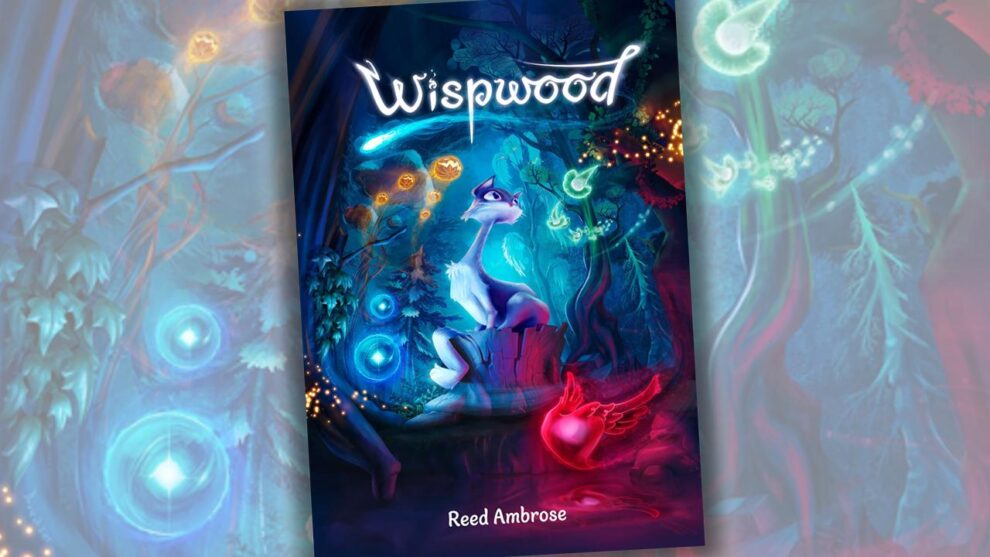
Soon after I opened Wispwood, the new tile-laying, pattern building game from Czech Games Edition, I knew we were in a very, very safe place.
Wispwood has cats. Animals seem to be in games all the time nowadays. There is a big bag of tiles, with simple, darkened trees on one side and “wisps” in one of four different colors on the other side. There are scoring condition cards, five of which are featured in each game. Tiles are placed on player boards in Tetris-style polyomino shapes, with players asked to complete grids in increasing sizes, from a 4×4 in the first round to a 6×6 square grid in the third and final round of the game.
Wispwood feels like many, many other games, representing the latest in an increasingly, and somewhat shockingly, crowded tabletop genre: the compact, often animal-themed tile-laying game. CGE didn’t have one, but as a company looking to build on a very reliable base of exceptional content, Wispwood fits the bill.
It has only one major flaw: it doesn’t surpass the titans of the genre.
Peekaboo
Wispwood is a tile-laying game for 1-4 players. Across three plays (a solo play and two four-player games), I found Wispwood to play in about 10-15 minutes per player. Scoring is the hardest part of the game, with a high volume of conditional elements that must be scored at the end of each of the game’s three rounds. (CGE has an app that can be used to score each player’s tableau; I didn’t use it, but I imagine most players will find value in having something else doing the math!!)
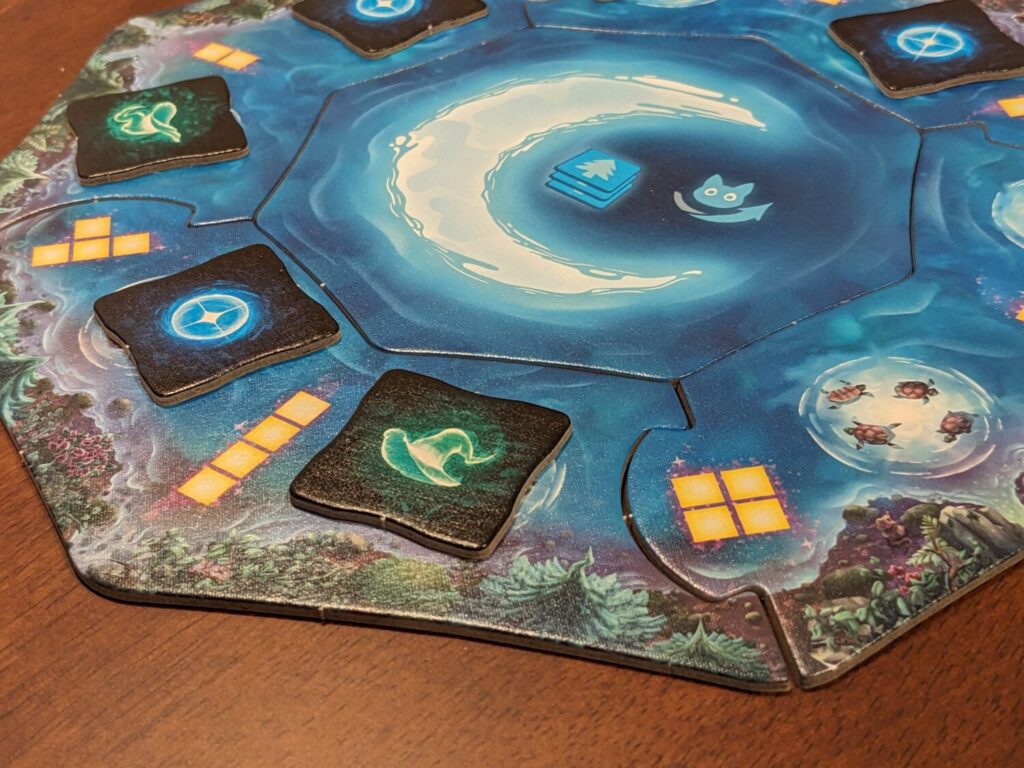
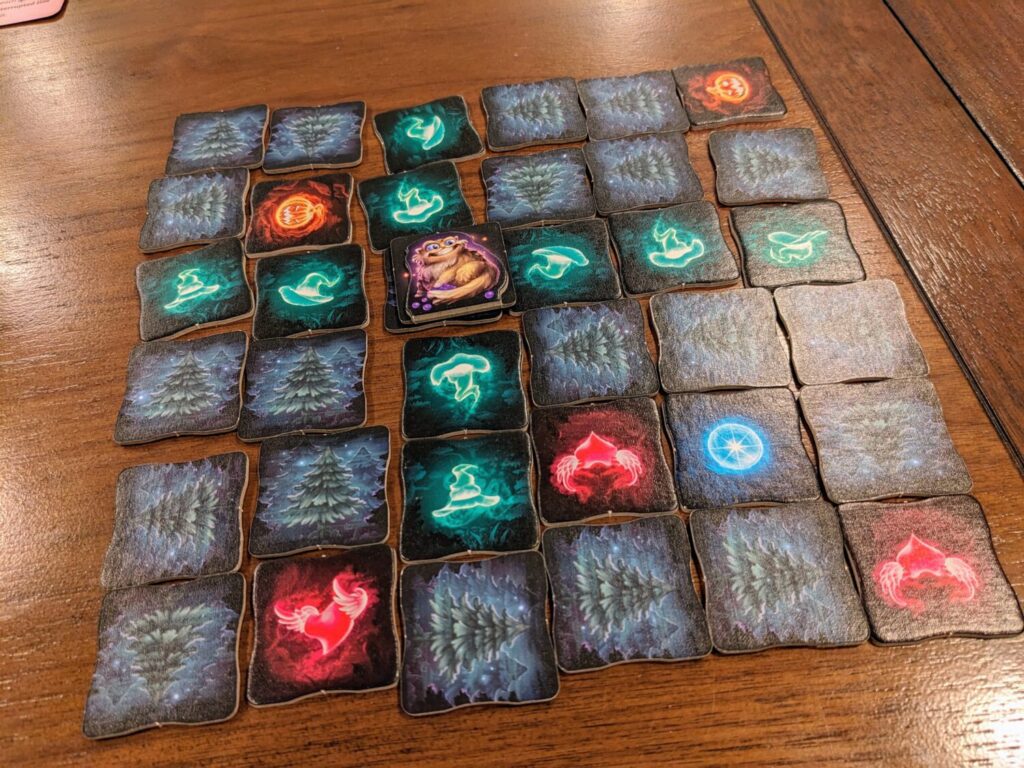
The game centers around a small drafting board with eight positions; each spot has a face-up wisp tile bordered by two polyomino shapes featuring 2-4 blocks. When players draft a tile, they must then add face-down tree tiles from the supply to build their shapes matching one of the polyomino shapes. These shapes are then placed adjacent to previously placed tiles in a player’s tableau.
Wisps make up just one block of each overall shape, and each wisp has a placement condition that dictates scoring. If you’ve played Cascadia, Cartographers, Calico, Harmonies, or any of the many dozens of tile-placement variants over the last five years, you’ll be in familiar territory. Each round ends when a player completes a square grid with 16, 25, or 36 blocks, based on the round number, and a scoring takes place after each round.
The one thing about Wispwood that stands out: when a round ends and tiles are scored, players remove the face-down tree tiles, leaving just the wisps. So, placed wisps score again and again, with new face-down tree tiles added when players add new shapes to their tableau. This makes for a fun planning element along with giving players a chance to temporarily pivot into new scoring opportunities in future rounds.
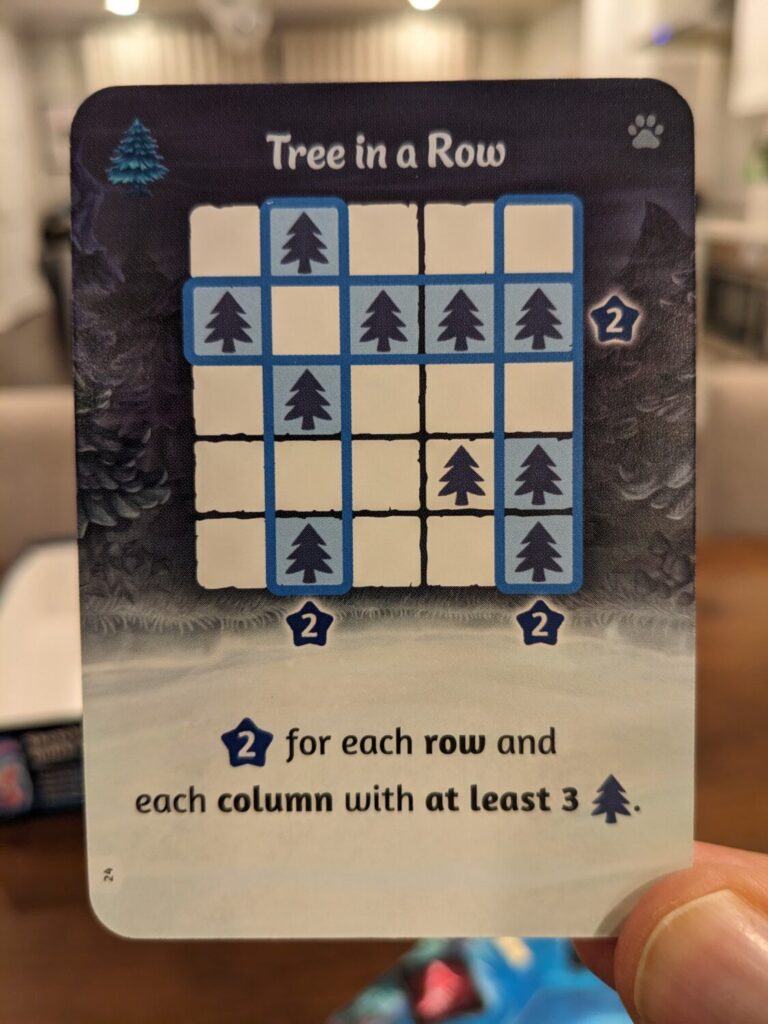
Wispwood also comes with a 25-card deck for scoring conditions, with only five used in any one game, offering a decent amount of variability from game to game. Otherwise, my three plays felt similar, and every scoring approach felt balanced; no matter what players focused on, scores always ended up being pretty tight.
Cat Lovers, Please Apply
Wispwood’s standout component is a cute cat token that players use to start their initial tableau. This cat token is double-sided, showing one of the six funny-looking, big-eyed cats available to players on one side, then that same cat peeking from within a tree on the other. I’m not a cat guy myself, but I had to admit that this is a cool component, which functionally serves to remind players that they have used a bonus power on a previous turn that must later be reset during a pass action.
Otherwise, Wispwood is pretty standard fare.
Other titles that feature the draft of shaped tiles, beyond the ones mentioned above, do things that build on the puzzly stuff, such as Art Society, Mighty Board’s 2023 release featuring tile placement with a fun bidding mechanic. Some of the heavier titles I’ve covered, like Horseless Carriage or Union Stockyards, are a little thinkier but build on their tile placement elements with more interesting systems. The Princes of Florence might be the best auction game I’ve ever played, but at its heart, it is more of a tile placement game than it is an auction game, with the purchase of specific shape sizes dictating how players score the majority of their points.
In Wispwood, you’ll draft a tile, turn it into a square or an L or a line or something, then score the whole grid at the end of each round. My family liked Wispwood, as did three of the guys in my review crew. One of those guys is always looking to add tile-laying games to his collection so Wispwood will check that box.
But no one, even Mr. Tile-Laying Game Guy, seemed to love it.
Scores regularly reach into the 150-200 point range or more, so Wispwood has the weird distinction of feeling like a tile-laying point salad Euro, if that’s a thing. For most players who love this category, Wispwood doesn’t surpass the greats, so it’s a hard recommendation for anyone beyond players who are new to this category. (Or players who insist on having more cat games on their shelves.)
If you are a player looking to build your collection, Wispwood is a great place to start!