Disclosure: Meeple Mountain received a free copy of this product in exchange for an honest, unbiased review. This review is not intended to be an endorsement.
To design a meaningfully thematic trick-taker is no small accomplishment. Other than Traveluencer, Daniel Newman’s Gachapon Trick is the only other one I can think of off the top of my head. In Traveluencer, the players are social media stars, and the cards they play represent both their posts and their view count. The trump suit is whatever topic is trending. The winner gains likes as points. It’s good. It’s thorough.
Mechanically, designers Ryo Nakamura, Zhonghao Yang, and Kai Zu have drawn from an unlikely source: Taiki Shinzawa’s 2019 charmer Inflation!. In both Inflation! and Traveluencer, you can play as many cards into the trick as you want, chaining them to create a single high number. If I play a blue 2, 5, and 7, I’ve played 257. There’s no limit to how many cards you can chain, but you do want to avoid both running out of cards too early and having any cards left at the end of the hand. Tricks missed due to a lack of cards represent periods of inactivity, death itself in the world of social media.
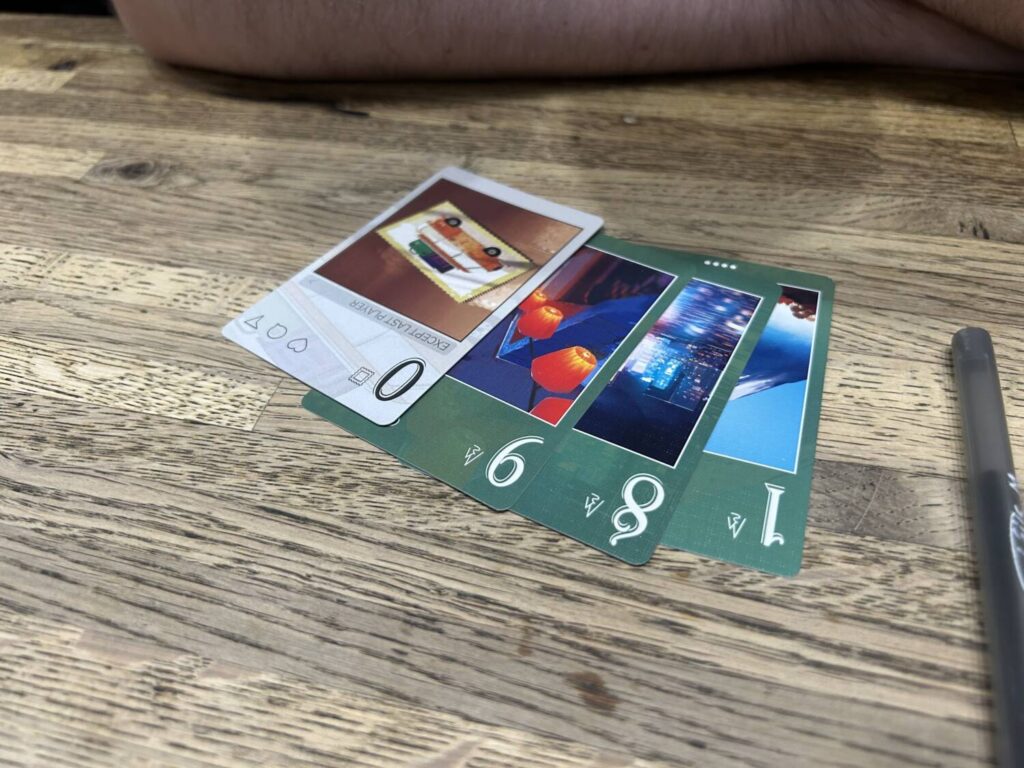
The risk of you running out of cards is minimal. Almost non-existent. There is no requirement around how many cards you have to play into any one trick, and you aren’t even required to follow the lead suit. You are encouraged to play more cards, since the number of cards in the winning play determines how many likes that player gets, but there’s no requirement that you play more cards than the last player or anything like that. The restriction exists to keep players from dumping all their resources into one early trick and then hanging out for the rest of the hand.
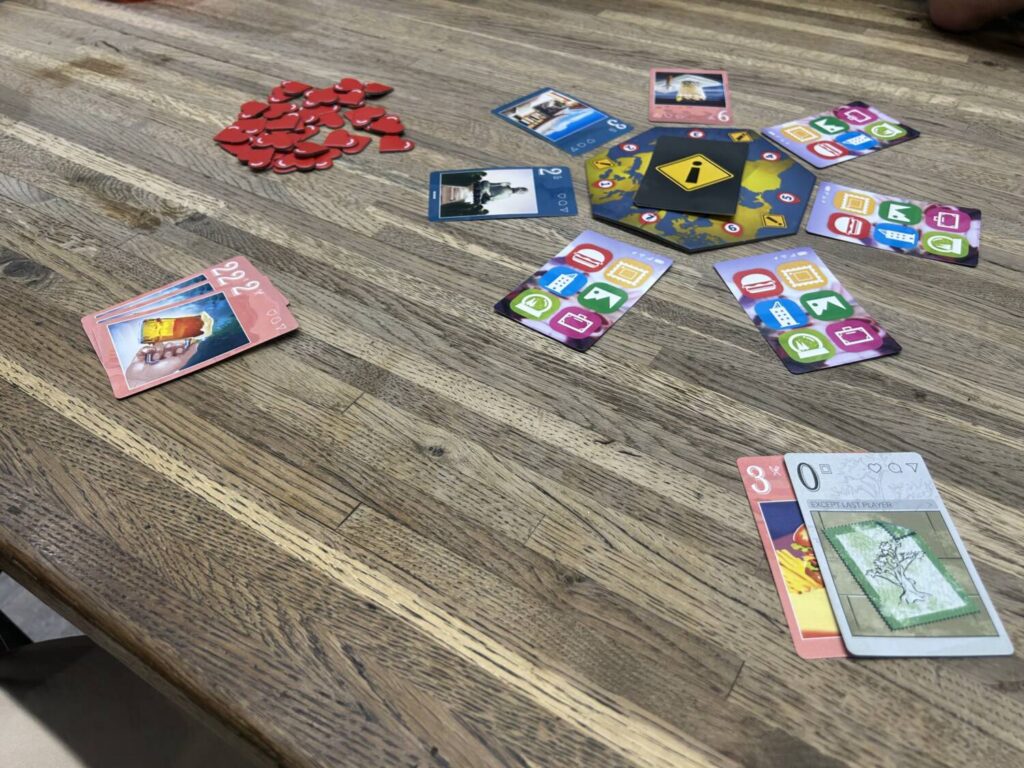
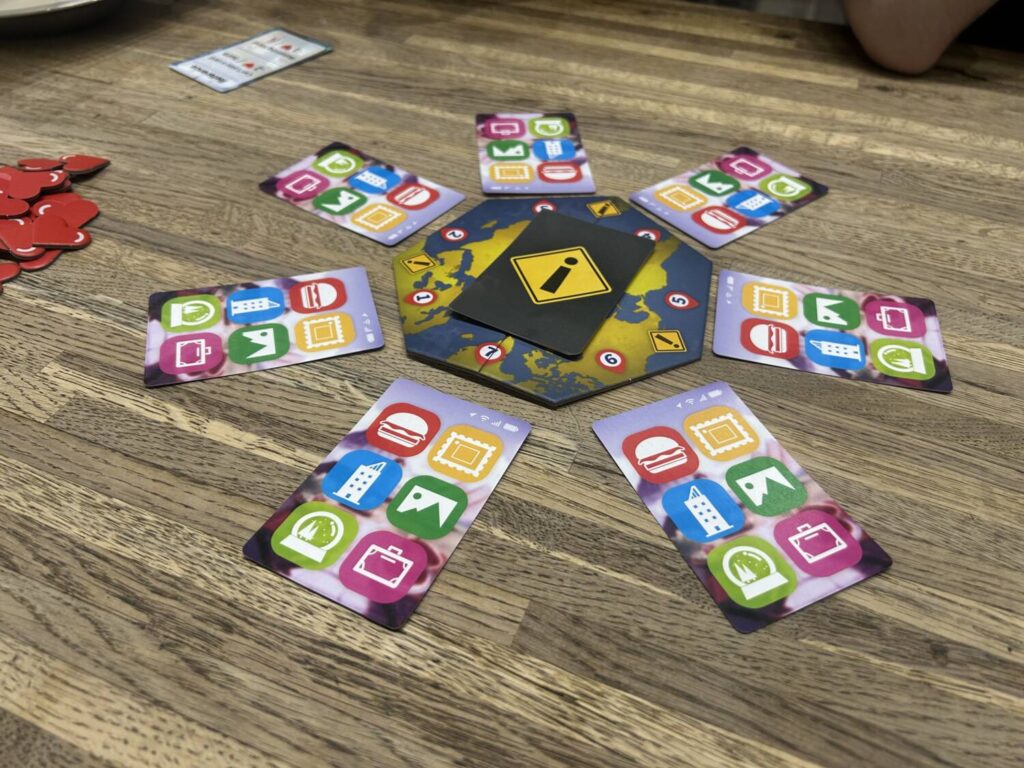
The trump suit changes from trick to trick, mapped out at the start of the hand by seven cards played in a circle surrounding the central board. While I’ve played games that mapped out the trump suits before—Hugame’s excellent The Icarus Club makes tremendous use of this idea—Traveluencer makes little of it. Between the lack of a requirement to follow and the large number of cards in your hand, it tends to be that either the player in the lead position puts down a bomb of an opener that isn’t worth beating, or the player in last position scoops. It’s just not very interesting.
And then there are the event cards. I loathe events in trick-taking games because the whole point of trick-taking games is that the system is already murky and impermeable. You can plan for contingencies, but you can rarely plan. The events here take any remnants of predictability in trick-taking and chuck them out the window. The worst offender is one that causes all players to pass their hands one player to the left. Sure. You never know if it’s going to be in the event pile or not, so you can’t plan for it, which means it can’t meaningfully impact play, which means you have to play a normal hand normally and then, whoosh, it may or may not suddenly go away.
This, to me, is bad. Traveluencer has two things going for it: It is thematic, rare for a trick-taking game, and it is one of the more individual trick-taking games I’ve played in a bit. The problem is, that second point isn’t necessarily to its benefit. It’s not that the game has too much going on, but it doesn’t harness its choices meaningfully. I can’t say the game works, but I can say I would rather play an ambitious design that fails than a modest design that doesn’t try.