
This is my first review for Meeple Mountain, so by way of introduction let me tell you that tile-placement games are my favorite. Carcassonne was my introduction to modern hobby games, and it’s possible this created a soft spot in my heart for the genre. And if a tile-placement game also has a city-building aspect, as in Warsaw: City of Ruins, Neom, or Suburbia? That’s a double win. Throw in a puzzle to be solved and wrap it all in a light- to medium-weight game, and you’ll almost always have a hit with me, unless the game is mechanically flawed, bug-ugly, or offensive in some manner.
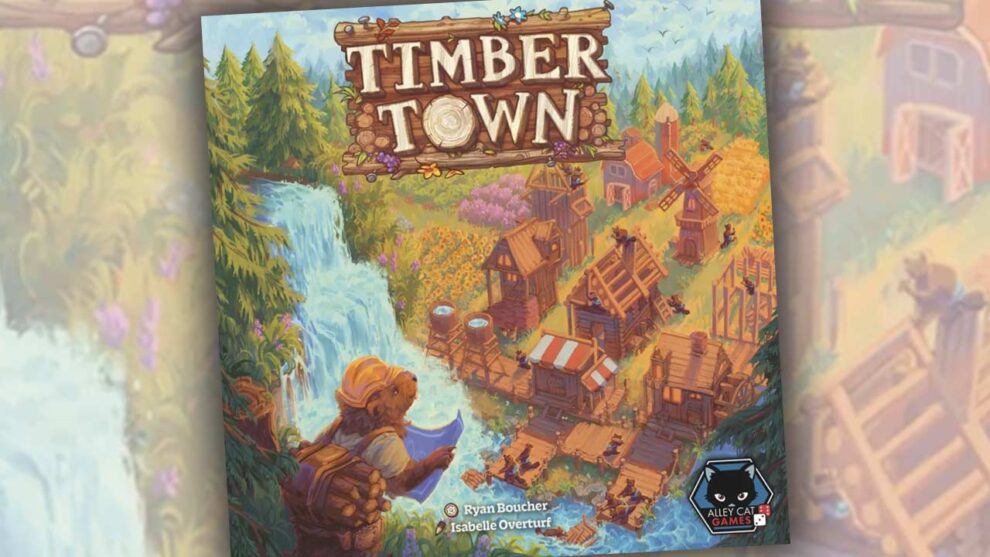
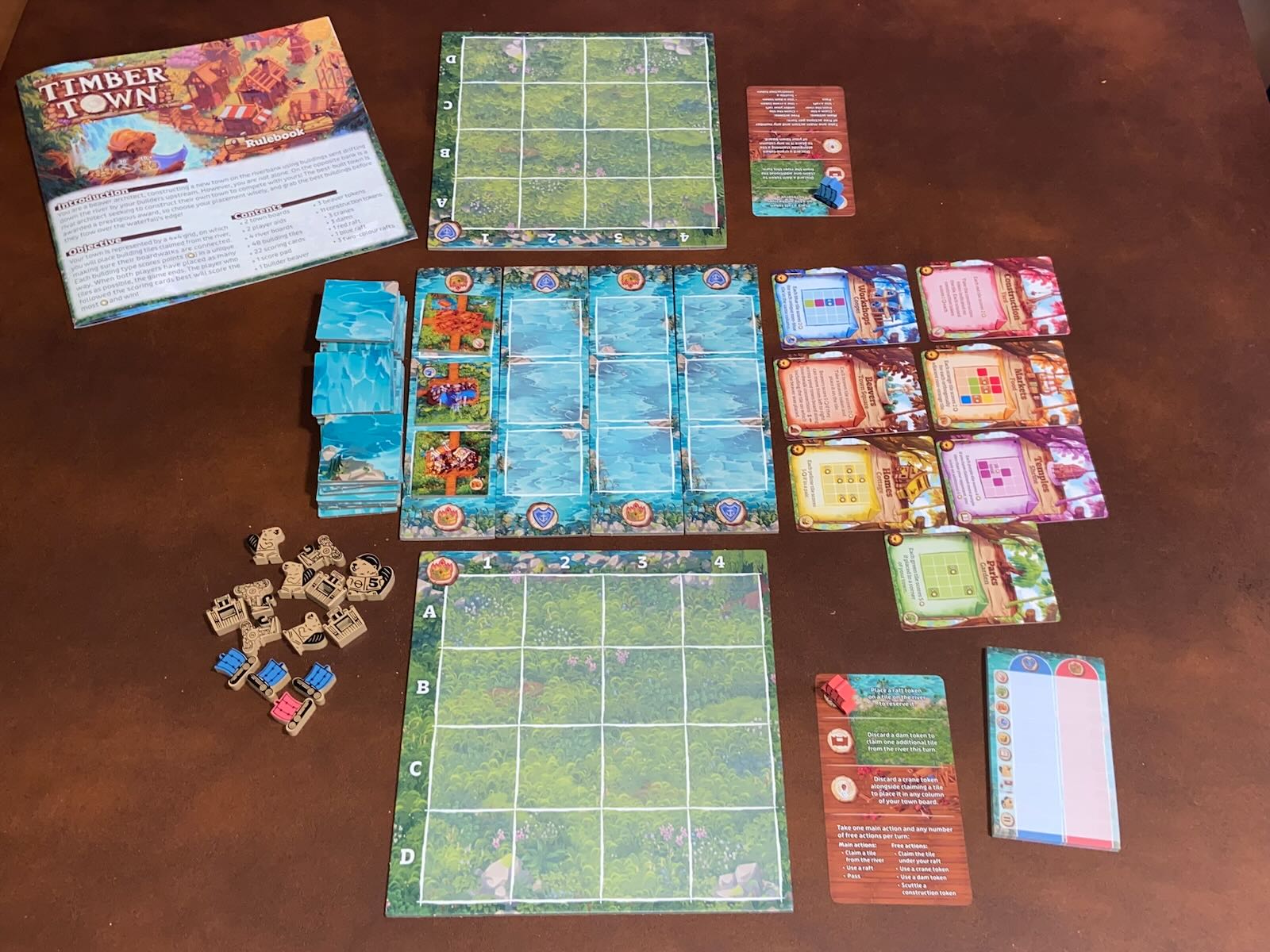
Enter Timber Town from Alley Cat Games. Timber Town is a two-player game where players are beaver architects competing to construct the best (i.e., highest scoring) town on opposite sides of the riverbank. Your eager beaver builders construct town components (in the form of tiles) upstream and then float them down the river for you to collect and place in your town. As the architect, it’s your job to place the tiles in legal and optimal scoring positions.
The trick is, the river is fast moving and components you (or your opponent) don’t choose in a timely manner will fall over the waterfall, lost to you forever. This simulation is accomplished with a neat, four piece river board. At the end of each round, the last piece of the river board is emptied of all remaining tiles and placed back at the beginning of the river where it is refilled with three new tiles. As the river board moves, players also alternate taking the first turn each round.
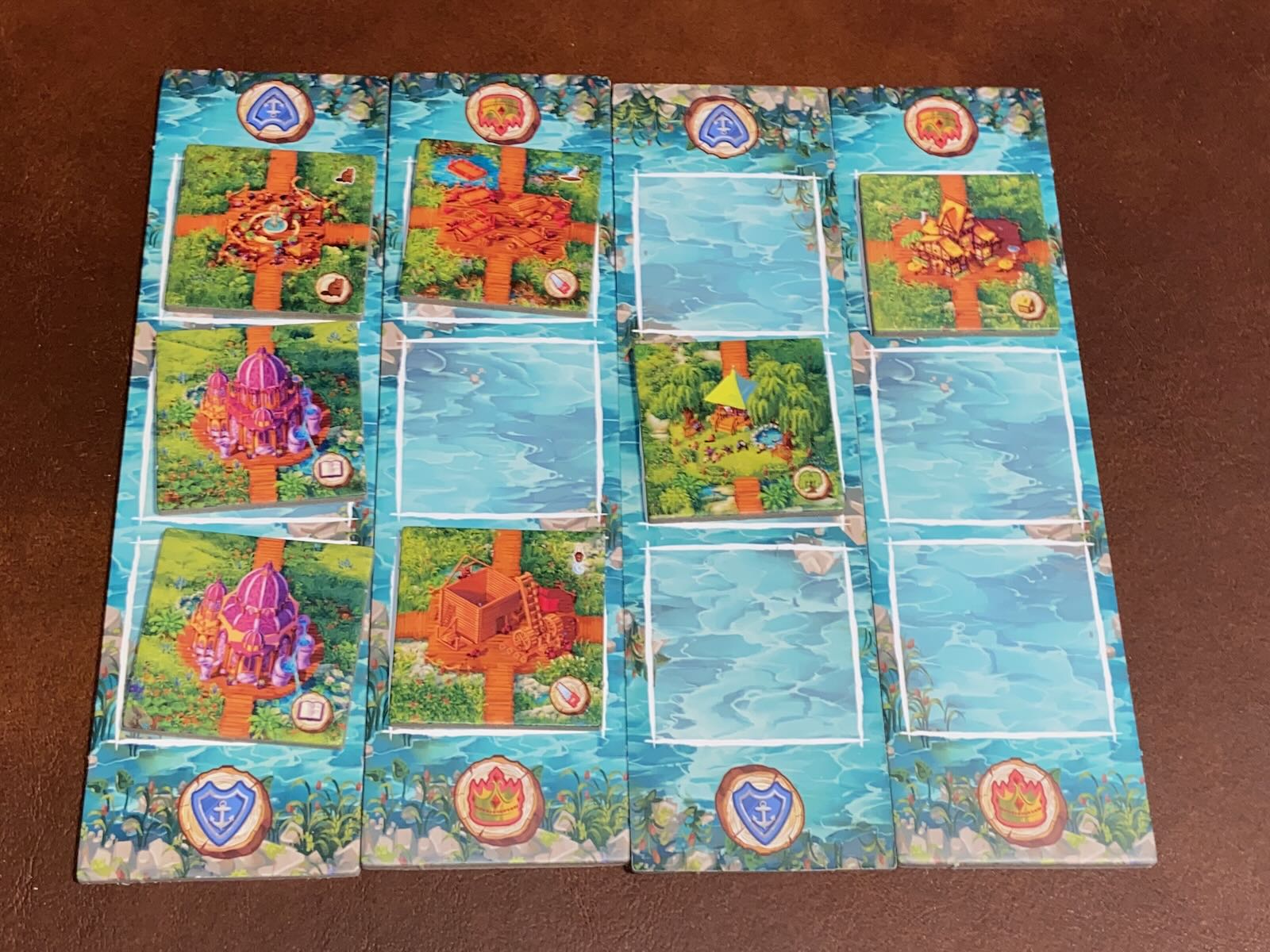
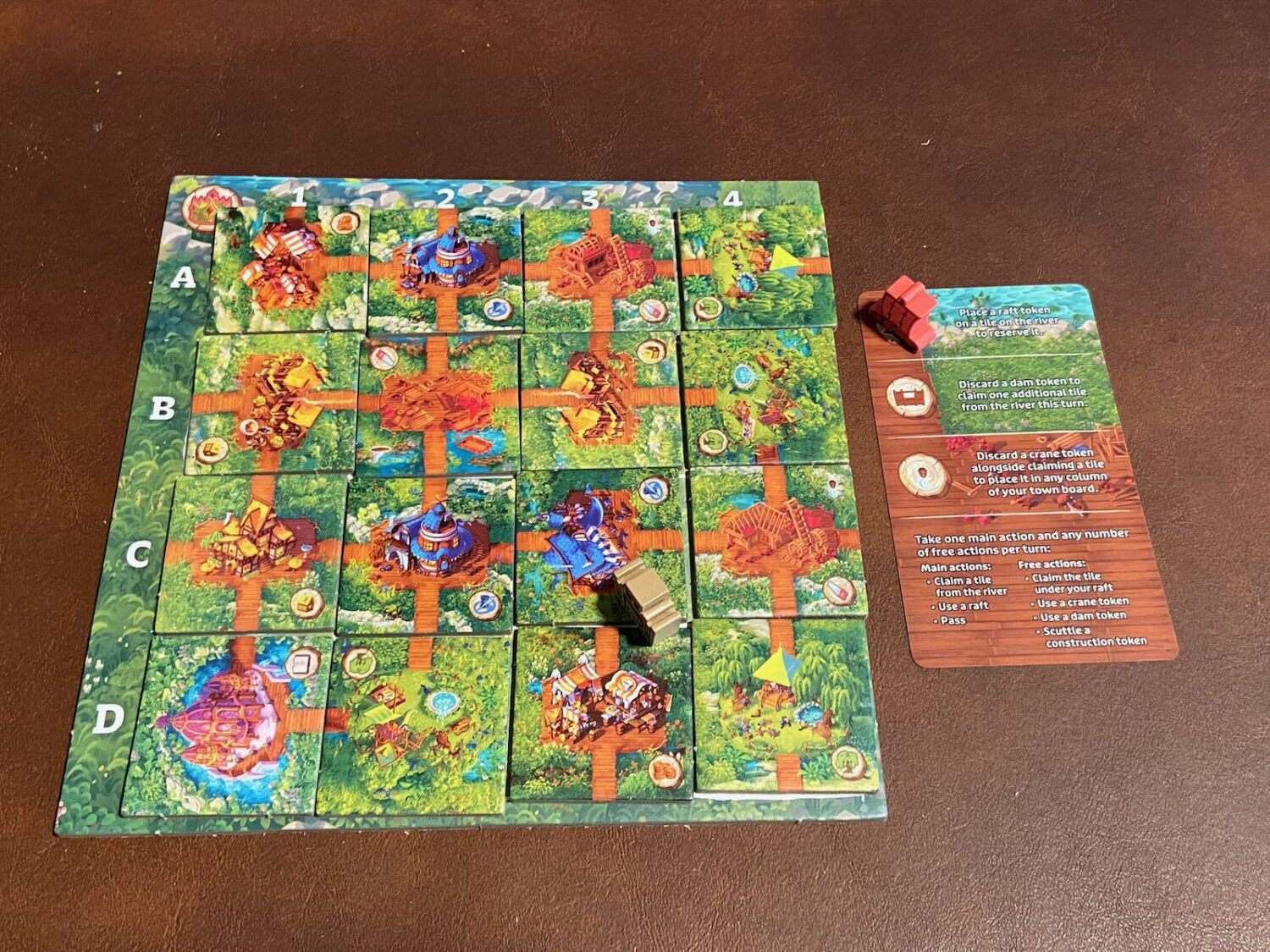
As the river boards float by, they dictate where you can place tiles in your town. Each player’s town board is divided into four columns. The river boards are placed between the player’s town boards so that their columns align with those on the town boards. If you take a tile from the river, it can only go into the matching column on your town board. This continually moving river means that you have to decide what is best for you right now, and what you are willing to let flow down the river.
Of course, if you let something go downstream, you may not be able to use it later, depending on which column it will need to go in. So you can’t only pay attention to what you want to do this turn, you need to plan ahead and leave spaces available to hopefully place later tiles. And then hope your opponent doesn’t snatch the tile(s), scuttling your plan entirely!
Fishing a tile out of the river and placing it in the correct column on your board is only the first part of the puzzle in Timber Town, however. Each boardwalk on a tile must also connect to another boardwalk, or to the edge of the board. If you can’t make the connection, you can’t place the tile. Unless…
Beaver Construction Workers to the Rescue
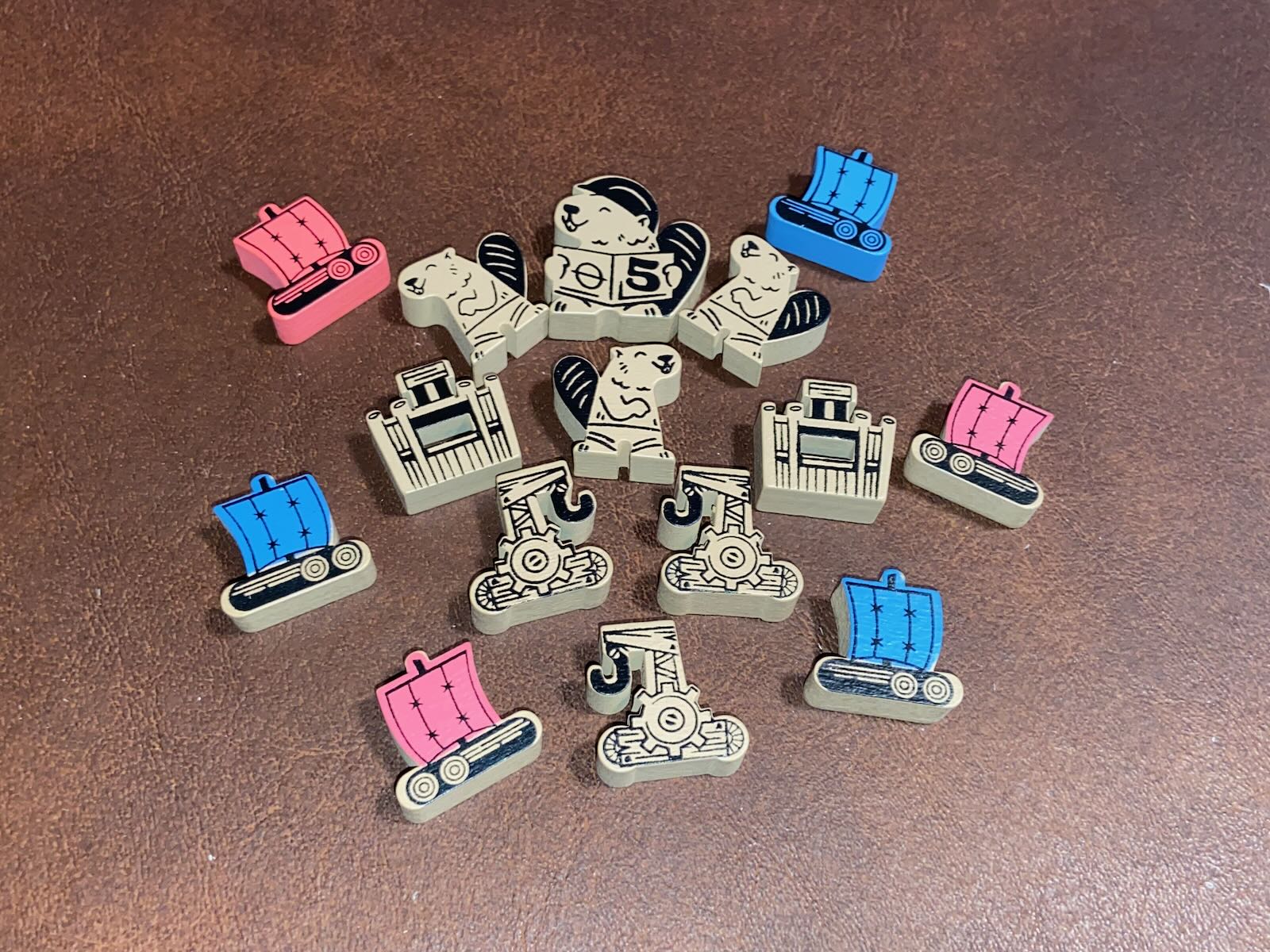
Your beavers are crafty critters, and they want to help you out. They’ve built some devices that let you bend a few of these rules. Choose the right tiles, and you’ll get access to these devices (which are tokens you place on your board). Rafts let you reserve a tile so that it may not be claimed by others as it moves down the river, giving you a chance to claim it later. Dams let you claim one additional tile on your turn. And cranes let you place a tile in any column on your board, instead of limiting you to the column from which the tile came. You can also scuttle a token and use it to create a boardwalk connection between tiles if you can’t create a legal placement otherwise.
The problem is, there aren’t nearly enough of these tokens available to bail you out of every tight spot. You’ll have to make some sacrifices and settle for less than ideal placements in some areas to hopefully build up other areas. And if you manage not to use your tokens, they are worth extra points at the end of the game, making the decision to use them or not even more fraught.
But That’s Not All Folks…
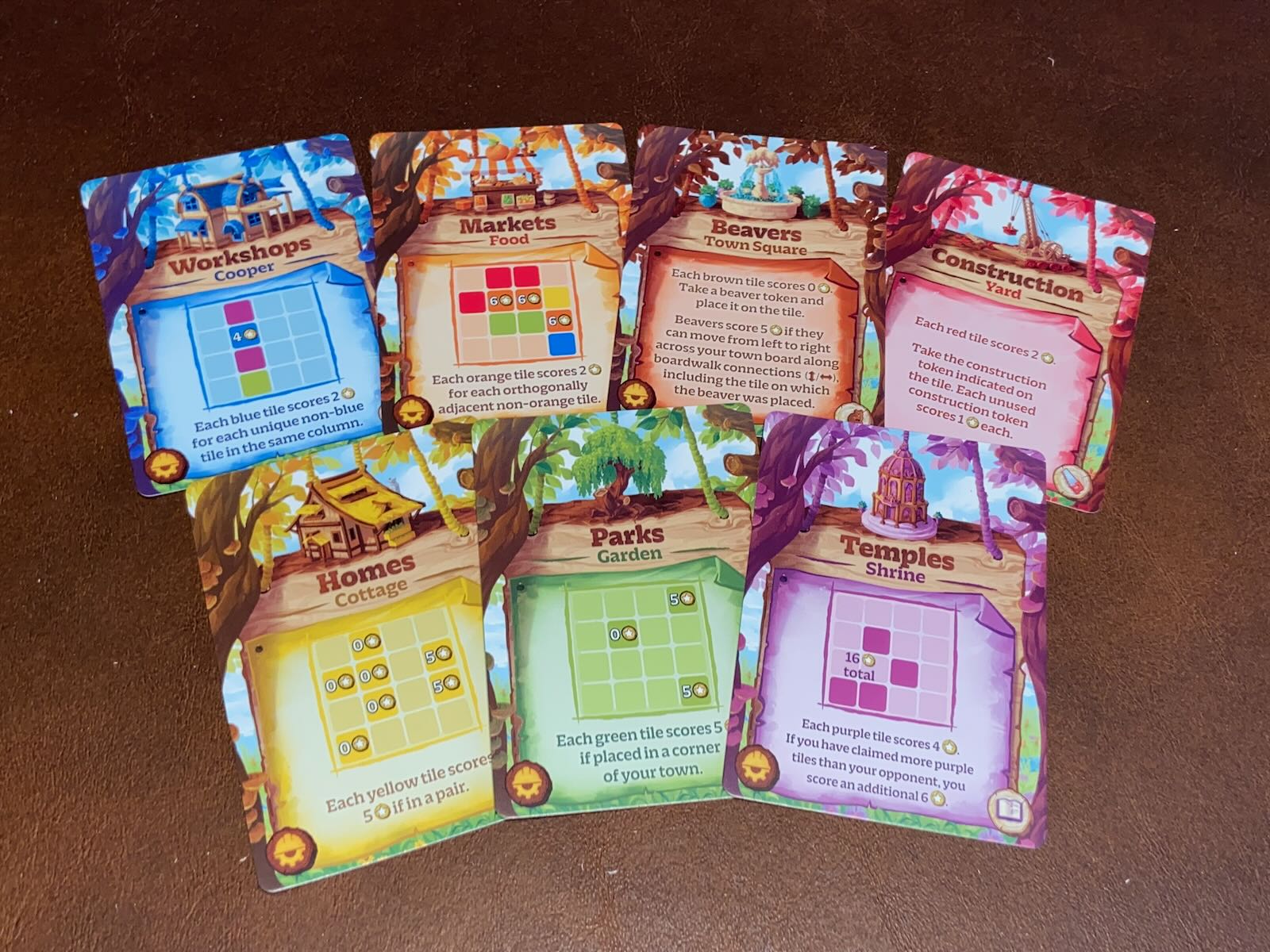
If that were all you had to consider, Timber Town would be a fun puzzle but not a very thinky one. There’s one more wrinkle in this game. Seven scoring cards (one for each building color) dictate how your buildings will score at the end of the game. For example, the green card might indicate that green tiles will only score if placed in the center of your town. The yellow card might only let you score trios of yellow tiles. As I mentioned, seven scoring cards are in play each game and you can choose to either play with the starter set, or mix it up and add in more challenging cards. Beyond the starter set, there are four of each color, except for red and brown, of which there is only one. This customizable scoring keeps the game from getting too stale. It strongly reminded me of the building cards in Tiny Towns, another game that I really enjoy.
And while you’re juggling all of this as you’re building your town, don’t forget the beavers themselves. If you gain a beaver token from a Town Square tile, you earn extra end-game points if that beaver can walk a continuous pathway across your board from Column 1 to Column 4 while also passing through the Town Square tile.
It’s this four-pronged puzzle that makes my brain happy. Figuring out which tiles to take for my town, trying to plan forward in case a coveted tile is still available downriver, managing the use (or hoarding for points) of tokens, and placing buildings so that I get the most out of the scoring cards is a fun challenge.
Two Beaver Goodness
I enjoy two player games, generally speaking. It’s my easiest player count to get to the table, and games that are tuned specifically for two often produce a tense, yet fun, game night in a smaller, easier to “set up and go” package. Unfortunately, too many of them are either deduction games (not my favorite), or “duels,” which can be a bit mean to play. Or they are just stripped-down versions of a larger game, with something lost in translation.
Timber Town is none of that. It’s competitive, but not mean. I can’t steal anything from my opponent or destroy their town. There isn’t a lot of direct interaction, other than we both know what the scoring cards will reward, and we’re both going to go for tiles that suit those arrangements.
I could try to deny my opponent a tile they need if I see that they are getting close to satisfying a scoring card, but that may come at my own expense if it doesn’t fit well into my town, or if it means using a precious raft to keep it away from them. It might be worth it in some cases, but I’m probably better off figuring out how to maximize my own town, rather than working to minimize theirs. My preference is for games that feel positive in this way, and Timber Town delivers.
There’s a little randomness when the river is refilled, as you’re never sure what’s coming out of the stacks of tiles. Beyond that, the game is fully in your control. All the scoring conditions are known from the beginning. This makes me feel like I have plenty of agency in my choices, while at the same time throwing the odd wrench into my and my opponents’ plans so that neither of us can figure out a win from the first turn. It’s a gentle river, not a raging whitewater of a game.
Final Verdict
Before I deliver the verdict, there are only two slight hiccups to mention. I can’t fully call them negatives because they don’t break anything or make me not want to play. They’re just more of a bump in the road and a personal preference.
First, the scoring is a bit fiddly. There are nine possible scoring conditions (scoring cards, walking beavers, unused tokens, and the “Builder Beaver” awarded to the player who completed their town first). The score pad is handy, but it can take a little time to go through everything and double-check that you’re not missing something. It gets faster the more often you play and internalize the requirements, so it’s not a deal breaker.
Second, while the scoring is customizable and there are quite a few different cards you can play with, I wish there were just a few more. The cards represent the city atmosphere with names like Estate, Monastery, Flower Market, Chalet, etc. While the type of building and the tile arrangement necessary to score each card can be viewed abstractly (as in, “Green tiles score more points the further away they are from the draw stack,”) you can also deepen the theme if you imagine why the tiles are rewarded that way.
The example I just gave comes from the Estate card. It makes sense that the tiles that are placed in the columns furthest away from the draw stack would be worth more points, as they are more difficult to place, owing to a likely smaller number being available further down the river. And since estates are usually valuable properties, this makes sense to me theme-wise. All the cards can be thought of like that, and you can really get into the theme if you choose to.
Maybe I’m overthinking it, but I tend to do that in city-building games as I like to feel like I’m building something real rather than just slapping cubes and tiles down on a board. In any city-building game, the more variety in buildings, the happier I am. So I’m greedy and wish for more buildings! I do hear the designer is working on an expansion, though, so I may get my wish.
Timber Town hits my tile-placement sweet spot. It’s lightweight, but thinky. Short enough at +/- 30 minutes to play on a weeknight, but with enough decisions to deliver a full game experience. It’s got lots of ways to score, meaning there’s almost always something to try for, even if you can’t get your first choice tile. The puzzle is challenging without completely melting my brain, and it scores high on my “let’s go again” meter because I want to beat my previous scores.
All in all, Timber Town is a town that I’m happy to visit often.
Timber Town details
- Designer: Ryan Boucher
- Artists: Isabelle Overturf
- Publishers: Alley Cat Games, REXhry, Seabrook Studios
- Release Date: 2025
- Player count : 2
- Age range : 10+
- Time range : 30 - 45 minutes
- Mechanism(s): Connections, Open Drafting, Slide/Push, Tile Placement, Variable Set-up
- BGG Geek Rating: 7.3804 - converted to Meeple Mountain scale: 3.5.
- More articles about Timber Town.