
Disclosure: Meeple Mountain received a free copy of this product in exchange for an honest, unbiased review. This review is not intended to be an endorsement.
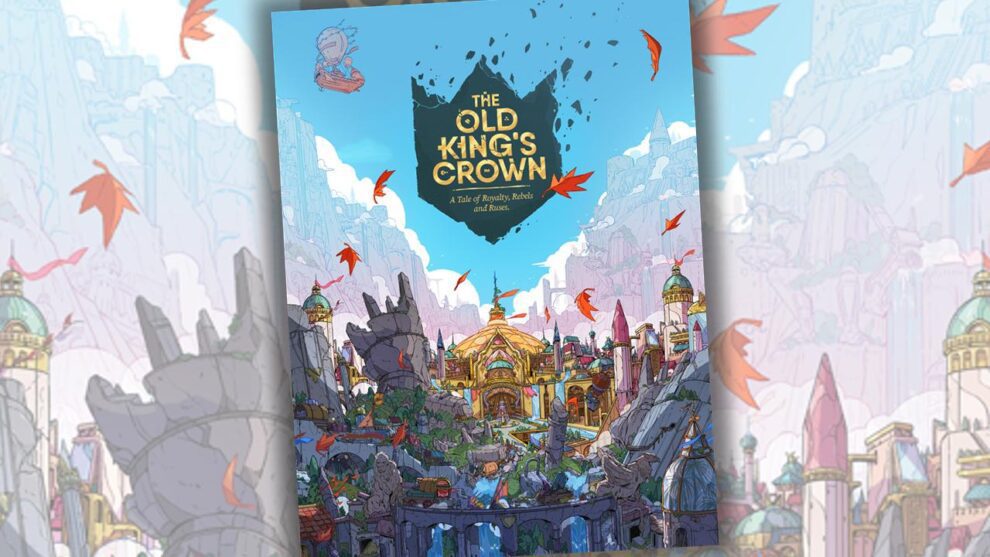
At this point, it feels impossible to write about The Old King’s Crown without grappling in some way with the sustained level of hype that it has produced over the last year. Pablo Clark’s ambitious entrée into the world of board games, this lane battler on steroids, has made a big splash. How big that splash is, exactly, is hard to measure, but the small board game café where I work gets a call about once every two-to-three weeks asking if we have The Old King’s Crown in stock. This is an ungainly mess of a game, an initially unwelcoming and overwhelming thing. Catan this is not. For The Old King’s Crown to break hobby containment would suggest a Blue Whale has just surfaced.
These are not, in full transparency, my favorite reviews to write. I prefer unexpected surprises to the heavily foreshadowed. If a game has too much momentum behind it when it reaches your door, your only choices are to be bowled over or to step aside and let it pass you by. I don’t want to get caught up in the current of excitement, nor am I interested in writing a reactionary takedown.
Fortunately, life conspired to keep me from playing my review copy of The Old King’s Crown for quite a bit longer than anticipated. For four whole months, it sat unplayed on my shelf. “What, this old thing?,” I’d reply when asked, demurely batting my eyelashes. I have a binder full of letters, text print-outs, and telegrams, all saying, “Hey, Andrew, when you play Old King’s Crown, let me know.” By the time I got to it, it felt more or less like sitting down to play any other game. Crisis averted.
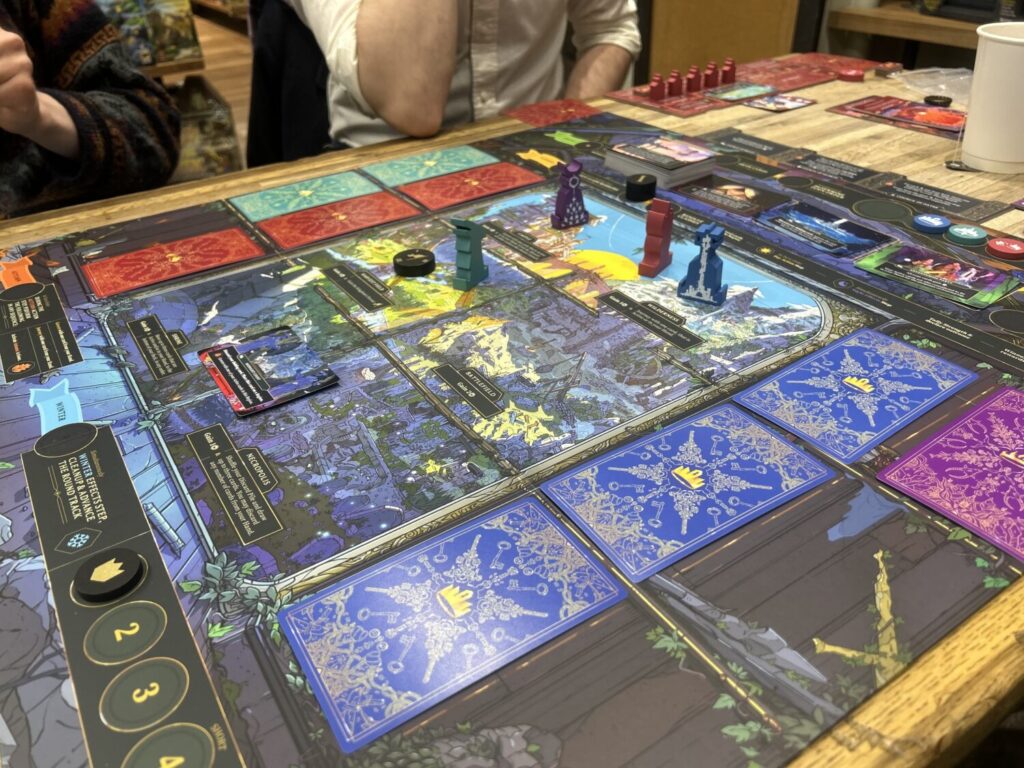
Any Other Game
The story of The Old King’s Crown is the stuff of legend and history; the king has vanished, and a power struggle ensues. Each of the four factions is a claimant to the throne, whether they be the Nobility who cling to their inexorably fading wealth and power, the Clans who used to call this land home, the people’s Uprising, or the moon cult that calls itself the Gathering. The goal is to guide your faction to the greatest Influence, thereby claiming the crown, or at least its authority.
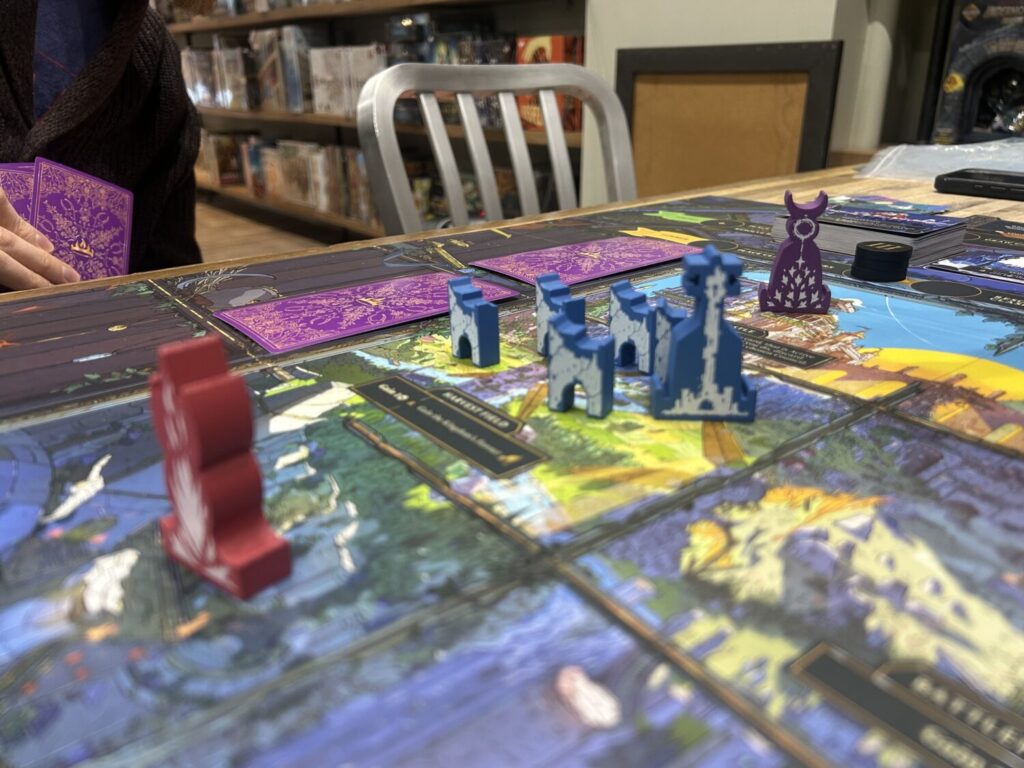
The fundamental gameplay loop is a lane battler that plays out across three lanes. Each player starts the game with a deck of 14 cards, numbered 0 and 10. The distribution of values is even across the factions, though there are other minor-but-crucial differences that emerge with time. At the beginning of each round, players pick one card for each of the three lanes, place them face-down on the board, and then reveal the cards and resolve the combat one lane at a time, in an order chosen by the player currently in last place. The winner of each skirmish chooses one of the two rewards in that lane before everyone moves on to the next. You wash-rinse-repeat four-to-six times, and that’s a wrap.
There’s more to it than that, obviously. Quite a bit more. One does not waltz to a 3.65 Complexity Rating on BGG with only that. If you chip away all the plaster and drywall, though, that’s the frame. I think the simplicity of this core is part of why The Old King’s Crown has taken off. For all the bells and whistles that surround it, some of which are tremendously loud, that loop is easy to grok. Good thing, too, since everything else is entirely overwhelming on the first play.
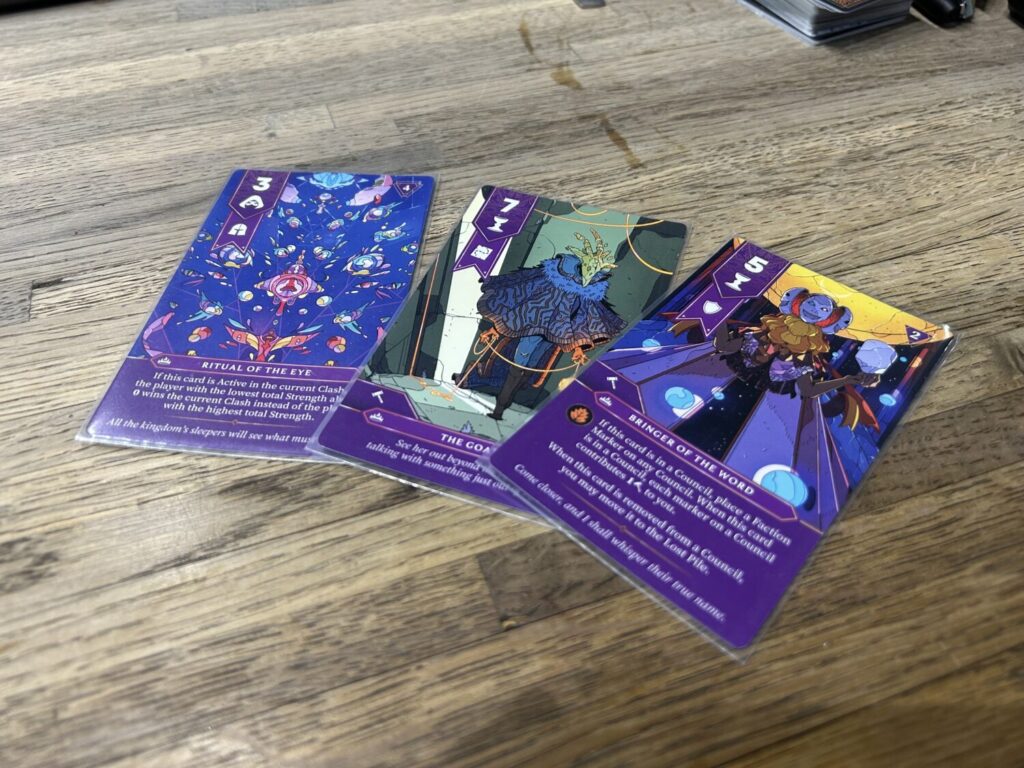
To play The Old King’s Crown, you have to come to grips with an incredible amount of material. Each faction has five unique powers, and knowing what all those powers are, both for your own faction and for others, is critical. In addition to the starting decks, each faction has five additional cards that can be bought during the game, each of which provides yet more bespoke abilities that you need to be familiar with. There’s also a giant deck of special ability cards, each unique, which require your attention, but at least you won’t see more than 15-20 of those during a game.
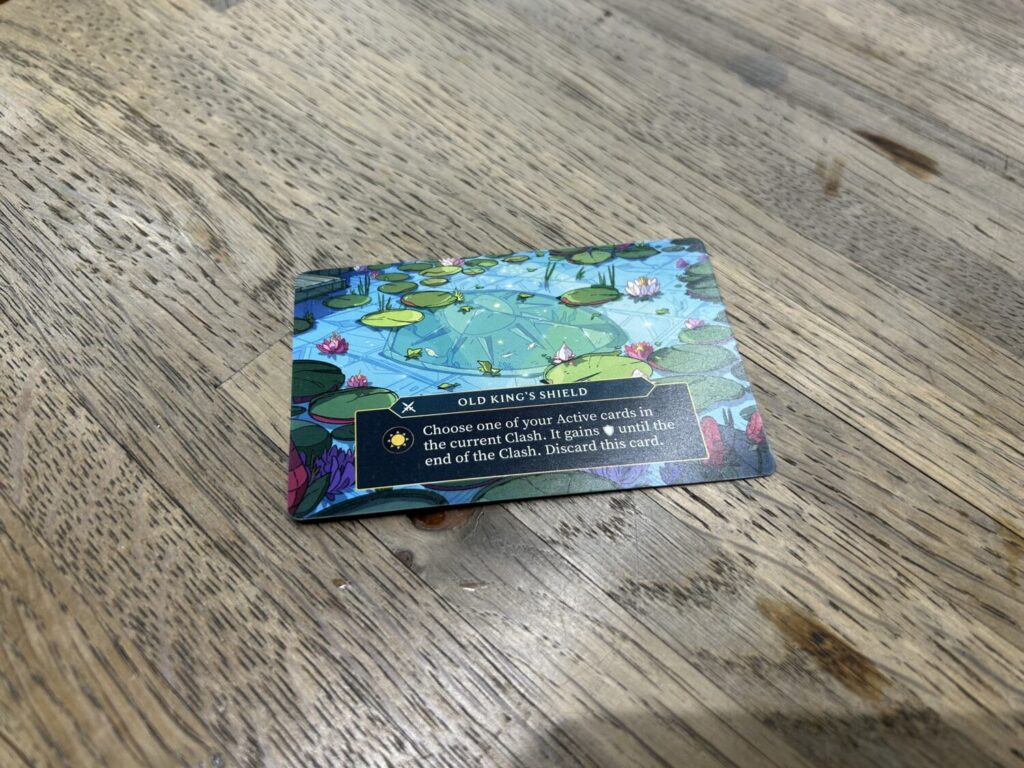
The good news is that vanishingly few of these things in and of themselves are complicated. The bad news, at least for those just logging on for the first time, is that the aggregate mass is considerable. Your first play will be full of misplays, missed opportunities, entirely unexpected reversals, and all manner of frustrations. My first game, a four player game in which I was the Nobility, was one of the most frustrating game experiences I’ve ever had, because absolutely nothing I did worked. There was always something happening somewhere to run direct interference. This was in part my own fault for playing at four, but we’ll come back to that, but that wasn’t the whole of the issue. There was always a power, always a card, always a something. As I said, an initially unwelcoming and overwhelming thing.
Once you start to get a handle on everything, though, the game opens up beautifully. You develop a sense of what ability cards paired with what factions or board states are a serious threat and what cards you can more or less safely forget about. You learn what player abilities are a problem for you, and how to navigate them. You start to figure out how to manipulate the three Councils at the top of the board, which inevitably seem ancillary for the first game or two, but are enormously important. It has been my experience with The Old King’s Crown that I make discoveries each time I play, that I find new means through which to achieve my ends.
In a way, I find that surprising, because it is also my experience that The Old King’s Crown discourages “clever” gameplay. Doing something cute rather than what feels obvious usually backfires. You get punished. Just do the thing that makes sense. That raises the possibility that the whole game is on rails—which, hey, if you like where the rails are going, what’s the issue—but my experience doesn’t bear that idea out. The Old King’s Crown is about looking for openings and blowing through them. It’s about patiently waiting to seize your moments and minimizing the damage done the rest of the time. Go ahead and play the exact same game twice against an opponent who’s paying attention and see if that works out for you.
Balance
The Old King’s Crown, like Innovation, is not all that concerned with the idea of balance. It strives for drama. It lives for chaos. It thrives on direct confrontation. I like it this way. Why have the mechanics of the game sanded down to a dull sheen when you can leave everything jagged and the idea of balance up to the players? Doesn’t imbalance make sense in the context of this story? Shouldn’t certain relics be stronger than others? Isn’t that how life works? Besides, if you have a power that’s simply too strong, I can take it from you during a subsequent round. The Old King’s Crown approach to balance is affording everyone a turn at the wheel.
This is part of why four player games fall apart, at least in my opinion. While two- and three-player games are spectacularly sharp, largely intentional affairs, four player games are Looney Toons shorts. There are too many people looking for their openings and nowhere near enough openings to go around. Special powers trigger left and right, creating a cacophony of exceptions that make it very hard to play in any sort of intentional way. That doesn’t necessarily mean you won’t have fun; you just have to know what to expect going in.
The longer I sit with it, the more impressed I am with the design work here. The factions feel meaningfully different, despite avoiding Root-like levels of mechanical disparity. They interact in interesting ways. Your priorities change depending on what other factions are on the board. Certain factions have a harder time living, but my favorite faction to play in Root are the Lizards, so. I’m used to that. It’s about the experience leading up to the end.
I have found The Old King’s Crown to be a source of great joy, frustration, humor, and tension. It is as political as you want it to be. It is full of lies and tricks, feints and triumphs. Clark’s magnificent art is a big part of why this game has stirred up so much fanaticism, and I cannot argue with that. His illustrations bring so much of the game to life that it’s easy to fill in the nooks and crannies with your imagination. What a thing for one man to have created. Beneath all the hype, The Old King’s Crown is indeed a very good game.