


Disclosure: Meeple Mountain received a free copy of this product in exchange for an honest, unbiased review. This review is not intended to be an endorsement.
Scooby-Doo (along with plenty of other Hanna-Barbera cartoons) was one of my favorite shows growing up. There’s something about all the unique villains and countless oddly themed movies, including those wonderfully bizarre WrestleMania crossovers, that sits at the core of my childhood memories.
So when Scooby-Doo: Mystery Masquerade was pitched to me as a social deduction game set in the Scooby universe, I was immediately interested, though admittedly more for the IP than the mechanic.
I want to enjoy social deduction games like Blood on the Clocktower or Ultimate Werewolf, but negative experiences with both have largely steered me away from the genre. After a couple of plays of Mystery Masquerade, though, I’d say this is closer to the type of deduction found in Betrayal at House on the Hill than the social sleuthing those other games provide.
In Scooby-Doo: Mystery Masquerade, players collectively control the entire Mystery Machine gang as they attempt to figure out which villain stole the Coolsville Diamond. The culprit is hiding among a selection of 16 iconic Scooby-Doo villains.
Players begin by building the map using room tiles, which can be arranged in pretty much any configuration. Each player then receives three villain tiles that indicate which villains secretly belong to them.
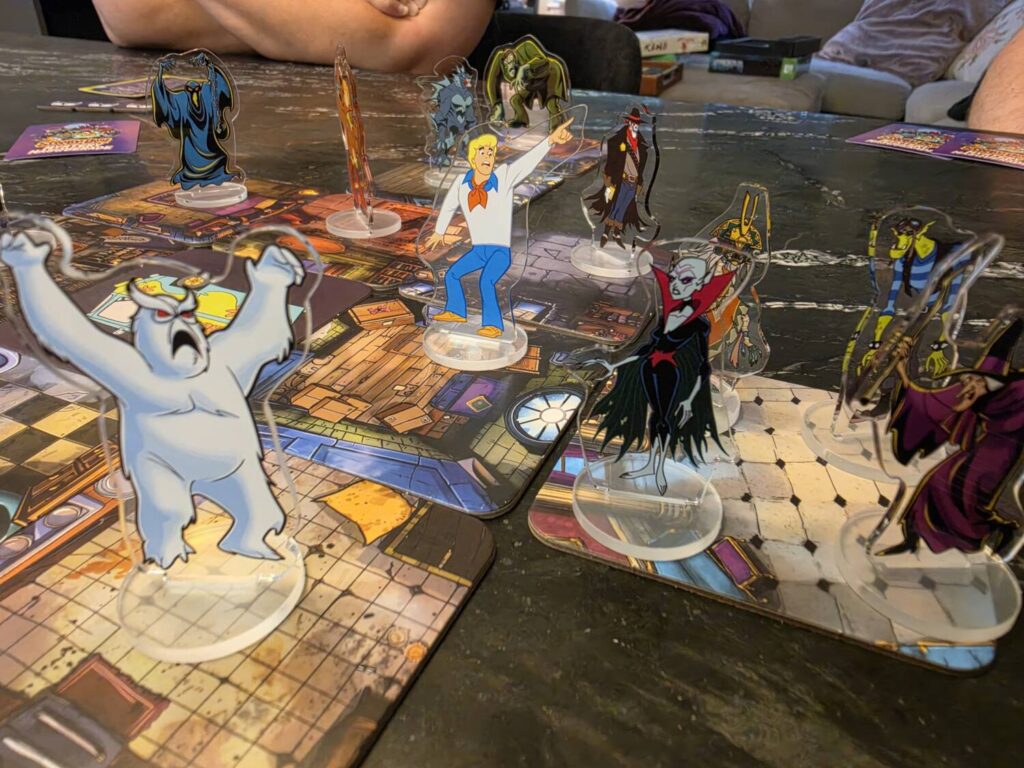
On a turn, players roll a die and move one of the Mystery Machine characters, each of whom has their own special ability. They then take two actions, which can include playing an action card, moving a villain, attempting to unmask a villain, or making a guess at the main culprit.
Action cards let players cancel other actions, gain extra movement, or otherwise manipulate the board. When attempting to unmask a villain, you choose another player and ask whether that villain belongs to them. If you’re correct, the villain standee is removed from the board and you receive a clue token, which can later be spent for another action or card draw.
The game ends once someone correctly identifies the main culprit or everyone has made an incorrect accusation. Players score points for every villain they successfully unmasked, their own villains that remained hidden, and correctly identifying the culprit.
Scooby-Doo: Mystery Masquerade was a fine time at the table. There were mild peaks of excitement whenever someone correctly identified another player’s villain, but the majority of our turns felt like blind guessing.

While players manipulate both the Mystery Machine gang and the villains, ideally moving characters to protect their own secrets while putting pressure on everyone else, it was surprisingly difficult to gain much useful information for actual deduction.
One player compared the game to Clue, just with better movement around the board, and I think that’s a pretty fair assessment. This isn’t to say the game is bad. It just felt a little underwhelming considering how much potential there is with the Scooby-Doo IP and the basic premise of unmasking villains.
The action cards don’t do much to alleviate this either. Most manipulate movement or interfere with other players rather than helping you gather new information. The major exception is an unmasking card that lets you directly look at another player’s villain tile.

Because that information is so much more valuable than most of the other cards, our games often turned into fishing through the deck hoping to find one. It became one of the easiest ways to tee up points without relying on a complete shot in the dark.
In all of our games, the winner had successfully identified a handful of villains, but many of those correct guesses came down to luck rather than carefully piecing together clues. I never really felt like I was building a case against someone in the way I’d expect from a deduction game.
Still, there’s definitely some entertainment to be had here, especially if you’re a fan of the show. The acrylic character figures look fantastic, and being able to build the mansion in whatever configuration you want gives the game a fun table presence.
Most of the players in my group also had no idea what half of the villains were actually called, so there was plenty of “Is one of your villains the weird skeleton cowboy guy?”
Luckily, the game includes a villain guide complete with names. Who could forget the Creeper?
I think the core audience for Scooby-Doo: Mystery Masquerade is families who enjoy the cartoon and want something in the vein of Clue with a different coat of paint, especially around Halloween. The deduction is light enough that younger or more casual players can jump in without having to bluff their way through an elaborate social puzzle.
I can’t say I’m yearning to return to Mystery Masquerade, but I did enjoy revisiting the wonderfully spooky villains that made up so much of my childhood entertainment. But as a deduction game, it leaves a lot to be desired.


