
Disclosure: Meeple Mountain received a free copy of this product in exchange for an honest, unbiased review. This review is not intended to be an endorsement.

Maybe you’ve heard: the movie business is really, really struggling right now. (And I’m doing you a favor by only sharing one link; I read about the movie business every day, so I could send you dozens more themed around the same problems.)
The struggles of the film industry haven’t stopped me from seeing a movie or two in theaters each month, and in my heyday, I saw one or two movies a week. To honor the end of my mass-market movie attendance, I saw 160 movies in theaters in 2013, the year before my first child was born.
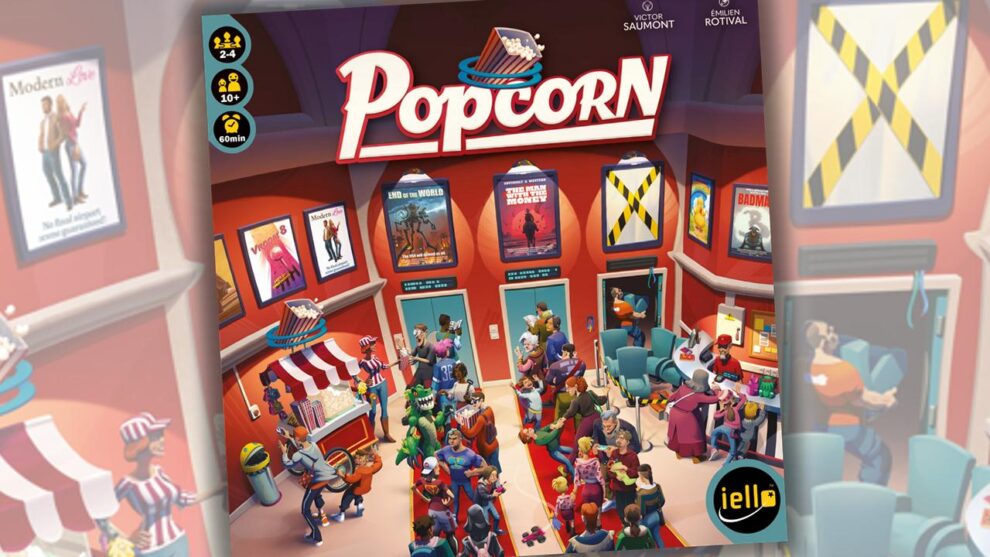
In other words, I am absolutely the target audience for the new board game Popcorn (2025, IELLO), a movie-themed bag-builder for 2-4 players. No one I know loves the theater experience like I do. I play board games 3-5 days per week. I have enjoyed a number of games from the IELLO catalog, such as Khora: Rise of an Empire, Ancient Knowledge, King of Tokyo, and Guilty: Houston 2015. Orléans, the best-known game that uses a bag-building mechanic, is a game I love so much that I wrote an article about it for our “Orléans: Games We Love” series.
Popcorn should have been a home run. It absolutely was not.
“Wait, This Isn’t Over Yet?”
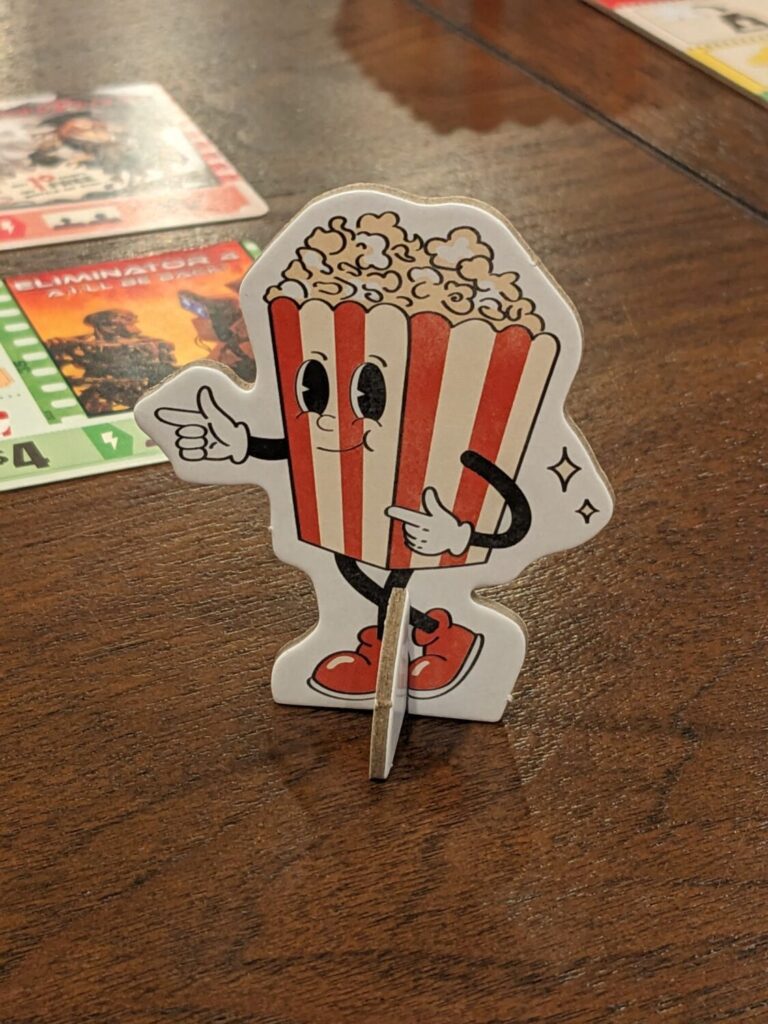
In the game Popcorn, players operate a small movie chain that asks players to line up new features in their multiplexes, handsomely represented by each player’s personal board. Within each ‘plex, players can screen up to three movies at a time, in theaters that range in size from 1-3 seats. Movie fans come in a range of flavors and must be attracted to your theater to watch movies to generate points, known here as popcorn and appearing as cute, cardboard popcorn tokens in 1-, 3- and 5-point increments.
All rounds play out the same way, across three phases. During the Buying and Advertising phase, players can add a new film, buy one new theater, and/or advertise to new customers. (I preferred screening room to theater, since most people think of new theaters as distinct physical locations…in Popcorn, all three theaters are in the same building. Maybe this is different in other regions.)
This portion of the game is handled in turn order, as players pick from a market of new films and screening rooms to make updates to their player board with new goodies.
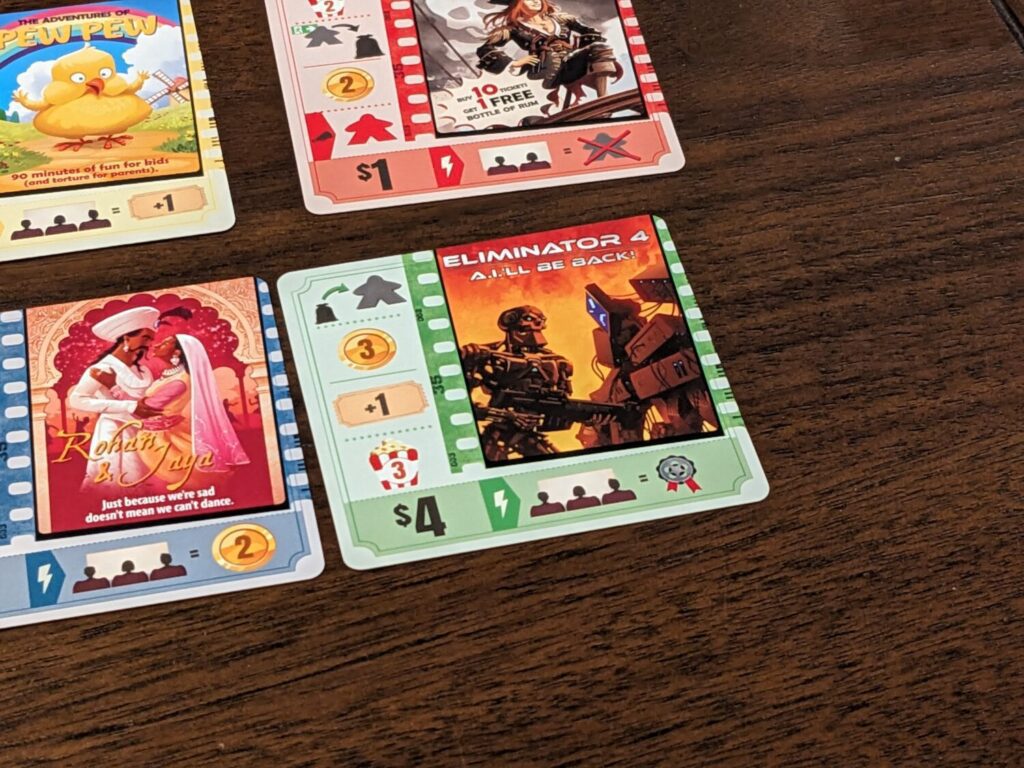
New films have to be added from time to time because after 3-4 rounds (weeks), audiences want to see new movies. New theaters/screening rooms expand a player’s capacity—more customers is usually better—but also lets a player tailor their theater to line up with showing, say, action films to action movie fans, represented here with a color-coding system that pushes players to put red meeples inside of theaters showing films outlined with red film strip icons.
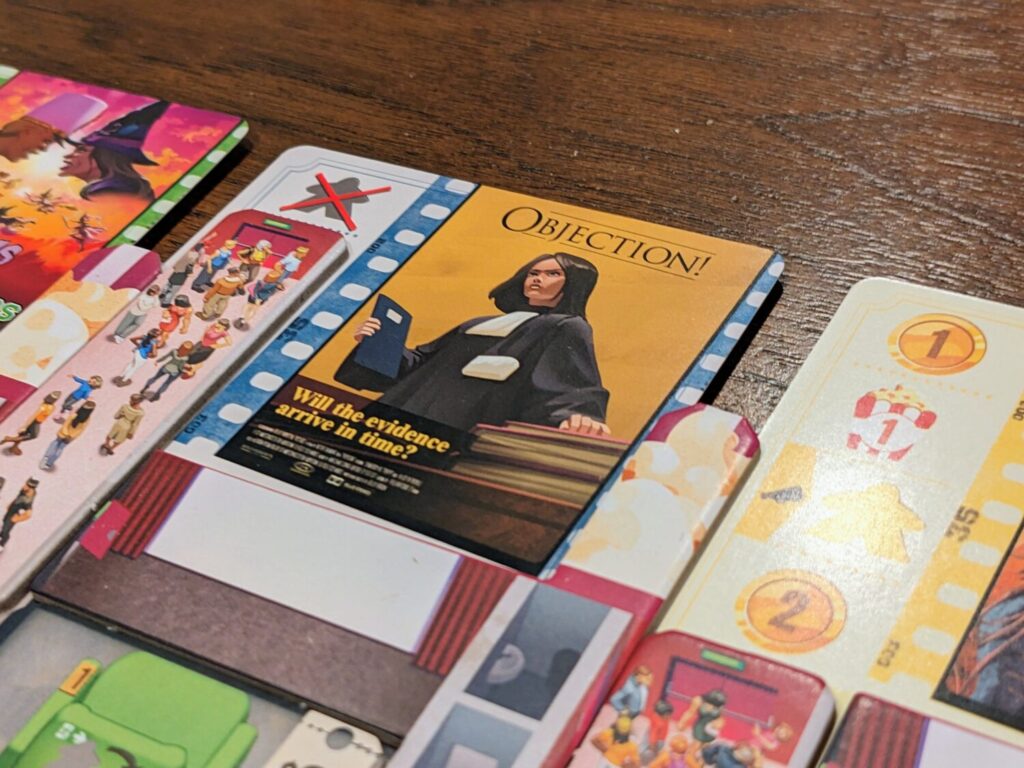
The second phase is the Showings phase, which all players conduct simultaneously. Depending on a player’s current Audience number, 3-7 meeples are drawn at random from their bag of meeples and can be placed in theaters.
Generally, Popcorn is a matching game. Putting yellow meeples in front of yellow movies (comedies) will give a player more chances to score, as players collect seat bonuses and movie bonuses using a list of bonus actions along the left side of each movie’s placard. Each theater’s seat color matters, too; all meeples can sit in all seats, but putting a yellow meeple in a yellow seat grants a bonus and gives that player a chance at a second bonus.
The third phase serves as end-of-round clean-up, before players run it back. Again, and again. In fact, this is the part that Popcorn gets wrong: for a game that has almost zero arc, it takes nearly an hour to play it. That means the first and second rounds of Popcorn look a LOT like the final turns of the game, and not in a good way.
“It’s your turn, hon.” I looked over at my wife, who was looking at her phone after completing her fifth or sixth turn. My wife is not a person who is usually “device distracted”, which set off alarms all their own.
“How many more rounds do we have of this one?” she asked.
Oh boy.
Watch a Bad Movie Instead
Technically, there’s nothing wrong with Popcorn. Everything works just fine, with gameplay elements that are easy to teach and simple to execute. If anything, I would probably feel better about the entire experience if I had just played the thing with my kids. (Instead, I did plays with adults, at 2-, 3-, and 4-player counts both in person and via the app currently available in alpha on Board Game Arena.)
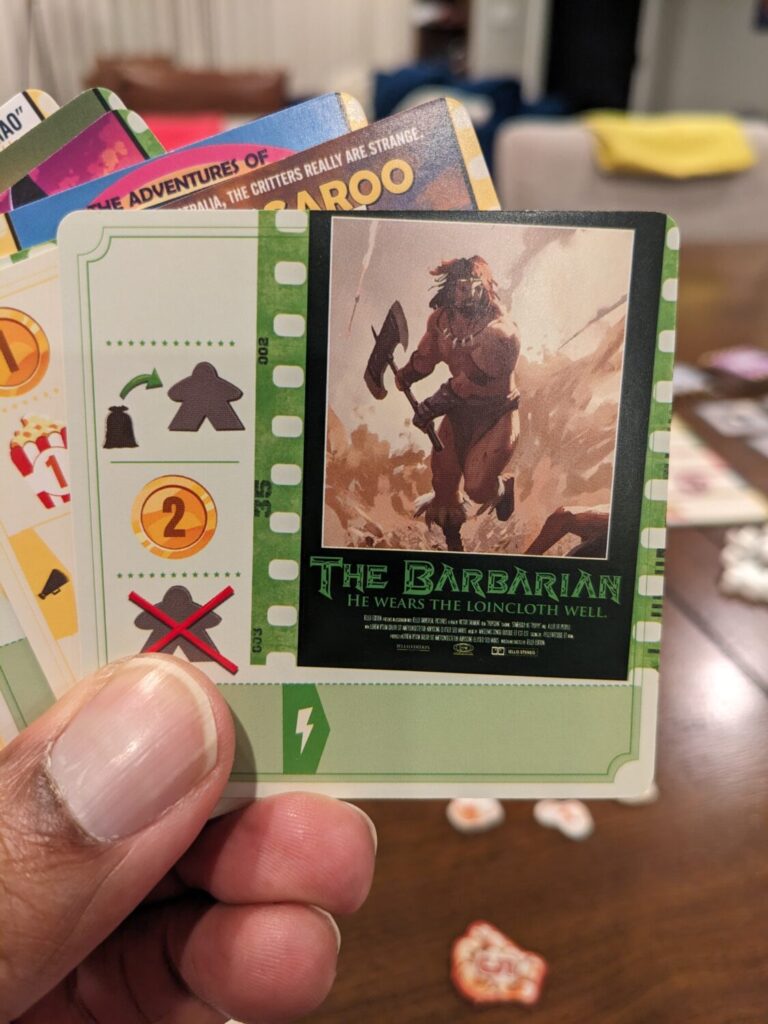
Popcorn’s production is very strong and designer Victor Saumont did his best to work with his illustrator, Emelien Rotival (one of the credited illustrators from Vantage) to come up with movie posters that look a lot like some of the most famous American and French films of the past 50 years, from the Terminator films to Apocalypse Now to The Shining.
But then the bland nature of the posters broadens to expose the bland nature of the game. The poster for what clearly looks like it is mimicking The Shining uses the title Mountain Hotel. Yes—the best this team could do with such an iconic film was to rename it Mountain Hotel. For Apocalypse Now, the title used for the Popcorn movie poster is War is Coming. How about something funny, like Apocalypse Chow, with two men fighting each other with spoons on one of the iconic helicopters from the film’s original poster?
Even if the game’s designer and illustrator aren’t having much fun, why shouldn’t we?
The game’s puzzle becomes pretty straightforward right away: put matching color meeples in front of matching color films. Makes thematic sense, should maximize my score. So, why is this game more than even five or six rounds? Every round plays out the same way. At first, I thought one of the game’s mechanics would make me angry—players can steal meeples from an opponent’s “exit zone” if they need a meeple and can’t get one from the common supply, ala games like The Gallerist where players can steal customers from the lobby of each opponent.
But as it turned out, that mechanic added a little spice to a very boring game. Also, one would have thought that the best way to score lots of points would be with the Award cards that serve as private milestones for each player. As I have found across my plays, the very best way to score points is to simply score popcorn every time you can, through seat bonuses, matching theater bonuses, or on the Audience track.
In my two-player game, my wife won by a solid 15-point margin, and she didn’t even maximize her Audience number. But every time she could, she matched a patron to the right movie and took popcorn bonuses as her movie bonus. She also was savvy enough to recognize that the best movies to take are the ones that score popcorn more often than other cards in that first play.
The Award cards eventually become very difficult to match up, and they are not worth nearly enough points. (Of course, this is where it doesn’t help when opponents steal some of your customers!) Some Award cards require a player to have pairs of certain movie colors in their archive by the end of the game…but that might only earn two points per pair. It’s a whole lot better to just take two, three, four-point scoring bonuses when you can in real time.
Popcorn is vanilla ice cream, but then it’s ice cream you have for dessert every single day for a week straight. It was already bland, but the repetition hampers the entire experience.
Popcorn details
- Designer: Victor Saumont
- Artists: Emilien Rotival
- Publishers: BoardBros, Hobby Japan, IELLO
- Release Date: 2025
- Player count : 2 - 4
- Age range : 10+
- Time range : 60 minutes
- Mechanism(s): Deck, Bag, and Pool Building
- BGG Geek Rating: 7.2736 - converted to Meeple Mountain scale: 3.5.
- More articles about Popcorn.