Disclosure: Meeple Mountain received a free copy of this product in exchange for an honest, unbiased review. This review is not intended to be an endorsement.
Disclosure: Meeple Mountain was provided a pre-production copy of the game. It is this copy of the game that this review is based upon. As such, this review is not necessarily representative of the final product. All photographs, components, and rules described herein are subject to change.
Growing Your Garden
In Perennial, your job is to grow the best prairie garden using tools and tiles. It’s a tile-placement game with set collection, drafting, pattern building, and end game bonuses tied to how well you’ve placed your tiles. Are you thinking you’ve seen this before? Maybe in Cottage Garden, or Pergola?
You haven’t.
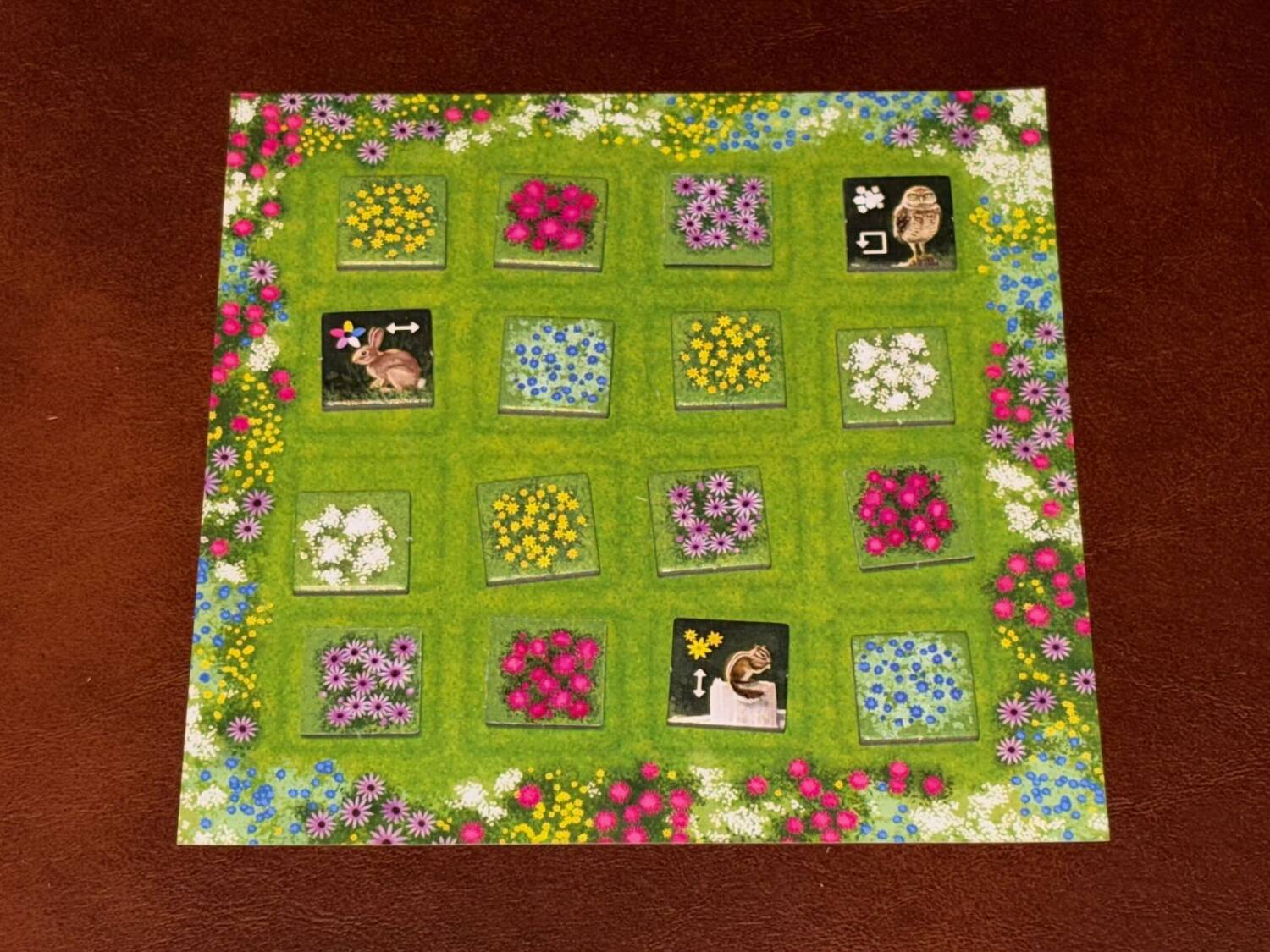
Oh, sure. The game starts in a standard fashion: Each player is given a Garden Board on which to place tiles, and a Workshop Board to store resources. The Garden Board is seeded with boulders which act as obstacles that you must build around, and actual seeds which can give you benefits later in the game. A greenhouse polyomino is placed in the middle as an anchor point for your first tile placement (and it acts as another obstacle). A square Central Drafting Board is randomly filled with Flower Tiles and Animal Tiles. Four Tool Cards are placed around the edges of the square. The Pond/Feature cards are shuffled and placed near the board, and the top one is turned over to reveal the first tile. Each player is given four Pond/Feature polyomino tiles that must be placed, one per round according to the card drawn from the deck.
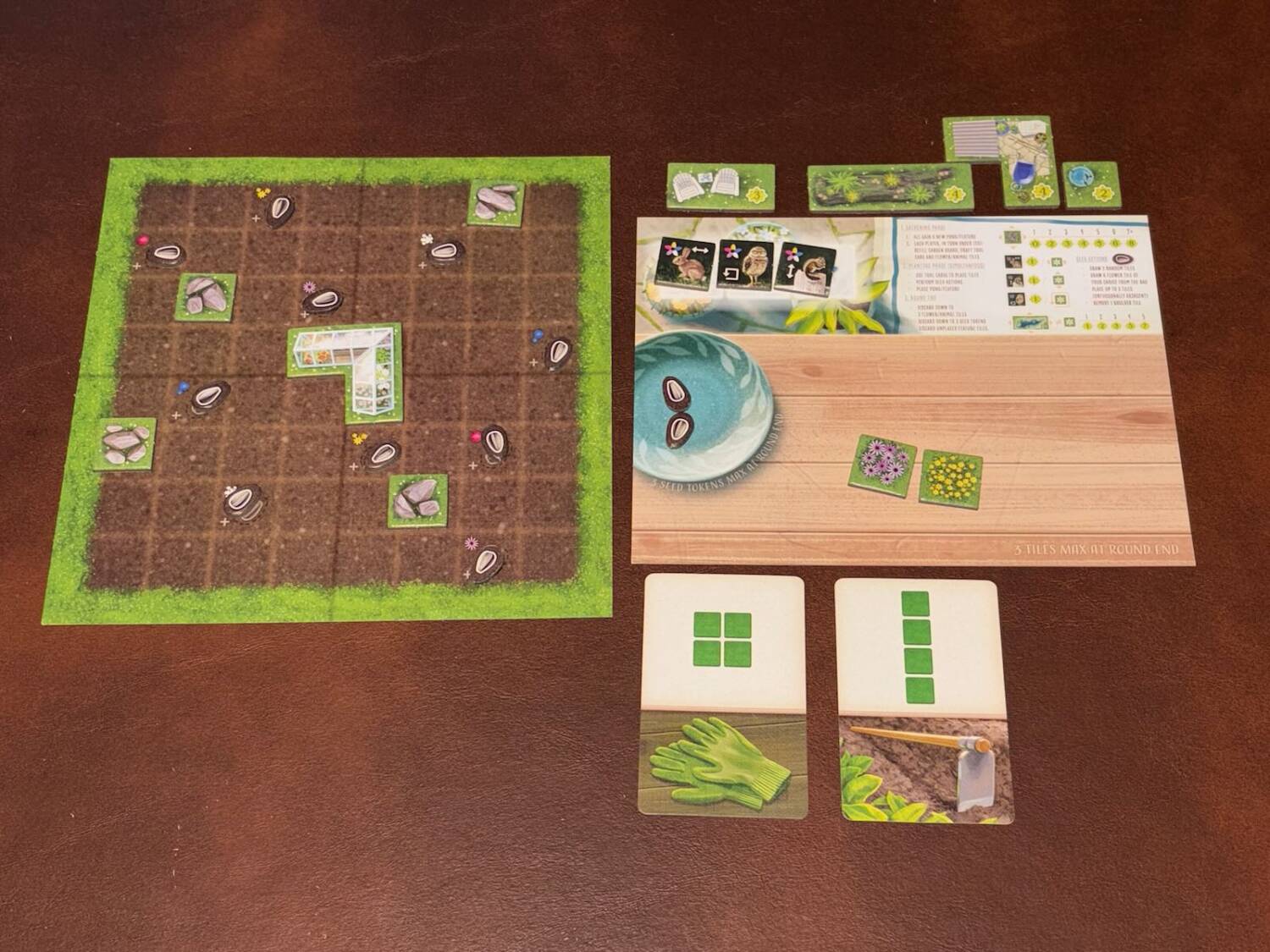
Sounds like your average tile-placement game, right? Wait for it—it’s from this point that things get brain-bendy.
Gather First, Then Plant
Perennial is played over four rounds, and each round is divided into two phases: Gathering and Planting. During the Gathering Phase, you are acquiring tiles for later use. You do this by first selecting one of the Tool Cards surrounding the Central Drafting Board. Then you take five 1×1 tiles from the board in the shape shown on the Tool Card. You can flip or rotate your Tool Card. The only restriction is that at least one of the tiles you take to form your shape must be from the row or column closest to the Tool Card you chose. Place your chosen tiles on your Workshop Board and your Tool Card below your Workshop.
The board is then refilled, and a new Tool Card is drawn to fill the empty space. The next player chooses a Tool Card and then drafts their tiles. This continues until all players have drafted twice, for a total of ten new tiles and two new tool cards for each player.
Then you move on to the Planting Phase. These actions are all done simultaneously, as all players move their tiles from their Workshop Board to their personal Garden Boards. Then, you will choose a Tool Card from your Workshop area. That card determines the shape you must make on your Garden Board. You can choose any combination of Flower or Animal tiles from your supply to make that shape. Place the tiles anywhere you choose on your Garden Board, as long as at least one tile touches either your Greenhouse or any other previously placed tile. If you don’t want to place the entire shape from your chosen Tool Card, you do not have to, but you must discard any excess tiles from play. You can’t return them to your supply. Discard the Tool Card when you’re finished.
You can do this as many times as you want, as long as you have Tool Cards available. Keep in mind that you can only have three tiles remaining in your Workshop at the end of the round, so you’ll want to use as many as you can.
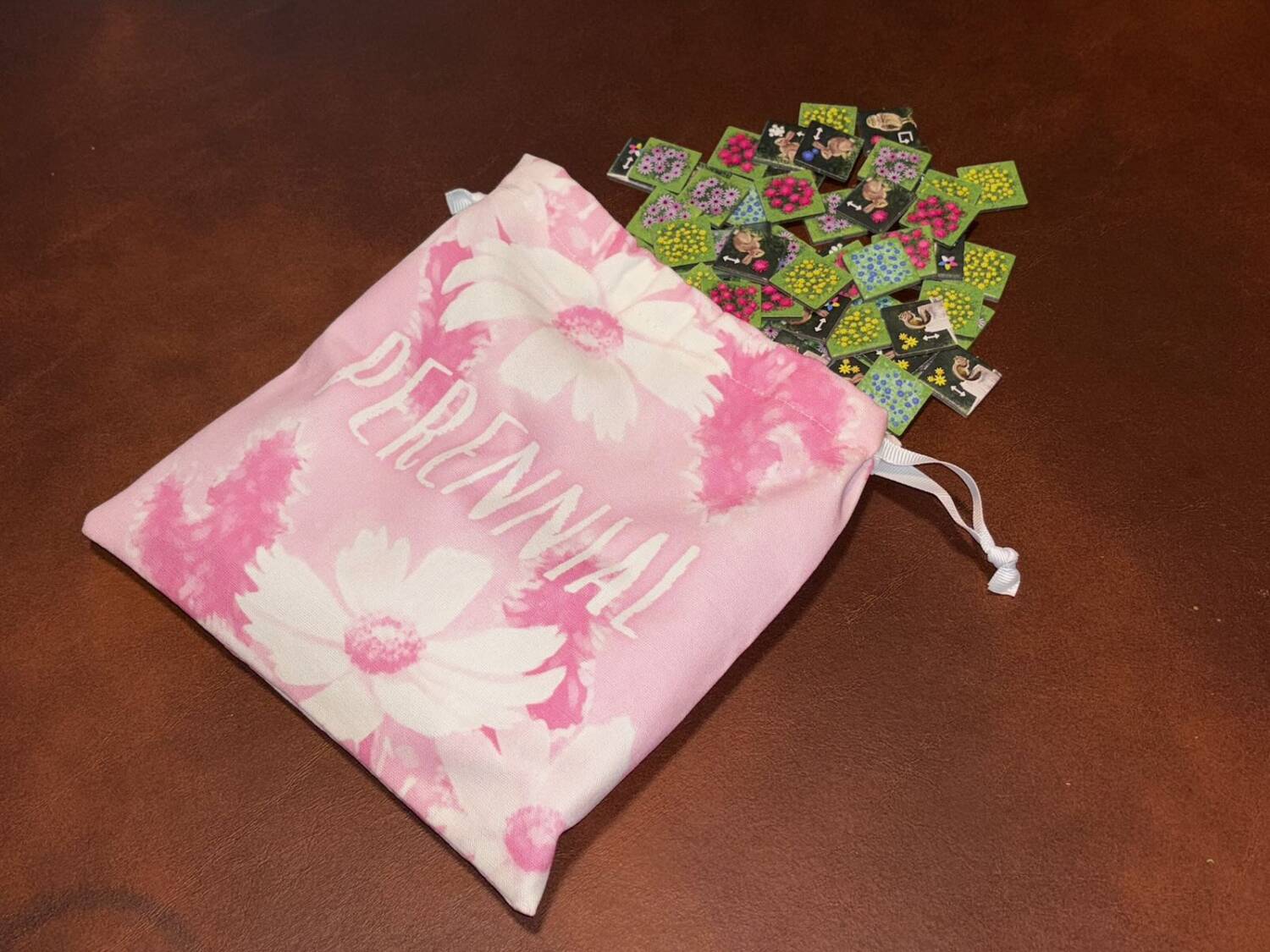
Seed Tokens can help you make better use of your resources. You’re given two Seeds at the beginning of the game, and you can earn more from your Garden Board if you place a Flower Tile on a Seed space that matches the flower color icon shown on the space. Simply place the tile and put the Seed token into your supply. If, however, you place a tile that doesn’t match the Flower Tile color shown, the Seed on that space is discarded from the game.
Seeds grant you extra actions during the Planting Phase such as drawing extra random tiles from the draw bag, searching for one Flower Tile of your choice from the draw bag, removing a Boulder Tile from your board, or placing up to any three tiles from your Workshop in a straight line on your Garden Board. You can use as many Seeds as you want during the Planting Phase, again keeping in mind that you can only carry three Seeds into the next round. Any excess must be discarded.
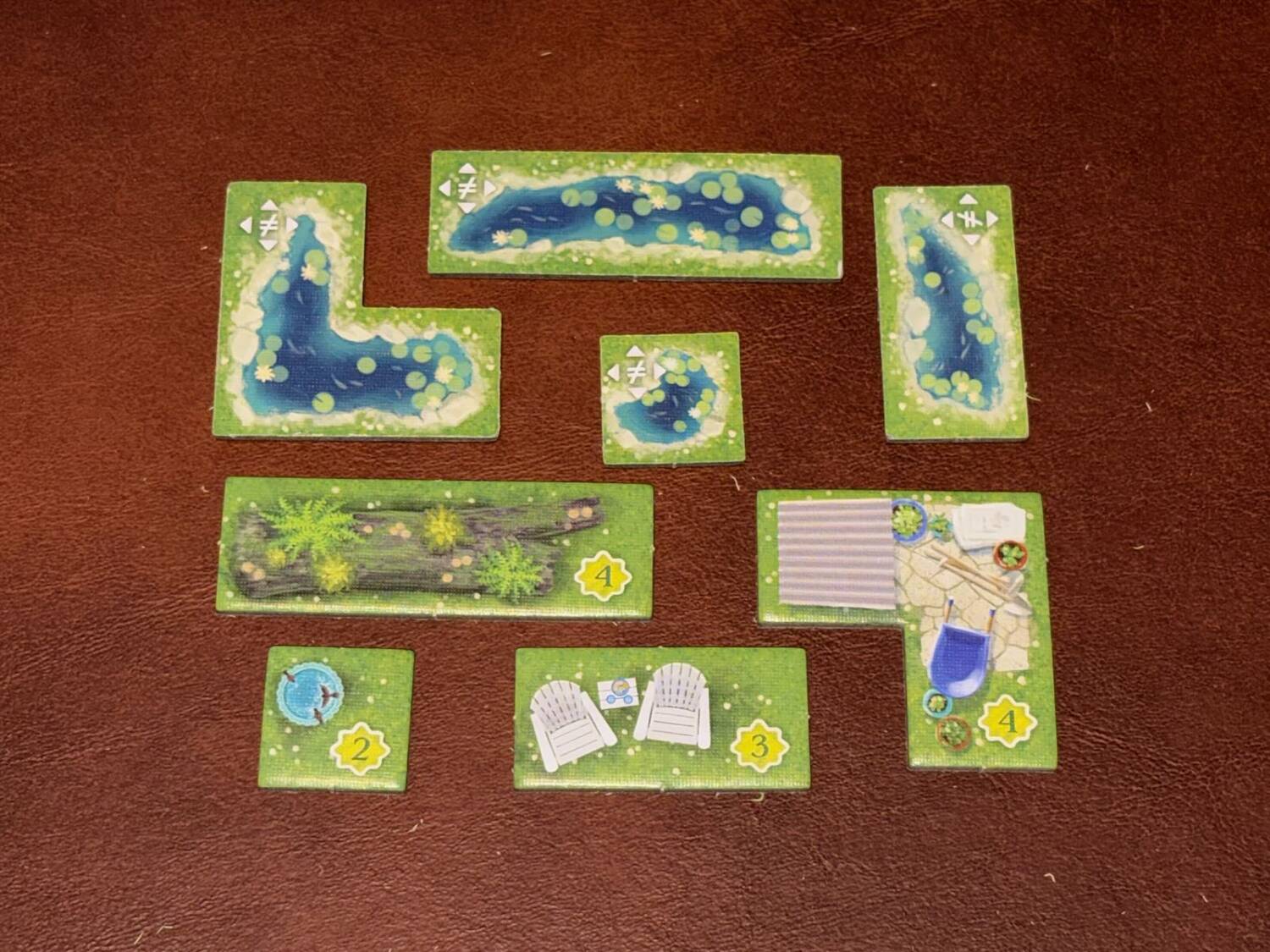
The other task you must accomplish during the Planting Phase is to place the polyomino Pond/Feature Tile drawn for the round. These tiles are double-sided and score at the end of the game. One side shows a Pond, which scores based on the number of different flower colors placed next to it. The other side shows a Feature, which scores the point value shown on the tile. You get to choose which side you use. Each player must place the same tile during the round and if you can’t (or don’t want to) place it, it is discarded from the game. These tiles cannot be held over to the next round.
After everyone has finished Planting, everyone must discard any excess Flower/Animal Tiles, Seeds, and unused Ponds/Features from their Workshops. Unless this is the end of the fourth round, reset all the elements and begin the Gathering Phase again.
Scoring
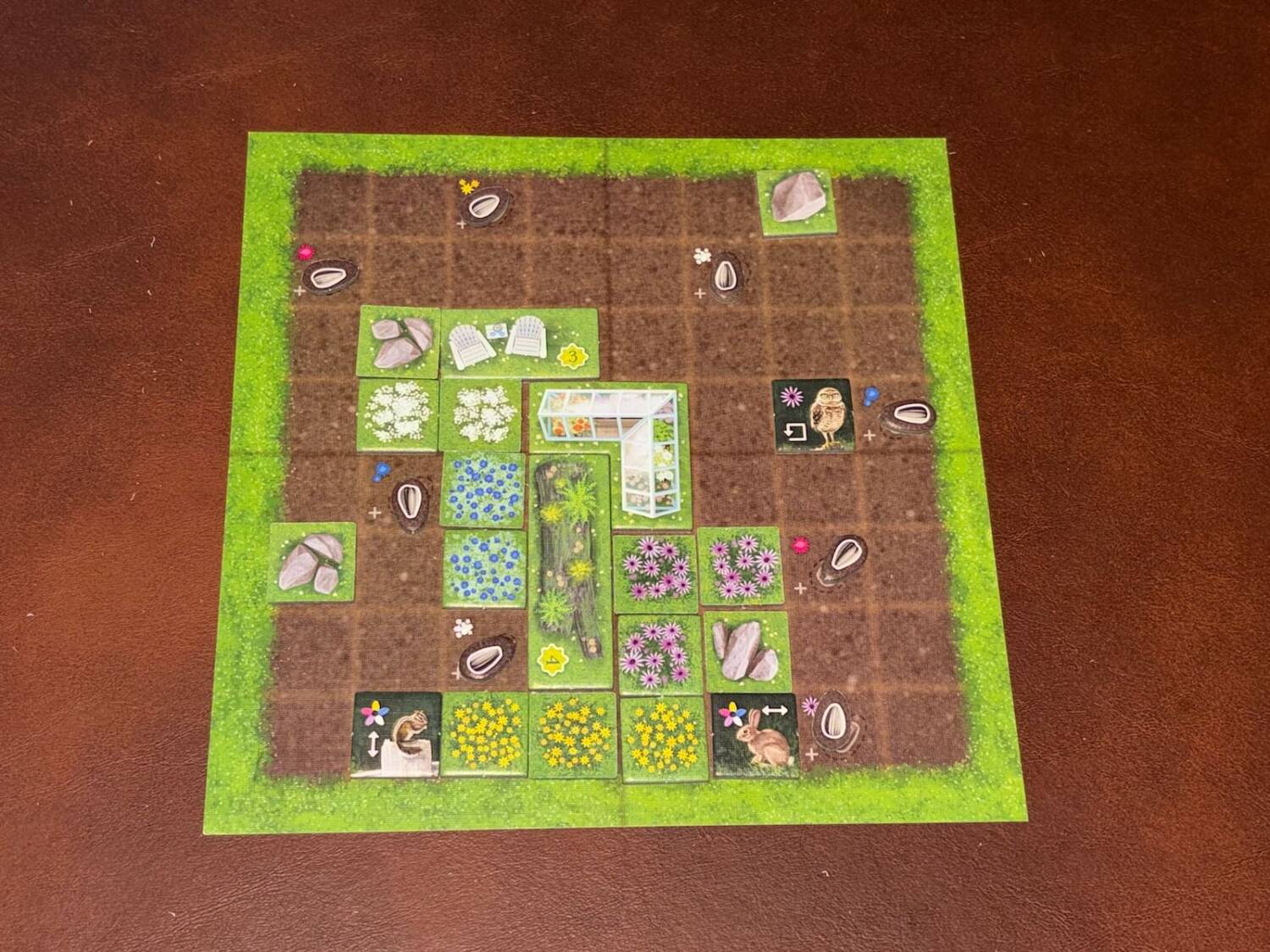
After the fourth round, scoring begins. There is a lot to take in for scoring, so what follows is a simplified explanation.
- Flower Regions are areas of the same type/color flower, and they score based on the number of tiles orthogonally connected. Each color of Flower Tile is scored in this way, for a total of five scores.
- Rabbits score based on the number of Flower Tiles of their color (shown on the tile) in their row. Wild Rabbits (indicated by a rainbow icon on the tile) score for whichever color the player chooses in that row.
- Chipmunks work like Rabbits, except they score for their column, rather than row.
- Owls score based on the number of Flower Tiles of their color (shown on the tile) in the eight spaces surrounding the Owl, including diagonally. Wild Owls (indicated by a rainbow icon on the tile) score for whichever color the player chooses that is surrounding the Wild Owl.
- Ponds/Features score either based on the number of unique Flower Tiles orthogonally connected (Ponds) or the points shown on the tile (Features).
- Add everything up, and the highest total is the winner.
Beam Me Up, Scotty!
The unique part of Perennial is the idea of DIY’ing your polyomino shape from 1×1 tiles of your choosing, rather than being forced to slot in a predefined tile as in most tile-placement games. Flatout Games uses the term disaggregation in their descriptions, but to me it feels like using the Star Trek transporter room. (Well, if you transported yourself and ended up with your leg on top of your head, or your arm sticking out of your rear end.) You choose your shape from the Drafting Board, but then those tiles are reduced to their individual parts on your Workshop Board. Later, they form another shape of your choosing (according to your chosen Tool Card) when you transport them to your Garden Board.
With all this freedom, though, comes a lot to think about. What flowers are you trying to group together and where? Can you make use of any Animal Tiles for extra points from your rows/columns? Can you squeeze a tile in the right space to earn a Seed Token? Which Tool Card in this display will get you closest to those goals, both when you choose the shape and when you have to plant it later?
You’re incentivized to place and spend everything each round because you can carry over so little, but doing so may mean making placements that box you in later. But since you don’t know what tiles you’ll even be able to get later, you might as well place everything you can each turn to avoid discarding too much. (Then curse yourself later for sticking that tile in that space when the perfect tile would have been available next turn.)
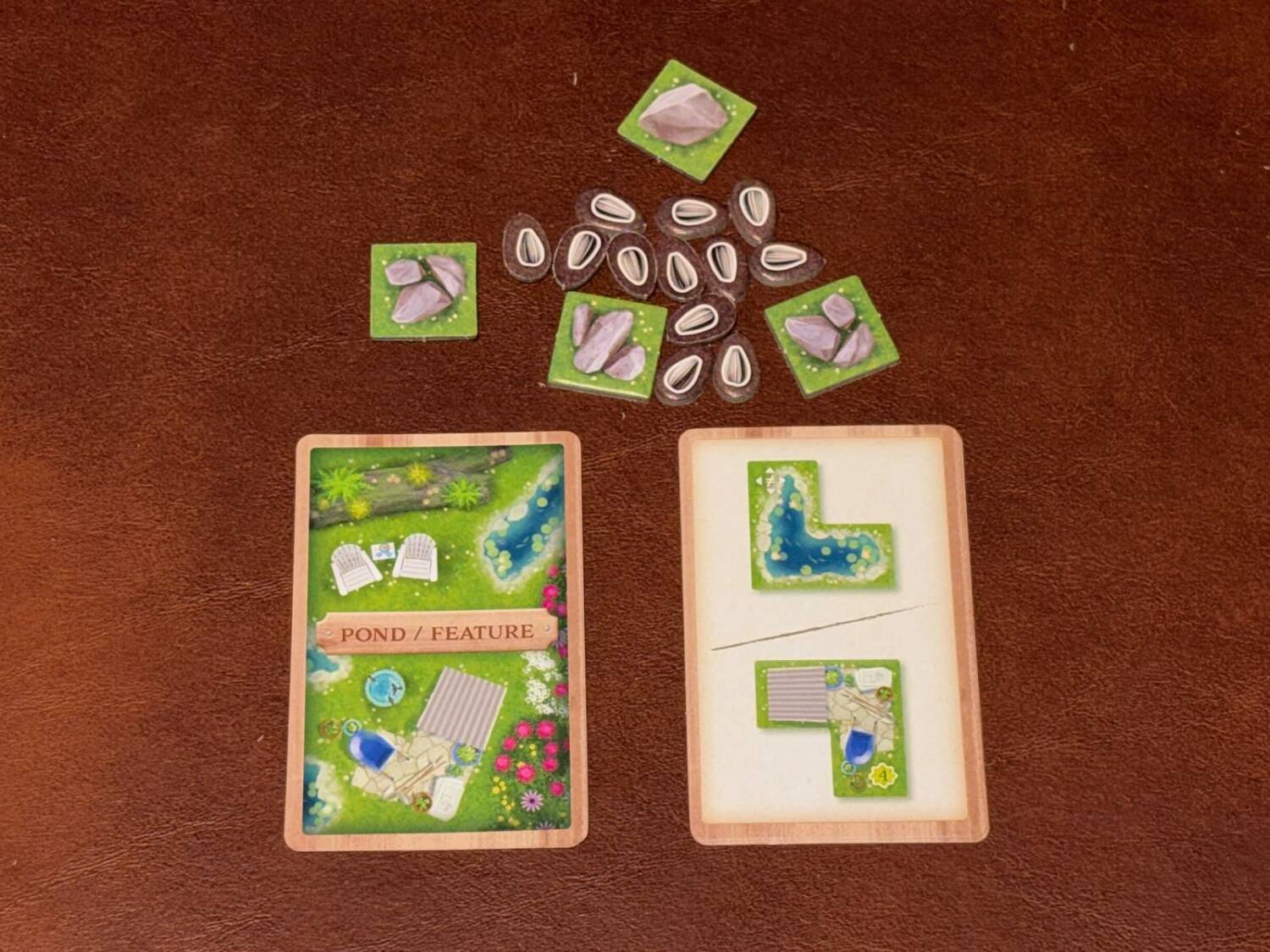
Of course, there are limits to your freedom. Those Pond/Feature tiles are pre-formed and must be put in somewhere, or else you lose the scoring opportunity. You have to keep an eye on which ones have yet to be drawn so that you (ideally) leave space for them. Unlike the Flower and Animal Tiles, you must place the entire shape. It can’t hang off the board. If you can’t do that, you must discard it and kiss those potential points goodbye.
All of these decisions get progressively more difficult as the rounds progress and your Garden Board fills up. The hard choices you have to make may ultimately mean sacrificing some good tiles because you can’t place full shapes, or you have too much stuff in your Workshop at the end of the round. It hurts to say goodbye to those tiles!
This is the sort of game that I adore. It’s a big puzzle, but there’s almost always something you can do on your turn to further your goals. It may not be the exact thing you want, but it’s something. And if one scoring area seems to be going sideways, you can pivot and try to work on something else. The uniqueness of the shape-forming alone gives my brain a workout as I mentally try to rotate and flip the Tool Cards over the Drafting and Garden Boards to see what can/should go where.
Some people don’t like multi-player solitaire games, but I enjoy them because I don’t relish getting hosed by others (or doing the hosing). The tile drafting and placement are constructed such that you can’t really even think about what other people are doing. What might they do with those tiles once they’re ready to be planted? You don’t really know. You can look at their Tool Cards and the state of their Garden and try to guess, but the odds aren’t great that you’ll be right.
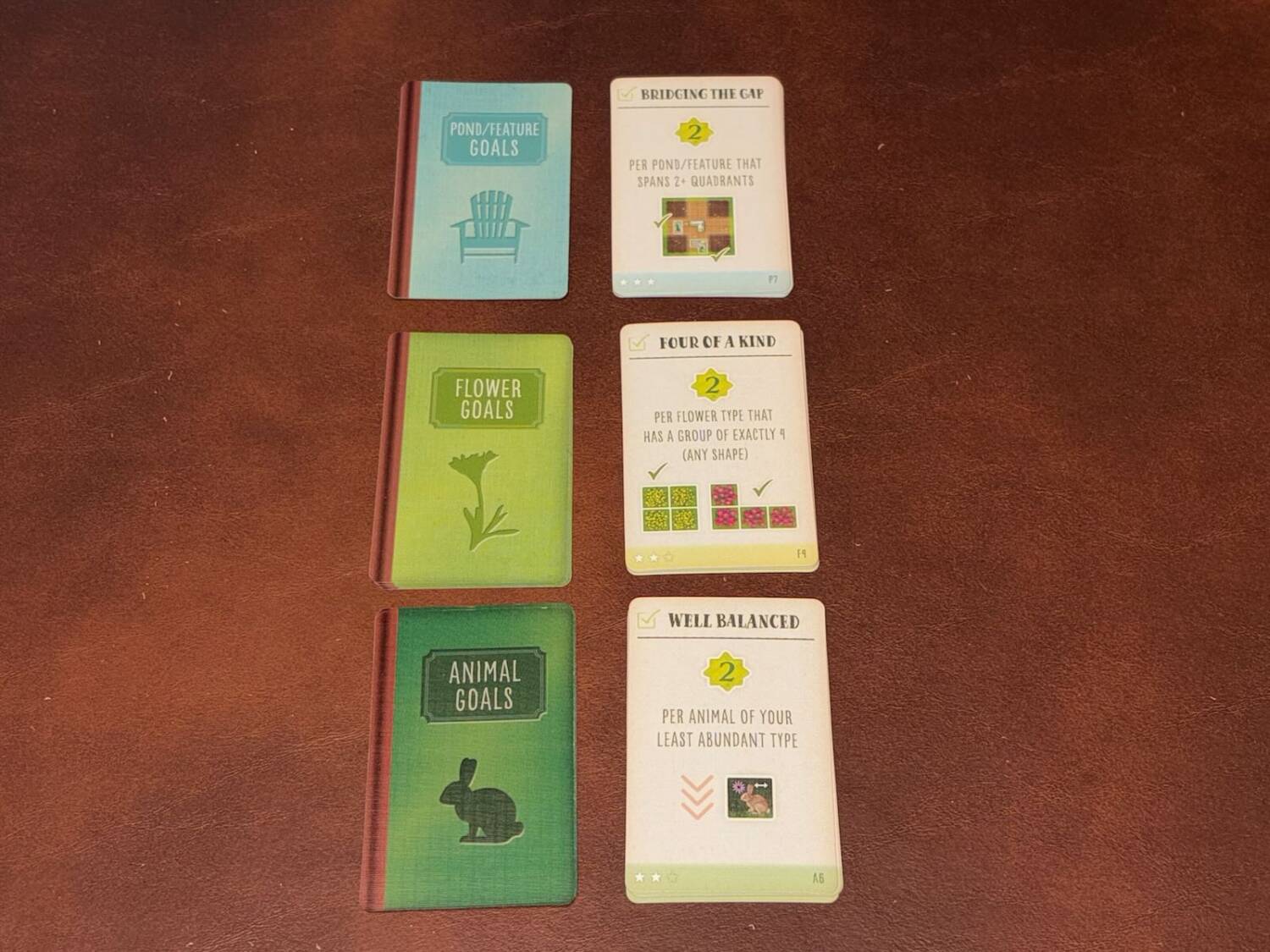
Besides, even if you could work it out perfectly, you’re far better off focusing on your own board to get the most out of your resources. It’s your personal puzzle to solve, and you only handicap yourself if you waste your very few turns taking Tool Cards or tiles that you think others want. Even if you play the advanced version (see below) and include the Goal Cards, the goals are for everyone. There are no extra points for finishing it first, or negative points for not completing it at all.
The only negative I can come up with (and I’m kind of digging deep here) is that scoring can be a bit time consuming. If you play with all the options, there are twelve scoring conditions to tally, and within those there can be several things to account for. (Multiple Animals, Flower colors, Goal Cards, and Ponds/Features tiles, for example.) The scoring pad walks you through it, but you still have to do the math.
To be fair, this is the price you pay for any game of this type which offers a layered puzzle and multiple victory point pathways. It doesn’t usually bother me as long as it’s not too onerous and the game is otherwise enjoyable. That’s the case here. But if you’re the sort of person who wants to take the last turn and know immediately who won without doing math, this type of scoring may bother you.
Other Ways to Play
Like most of Flatout Games’ other titles, Perennial includes several different modes of play to change up your experience. Goal Cards can be added to the base game. These offer additional scoring opportunities if you can meet the objectives depicted on the cards. There are goals for Flowers, Animals, and Ponds/Features and you can choose to add one, two, or three goals to the game (but only one of each type).
Perennial can also be played Solo or in Family mode. In solo mode, the opponent drafts tiles from the central board during the Gathering Phase, but does not participate in the Planting Phase. You are strictly competing against yourself and your previous scores in this mode.
Family mode simplifies the game down to just placing flowers and animals without the twists caused by Wild Animals, Seeds, and needing to place tiles according to a Tool Card’s shape. Seeds are not used in the game at all. During setup flowers of the matching color are placed in the spaces where Seeds normally go, giving you a little leg up on Flower placement. The Boulder tiles are not placed during setup, giving you more room on the board. Wild Animals and Starter Tool Cards are not used, either.
Tool cards are used during the draft, as in the regular game, but are not used during the Planting Phase. Instead, you simply place tiles following the standard adjacency rules, but you do not have to match a shape. To further simplify things, you can opt to play with only the Feature side of the Pond/Feature tiles, minimizing the scoring options further. This mode is great for kids and non-gamers who might not be up to parsing all of the elements of this puzzle!
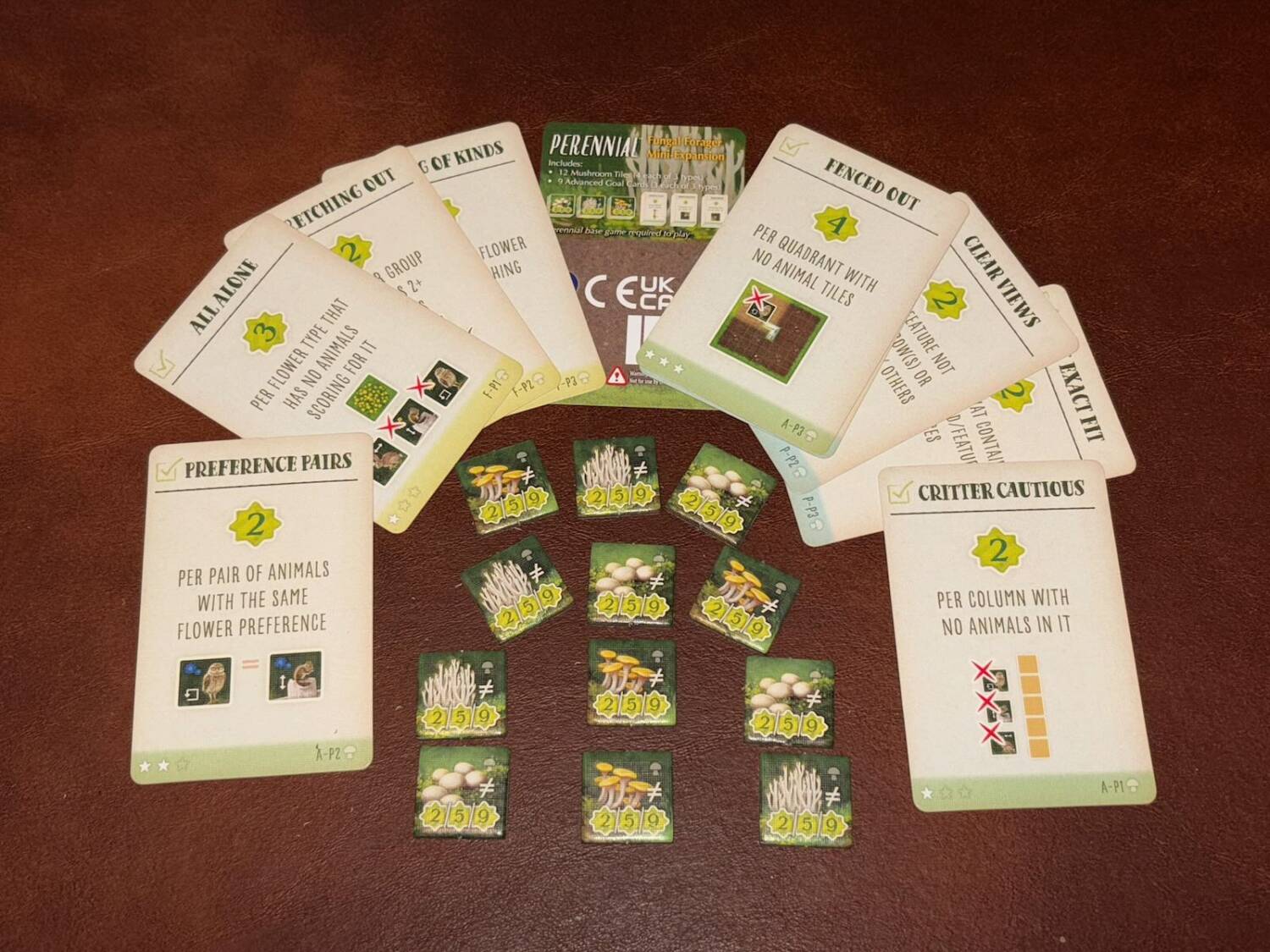
There is also a small Mushroom expansion which will be included with the Kickstarter. It simply adds a few new Goal Cards and Mushroom Tiles that are added to the tile bag and drafted like the other tiles. These tiles score based on how many unique mushrooms you have at the end of the game.
Finally, there are Achievements and Scenarios that give you things to aim for as you play. The prototype version of the rulebook I was given was vague on how these would work, but Flatout Games tells me that they will work similarly to their other games.
Wrapping Up
I have never met a Flatout game that I didn’t love, and Perennial is no exception. It has everything I love in a game: a multi-layered puzzle to solve, tile-placement, scalable difficulty, and variable setup. Where Perennial takes it up a notch is the notion of “DIY” polyomino shapes. Perennial’s idea of taking the polyomino shape shown on a Tool Card from the board, breaking it up into individual tiles on your player board, and then using any of your tiles to create another shape using a card in your hand is, well, mind-bending.
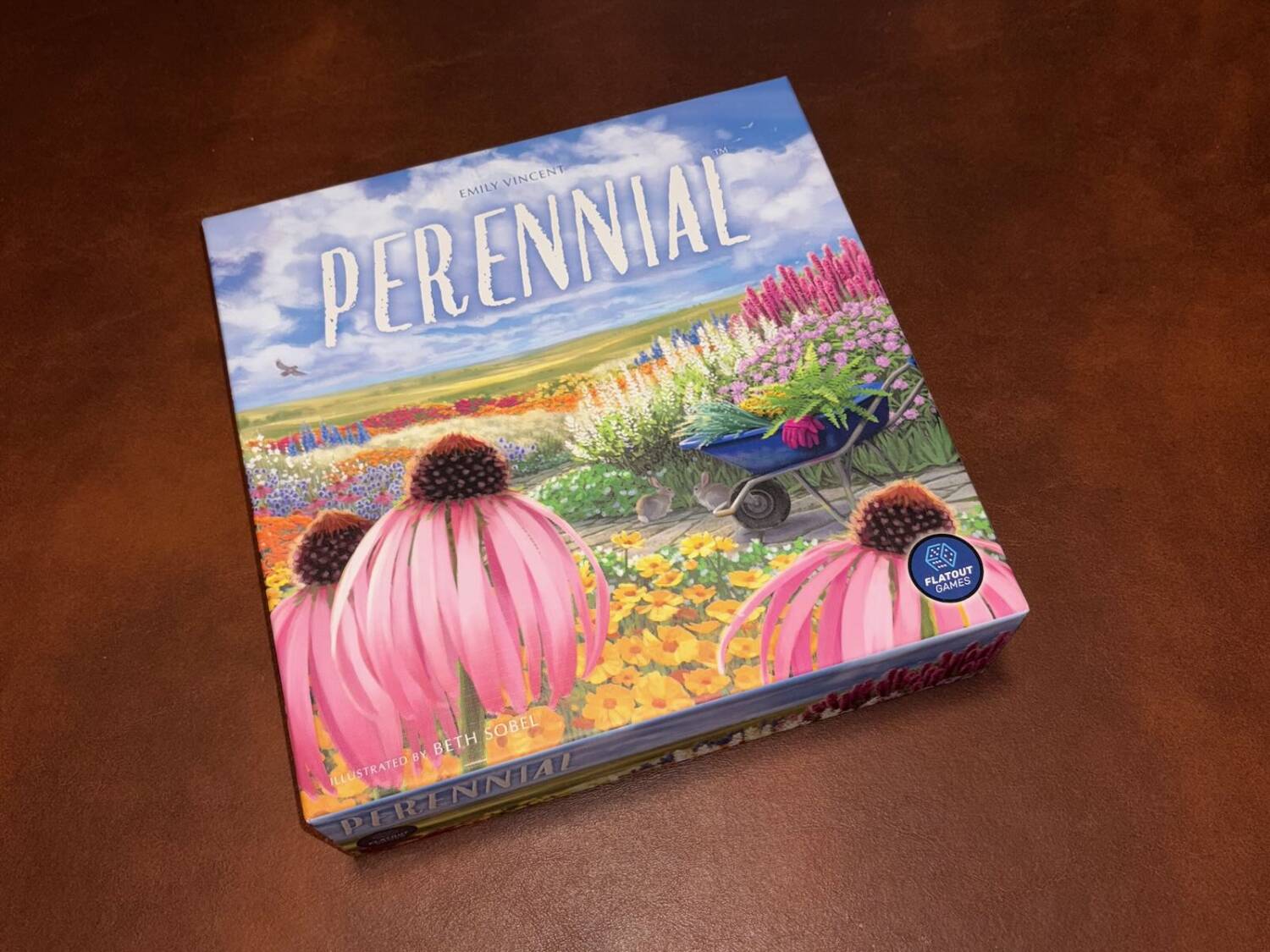
Most polyomino games give you pre-formed tiles that you must fit, jigsaw puzzle-like, onto a board. In Perennial, only the Ponds/Features are pre-formed. Everything else is anarchy. You can use any flowers or animals that you have on your player board during the Planting phase to make the polyomino shape on your chosen Tool Card. You don’t even have to place the full shape from your Tool Card if you don’t want to!
This glorious madness means that I’ll never view tile-placement the same way again. Which might be bad because it’s my favorite mechanism by far and now some of my old favorites like Barenpark, Isle of Cats, and even (gasp) Cascadia are suddenly looking a little less sexy with Perennial in the room.