Disclosure: Meeple Mountain received a free copy of this product in exchange for an honest, unbiased review. This review is not intended to be an endorsement.
Hidden movement games occupy a strange corner of the tabletop world. Compared to juggernauts like deckbuilding, worker placement, and engine building, the genre feels like it has been locked in the crypt, occasionally rattling the door to remind everyone it still exists.
Nuns on the Run is a perfect example of that. Originally released in 2010, the game flipped the typical hidden movement structure on its head. Instead of many players hunting one, a single player searches for several invisible ones. Throw in a genuinely charming religious theme that somehow manages to poke fun without punching down, and you have something worth paying attention to.
The Lord’s Work This is Not
Our story starts with life in the abbey not going quite as planned. Most players are novice nuns who have very clearly not yet grasped what life in the cloth actually demands of them. Locked away somewhere in the abbey is a relic of their former life: a love letter, a bottle of booze, a box of cookies. The goal is simple: sneak out of bed, grab the key, retrieve their precious contraband, and make it back before anyone notices they are gone.
Standing between the novices and their contraband are the two nun pieces, both controlled by the Nun player. They patrol the abbey as the antagonists, and their job is to catch enough novices or run out the clock.
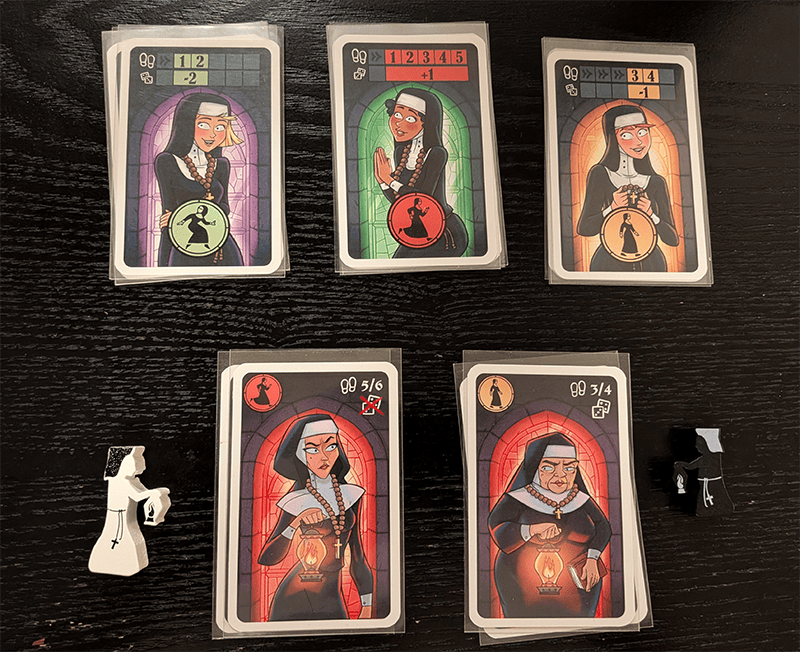
One thing Nuns on the Run gets right is structure. Every round flows clearly from a player card that everyone references, starting with the novices writing their planned movements behind their screens and selecting one of four movement cards. The choice matters more than it looks. Movement type determines how many spaces you cover and how much noise you make in the process.
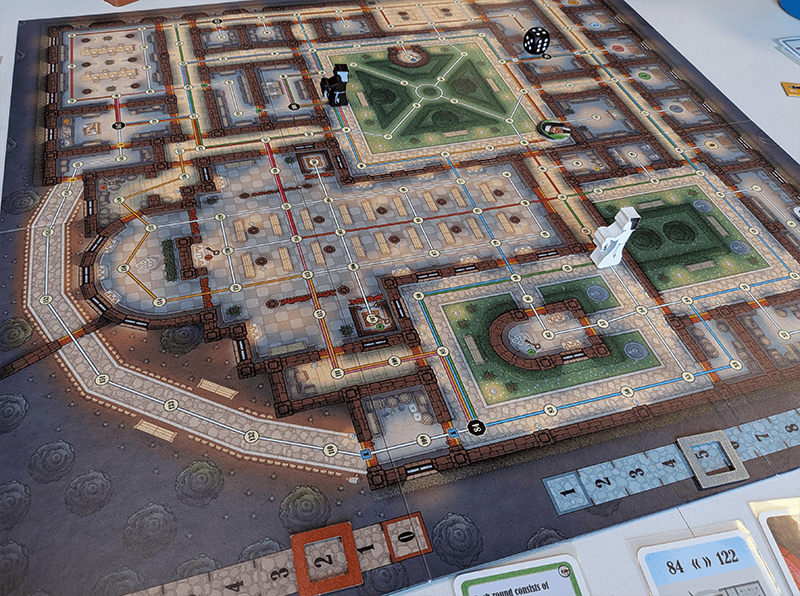
The map is less intimidating than it looks. It is essentially a series of connected dots, giving both sides a clear sense of how to navigate the abbey. The biggest change from the original edition is how line of sight works. Gone are the charts and fiddly standee positioning nonsense. The moment a nun piece enters a room, everything in it is visible, unless a novice is hiding behind a curtain or a closed door. The map itself has been redesigned around this change.
In Dice We Trust
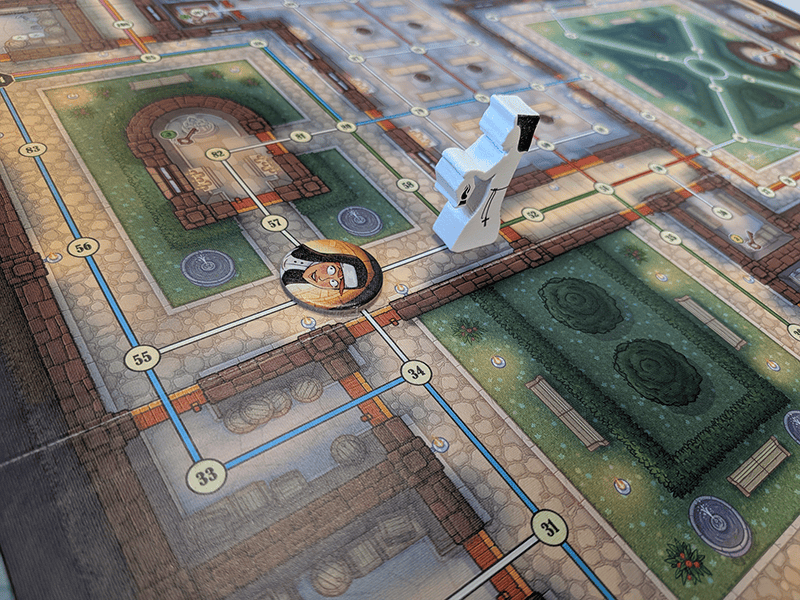
Once novices have recorded their movements, they reveal their movement card and roll a six-sided die. The result represents noise, modified by the type of movement used, and determines how many dots away the nun pieces can hear. If the sound reaches them, the novice places a token in the general direction relative to the nearest nun piece. Not a precise location. Just enough to make everyone nervous.
After the noise check, the Nun player takes their turn. It is far more systematic than what the novices are doing. Before moving, the Nun player must commit to a path for each of the two pieces by playing their path card face up. Yes, the novices know which path the pieces are taking. The map shows several highlighted numbered spots and colored paths, giving novices a general idea of where the patrol is headed.
Once the Nun player has committed to a path, they decide whether each piece walks or runs. Beyond the number of spaces covered, the real consequence is the noise check. A walking nun piece triggers its own die roll from its new position, and novice players must honestly declare whether they fall within earshot, following the same procedure as their own movement phase.
The nun pieces do not roam freely. They follow a set path unless something gives them reason to deviate. Heard a noise? Follow it. Spotted a novice in the open? Give chase. Did that novice just slip out of sight? The hunt is on. Outside of those moments, the path holds.
Though Shalt Not Get Caught
Getting caught is not an instant elimination, but it stings regardless. A novice caught by the Nun player must retreat back to their room, burning precious time on a journey they have already made. The clock is always the silent enemy here, and since this is a dash between contenders you cannot see, there is this constant pressure to push yourself and take risks. It is a private race with public consequences. Games tend to wrap up in 30 to 45 minutes, which is about the right length for the tension it generates.
That tension, however, is far from guaranteed. One of my biggest issues with Nuns on the Run is how wildly inconsistent the experience can be from session to session. The Nun player operates on a formulaic, reactive system that can make long stretches of the game feel like clockwork rather than a hunt. The noise system is the bigger offender.
A novice could host a New Year’s party next door, complete with a three minute countdown to midnight, and the nun pieces might not hear a thing due to lucky dice rolls. A standard six-sided die swings hard in both directions, and when luck heavily favors the novices, the Nun player is left patrolling hallways with nothing to show for it.
The most consistent source of pressure in this game is not the Nun player at all. It is the other novices. With only one winner, novices will occasionally push into riskier territory to gain an edge over each other, and their movement cards tell a story of their own. A novice running several turns in a row is almost certainly far from the Nun pieces. That meta reads quickly and changes how everyone operates, which ends up being more interesting than the hunt itself.
Bless This Mess
When a nun piece picks up a trail, the map itself becomes a third faction. It is clear a lot of testing went into making sure the layout works for both sides. Tight corridors and hallways give novices places to duck into and break line of sight even when a Nun piece is near. Wide open spaces like the church and the gardens belong to the nun pieces, yet novices are constantly tempted to cut through them anyway since open ground means fewer movement steps. That tension between safety and efficiency is where the map design does its best work.
Nuns on the Run is a family game wearing its habit proudly. It is a step above Scotland Yard, offering a more engaging experience for both sides without demanding much from either. The game also moves quickly for what it is. Even at the full eight-player count, the novices all record and reveal their movements simultaneously, which keeps the round structure tight and prevents the downtime that kills most games at higher player counts. Just do not bring this one out expecting a deep strategic experience.
Compared to heavier hidden movement games like Sniper Elite, Fury of Dracula, and Mind MGMT, Nuns on the Run sits at the bottom of the complexity ladder. You move, you record, you hope. There is an advanced variant that gives each novice a once per game blessing to bend the rules, but outside of that it is a bare bones experience. Glorified hide and seek with extra steps, and it does that job well.
The Devil is in the Details
Production-wise, nothing here is overproduced and that works in its favor. Every inch of cardboard serves a purpose, making setup and teardown easier than breathing. The rulebook gets the job done, though it has a habit of overexplaining concepts that barely need explaining. The biggest draw on the table though, is the artwork.
The art direction does something brilliant. Novices are illustrated as if they are about to post their best selfie: rosy-cheeked, bright-eyed, and radiating the kind of energy that has absolutely no business being in a convent. The nuns, on the other hand, look like they have not smiled since the reformation. Serious, rigid, and entirely without warmth. No caption needed. The contrast between the two sides tells you everything about the dynamic before a single move is made, and that kind of visual storytelling without exposition is harder to pull off than it looks.
For a game about sneaking around a convent, Nuns on the Run is surprisingly upfront about what it offers. Hobbyists with a table hosting Fury of Dracula and Mind MGMT will likely find it too simple to hold their attention for long. But for families looking for something with a little more personality than your average gateway game, this one earns its place. The funny premise and lightweight rules are worth passing around the table. Sometimes a good game of cardboard hide and seek is all you need.