
Disclosure: Meeple Mountain received a free copy of this product in exchange for an honest, unbiased review. This review is not intended to be an endorsement.
Disclosure: Meeple Mountain was provided a pre-production copy of the game. It is this copy of the game that this review is based upon. As such, this review is not necessarily representative of the final product. All photographs, components, and rules described herein are subject to change.
Nippon: Zaibatsu—2026’s updated version of the 2015 original, Nippon—is so hot in my gaming circles that I had the chance to play the base game three times over the course of a week, and it seemed like the game was popping up at game nights all over Chicago for the first couple months after it hit the market.
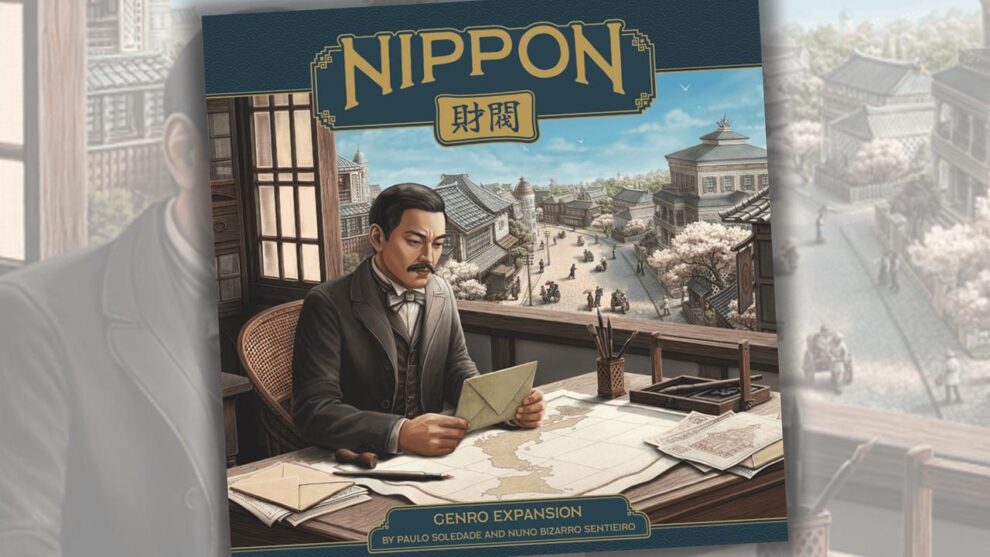
After drafting my initial review of the game, I learned that the game’s first expansion, Nippon: Genro, is hitting crowdfunding in late June of this year. A couple prototypes were floating around the US, so I reached out to CrowD Games to see if I could grab a pre-production copy to play for about a week, and I’m excited to share that CrowD obliged.
Nippon: Zaibatsu is a relatively easy game to learn, but it is a very difficult game to play well. By that, I mean that the game’s high volume of timing decisions make for a tricky gaming affair, and I’m surprised how often I had a plan to get all my ducks in a row during each play only to have an opponent snipe end-game turn order, or mid-game area control elements, or the perfect worker color for my consolidation plans just before I could.
Nippon: Zaibatsu may come across as a cutthroat area majority experience. Moving into new markets with your influence tokens might mean bumping an opponent completely out of a region, and as a game simulating the effects of new industries and competition in local markets, I found Nippon: Zaibatsu to be one of the best games I’ve ever played. Timing these moves with scoring rounds is one of the most fulfilling things I have seen in gaming…not just in 2026, but ever.
With that as our frame, the Genro expansion is for the Nippon: Zaibatsu superfan. Some expansions make the base game more approachable; Genro goes in the other direction. Genro is absolutely not recommended for new players. To ensure I saw the game with both brand new players as well as experienced Nippon: Zaibatsu players, I did three plays of this expansion, including plays with three players who had never played the base game and two players who have played Zaibatsu three times each. The new-to-Nippon players did not enjoy this experience, in part because of what each Genro board brings to the party.
So, let’s start there. Nippon: Genro adds two Genro boards, from a pool of five included in the box, each serving as its own mini-game that is triggered when a player takes the Local Markets action. Normally, a player will drop an influence token aligned with the type of goods spent during the action (cotton, paper, bento, lenses, bulbs, clocks) in one of the four main regions of the map. In Zaibatsu, players can then take a reward: two points per token dropped, or the pictured bonus for that region: cash, iron, silk, or coal.
In Genro, players now get a third choice: influence one of the current game’s Genros, local government administrators and statesmen who can help a player “get things done”, if you know what I mean. This all feels game-appropriate, because you know that running a business conglomerate in the Meiji era meant working around the edges to get ahead of the pack. So, instead of taking two coal or a couple of measly silk tokens, players can—and should—place Loyalty tokens on a Genro during the Local Markets action.
When placing these Loyalty tokens, players slip an envelope onto the Genro’s Loyalty board, with tokens placed in the row and column aligned with the number and type of crates that were used to place the influence token on the map. (One might assume this represents written correspondence to each Genro, but I went a different direction and assumed this was correspondence loaded with yen to help “influence” local politicians. Board games!)
The main reason players have to interact with the Genro characters? In this expansion, there are six area majorities in play instead of just the four from the base game. These two new majorities are tied to the Genro characters and are worth the same amount of points as influencing one of the map regions, with the scoring potential for each region consistent with the base game. No one wants to miss out on 26 points for first place in that final scoring round of the game, right?
Each Genro offers a benefit when placing Loyalty tokens, but each Genro also makes Nippon a harder game for all players, although that can be mitigated to become “most” players depending on how well you can influence each Genro.
For this review, I did three plays:
- Legislator Genro (Genro #1) and Regulator Genro (#4), four-player game, including two brand-new-to-Nippon players
- Enlightener Genro (#2) and Lawkeeper Genro (#3), three-player game, including one brand-new-to-Nippon player
- Legislator Genro (#1) and Exporter Genro (#5), a solo play so I could evaluate how the increased rules load with these Genro boards would work with an automa. (Solo for the base game is pretty slick and very easy to administer. Depending on the Genro boards in play, Nippon: Genro is a trickier game to manage.)
Here are a few thoughts on each Genro: how they play (using the draft rules listed on BGG), and how they affected each game.

Legislator Genro (#1)
The Legislator is the easiest of the five Genro characters to navigate.
When players interact with this character—and, with all Genro boards, these interactions take place during the Local Markets action only—they must spend 1,000, 3,000, or 6,000 yen to move a large token one, two, or three spaces in a clockwise direction around a small bonus rondel spread across four sections randomly placed during setup: ships, trains, machines, and factories. Based on where the token lands, the matching section’s action is a little more expensive for all players; that might mean spending one extra iron when taking the machines action, for example.
While that cost might not seem high, it was shocking how often players found themselves wanting to take the action currently under penalty and not able to, because of this slightly higher cost. This requires much more careful planning, or using actions to manipulate the bonus/penalty token out of a section that impedes your current plan to force an inconvenience on someone else.
The bonuses on this wheel are a range that includes some of the game’s standard bonuses—triggering a Department bonus here, or getting two bumps on the income track there. But most of the bonuses are much better: a free train, an extra loyalty token (very useful for majority scoring), a free machine. This is another way in which the Genro expansion makes influencing these characters a non-negotiable; I’m always taking a cheap ship over, say, two silk or 2,000 yen.
The Legislator comes with tokens that are used to call out the increased costs for these four actions, so it’s always easy to tell what action is the one to avoid, at least temporarily. And because the bonus/penalty marker moves often thanks to the players and end-of-round rules (when workers refill the hiring markets), there are always timing considerations aligned with snapping up the best bonuses at just the right moment.

Enlightener Genro (#2)
I’m a little torn on the Enlightener. I think I see what the designers, Nuno Bizarro Sentiero and Paulo Soledade, were going for here, by forcing players to signpost which industries they will pursue early in the game. But some of the early bonuses with the Enlightener are really terrible—a silk here, 2,000 yen there—and it’s really hard to make a meaningful dent into progress with the Enlightener early in the game, limiting the fun players may have with this character.
The Enlightener board includes a mix of basic and advanced tiles that are placed underneath it. The tiles have a mix of gold, silver, and bronze rewards, earned as a player moves to the right along four tracks tied to the advanced industries: lenses, bento, bulbs, and clocks. These tiles also have penalties, and if a player wants to build or maintain one of these four industries, they will face extra costs to do almost anything until they move their marker on the appropriate track.
In our game with the Enlightener, all three players advanced to the end of one track, while one player moved off the starting space of a second track. As players get bonuses, they have to move tiles to the left on tracks different from the one they moved on, which makes other industries easier to incorporate.
By the end of the game, this led to a couple of strange effects. Bulbs became easy for everyone to start late. No one bothered to move up the clocks track. Only one player was able to get a gold-tier bonus. And all the bronze-tier bonuses are, well, terrible.
The Enlightener ended up being only mildly interesting. It didn’t make life hard for, really, anyone, because they simply avoided starting a factory in the industry (or industries) where they made no meaningful progress. The best thing about it during our play? Players became more narrowly focused on only one of the two Level II industries and forced more competition for influence spaces within each region during scoring rounds.

Lawkeeper Genro (#3)
The Lawkeeper is quite the mini-game!
This Genro introduces a puzzle element, where players can place tiles in a grid that cover spaces that grant bonuses to the active player. There is a market of three double hex tiles, and each time a player interacts with the Lawkeeper, they spend one to three thousand yen to take a tile and place it in the grid, gaining bonuses similar to the ones we’ve mentioned so far: a little cash here, a train for a slight discount there.
But mathing out how to place the tiles is a fun little puzzle, which thankfully does not take too long to puzzle out while other players are waiting to take their turns.
The real hook with Lawkeeper is not the bonus area, but the penalties. Here is where things get spicy. A column of Striker tokens is randomly slotted during setup, tokens that look a lot like the Expert Worker temporary tokens that can be acquired during the Ships action from the base game. This Striker column features one worker in each of the game’s six worker colors. Adjacent to this is a “Discontent” tile, which points to different sets of workers.
Whichever Striker token is at the top of this column is a problem, because that color of worker cannot trigger income bonuses, regardless of where they are in your own worker play area. The workers below that top worker can still trigger an income bonus if they are in your bottom-most space, but if they are at the top of your worker column (assuming you have at least four workers when you Consolidate and the top and bottom workers are different colors), they can’t trigger your second income bonus. The workers at the bottom of the Discontent track operate normally.
This means that you’ve got to constantly gauge the market of workers by color, to see which ones will get you any bonus at all. As a player obsessed with making sure I get all my worker bonuses, the Lawkeeper was the devil—I hated it when it hurt me, and I loved it when it hurt other players. Jockeying for position with the right colors of workers on the Striker track was something else; moving a worker out of the top position just in time to benefit me was a joy during my single play with this Genro. One player hated the Lawkeeper because he kept getting hosed by the shifts in that market.
The Lawkeeper might be the best example from this expansion of why Nippon: Genro is best suited for experienced players. There’s so much to focus on already, but with the Genro boards, there is so much more to worry about as you make your plans in each round. I both loved the Lawkeeper and rued its existence—perfect for a cutthroat, corporate area control game.

Regulator Genro (#4)
The Regulator proved to be the most frustrating of the Genro included in this expansion. In part, that’s because I think this character pushes players hard on boosting their way up the three tracks on a player’s board: R&D, Mining, and Income.
The penalties imposed by the Regulator are aligned with a player’s progress on those tracks, in a wild way: if you don’t keep up with the Regulator’s ongoing track progress across those three categories, a Restriction token is used to limit the number of workers that can be drafted before forcing a player to consolidate.
A grid of bonus tiles resides along the upper right quadrant of the Regulator’s board. These tiles have some great bonuses—maybe none of which is better than the two crates that can be used in two separate factories beginning with a player’s next turn—but can only be acquired when a player takes the edge tile (of 2-3 choices) in the row or column aligned with the type of crate that was spent to influence a region. During setup, and again at the end of each round, players check the background colors of the three tiles currently in the “bonus queue” to see which tracks move forward, which may force players to have even fewer worker slots based on their progress versus the Regulator.
Boy, did this create a lot of chaos in our game. It also depressed scoring a bit, as players scored lower totals at the end of the game thanks to the harder Favor token conditions forced during consolidations.
On the positive side, it forced everyone to push hard on boosting their income track as well as finding creative ways to continuously push up on the R&D and Mining tracks, even when players wanted to take other actions. Staying ahead of the Regulator requirements was quite a challenge throughout that play, and timing the bonus tiles was another challenge because a few of the bonuses only trigger if a player has 3,000 yen to spend on a train, for example. The way tiles are scooted around the bonus tile area also forces a lot of timing considerations, but not everyone found that to be as much fun as I did.

Exporter Genro (#5)
The Exporter is rated as the hardest of the five Genro in this expansion to incorporate, and after even a single consolidation, I can see why.
The Exporter changes some of the options available to players when they take the Investment and Contracts action, by offering a side board that has three new goods categories that align with the I/II/III levels of the goods from the base game. So, now there are darumas, masks, and vases that align with the two goods from each level of the base game.
There are special contract actions that can grant interesting bonuses with the Exporter, and I like that dropping crates with the Exporter is tied directly to a player’s Mining production level. That probably means it shines best when aligned with the Regulator Genro, since that pushes players to make tracks a major priority in such a game.
But it is the penalties for the Exporter that make it a no-fly zone for me. The escalating penalties—which begin with the payment of an extra 1,000 yen during consolidation, and can get much worse very quickly based on the randomized setup of the board—made for a very un-fun experience. (Un-fun is a word, right?)
Throughout that play, I often lacked the cash or the iron to execute meaningful rounds. I was constantly chasing the automa on area influence of the Exporter’s loyalty tokens. It felt like it was very difficult to suss out the timing considerations tied to the bonuses. I get it—all the Genro boards are intended to make the game harder. But the Exporter very much felt like “difficult, for the sake of difficulty”, and it is the Genro board I rate the lowest.
Wrap-Up: Do You Need This Expansion?
“I could see this being a part of every play,” one of the new-to-Nippon players said after the Legislator/Regulator play. “It’s hard, but some players will like that.”
I totally agree with this assessment. If you like a good challenge, Nippon: Zaibatsu already offers that in spades and Nippon: Genro makes the game much more difficult. If you like pain—pain in the form of moderate-to-severe limitations, both in turn-to-turn actions as well as across the game’s entire journey—Nippon: Genro is a must. Even though some of the bonuses are juicier when taking the Local Markets action, there’s no question that the game is simply harder with this content included.
That means there will be some frustrating turns, as you realize that the Regulator has once again forced you into an early Consolidation before you could trigger your top-level Favor token for end-game scoring, or when you have to pay 6,000 extra yen if the penalty tokens are lined up in the worst possible ways with the Exporter.
That also means Nippon: Genro will make you feel really good about yourself when you navigate the chaos and pile up extra cash and coal to do an extra production in a round where you thought you wouldn’t have the chance to do so. The range of minigames on display here is impressive, and a bit like games such as SETI: Search for Extraterrestrial Intelligence or Shackleton Base: A Journey to the Moon, having just two of the five Genro in the box used in each game keeps the approach fresh while offering different ways to challenge the most seasoned corporate combatants of the Nippon: Zaibatsu player base.
My favorite thing about Genro? I love the way all five Genro boards align with how the base game prioritizes the phrase “timing is everything.” Whether it was the bonuses a player can grab using the Regulator, the way tiles built up using the Lawkeeper, or finding ways to take actions before they became a little more expensive thanks to the Legislator, the Genro expansion sticks to the script in a way that players who love the base game will really embrace.
I used a pre-production copy of Genro for this review, and I have to really applaud CrowD’s production partners for the quality of this toy. The five Genro boards are in great shape, and everything fits perfectly in the recessed spaces of these additional components. I love the artwork on the boards, and I’ll be curious to see where an updated player aid (or maybe a new Player Handbook) ends up with the extra content, so that everything is in one place.
If you’ve got a group of hardcore Nippon players, consider backing Nippon: Genro as soon as the campaign goes live. I’m going to use Genro mostly as a way to incorporate the Lawkeeper, Regulator, and Legislator boards when players want a little extra challenge.