Disclosure: Meeple Mountain received a free copy of this product in exchange for an honest, unbiased review. This review is not intended to be an endorsement.
(Note that this tile set is for American mahjong, not Chinese mahjong. While the games are similar and share the same roots, the tile sets required to play each are slightly different.)
Editor: Please read to the bottom for a discount code on Monet’s Garden Mahjong set.
The Mahjong Moment
Mahjong is a traditional game that’s having a modern moment. Like chess, it’s a game that has long had its followers but has never quite become part of the mainstream hobby scene. Now both games are experiencing renewed popularity.
In the tabletop world, we saw a big boom in gaming during and after Covid. The need for entertainment and escape, coupled with a need to engage in-person after being isolated drove renewed interest in modern board games. The same is true of role-playing games, chess, and, yes, mahjong.
Suddenly mahjong is everywhere. Social media is bursting with pictures and meetups. I don’t even live in a major city and I see flyers advertising mahjong classes, playgroups, and tournaments all over town. Hallmark even made a mahjong movie and matching Christmas ornament!
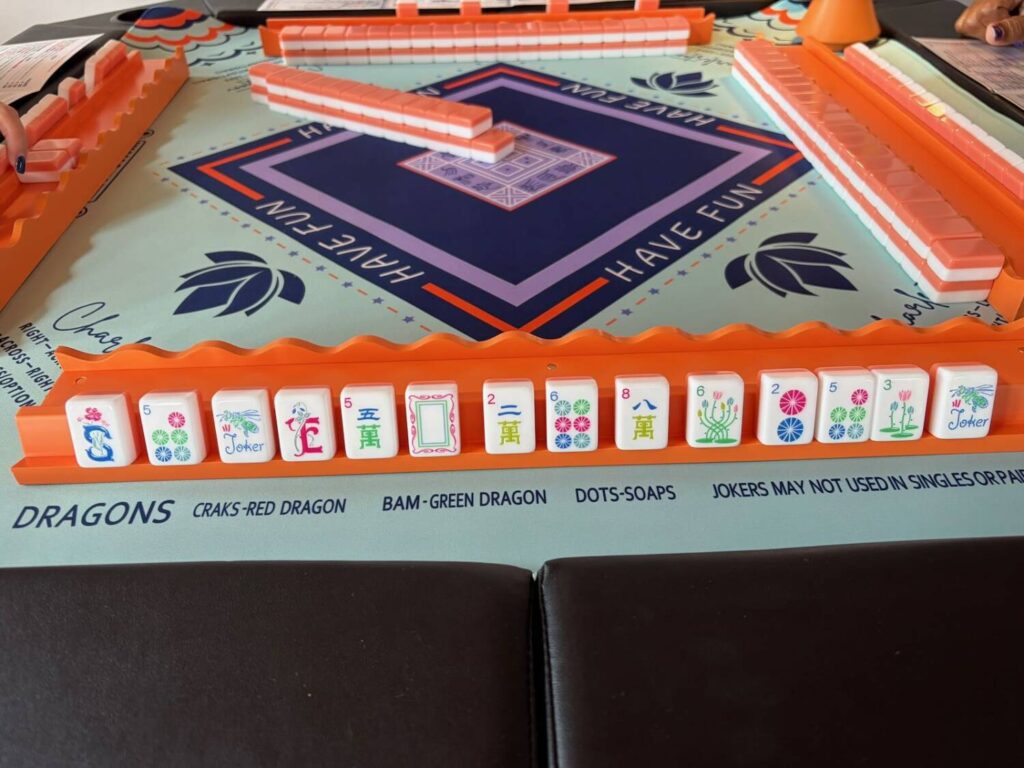
With all of this interest comes a flood of products designed to capture every possible dollar. Mats, racks, lamps, tile sets, tables, carrying bags and more are all out there tempting you to buy just one more thing. Welcome to the arena mahjong-lovers! Board gamers saw +/- 8,000 new games and expansions released in 2025 (according to BoardGameGeek.com), all designed to capture our dollars. And that’s before we include the carrying bags, special tables, sleeves and other accessories of the board gaming hobby. Congratulations mahjong players, you’re one of us, now. Hang on to your wallets!
When it comes to tile sets, any set will technically do the job of allowing you to play the game. Like chess sets, the pieces are standard (all sets include Bams, Craks, Dots, Jokers, Dragons, Winds, and Flowers). Even a bargain-basement tile set will have all you need to play.
Where things diverge is in the quality and aesthetics of the tiles. Some tiles are lightweight, others heavier. Plastic, bakelite, and actual stone are just a few of the materials that tiles can be made of. Some tiles feature the standard decorations/numbers, while others focus on art and aesthetics with unique colors and decorations. In some sets, the decorations are painted on the tiles while in others the artwork is etched into the tile face.
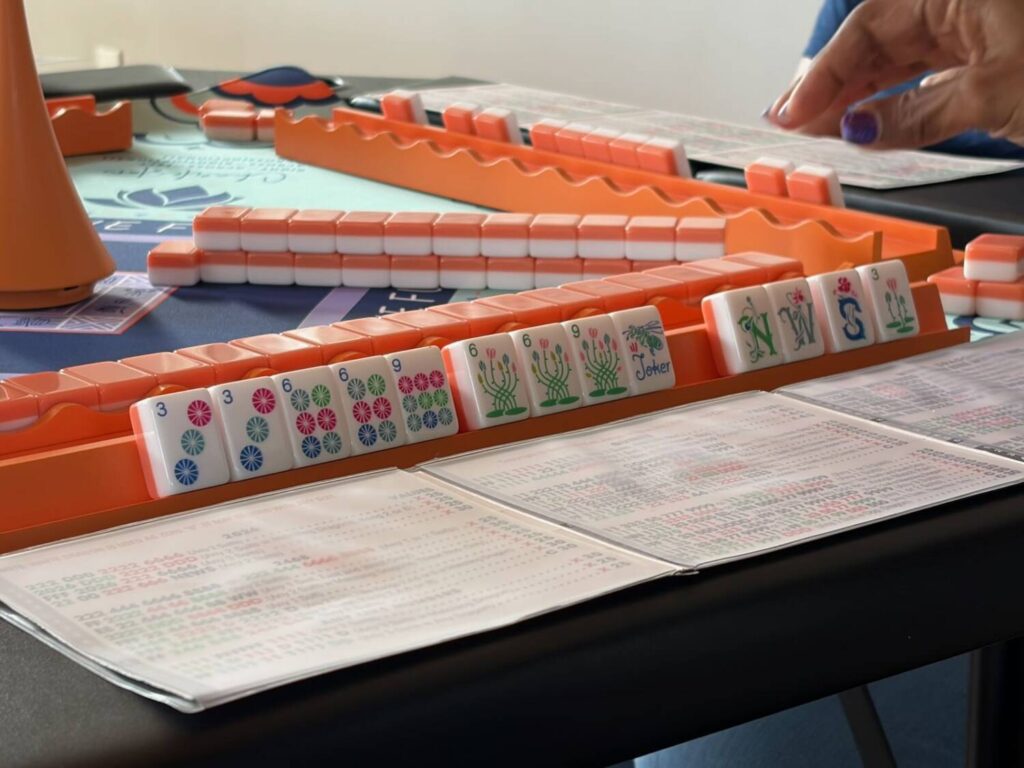
There is also often a difference in what comes with the set besides the tiles. Some include bags, mats, and/or tile racks, while others don’t. Some also include the official card from the National Mah Jongg League, while others include a generic card, or no card at all.
(The card shows the winning hands and how they are constructed. The official card changes every year, which means the winning hands change each year. To play casually, you can play with any card, but to play in tournaments you need the current year’s card.)
Choosing a set (often) isn’t simple!
I am a mahjong novice. I’ve only played with a handful of sets, so many of these nuances are lost on me at this point. I’m still at the stage where I say, “All the parts are here? Great, let’s play!” and I don’t give a lot of thought to what makes a great tile set versus a merely adequate set.
I needed help to write this review.
Enter the Experts
Since I am not an expert, I sought out some friends who are to help me with this review. Naomi Randolph operates Mahjong Mania, offering classes, tournaments, and guided play opportunities in our town. She’s been mahjonging for years and I asked her to weigh in with her thoughts on Monet’s Garden.
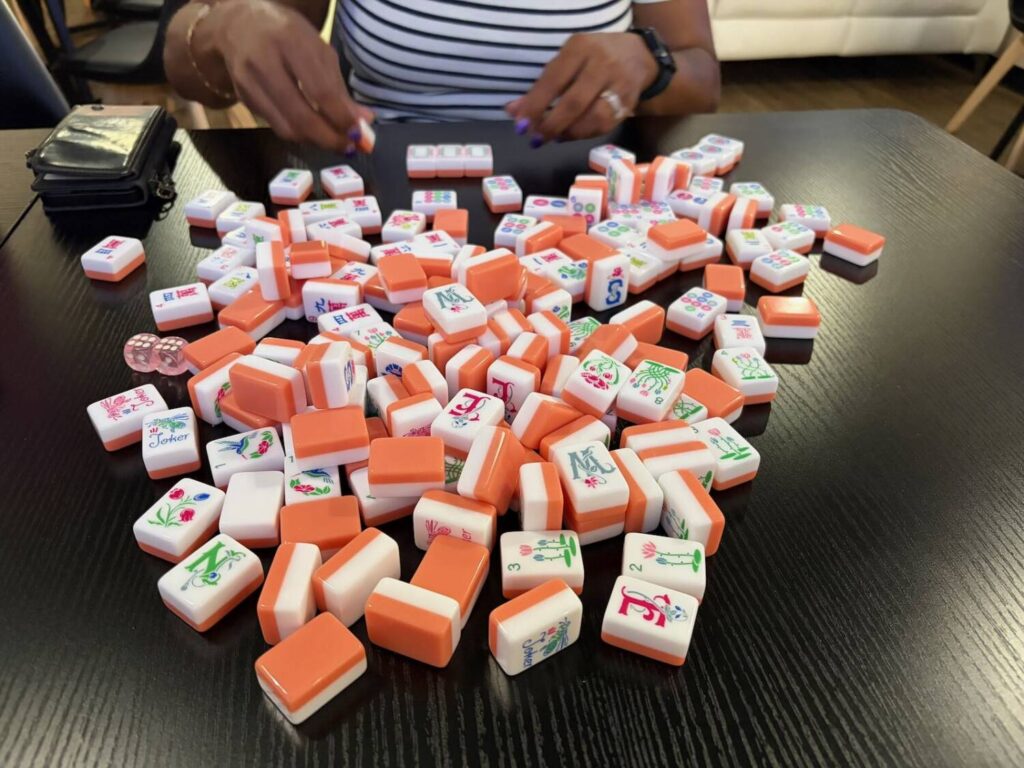
In turn, she enlisted some of her regular playgroup to also offer their opinions over a few mahjong hands one afternoon. What follows is a group effort!
(In addition to Naomi, special thanks go to Katie, Barb, and Christine for giving up their Sunday afternoon to play and talk to me, and for allowing me to poke into their games to take pictures. Thank you!!)
Functionality and Quality – The Good
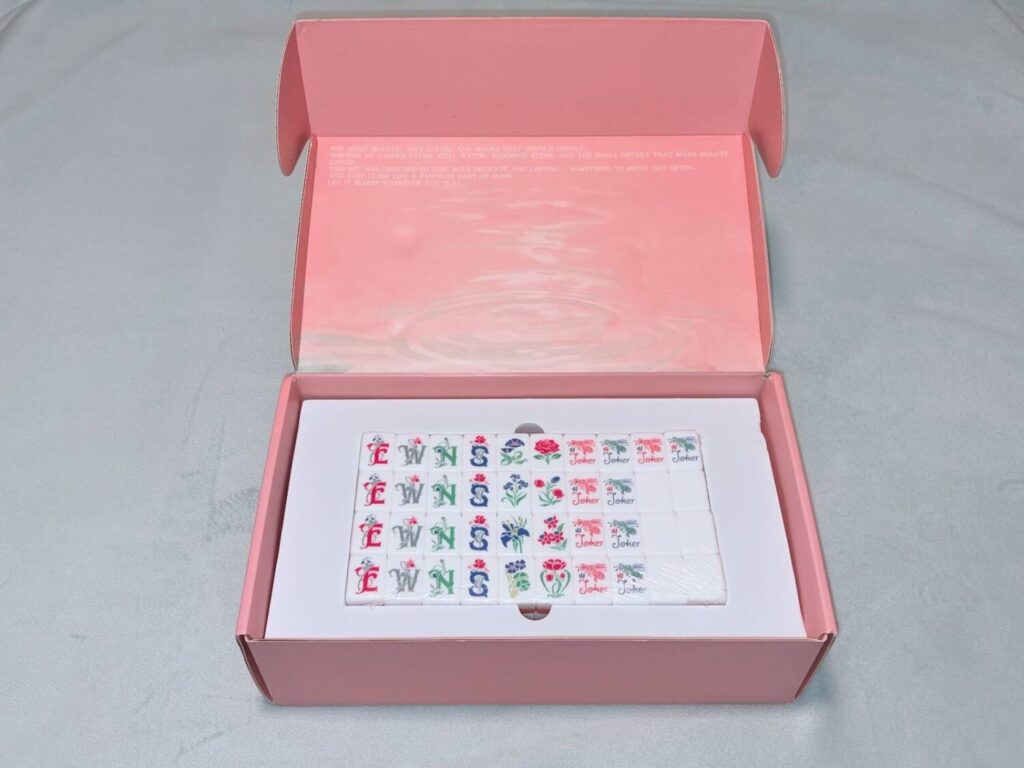
Monet’s Garden is primarily a tile set. It comes with all the tiles you need to play American mahjong, plus a few blanks in case you lose a tile or two.
The tiles are medium-weight and made from acrylic. My experts noted that they’ve played with both lighter and heavier tiles, so these sit comfortably in the middle. It was noted that they are light enough to travel with, should you want to take your set on the road. Naomi noted that weight is often a personal preference, but these do feel good in-hand and offer a satisfying “thunk” as you draw and rack them.
The artwork is etched into the tiles rather than painted on. Players noted that this usually means the decorations will last longer, as the designs don’t chip off. The etching was generally uniform and centered, although a couple of the tiles were a little off-center. Nothing that impacts playability, just a likely consequence of mass production. The tiles did hold up well to shuffling and play, and no nicks or dings were noted after several playthroughs and shufflings.
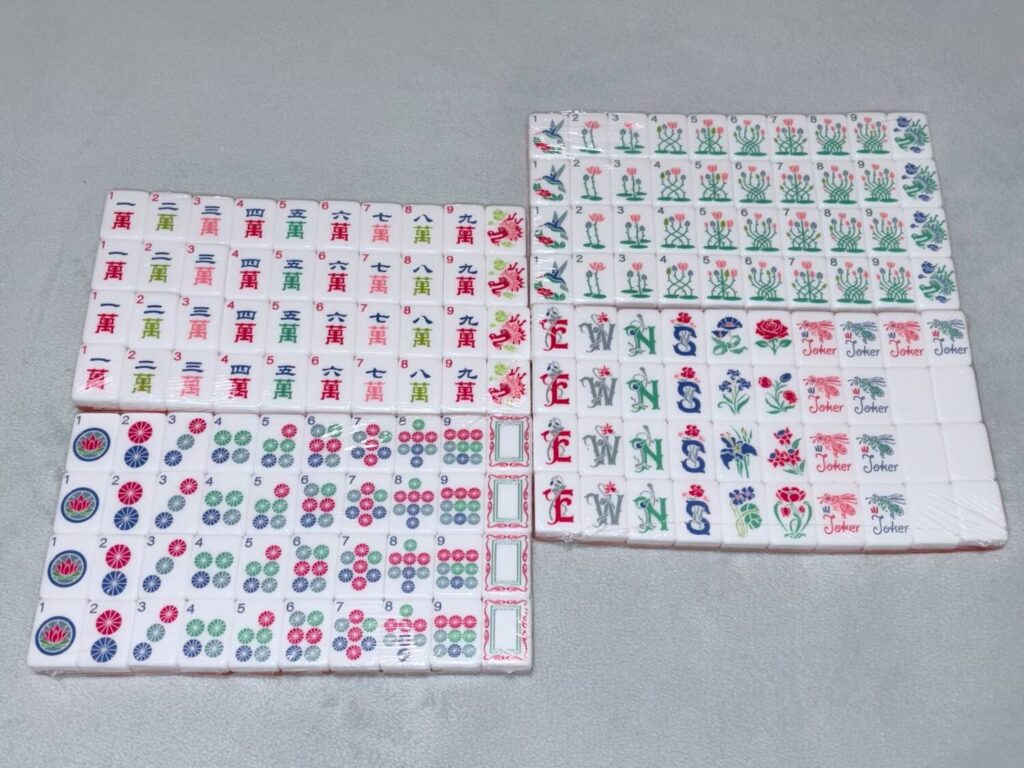 Speaking of the designs, my group largely liked the artwork. Some of it differs a bit from the standard, basic sets. For example, the Bams are lily pads with bamboo-esque flowers on them, rather than straight bamboo rods. And the Craks are different colors in this set, while in most basic sets they are all the same color. It’s not a problem for an experienced player to tell what’s what, but a brand new player might struggle a bit if all they’ve seen is a standard, basic set. One of our players said, “This set is almost too pretty. The artwork gets in the way of play a bit.”
Finally, the tiles got good marks for readability, with several players noting that people with bad eyes would have no trouble seeing the tiles across the table.
Where this set excels is in its table presence. At this point, American mahjong is as much an aesthetic as it is a game. Look on Instagram and see all the lovely tablescape photos. Pairing the tiles with coordinating mats, racks, and lamps is an art form.
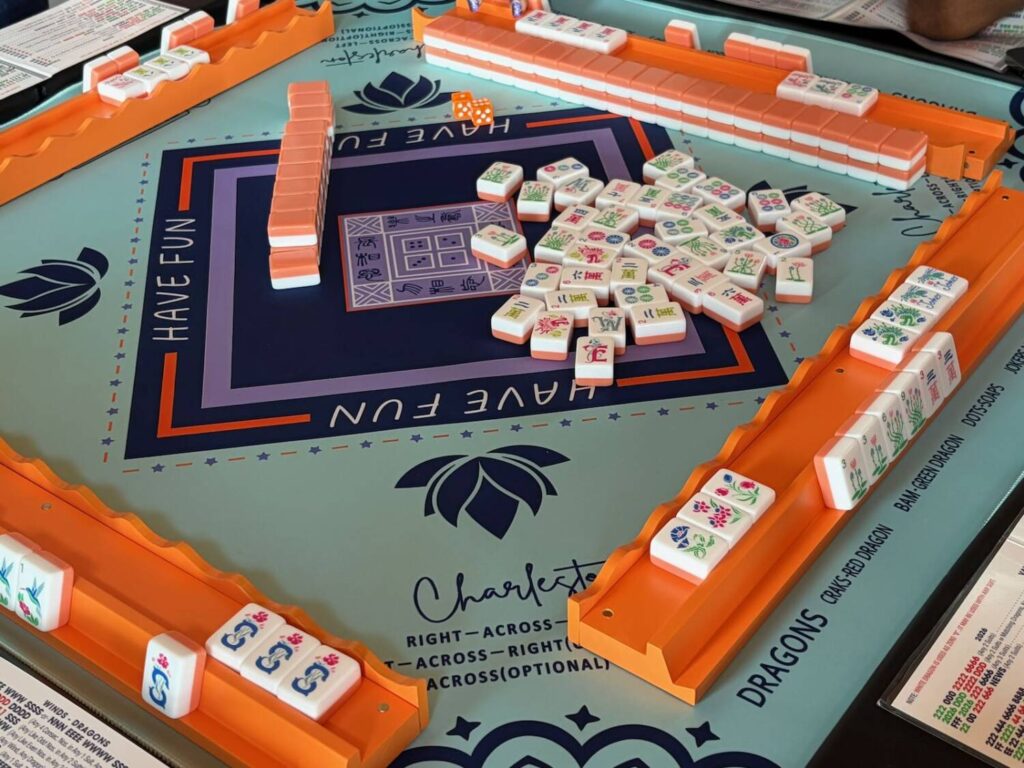
If you are someone who likes to craft lovely tables, this set may be right up your alley. (Or if you’re a fan of Monet’s artwork.) The colors are pretty and vibrant, and the patterns are different enough from the basic sets to bring something new to your tablescape. It feels very spring/summery, so it may be something you want to pull out seasonally.
Functionality and Quality – The Bad
In addition to the tiles, the set comes with three extras which prove that the tiles are the star of this show. While the tiles were rated good to great, the extras did not score high marks.
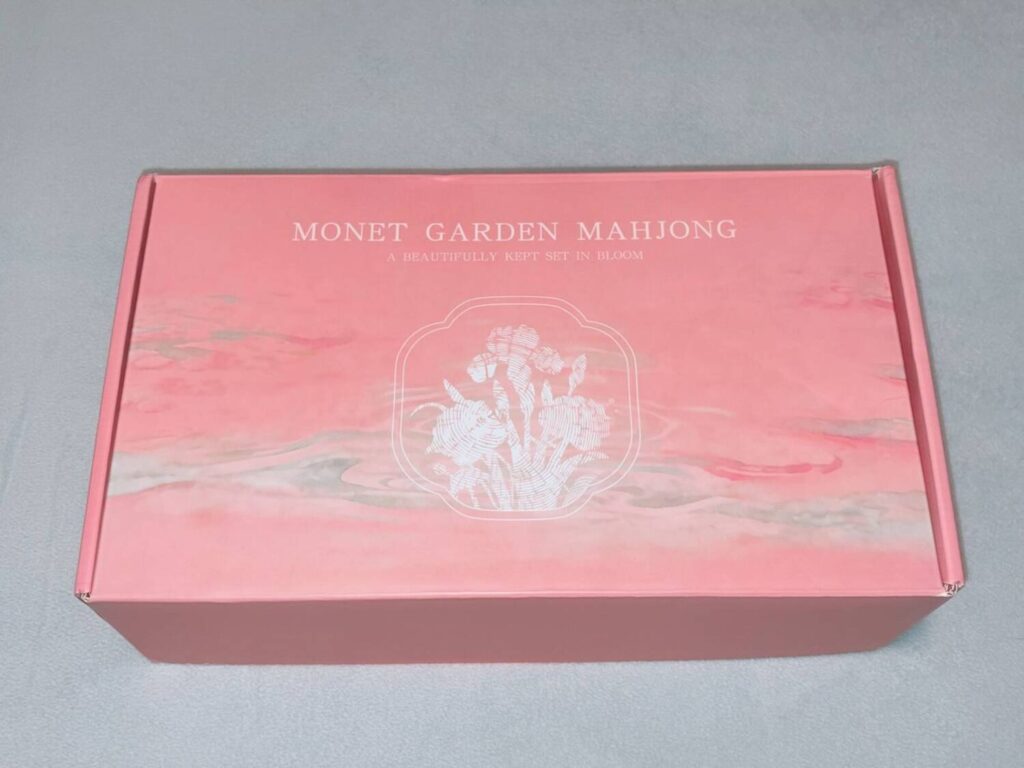
First, the set comes with a carrying bag for the tiles. While my group noted that including a bag was a positive, this particular bag could be better. The tiles just barely fit and Naomi had to jiggle it several times to get the zipper to close. Once closed, it was tight and pulling at the seams. It feels like it might pop with repeated use. Alternatively, you could use the box the set comes in for storage as it is a lovely box. It’s just bigger and bulkier than the bag to haul around.
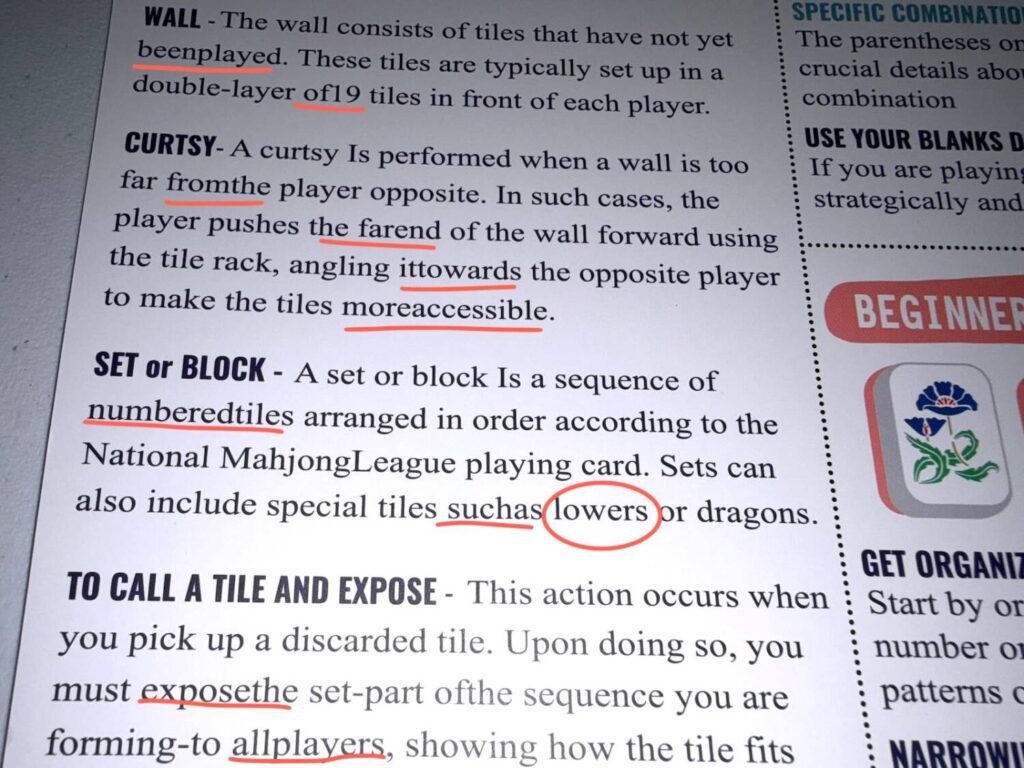
Second, the set includes a condensed version of mahjong rules. Again, it was noted as a positive that rules are included (some sets don’t even attempt to include rules), but this particular rules sheet was, frankly, terrible. (It was more of a pamphlet than a rulebook.) It was filled with typos. There were so many instances where spaces weren’t placed between words that we gave up counting. There were also missing letters and misspellings. In one case, the rules referred to the “Flowers,” but the “F” was missing, making the text read “lowers.” Naomi spent some time trying to figure out if there was some “lower” rule that she’d missed, until she finally figured out it was a typo.
Okay, but can you learn the game from the rules? Not really. My experts were confused by some rules that were outright incorrect, and some that may be some version of a house rule that made it into the “official” rules. There was also some confusing vocabulary used. It’s possible that some of this is due to a translation problem, but there obviously wasn’t an editor involved or else the lack of spaces would have been corrected (at a minimum).
A brand new player could not learn American mahjong from these rules and play to a social or competitive standard. Learning from these rules will probably require some “unlearning” at a later point once the player becomes involved with experienced players and competitive groups. Players would be better off learning from a different source such as a local class, online tutorial, or a “Dummies” book. The National Mahjong League also prints a guide called Mah Jonng Made Easy that might be helpful.
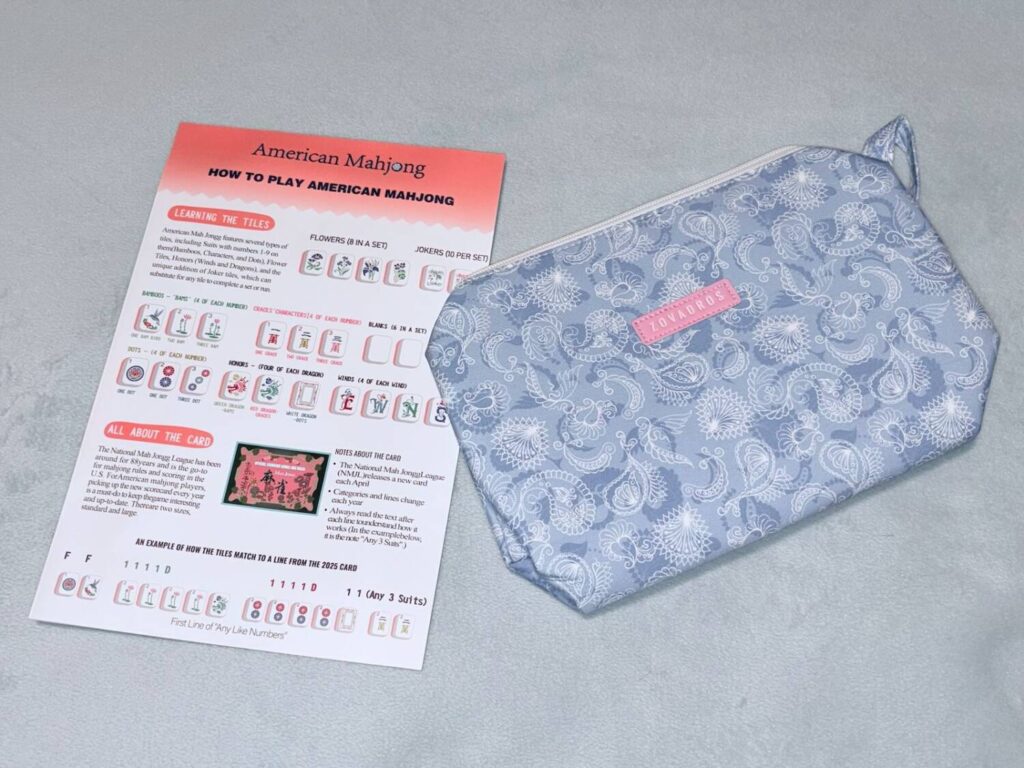
Third, the set does include a version of the 2026 official card from the National Mah Jongg League. My players noted that it was great that a current card is included at all (many sets don’t include one, or only include a generic or prior year’s card), but like the other extras this card is problematic. The rules refer several times to the 2025 card, even though the 2026 card is included. This can be confusing. It would have been better if the rules had simply referred to “the included card.
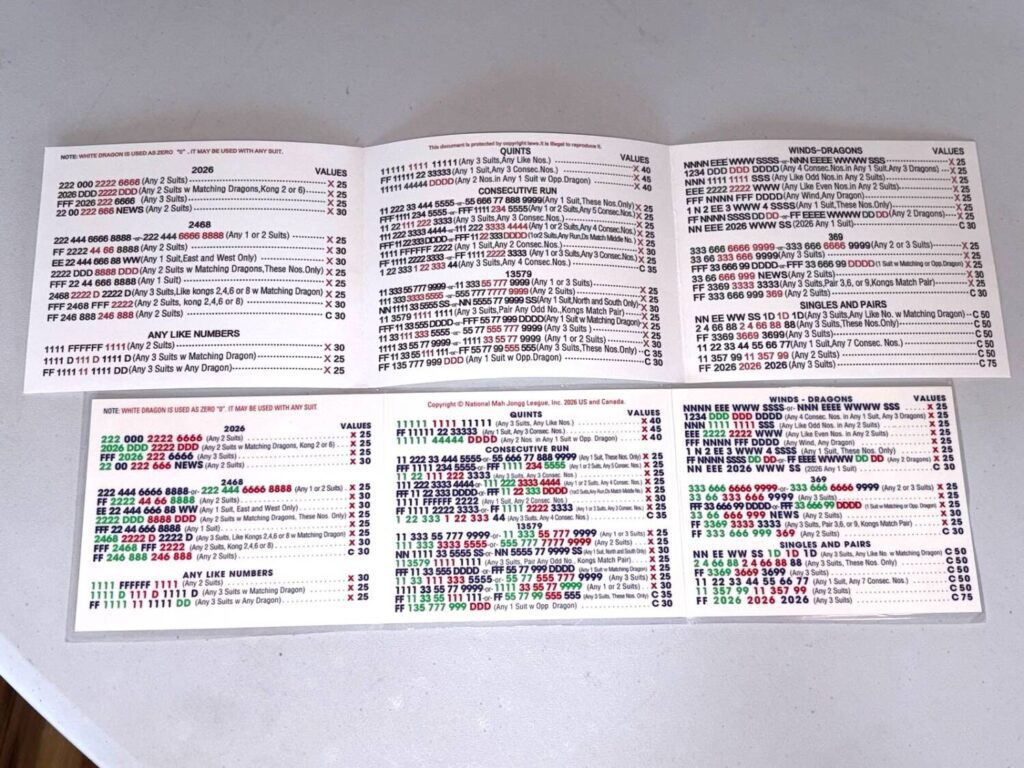
All of the information about winning hands is technically on the card. However, the colors are hard to differentiate. An official card uses red, green, and bright blue to differentiate the suits needed to construct a hand. The card included with this set uses red, black, and dark green, with the black and dark green only being distinguishable from each other in bright daylight. (See the picture above.) As with the rulebook, there are font and kerning problems that contribute to the readability problems.
All of this to say, it’s nice that some extras are included with the set, but they are not going to be the deciding factor in whether or not you buy it.
(Note that the set does not come with a mat or tile racks. Racks (or possibly player screens) are a necessity as you need a way to display your tiles for your own use, but also keep them private from other players. A mat is a nice-to-have, so it’s not necessarily a negative that this set doesn’t have one. Some sets do include them, however. They are usually neoprene and help to muffle the noise of tiles shuffling on the table. Some also have player aids printed at each place to help keep the rules straight. If you need or want a mat or racks, you’ll need to get them elsewhere.)
Is Monet Worth Your Mo-ney?
Monet’s Garden is not a great set for teaching or learning the game. As noted, the rules sheet that comes with it is not up to the task of teaching the game, and the fact that some of the suits diverge from the standard designs may be confusing to new players. The card colors are also problematic, but at least all of the information is there and it is a current card.
If you’re new to the game, the set could work for you if you really like the look of it. Just be prepared to invest in some classes, a tutorial version of the game, or a “For Dummies” book to learn all the rules, and then buy an official card that is easier to read. You’ll also need to acquire some racks for your tiles.
However, if you are someone who needs or wants multiple sets and you already play mahjong frequently and have all your accessories, Monet’s Garden may be a worthy addition to your collection. The tiles are good quality and offer a feel-good tactile experience. While there were some minor imperfections on some tiles, this is likely just a consequence of mass production, rather than a serious ding on the set as a whole. (And we did have expert players poring over these tiles for several hours. Casual players would be unlikely to notice.)
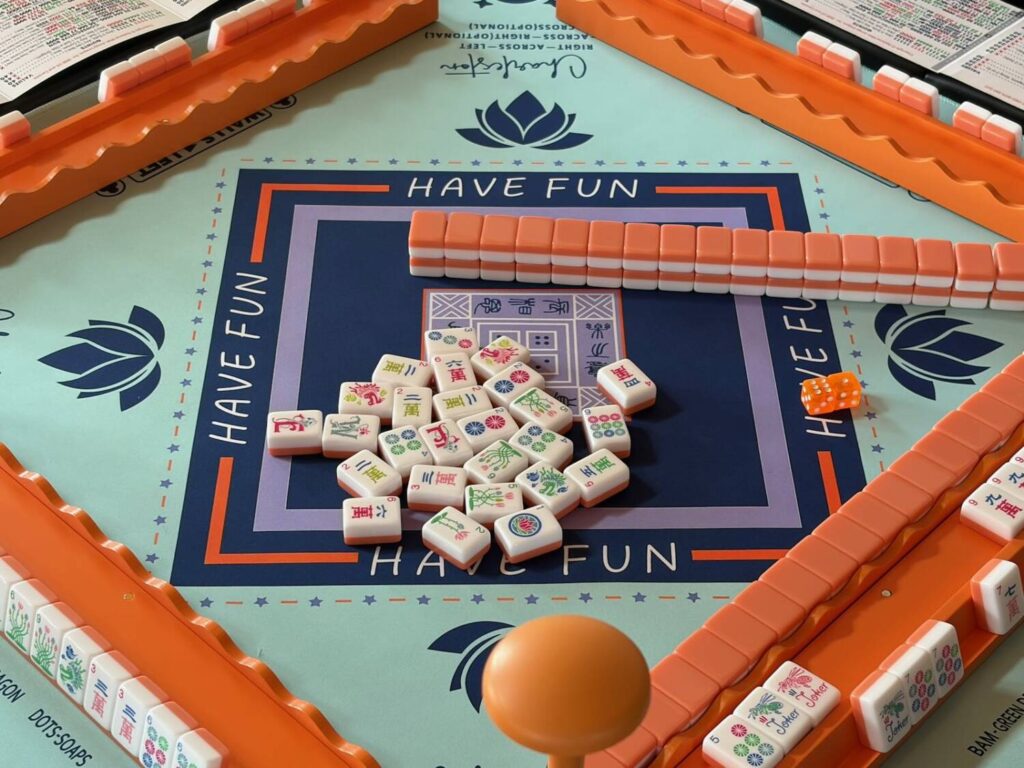
“Pretty” is subjective, but our group all felt that the set was lovely to look at. They appreciated the colors and the “Monet specific” touches like the lily pads for the Bams. The overall nature theme was appealing, and the dragonfly joker tiles earned a few oohs and ahhs.
My expert group largely felt that the price ($159 as of this writing) was fair. We did have one member who felt that the set is overpriced and suggested that a better price would be $90-100, especially given the problems with the extras. Since much of the appeal of any tile set is subjective, whether the price is fair for you is likely to also be subjective. Everyone places a different premium on qualities like tile weight, artwork, color, etc. and that will affect your view of the price.
My own view is that I probably wouldn’t pay that much, but then again, I am not the target market. I’m just happy to play and not so concerned (yet) about the nuances of tile sets. This set is geared toward collectors and enthusiasts (or new players willing to splash out on the required extras), rather than casual players. If that’s you and you like the look of the set, my expert group agreed that it would be a fine addition to your tile set rotation.
Editor’s note: The producers of the Monet’s Garden Mahjong set have extended a special offer to our readers. Receive 25% the cost of this set by ordering through their website, using the code MEEPLE10.
American Mah Jongg details

- Designer: N/A
- Artists: N/A
- Publishers: (Unknown), Charles E. Tuttle Co., National Mah Jongg League, Inc.
- Release Date: 1937
- Player count : 2 - 5
- Age range : 12+
- Time range : 45 minutes
- Mechanism(s): Set Collection
- BGG Geek Rating: 7.2424 - converted to Meeple Mountain scale: 3.5.
- More articles about American Mah Jongg.