
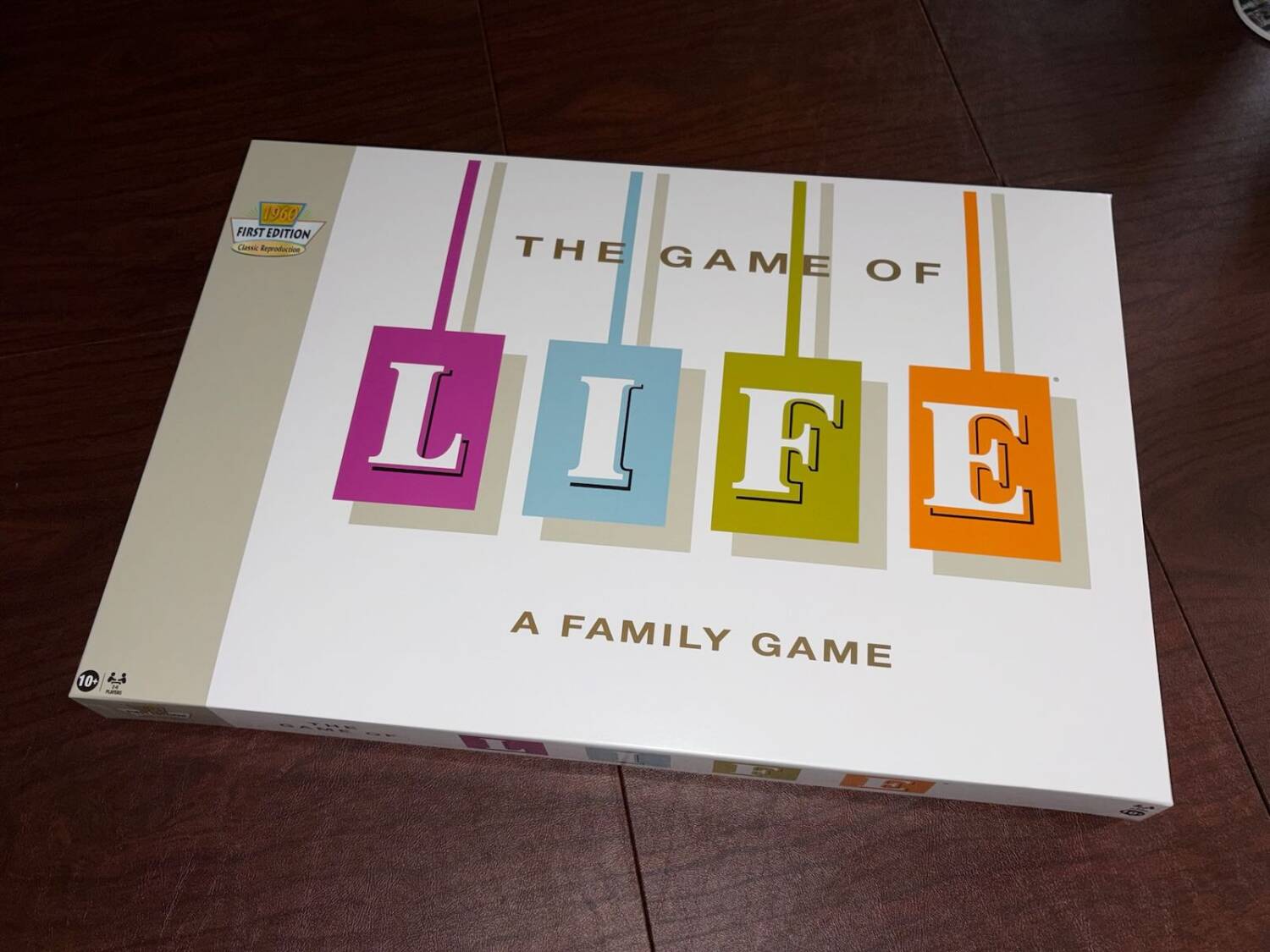
(For reference, everything in this piece refers to the 1960 version of The Game of Life. This version is the version I had as a kid and re-bought when Winning Moves Games remade it. There have been many versions since, but I haven’t played all of them. The ones I have played tweaked the formula and have failed to capture “life” laike the original.)
Sigh. I just finished another play-through of the newest life-simulation board game, Coming of Age. As a “gamer’s game” it is okay, if a lot heavier than I anticipated. There is a lot to think about, manage, and optimize. Plenty of cubes, tracks and tokens, if that’s your jam. It gave my brain a workout.
That’s not the reason I bought it, however. I was (and still am) looking for a fun, “gamer’s” life-simulation game to replace The Game of Life. I’ve tried almost all of the life-sim games out there. Pursuit of Happiness. CV. Adulthood. And now Coming of Age. They are good games, for the most part, but they lack the pure fun and whimsy of The Game of Life.
As a kid, The Game of Life was just a blast. We’d put the pegs on the spinner and send them flying. We screamed for do-overs until we got the jobs we wanted. We gambled like maniacs, lost big, and laughed like mad. While I outgrew those antics, I’ve never lost my love for the game. I play it seriously, now, using the rules as written without do-overs or house rules. If anything, the more life I’ve lived, the more I appreciate what the game was trying to accomplish, and how well it succeeded. Yes, it’s simple, but that doesn’t automatically mean “bad.” Look at the recent success of Magical Athlete to understand how simple can translate into fun.
Life Isn’t an Optimization Exercise
Most of the hobby-oriented life-simulation games treat life as an optimization exercise. Gather specific resources (such as happiness, energy, or time), chain them into more resources, and turn those resources into points. Move your marker up or down the track to achieve success or happiness. Buy or upgrade cards to get better jobs, pets, or partners. It’s pretty dry stuff.
In order to feel like you’re living a life in these games, you have to lean hard into the theme. It doesn’t come to you. You have to actively narrate your turns, or keep building your character’s life in your head because all you’re seeing on the board are cubes, tracks, cards and markers that don’t easily translate to “life.”
That’s fine if that’s what you’re looking for. But what if you don’t want to work that hard and just want a rollicking good trip through life with all of its crazy messiness?
That’s where The Game of Life excels. Real life isn’t an optimization exercise. It isn’t controllable, and it isn’t linear. You can try to control everything and progress ever up the ladder, but you’ll probably fail. Life likes to mess you over pretty regularly. You can make a plan and diligently work that plan only to see it go up in smoke. Go to college only to see AI destroy your job prospects. Lightning burns down your house. You end up disabled through no fault of your own. I could go on about all the ways your plans can end up in the ditch, but that would be depressing.
Of course it can go the other way, too, and you can end up with unexpected inheritances, incredible jobs you never thought you’d have, and outstanding friends and family. Chaos flows both ways, sometimes on the same day.
Most board games have trouble capturing that experience. They seek to reduce “life” to a math exercise that involves managing six factors of “happiness” and then somehow tallying them all into one score at the end that says, “You’ve succeeded at life.” Life isn’t like that at all, and that’s why I think I don’t find these games fun. In seeking to be “realistic,” they strip out the chaos that is just… life. Order isn’t fun. Chaos is.
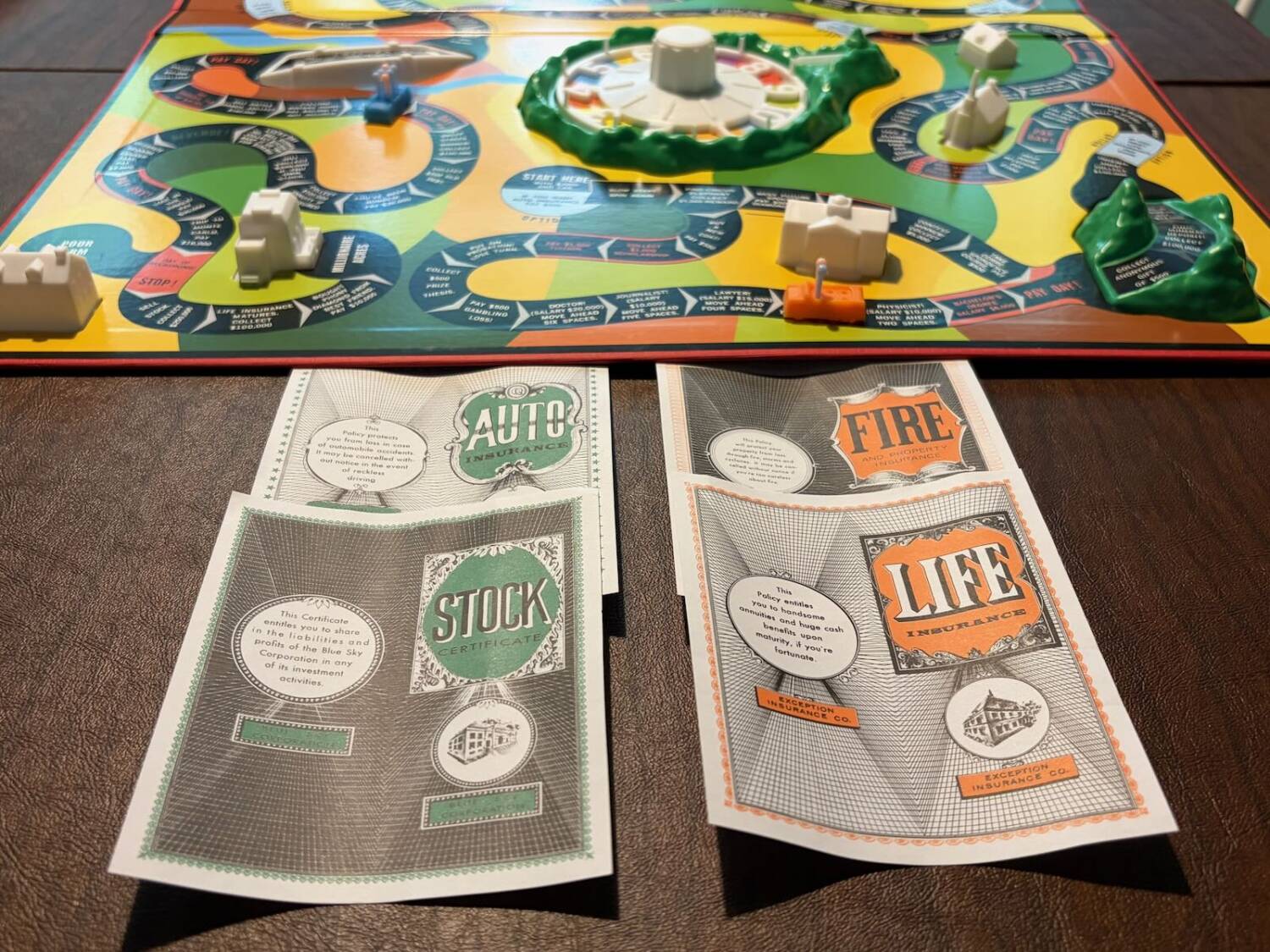
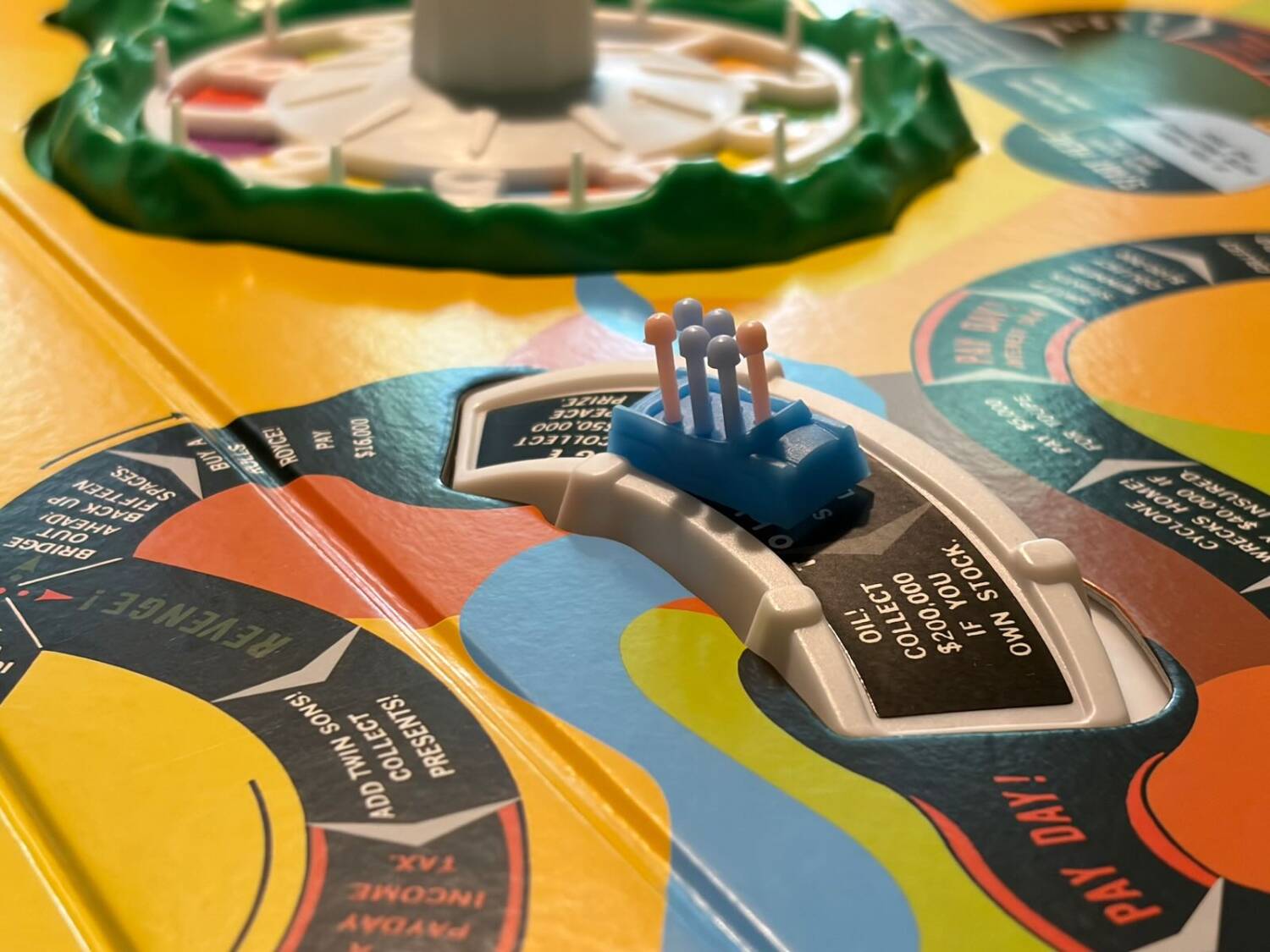
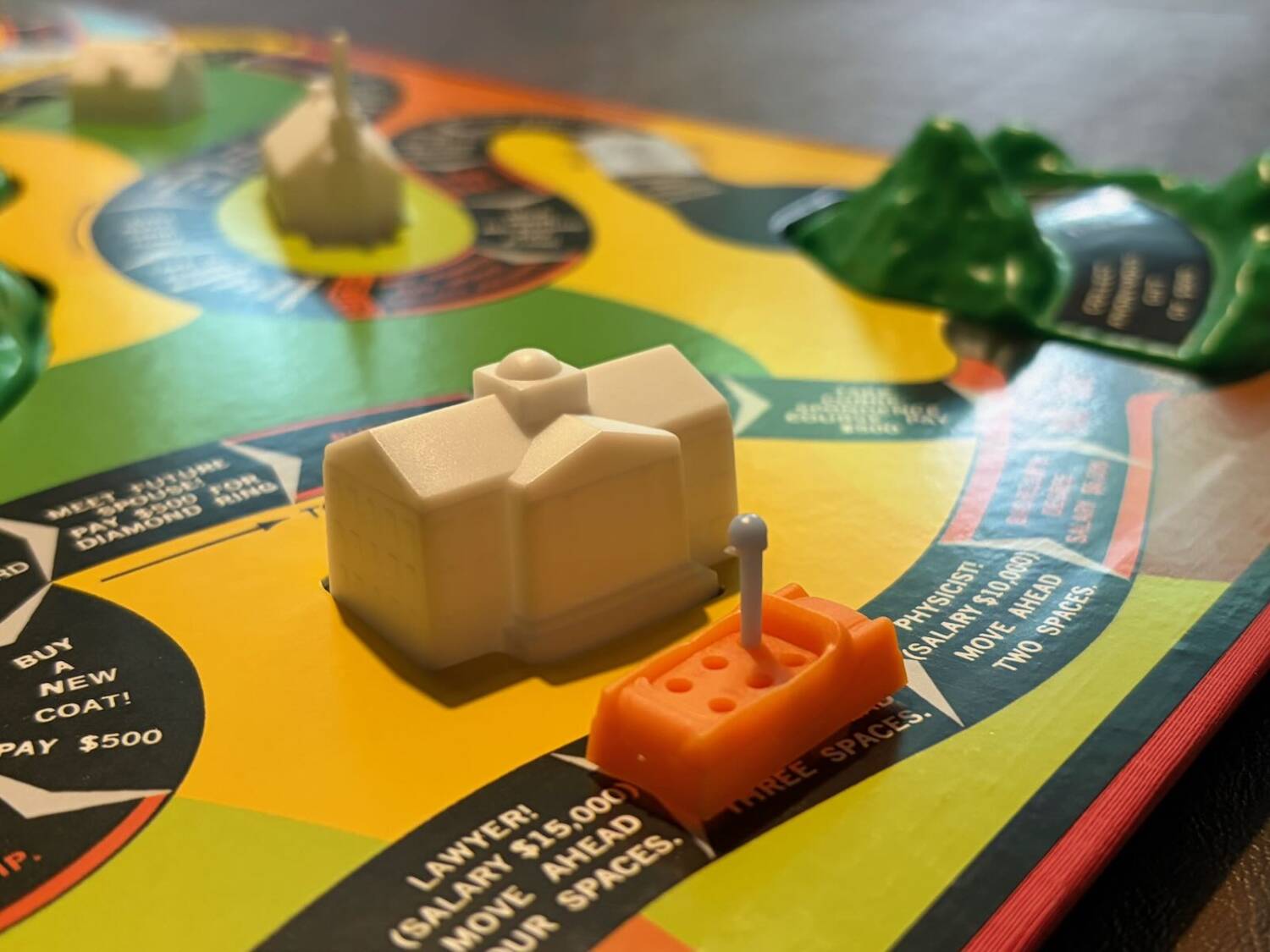
In real life, you have to learn to roll with whatever life throws your way, and often there isn’t any strategy to any of it. That’s the vibe that The Game of Life has always captured so well. You’re rolling along in your little car, over the hlls and past the buildings, and good things and bad are flying at you, seemingly with no rhyme or reason.
And that’s the criticism most gamers lob at The Game of Life. It’s too random! There’s no agency or strategy! I would argue that this is the point, and likely what the designers had in mind.
(Tangent Alert: There is more agency than you might remember. Insurance, job vs. college, stock market gambling, Revenge spaces that let you take money from other players, debt utilization, and Share the Wealth cards that can be deployed strategically are all choices/strategies you can make throughout the game. It’s not just mindless spin and move.)
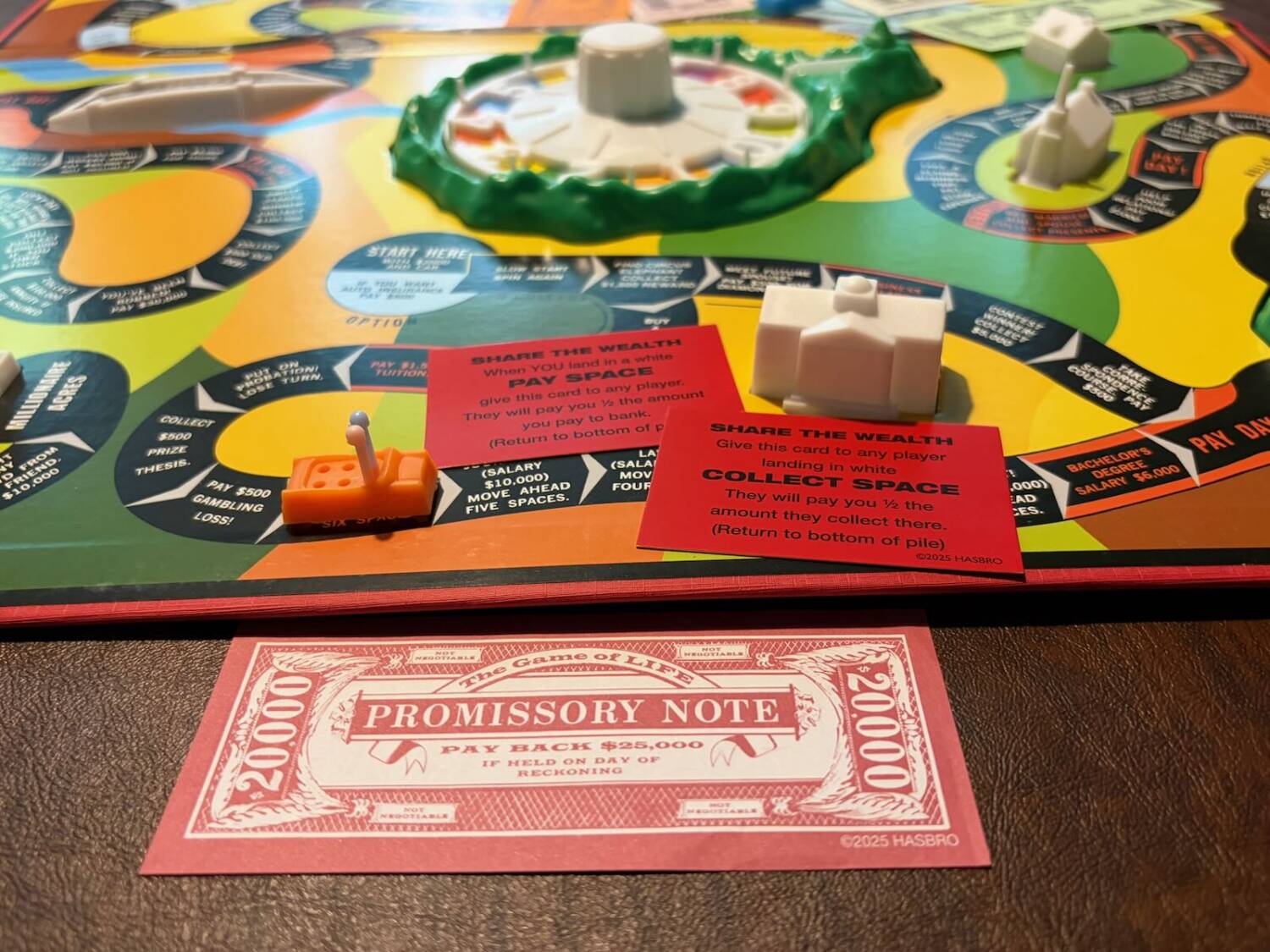
The Game of Life is the most accurate reflection of the chaos of real life that I’ve ever found in a board game. And this is what makes it fun for families and groups. There’s no heavy thinking, no trying to force the theme into the game. Just laughter and groans around the table as your fortunes ebb and flow. It’s a chance to find the lighter side of situations that are otherwise pretty miserable in real life.
In hobby games, your interpretation of the theme usually goes like this:
“Why am I happy? Oh, because I filled up all the token spaces on that card and achieved its goal. Now in this turn I’ve built on it by adding a card for a sub-goal and my cube has moved up four spaces on the happiness track. Yay.”
Whereas in The Game of Life, theme integration comes down to:
“Oh, my house burned down and I didn’t have insurance, and I just had to bail my uncle out of jail. Crap. But at least I’ve still got my spouse and six kids crammed in this car! Of course, we’re all living on my paltry “business salary” because I didn’t want to go to college. But maybe I’ll get lucky and my stocks will split!”
Real life is hard enough. When I’m in the mood for a life-simulation game, I want to laugh and have silly fun in a world that basically makes fun of my everyday hardships and reminds me that maybe I’m only one spin away from something great happening.
Show Me the Money! (Or Why It Works)
The underpinnings of the game are all about money. At first glance, it seems shallow that the only arbiter of success or failure in the game is money. He who has the most wins. And, yeah, it may be shallow, but at least it’s honest. As someone who spent years writing about finance and hearing about all kinds of financial problems and successes, I can tell you that money underpins everything, no matter how much we may wish it not to be so.
It’s fine to have lofty, intrinsic goals like in Adulthood or The Pursuit of Happiness. You want to be happy, fulfilled, and feel like you’ve contributed to society. Maslow’s Hierarchy of Needs is a classic in psychology for a reason. But you need money to reach those goals. Money may not buy happiness, but it makes it so much easier (and, realistically, possible) to achieve your lofty goals. The Game of Life gives you the means to acquire (or lose) the money, but it also sets you up for an easy segue into the theme of “life.”
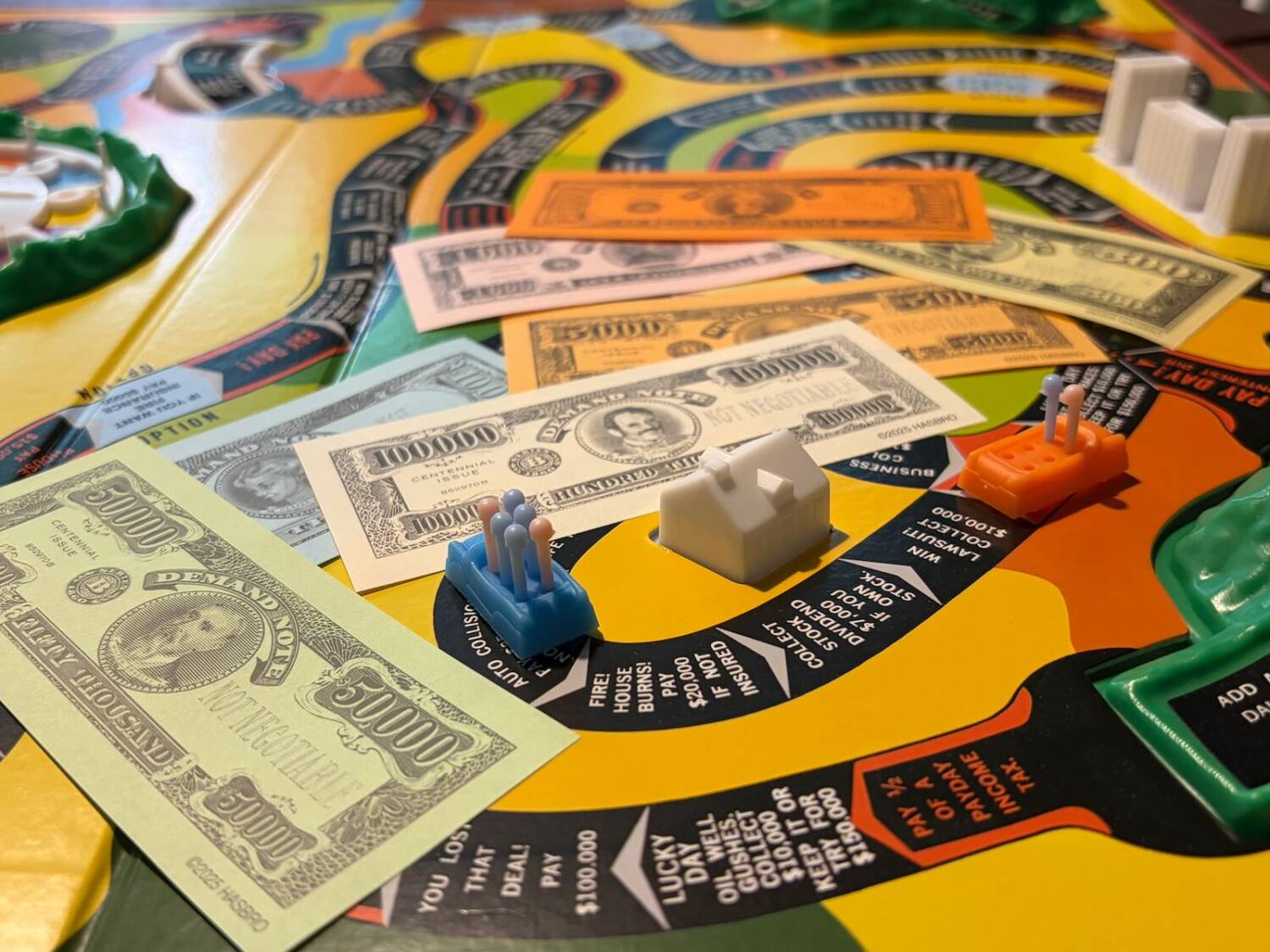
How? By simply being familiar and basic. Intrinsic goals are nebulous and hard to quantify. A game about “being happy” or “succeeding” will have a harder time achieving its goal than one that rewards “having the most money.” Happiness is different for everyone. Success is measured differently for everyone, too.
Money, however, is a universal experience. By telling you a story tied to money, the game is instantly relatable. We all know how good it feels to get money, and how terrible it feels to lose it. We all understand this struggle on the same level. The game isn’t asking us to apply different frameworks for happiness or success to its mechanisms. All it’s asking us to do is engage in a universal struggle.
The Game of Life’s spaces might be a little silly and dated in some cases, but we still immediately feel their punches. We can all relate to a father-in-law or relative needing money. Happens to most of us at some point. You bought two two saddle horses! Okay, maybe not horses, but who hasn’t blown money on an ill-advised purchase and lived to regret it? You may end up with more kids than you planned for, or can comfortably afford. An old debt gets paid back, and you get robbed the next day. You skimp out on insurance and get in a car wreck. Inherit some money, and then blow some of it on a trip. You can gamble in the stock market which, let’s face it, feels a lot like most of our 401K’s.
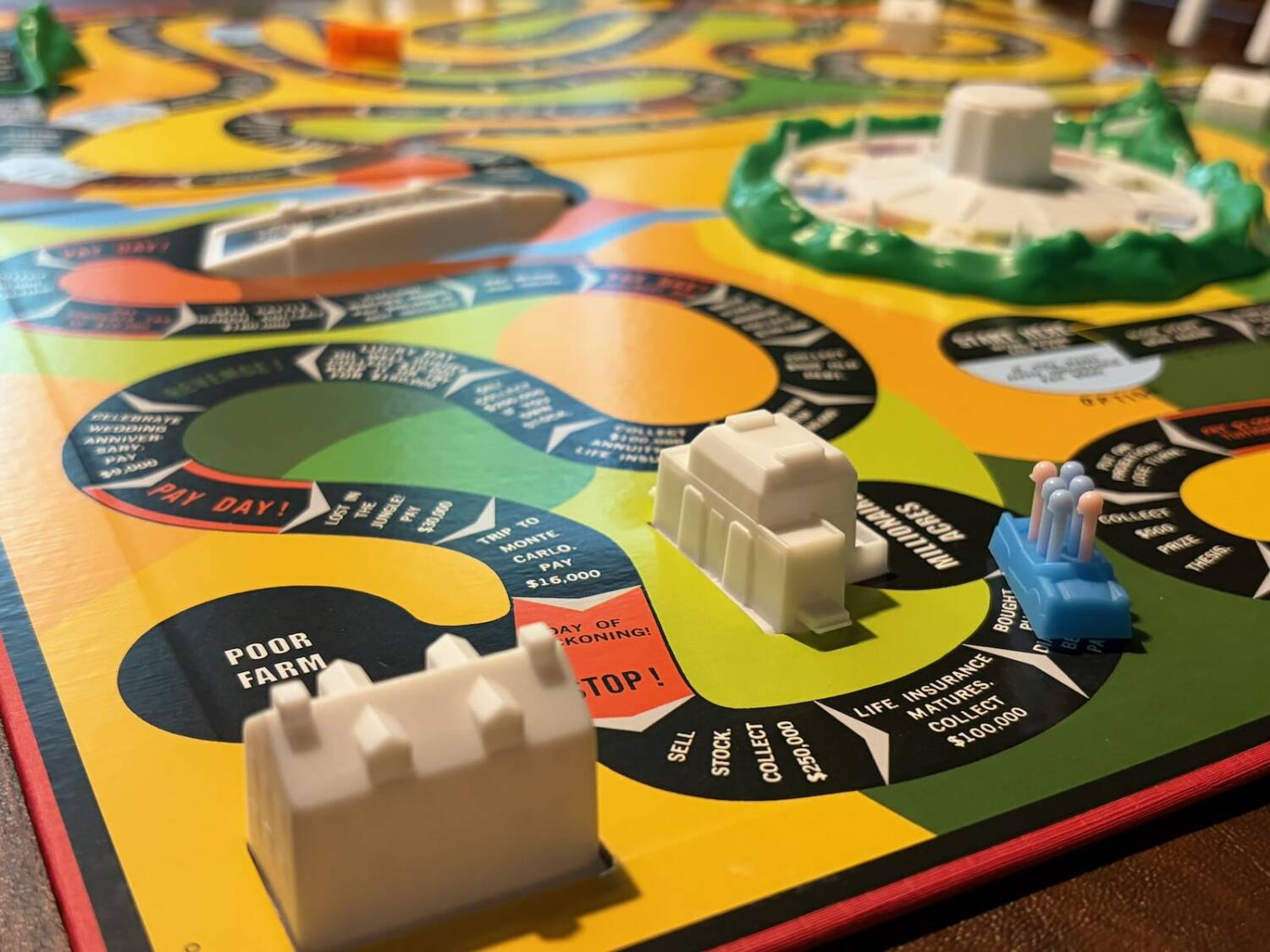
And on it goes until you get to the end and either end up in the Poor Farm where you hope to have just enough to win the game, or Millionaire Acres where you have a chance to earn some last big payouts on your way to likely winning the game. (There’s a commentary to be made here about wealth gaps and inequality that seems strangely prescient for a 1960’s board game. Anyway…)
This is all familiar, universal stuff and it’s very easy to build a larger story around it as you go around the board. You chose to go straight to work, so your earnings are less during the game. But maybe you hit it lucky a few times and come out okay. Or you just get pounded and end up at the Poor Farm. Or you went to school and got a great job, nothing bad ever happened to you and you end up in Millionaire Acres. Great for you, but your fellow players want to kill you.
Your poor little pegs are crammed in their cars, rolling along and being buffeted by fate. They’re on top of the world! No, wait two turns later and they’re in debt! We all know how money works, and the feelings associated with it, and that makes it a very effective carrier of the theme of life.
Yes, parts of the game haven’t aged well. (The salaries have definitely not kept up with inflation!) It’s very gender-normative and marriage and kids are foisted upon you whether you like it or not.
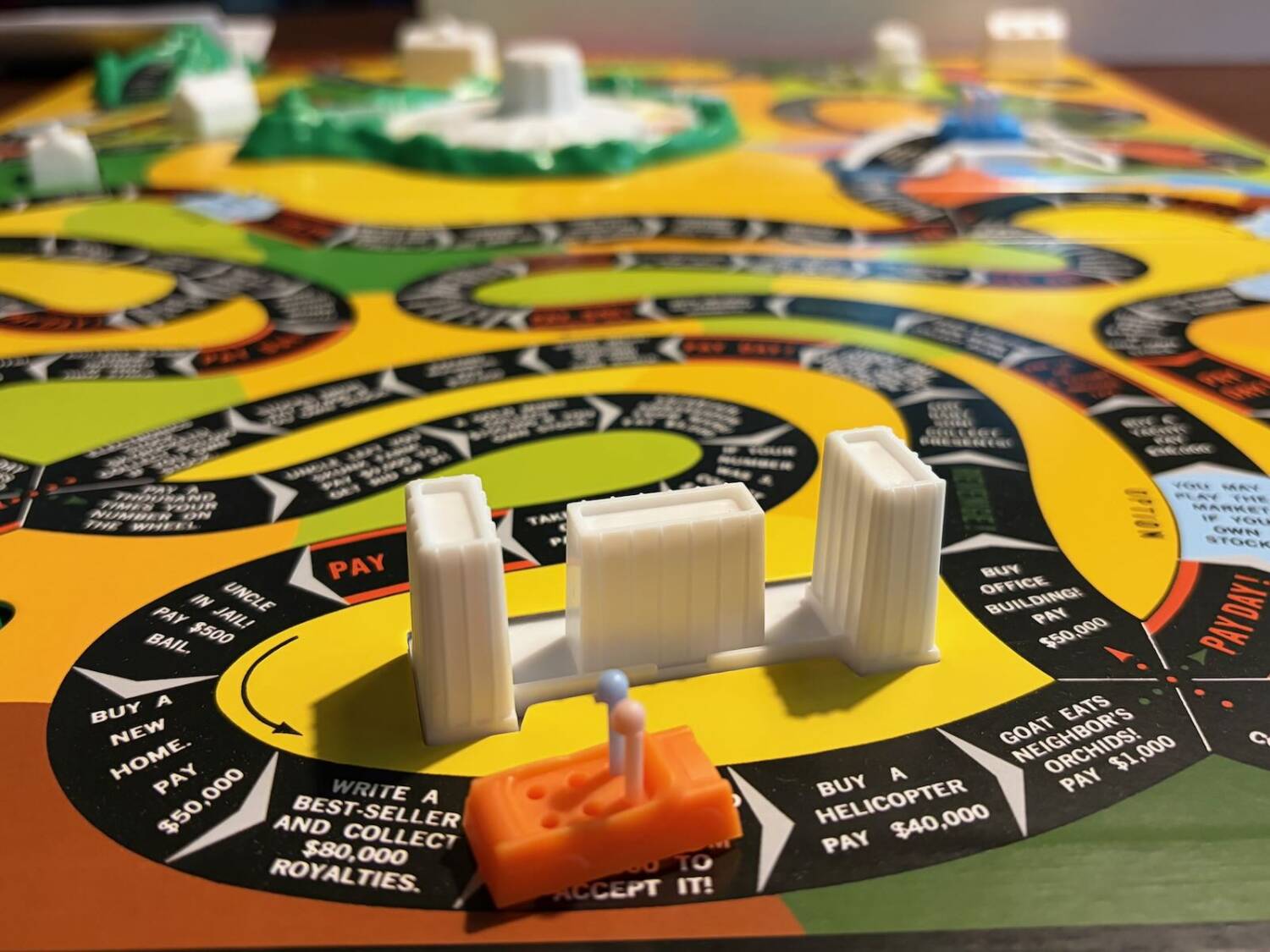
But in some ways, the game was also very progressive for its time. And still is, given that we haven’t come as far down the equality path as we’d like to believe. All genders, races, and abilities can play, and all can land on the doctor career space, own a cattle ranch, or climb Mount Everest. There’s nothing here that keeps someone from envisioning themselves as the driver of this little car, achieving, failing, and just pushing on to the end.
Because that’s really what life is about. Pushing on to the end, through the good and the bad. Ideally you find some parts of it hilarious, satisfying, and rewarding, but there will be plenty of crap along the way to deal with, too. The nice thing about The Game of Life is that if you lose, you can set it up and try again. That’s much harder to do in real life, which is why The Game of Life succeeds as an hour of escapist fun.
I’m not saying that The Game of Life is the best game ever. There are plenty of other games that I enjoy more and that demand more from me. Many games are arguably more satisfying to play. But they aren’t life simulation games, and I don’t play them when I’m looking to scratch that itch. When I’m in the mood for a life-simulation board game, it’s usually because I want to be reminded of the absurdity of daily life, not hit over the head with heavy concepts or a math exercise. And for absurd, escapist fun, The Game of Life still delivers.