
Disclosure: Meeple Mountain received a free copy of this product in exchange for an honest, unbiased review. This review is not intended to be an endorsement.
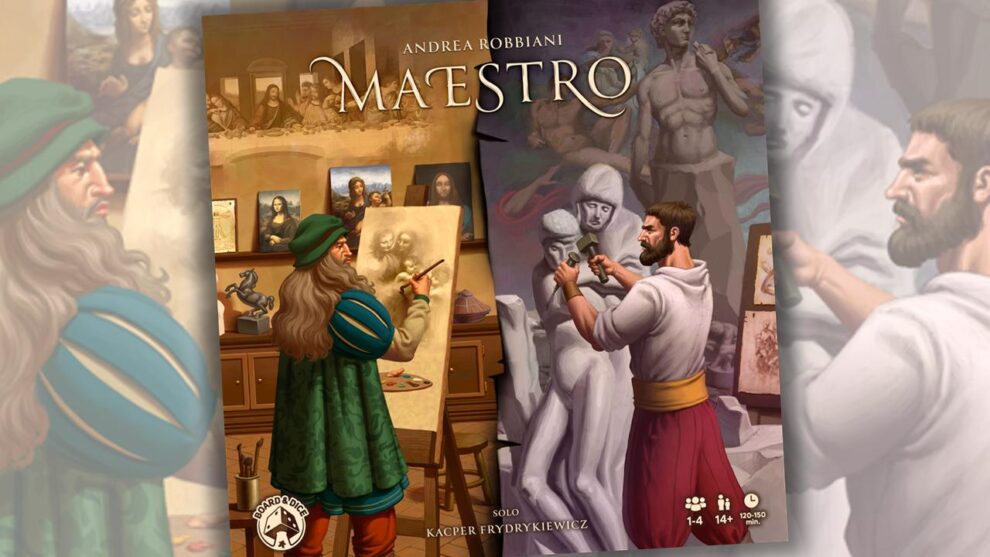
The cover for the new strategy game Maestro is a fun one: it’s the early 1500s, and the painter Leonardo Da Vinci is staring menacingly at the sculptor Michelangelo as they work in their respective workshops. The game’s manual details more about this famous feud between star artists, and in the game, players take on roles in the workshop of one of these two Renaissance geniuses as they compete to get centerpieces into Italy’s most famous galleries.
I learned about Maestro during our meeting last year with the team at publisher Board&Dice, admittedly one of my favorite publishers because they have released a string of bangers over the course of their company’s history. A few are some of my all-time favorites—Tiletum, Nucleum, and Teotihuacan: City of Gods—while a half-dozen others include titles I am happy to play, from Reef Project to Tabannusi: Builders of Ur to last year’s Tianxia.
This means that any time a new Board&Dice game is announced, I have to at least know if it will eventually make my “shelf of fame.” Maestro had a great cover, and it was designed by Andrea Robbiani, the co-designer of ANTS and Timeless Journeys: The Italian Grand Tour. On its own, that’s not an endorsement; I was not a fan of Timeless Journeys, and while I would give ANTS another spin down the round, my review plays were middling.
Maestro is the best game Robbiani has pushed into the market. That said, it’s rife with a small pool of minor issues bolted to the fact that the game’s playtime makes it a very tricky recommendation.

Me Versus You, or Me and You Versus The Two of Them
Maestro is an area majority, action point card game for 1-4 players. For this review, I played Maestro twice: one with two players, and once with four players.
That’s because I wanted to see the game the way I think it was intended—head-to-head, with each player controlling either the Da Vinci workshop team or the Michelangelo workshop team—as well as a 2v2 affair. Technically, the game can be played solo, and there’s a separate rulebook along with additional cards, meeple and dice for the solo plays. Maestro could also be played as a single player versus two other players, but that also felt strange so I stuck to even sides populated by humans in my review crew.
Over the course of four rounds, players take on the role of either Da Vinci, Da Vinci’s assistant, Michelangelo, or Michelangelo’s assistant. In a two-player game, each player takes alternating turns as the two people from their workshop. In a four-player game, each player takes on one of the four roles listed above. There are 12 total actions in a round, three for each character.
And I think this is the breakpoint for players. On paper, it sounded like taking three actions per character per round—12 over the course of the entire game—seemed like it might be quick, breezy even. But the reality is that players get to take two actions each time it is their character’s turn: both a main action and a “workshop” action.
This means that Maestro lasts for 96 actions: six per character, not three, with 24 actions per round. That quickly turns Maestro into a game, size-wise, of Hegemony: Lead Your Class to Victory or World Order, with my two plays each lasting about three hours…and that was only for three rounds in each game, because in both games, the Michelangelo workshop had a lead ranging from 80-100 points going into the final round, a lead that we decided was unbeatable.
Yeah.

Maestro doesn’t feature complicated actions; in fact, the main action for each character is one of four very simple options, as players create or move their workshop’s art around a 12-region map of 16th-century Italy. These are the two most commonly used actions, with one additional action offering players a chance to move up a Study track to gather resources and upgrade bonuses to make their workshop’s shared deck of 10 cards slowly more powerful over the course of play. A fourth action is very cool and very simple, as players influence a council of 12 important-looking meeples to determine which of the map’s four regional colors is most vital when players score popular and secondary gallery locations with centerpieces at the end of each round.
Scoring area majorities in the 3-6 regions of the map at the end of each round is also snappy, and a second step measuring a publicity value in cards played against each action is also straightforward. This latter process serves as a way for each team to earn one-time bonus or end-game scoring cards, boosting a side’s options during future rounds.
Even the workshop actions on offer are free of complication. Da Vinci’s team has a set of six invention cards, each with a pattern-matching tile attached to each invention. Over the course of play, the Da Vinci players will gather resources to build into a “workshop board” (a grid of 20 spaces) which they can use to make the four main actions as well as the exhibition scoring a little juicier while earning up to 40 end-game points.
Michelangelo’s workshop action is even simpler. Players spend 0-2 resources to activate, flip, and/or remove a bonus tile that gives the Michelangelo side something juicy to work with before the active player’s turn or to set up a future action, by lining up a resource color in each row and column of their own 20-space workshop board.

So, Why Did Your Games Take So Long?
The actions are simple and are driven by a simple card system that players use to place a hand card on the board next to the action they want to take. Using each card’s level of effort (a number on a red banner, ranging from 1-6 in most cases), that effort translates to a certain number of action points for that player’s main action.
Two such efforts, then, could mean two bumps on the Study track, or four artwork movements on the main map, or moving two meeples around the Influence table. But choosing which place to use which card is a fun puzzle, and one that takes a little longer than we were expecting during our plays.
Maestro is an area majority game, so in a game with rotating turn order (each character is slated to start one of the four rounds as the first player), each team will play last twice. And those last couple turns turn into quite an exercise, because maximizing your score during the exhibition phase is the lion’s share of in-game points.
Maestro is also a limited communication game. For reasons that are not exactly clear, players can only talk with their teammate (in a four-player game) before each round begins, during a “Planning Phase” as players talk out their hopes and dreams before they draw cards and consider which cards to discard before a round begins.
This Planning Phase posed a couple of interesting questions. The first, and most glaring: do I want the other team to hear my team’s specific plans? The second: I really want to hear what the other workshop plans to do this round—should we discuss plans in a separate location? But that’s really hard because everything you want to plan for is on the board right between each workshop team!

So, you both want to work out some plans with a teammate before the round begins, but you don’t want the other team to hear it. Whispering feels weird, as would speaking in a language the other team can’t understand. But the planning phase was a fun way to talk out the thoughts in my head with a teammate, win or lose.
After this Planning Phase, Maestro then becomes a limited communication game, with a stated rule that players “cannot share information regarding cards in their hands, nor the plans for the actions they want to perform.”
Maestro is sort of a team game. It is a team game, then it is strictly not a team game, although two players are working together to accomplish the goals they set out to achieve during the Planning Phase. I think this rule was built around the idea that Robbiani didn’t want one player to “quarterback” their teammate, but in practice, it leads to a very difficult way to play together, but not really. (The rulebook does offer a “Communication Variant”, where communication is not limited. Now that I’ve played the game with its base rules, I would never play it with limited communication again. There’s just too many things that change during the course of each round that require players to chat about their plans on the fly.)
This communication bit is another reason why I would call Maestro a two-player game, with a four-player variant. When you don’t have to worry about the plans of your partner, you can just play the game, and that was a smoother way to both play the game and shave a few minutes off the playtime (although, not much, since you’re still taking 96 total actions in this game regardless of player count!).

Maestro Could Use a Buff Job
Maestro does some interesting things with its cardplay and the way popular galleries fade into secondary galleries, as players find ways to score points during the area majority exhibition scoring phases. I love the artwork on the cards, all picturing sculptures or paintings of the legendary characters profiled here. The card upgrades are very meaningful, with each side’s 10 starting cards being decent and the upgrade cards swinging in different upward directions to make upgrading action cards a core requirement.
But the length here is a serious detractor. Further, the game feels like it is a little easier for the Michelangelo side to win over the Da Vinci side, albeit not so much that I’m going to try and claim that one side is simply better than the other. (With only two plays under my belt, I’ll save that argument for another day.) Still, now that I’ve played both workshops, I would push to play as Michaelangelo over Da Vinci, because it seemed like it was easier for the Michelangelo side to create more artwork faster than the Da Vinci side (critical when considering the area majority scoring), and because the Michelangelo workshop mini-game was easier to trigger one-off bonuses that could be helpful immediately, versus when taking a specific action (like the Da Vinci inventions offer).
There’s an event deck available as an option for “players who are familiar with the game”, but using it in our four-player game didn’t offer any meaningful boost. In fact, the first card we drew for round one was not playable; a bonus resource known as a Publicity token only comes through consolation when a workshop loses out on getting a one-time bonus or end-game scoring card at the end of a round. In the game’s first round, workshops don’t have, nor can they even get, publicity tokens.
Issues like these that make Maestro a very mixed bag. It features some interesting ideas, but they are mixed with a game that can sometimes feel like it is on rails, as players will always push to score majorities by creating artwork and then moving pieces to the regions that will score in a round. Because regions only score for popular galleries once per game, it also becomes easy to tell which regions will be the main targets at the end of the game.
The production looks great, but then has a couple of minor issues, like stands for two upgrade cards that feature card slits that are cut too deep…and as a result, the bottom effort number on each card can’t be seen unless you lift the cards out of the card stand. The 12 regions on the map are well drawn with bright colors to delineate which region is which of the four possible colors, but the 12 numbers don’t run in any kind of meaningful order.
For example, the top four regions of the map are numbered 6-9, with 12 at the bottom and 1, 2 and 3 in the middle. Even along that top portion of the map, the numbers run in this order: 9, 6, 8, 7. I am not making this up, and I am still completely unaware of why the graphic design here seems to be trying to mess with me by not just numbered the sections in a reading order, or a big circle, or anything resembling reason.
Maestro is being marketed as a throw-in for the crowdfunding campaign for a different Board&Dice title, Entropy. I can’t tell what that really means, especially because the game is available at a somewhat discounted price despite the fact that it is not releasing until after Gen Con. As a game, I recommend Maestro for very patient players who love area majority games and are willing to look past some of the strange choices on display here. While not Board&Dice’s finest work, it offers a few interesting ideas.