
Disclosure: Meeple Mountain received a free copy of this product in exchange for an honest, unbiased review. This review is not intended to be an endorsement.
I played a lot of games in 2023. The best of those games, by a sizable margin, was Hegemony: Lead Your Class to Victory, designed by Vangelis Bagiartakis and Varnavas Timotheou and released by the two men under the Hegemonic Project Games banner. A bold effort in almost every way, Hegemony did an excellent job of simulating a real-world environment and mixing that with a number of different gaming systems. The end result now resides on BoardGameGeek’s top 50 all-time games and has hit my table for nearly a dozen plays; as an event game, it’s tough to beat.
Those accolades put a big target on the back of Hegemonic Project Games’ second design, World Order. Varnavas and Vangelis were kind enough to send a review copy in advance of the game’s full release, and it was pretty easy to get the members of my review crew to line up for plays.
I tempered expectations a bit here. I thought Hegemony was a classic example of “lightning in a bottle”, an asymmetric negotiation game that really did play differently from faction to faction, which landed in a January dead zone after working through a big pile of games from the year before. Could Hegemonic Project Games do it again with World Order? My main hope was that the team could avoid any measure of a sophomore slump.
World Order became an interesting case study for my group, in part because of what it does well and in part because there is such a thing as “some games take too long.”

This is a Different Game
World Order is a political and economic area majority game for 2-4 players, driven by a mix of mechanics led by deck building and hand management. With the expansion World Order: Diplomacy & Dominance (sold separately), solo play against 1-3 bot players can be added to the base game. The playtime listed on the box is 120-180 minutes, and it is this number that will color the remainder of this review.
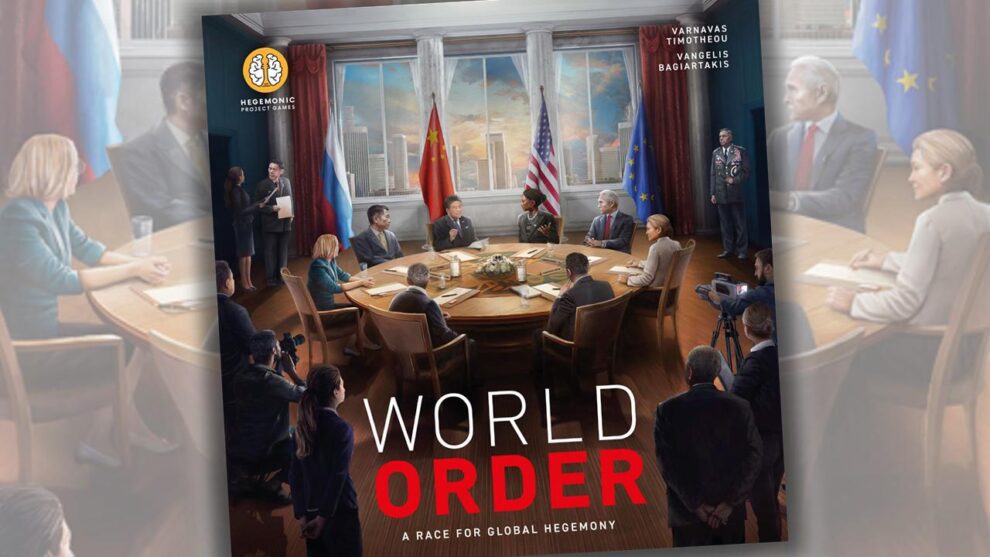
The year is 2010. Players, taking on the roles of one of the period’s four major superpowers (USA, China, the European Union, and Russia, known as the Russian Federation here) will take turns across six rounds to build a pool of allied countries, impose the threat of military conflict across the game’s seven regions, invest in favored allies and engage in diplomatic relations, all in search of the almighty victory point, points that will be both gained and lost throughout the game.
World Order is a much more straightforward game to teach and play than Hegemony, one of many differences from Hegemonic Project Games’ first title. That starts with a very simple turn structure in a game where all four factions play essentially the same way: play a single card from a hand that begins each round with six cards per player. That card can be used for its written card effect, discarded as a pass action for cash, or discarded to use a once-per-game special ability.
Players begin the game with 12 cards, most of which feature basic versions of the game’s eight main actions, from Trade (the main way to earn cash) to Improve Relations (adding more allied countries to a player’s tableau, offering them chances to build military bases in friendly countries, using allies to discount other actions in the same region, and other goodies) to the Move action, which grants a player chances to move their military units around the globe to impose the threat of military action, mainly to force opponents to match strength or potentially lose end-of-round points.
At the end of each round, players can spend unused cards from hand as well as exhaust allied countries to shop for new cards, which are added to the top of a player’s draw deck for use in the next round. This is another major change from the Hegemony design, which adds to my growing sense that players looking for another Hegemony-like clone might leave disappointed by what World Order has to offer. World Order uses a political landscape to build its narrative, but the tiered nature of the factions in Hegemony mixed with the way scoring works makes World Order a different animal.

Another major change: World Order’s turn order structure is tied to total victory points at the end of each round…and here, the player with the lowest VP total gets to choose their position in turn order. (In Hegemony, the turn order is always the same in every round.) In World Order, the game’s major scoring phases take place after the third and sixth round, and because much of the scoring comes from area majorities built around influence cubes, going last is a key success factor in World Order.
During my first pass of the game’s breezy 23-page rulebook (breezy for a strategy game, anyway), I assumed that the turn structure would lead to fast turns…an assumption that was ultimately incorrect. Sure, some of the game’s actions, such as passing or the Invest action, are usually quite simple and only take 30-60 seconds.
But a four-player game features NINETY-SIX turns, and in limited cases, a player might play a card that gives them a minor action before playing another card on their current turn. During my second four-player game—with three of us having already played World Order once—we technically took 102 turns, because we had cases where someone played a “draw three cards, discard two cards, then take another turn”-style action.
Remember, I’m someone who not only likes Hegemony, but loved it enough to call it my 2023 game of the year…and in Hegemony, there are 100 turns in a four-player game. So, I’m fine with a game that features this many turns, but there’s a difference between the two games. In Hegemony, the overall rule set is more complex…but the actions tended to be a bit faster. In World Order, the rules are more streamlined…but the actions are just a hair slower.
The real culprit for the increased game length in World Order, though? The Research phase. This is both the best and worst thing about the game…and it will add a chunk of time to your plays, especially when you have less familiarity with the cards.

Get a Little Closer
After each round’s action phase, play moves to the Research phase. Here, each player may use any remaining cards from their hand to gain minor bonuses (usually, cash, military units, or the diplomacy resource, used during the Engage and Improve Relations actions) before shopping for new cards to be added to their deck. Usually, a player has enough card-buying power to buy at least one card, but in later rounds, I found that players might sometimes have enough juice to buy three, maybe four cards, especially because allied countries have a buy value that can be used during the Research phase.
There are always six cards to choose from in the market, and all market cards are better than a player’s starting cards, so it’s important to buy new cards. Shopping for new cards, then using those cards in the next round (new cards are added to the top of a player’s draw deck), is a blast in World Order.
Some of the highest cost cards have two, sometimes three actions all lumped onto the same card, and those cards are the ones that get snapped up quickly when they hit the market. (And, yes—sometimes, another player will buy a card, then flop a new card into the market. That new card might be the juiciest thing you’ve seen all game right as it becomes your turn. In fact, there’s a decent chance that happens to someone every round in World Order. You won’t like it sometimes. C’est la vie!)
The cost of all this shopping, especially in a four-player game where you are last in turn order, is time. You might literally wait 5-10 minutes to buy cards. That’s because most of the cards in World Order have a LOT of words on them. (I’m thankful some of the starting cards simply state “Invest” or “Trade.”) When a player’s turn to buy cards comes up, everyone stands huddled over the card market, while the active player decides how to spend their card-buying power based on what they think their deck needs at this moment.

These are important decisions! If I know my deck is light on military actions, I might snap up one or two of the red military cards from the market. (At this point in the round, a player does not know which cards they will draw for the following round, adding to the drama.) However, if I’m light on cash, I really want to make sure I have a Trade action available for the next round.
Et cetera, et cetera. By rounds four or five, a player might have a buy power of eight, plus a number of allied countries they could exhaust to buy more cards. Each time a card is purchased, a new card is revealed, complicating choices. And, players later in turn order won’t bother to look at the card market until they know which cards are really available. (Half the card market can be wiped by spending a certain amount of buy power, any number of times.)
I looked forward to the Research phase each and every round…at least, when it was my turn to buy cards. When it wasn’t my turn to buy cards, I tried my best to look attentive while everyone else was shopping.
I don’t think I’m exaggerating here: across six rounds, the Research phase alone took up about an hour in my second four-player game…in a game that ultimately took five hours and 15 minutes. I don’t see any way I’m getting through a four-player game of World Order in less than four hours, likely much longer. We aborted one of our games because the first three rounds took 3.5 hours, and it was a school night where I knew we couldn’t do another 3.5 hours to wrap it up.

An Event, With Another Event On My Shelf
World Order does a lot of things well. I enjoyed the area majority jockeying, particularly with some of the rules around how regions are scored and the timing mechanics aligned with player choices particularly in the third and sixth rounds of each game. As noted, I think World Order is a fun deck-builder, although I wish there were more ways to consistently trash starting cards from a player’s deck. (World Order has a minor player power system tied to “Growth Cards”, which can be bought using cash or in-game resources. One of these Growth Cards allows a player to trash a card once per round.)
Like Hegemony, World Order is a heck of a production, from cute-yet-chunky resource trackers players use to keep track of their primary and secondary resources, to player boards that keep everything in just the right place. The rulebook is great, and the player aids might be better than the strong work Hegemonic Project Games did with the Hegemony player aids. (I can now teach World Order in its entirety by only using the player aids.) The storage solution is great and has a lot of room for the expansion bits, so one could get away with jamming everything into the base game box with room to spare.
But there’s no getting around the game’s massive play time. Like all games, I’m sure I could get the time here down a bit with successive plays. But like most area majority/area control games, World Order almost demands to be played at its maximum player count, and nearly 100 actions is a lot. The Research phase is unavoidable—and generally a blast—so that is going to add time. Deliberate players and “analysis paralysis” sufferers, beware: in the wrong hands, World Order will easily be a 5-6 hour game.

Even my first play of Hegemony was faster (barely) than my first play of World Order…and World Order is, without question, the easier game to parse. That means that some players will only table World Order on a weekend, which really limits how often a game can get to the table.
The other main criticism I have with World Order will vary based on your playgroup: I never had an epic experience or wild story or incredible arc with a play of World Order. Generally (in part, because a player will definitely have starting cards in their deck and possibly in their hand by the sixth and final round of the game), players will still be taking basic actions by the end of the game. Across my three review plays—two plays at four players, one play solo—there were no epic tales of the way a player pushed an influence cube out of the Africa region to grant control to a different player by the end of the game…because that is what everyone is trying to do by the end of every game of World Order. The details may differ, but I think the game’s final round will usually land a bit “samey” across multiple plays.
I still tell stories of the first time the State went belly up and had to call in the IMF during a play of Hegemony. Or the time the Working Class went on strike to hose the Capitalist player’s run with certain businesses. For one of our Hegemony plays, players showed up in costume. I haven’t had any moments like that with World Order, at least not yet…but everything I described in this paragraph happened during my first four plays of Hegemony. I think Hegemony creates drama in a way that I expected with World Order, expectations that never materialized.

One minor callout, which may or may not be a criticism: the four factions play essentially the same way. However, during scoring rounds, the USA has an “ability” that requires them to be tied or have strict area control in at least four of the board’s seven regions. I found that to be quite challenging during my single play as the USA, and I wasn’t even being specifically targeted for area majorities during that game. If the USA has control of fewer than four regions, they take a penalty in victory points. China and the Russian Federation have unique scoring conditions that grant them points instead of penalties, and China’s condition only triggers at the end of the game, not during both scoring rounds like the US does.
And the EU has no special scoring ability at all…but they do get an additional starting allied country. That made World Order feel like a game that has a difficulty tier system built into the faction selection, with EU being “easy” to manipulate and the US being “hard.” More plays will tell me if I am right here, but this was called out by players during my review plays and I think most players will have commentary on this as the game’s meta builds over time.
That doesn’t make for a bad game. In fact, most players who joined me for World Order agreed that the turn-to-turn actions were a lot of fun. But it is two rounds and 1-2 hours too long. I’m already considering a house rule, where scoring rounds take place after rounds two and four, with a modification to how regions score so that they score regardless of the number of permanent versus temporary influence cubes.
I’m glad I had the chance to try World Order. However, given its length, I’m leaning towards Hegemony as my political event game on weekends. Hegemonic Project Games has built up a couple of very interesting game systems, so I will continue to track their upcoming catalog!