Disclosure: Meeple Mountain received a free copy of this product in exchange for an honest, unbiased review. This review is not intended to be an endorsement.

Vibrant, Historic, Rhythmic, Soulful, Crumbling.
With its colonial mansions and mid-century modern buildings suffering from decades of neglect, Havana needs someone with the skill and cunning to collect the right materials and rebuild the structures that make the town the cultural, vibrant city it once was.
To win, you’ll need to collect the right materials to claim building cards that add up to a sliding total based on player count. With limited access to your cards/actions, this is not going to be an easy job.
Let’s get La Habana to the table to see what I mean.
Getting Ready to Rebuild
Start by separating the three types of cards, placing each in its own pile. Put the bag of bricks within easy reach of all players.
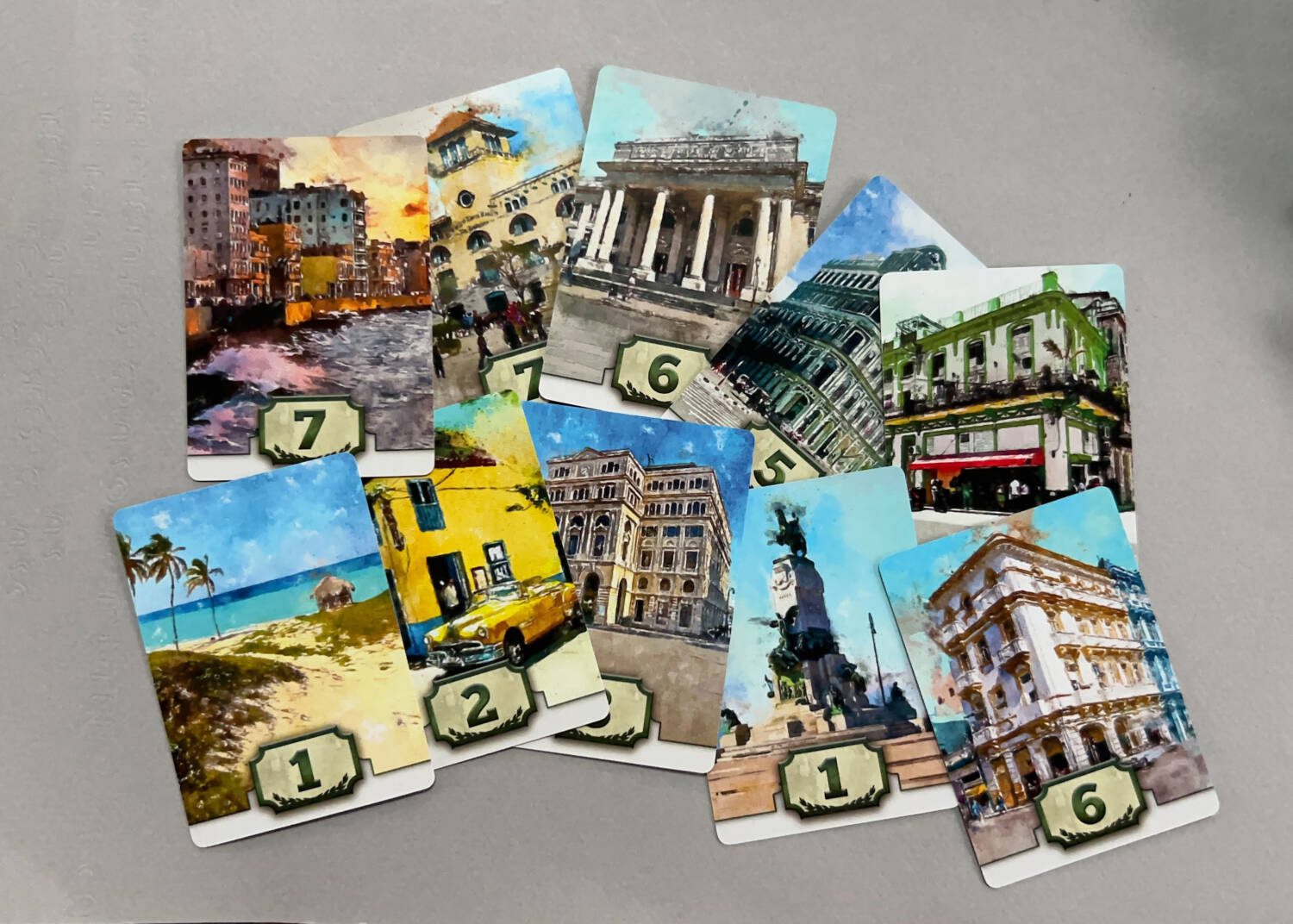
Shuffle the Building cards and lay out, side-by-side, two rows of six cards.
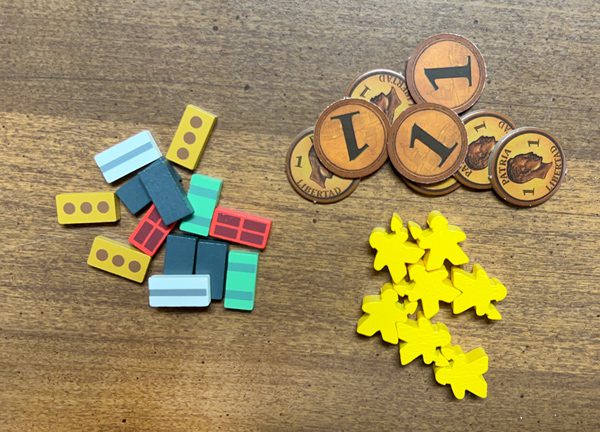
Give each player 1 peso coin, 1 grey brick, and a deck of 13 cards with the color backing of their choice. Place the Central Display card on the table and seed it with 3 pesos and three random bricks drawn from the bag.
Rebuilding
Those 13 cards are the heart of the game, and your set of cards is the same as everyone else’s. Cards have two features of note: a numerical value in the upper left corner and a special ability. You’ll start by choosing two of your cards to play, face down in front of you. When all players are ready, they reveal their cards.

Each round’s turn order is based on the numbers on the cards. Here, you aren’t adding them together; you’re placing them side-by-side, facing your opponents at the table, with the higher number to the left of the lesser number. This means if you played The Workers’ card (#4) and The Entrepreneur (#8) your ranking for turn order would be 84.
The player with the lowest combined number goes first. That player takes both actions on their face-up cards, and the turn passes to the player with the next lowest combined number. It is (frustratingly) possible that the actions allowed by your higher-numbered cards are no longer available thanks you players who played lower-numbered cards.
After that first round is complete—and for all future rounds—you leave one card you just played back on the table and place the other card facedown in your discard pile. For your next turn, you must play the remaining card and your choice of a new card from your hand.
Concerning the cards: some allow you to take material or money from the Central Supply or from other players. Two of the cards give you workers, while another protects your stash of pesos and bricks from those who would try to steal them from you.
At the end of a Round, if you have the same set of bricks/workers/money shown at the bottom of a Building card at either edge of the two rows of Building cards, you may turn them in and claim that Building. (Yes, all those nice cards in the middle are off limits—for now.)
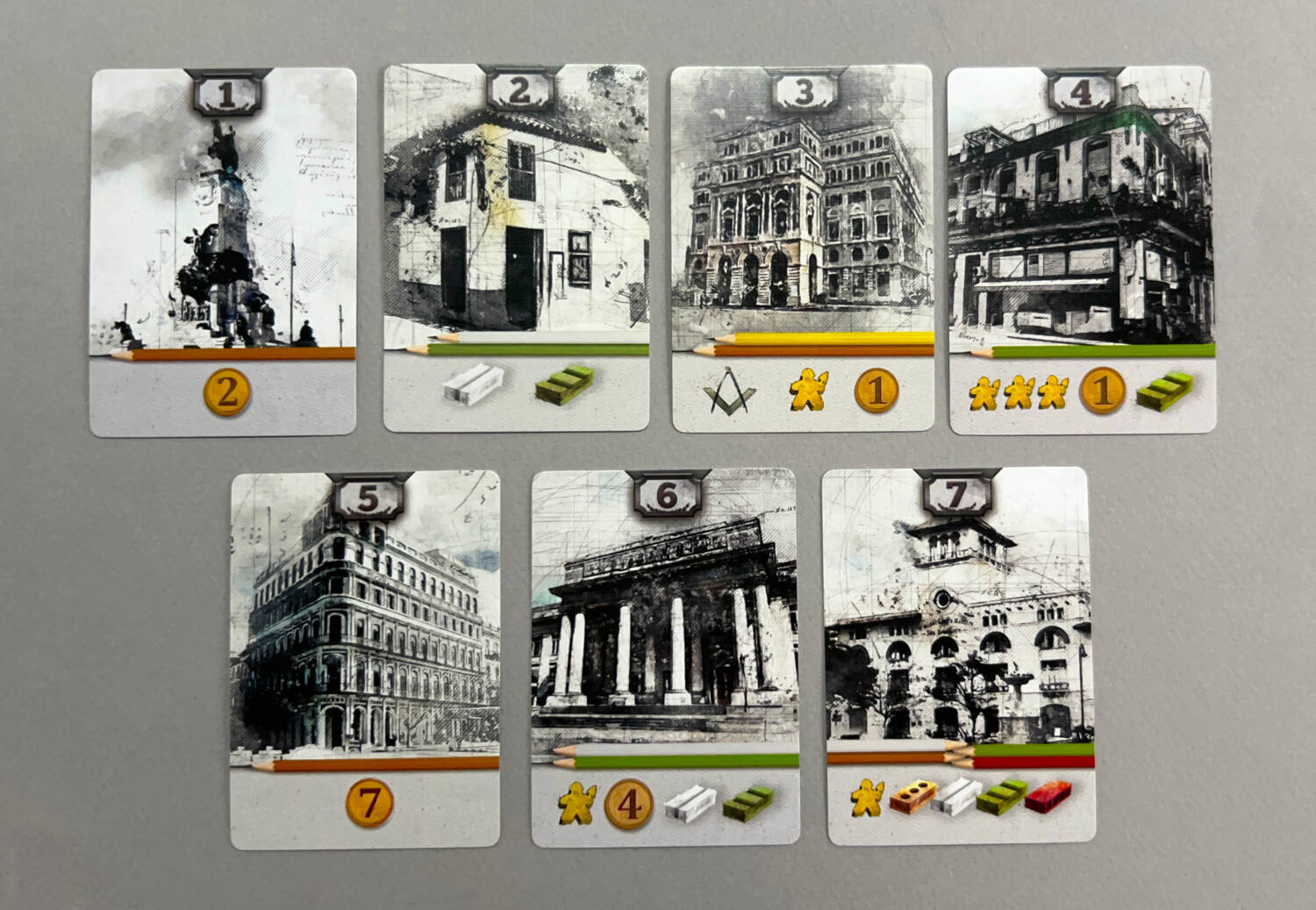
At the top of each Building card is a Prestige ranking—e.g., the number of points the card is worth. Be the first to reach the winning number for your player count, and you win.
Thoughts and Remembrances
La Habana is a game of incomplete information and timing. After the first round, all players keep one card they played in the last round in front of them. They then must place their new card on the correct side of that card, facing the table—meaning lower numbers to the right and higher numbers to the left.
Add to this the open Building market, and you have just enough information to manage a guess as to what that new card might be and what they’re planning. Or do you? And how does that determine your choice of new card to play?
You don’t want to be the second person to claim money/bricks from the Central Supply. If an opponent has played a card to the left of their #2 (Take one peso from the Reserve) you know this is either their #0 (No effect, it just ensures you a single digit when determining turn order) or a #1 (Your stash of workers and bricks are protected from thieves) you probably don’t want to play the card allowing you to steal a brick (#6) or two pesos (#5) from another player since there’s a 50% chance they’ve played the card that protects their stash.
What really made La Habana a hit with my review crew is the rule that says you cannot reclaim any of your discarded cards until you are down to two cards in your hand—with one exception: the Recycle card. Recycle allows you to discard one card from your hand to bring a discarded card of your choice back into your hand.
The timing of when to recover which card is one we’ve all struggled with. It’s typically played late in the game when you need a previously used ability to get/take something to help you claim an important building or prevent your opponent from doing the same.
La Habana’s small box betrays the amount of thinky fun waiting inside. If you like this kind of game, give it a try. Soon. It’s a solid 20-30 minute game that leaves enough time to play it a second time, just after the first winner is declared.
La Habana details
- Designer: Reinhard Staupe
- Artists: Ian Parovel, Michael Menzel
- Publishers: 25th Century Games, 999 Games, eggertspiele, Evrikus, Filosofia Éditions, Ghenos Games, Igiari, Lacerta, Rio Grande Games, Stupor Mundi
- Release Date: 2009
- Player count : 2 - 4
- Age range : 10+
- Time range : 30 - 45 minutes
- Mechanism(s): Action Retrieval, Hand Management, Memory, Set Collection, Simultaneous Action Selection
- BGG Geek Rating: 6.83397 - converted to Meeple Mountain scale: 3.5.
- More articles about La Habana.