
Disclosure: Meeple Mountain received a free copy of this product in exchange for an honest, unbiased review. This review is not intended to be an endorsement.

For my money, 2025’s most underrated (and severely underreported) game was En Route, a “blank and write” game system from the team at CrowD. It landed on my top 10 games of 2025 and for a person who usually frowns at the chance to cover roll/flip/draw-and-write games, En Route was such a hit that one person literally bought a copy of it while playing the first few rounds of a review play.
Little did I know that CrowD plans to extend this system by using the same round structure and game mechanics on different maps based on interesting themes…so when I learned that the new game Innsmouth Travel Guide looked a whole heck of a lot like En Route (prompting my group to call this new title “En Route: Innsmouth”), I reached out to the team at CrowD to secure a review copy of this new expandalone title.
We’ll keep the proceedings here brief: buy this game, especially if you are a strategy gamer who wonders why blank-and-write games fall flat for you…this system is the solution.
“Is That a Monster?”
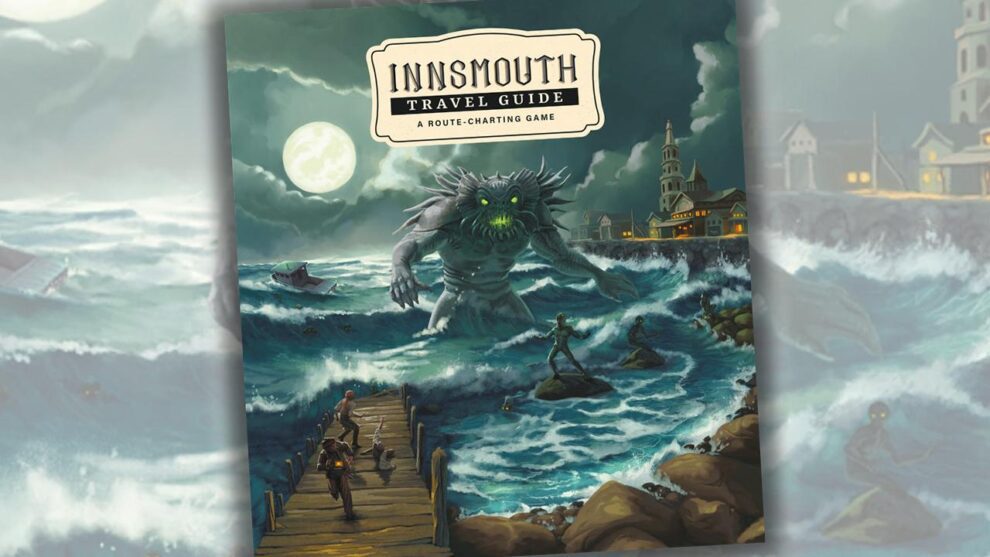
Innsmouth Travel Guide is a roll-and-write game for 1-4 players. Although it is a standalone product, Innsmouth Travel Guide uses most of the rules from the game En Route; as such, feel free to read that review if you want to get a better feel for how the game is structured.
The main change here is the setting. If Lovecraftian lore is your jam, you’ll feel right at home with Innsmouth Travel Guide…from the special characters to threats presented by The Cultists and The Deep Ones to a deck of special cards known as Dagon’s Artifacts, fan service is being provided up and down the spectrum for players interested in the theme.
I don’t know a lick about the theme, and I still had a blast playing Innsmouth Travel Guide. That’s because the core system here shakes up what I hate most about these blank-and-write experiences…there’s interaction on the front end of each round, mixed with variability of each player’s personal board that ensures everyone is playing a different flavor of the same game, heavily influenced by the choices of other players.
In that way, the main things that I love about En Route remain intact:
- The 10-round play structure remains, with special rounds on the front end to ensure all players get an equal number of chances to be the first player (I really can’t stress how often games of all shades blow this!)
- Playing with three players is the optimal player count, so that each round features dice selection choices influenced by everyone at the table, but solo remains a very reliable way to play
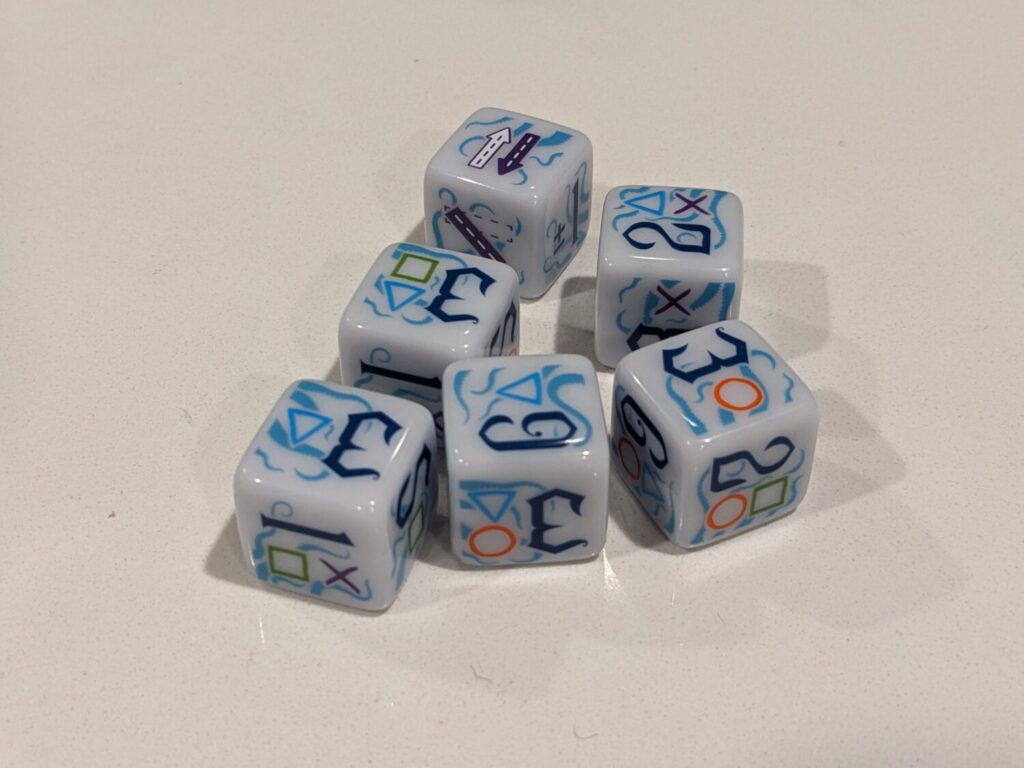
- Innsmouth Travel Guide uses the dice variant of En Route as its only way to deliver route choices each round…and now, I’m only going to use dice in the En Route base game because I love the way this changes variability and lets me chuck more dice
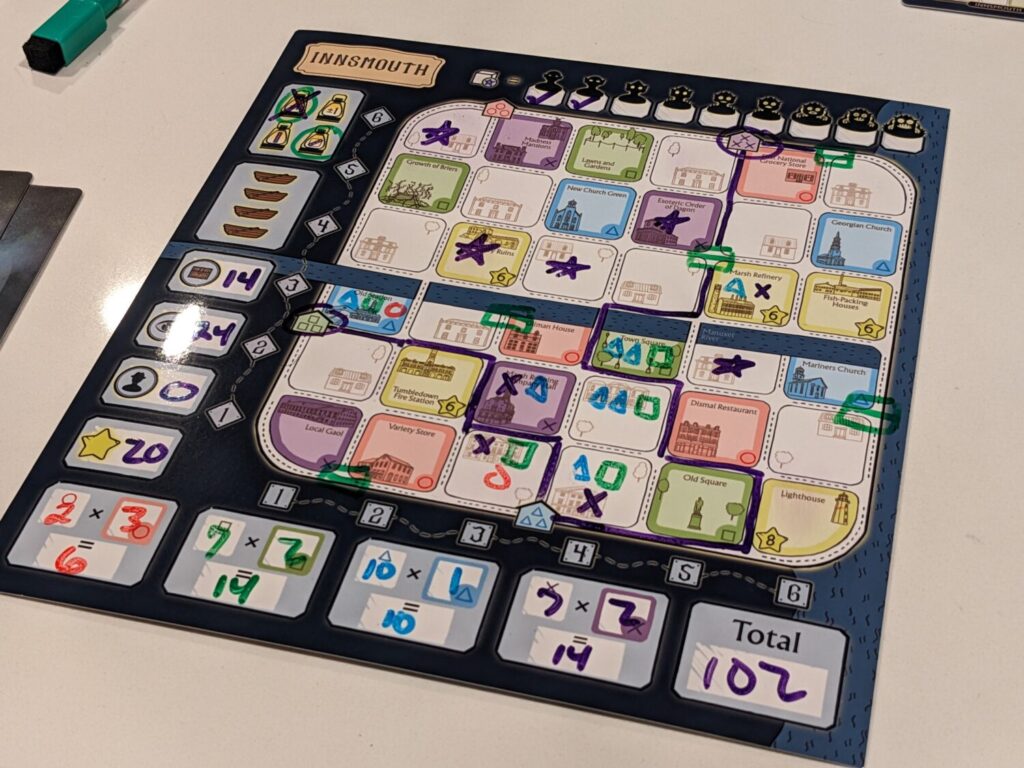
- The base scoring is very easy to compute—players must focus on getting their Final Route to pass through as many non-white boxes as possible, with a push to focus on getting 2-3 types of tourists that match the colored boxes on the Final Route. Mixed with two final objective cards, players know what they need to do but are challenged to maximize scoring opportunities presented by the die rolls.
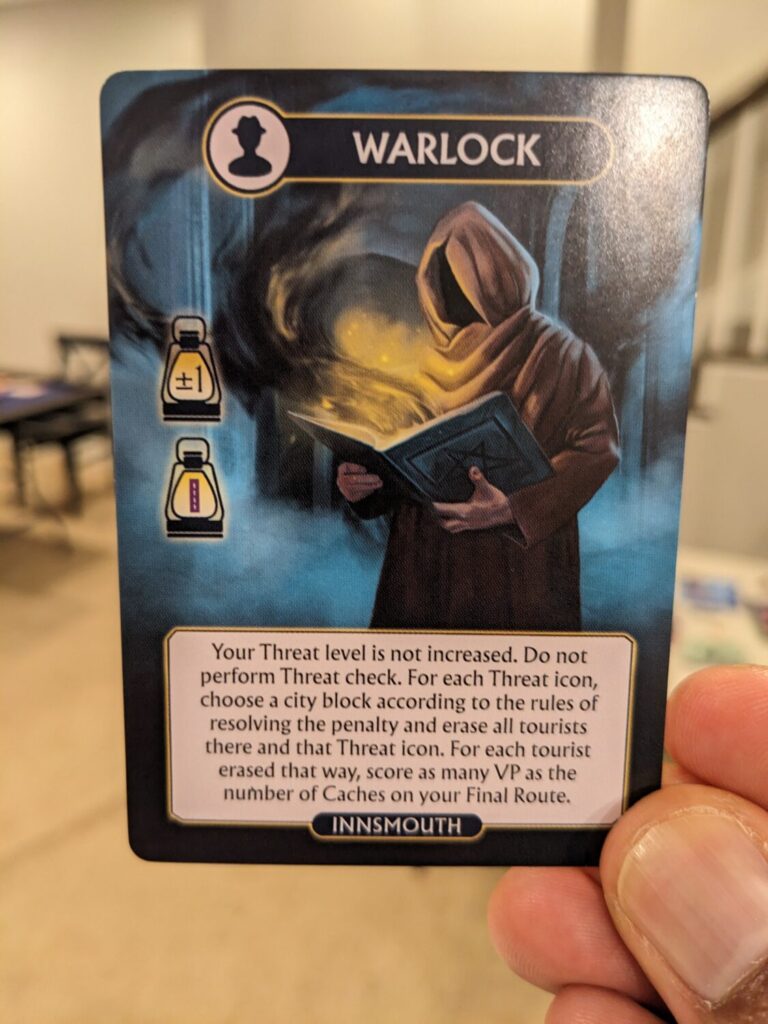
Innsmouth Travel Guide goes a step further, using some of the ways special maps extend play from En Route by offering five different character cards that change end-game scoring conditions. A bonus die is rolled each round to offer players a chance to affect how their routes are placed in that round…with one die face offering no bonus at all. (I was surprised how often I screeched when a player rolled a blank bonus face, when I was counting on something extra to boost my current turn. Dice, baby!)
Ferries can be used to cross a river running along the middle-most row of the map at the end of play, useful when extending each player’s Final Route. Threats presented by each game’s enemy are resolved at the end of the game, and the way threats surface adds a subtle layer of strategy as players try to math out where they might lose the most tourists based on where a threat is placed. Die rolls at the end of the game to resolve Threats are mitigated by charting a path through Cache icons laid out using variable set-up cards.
Do It
Innsmouth Travel Guide might be enough for most players who like roll-and-write games thanks to the sheer amount of variability included. With a tidy 45-minute playtime, there’s enough here for 5-10 plays, easy. (I’m spoiled by the En Route box of goodies…with a dozen maps, a half-dozen variants, and mountains of cards to shake up the system, En Route: Special Edition is all I will ever need!)
I think Innsmouth Travel Guide has a little too much going on for a casual player, so I would position the audience here as a long filler for a strategy gamer who likes their games to have at least a hint of interaction/confrontational elements included. Opponents usually have a say in how dice are chosen (with the exception coming at the four-player count), and I only really felt like I got hosed by an opponent’s choice once in my three-player review play. (I did a couple plays solo to round out my experience.)
The major negative here? The dry erase markers aren’t the best from En Route, and here, they are better…but there is only one set of them! That means in a multiplayer game, players will have to share the set of four included markers. That certainly kept the price down, but that makes the playtime shoot up if you don’t have multiple sets of markers for other players. (I used my En Route markers to ensure everyone had their own set.)
The inclusion of just a single set of markers makes me think that Innsmouth Travel Guide is meant to be played solo, and again, the ruleset for solo is very easy to administer and offers a solid experience.
Innsmouth Travel Guide has helped get 2026 off to the right start. It’s a great game that plays quickly, offering a thinky, interactive experience.
Innsmouth Travel Guide details
- Designer: Dan Lièvre
- Artists: Ekaterina Mamontova, Ekaterina Tsoy
- Publishers: Crowd Games, HIT Games
- Release Date: 2025
- Player count : 1 - 4
- Age range : 14+
- Time range : 30 - 40 minutes
- Mechanism(s): Connections, Grid Coverage, Line Drawing, Network and Route Building, Paper-and-Pencil, Solo / Solitaire Game
- BGG Geek Rating: 6.97344 - converted to Meeple Mountain scale: 3.5.
- More articles about Innsmouth Travel Guide.