
Disclosure: Meeple Mountain received a free copy of this product in exchange for an honest, unbiased review. This review is not intended to be an endorsement.
Boy, what a game.
You’d think straightforward tile-layers would be tapped out by now, after thirty or forty years of design, but then you sit down and play something like Iliad, which feels as fresh as the day Carcassonne was born. It manages to be fresh and exciting while comfortable and familiar. That’s a hard combination to pull off.
Each player starts with an identical deck of tiles, which vary in value from [input needed] to 5. You take turns choosing a tile from your hand of two and placing it on any contiguous space in your color on the 5 x 5 checkerboard playmat. Whenever a row or column is filled up, the values of each player’s tiles are added together, and the winner chooses from one of the two bonus tiles that sit on either edge of the relevant region. The other player takes whatever is left. The game ends the moment both players have played all of their tiles.
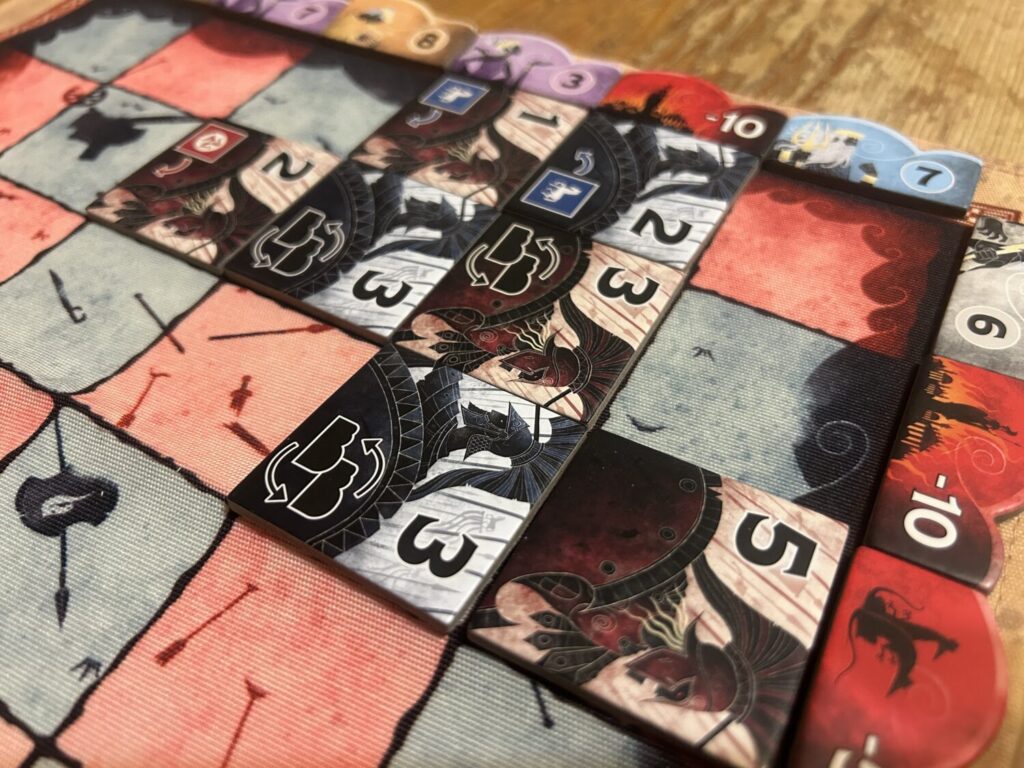
That, believe it or not, is that, as far as the broad strokes are concerned. With just a little more information, you’re ready to begin. While the value-5 tiles have nothing to offer but their largesse, everything else has a special ability. 4’s can be sacrificed to flip an opponent’s tile. 2’s and 3’s let you move either your own or one of your opponent’s tiles to another valid space. The [input needed]s are my favorite, worth the combined value of the two adjacent enemy tiles in their row or column. The temptation to place your beefiest boys in a high-value row is strong, but do so too eagerly and your opponent may be able to throw your own strength right back at you.
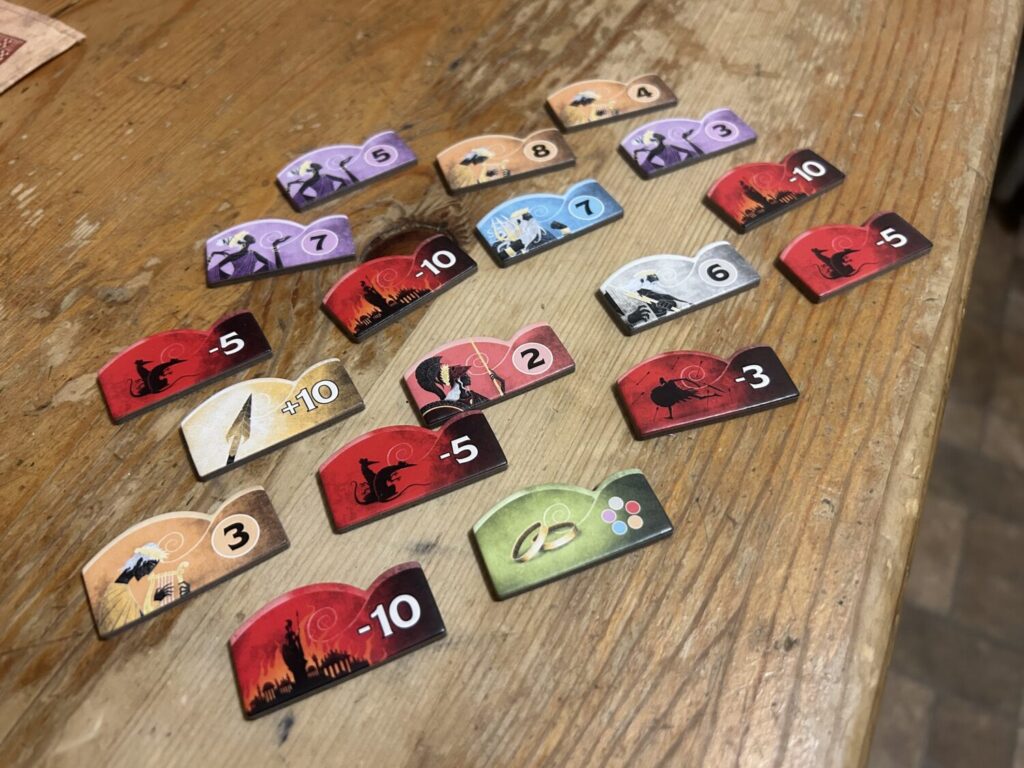
The scoring tiles are randomized, which shakes up the contours of Iliad from game to game. Not only are they worth varying amounts, they also encourage a bit of set collecting. Many of the tiles are assigned to gods, and these introduce two restrictions: you only score points for the highest tile you have in each god’s suit, and if either player fails to collect one of each god before the end of the game, they immediately lose.
Between the scoring and the tile powers, Iliad most impresses me with how nuanced it is. This is a surprisingly rewarding game to revisit. Player tiles are only randomized in how they are drawn; I know what’s in your deck, you know what’s in mine, and we can make informed decisions based on that. Not everyone is into tile counting, and that will drive some people away from Iliad, but a game is so short—well within half an hour—that it never drags. You have to think about your placements not just in terms of what you want to do, but in terms of what your opponent might. It’s all very good.
I recently reviewed Cosmolancer, a revival of Knizia’s own Kingdoms, and talked in that review about the brazenness with which it engages with the math at the core of its design. Iliad feels to me like a continuation of that design, an excellent narrowing of the same principles and ideas. The math is on the surface, though Iliad feels much less arbitrary than its older brother. The occasional turn will force a poorer play, but over the course of a game, skill and finesse get rewarded.
The best testament to Iliad is its staying power. Two weeks after my first play and a few days before I was able to get it to the table again, I was still thinking about the game. It’s a flavorful, easy-to-digest, and filling meal. Reiner Knizia will almost certainly become the designer who launched a thousand board games. Every now and then, he releases an absolute corker that reminds you why we keep playing them.