
Disclosure: Meeple Mountain received a free copy of this product in exchange for an honest, unbiased review. This review is not intended to be an endorsement.

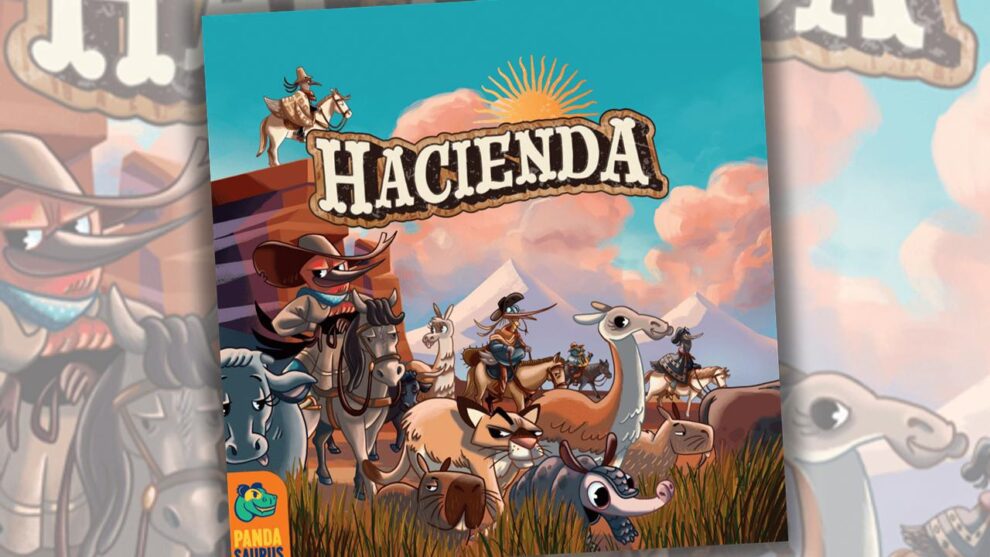
I don’t want to belabor the point here, but I have real questions, like this: does the new game Hacienda (based on the 2004 version of Hacienda by Wolfgang Kramer) want the leopard-looking creatures on offer here to be pumas, or jaguars?
I ask because the rulebook interchangeably uses the terms for both (they are pumas on the manual’s cover description, but jaguars on page four), and technology tells me that the two breeds of cool-looking cats are definitely different. Another theme note: Hacienda’s new theme is tied to building an eco-friendly tourist destination in the hills of Argentina. For the life of me, though, Hacienda feels like a game where I am simply placing clumps of animal tokens on a map to score adjacency bonuses and piles of cute-looking capybara packs.
Hacienda isn’t nearly as complicated as I’m making it out to be. In fact, like other Kramer games—the German legend has, as a lead or co-designer, gifted the world with titles ranging from El Grande to Tikal to Wandering Towers to my all-time favorite Kramer co-design, The Princes of Florence—Hacienda is extraordinarily simple to teach, and his work here with Daryl Andrews (Sagrada) is sleek, with a playtime that might last 30 minutes or less with lower player counts, 45 minutes with the max of five players.

Hacienda’s theme has its heart in the right place. In execution, this is a quick action selection and network building game. On a turn, players take three actions, from a pool of six that can be taken multiple times on the same turn. Managing an uncapped hand of cards that feature one of four animals, one of six terrain types, or wild cards that stand in for either animals or a terrain type, players must build packs of animals in the Argentine countryside originating from land markers that help build out a network. These animals are represented by thin, handsome animal tokens that stand in their spaces—although even a single table jostle could mean disaster, because the tokens are too large to lay cleanly in the small hex spaces that make up the main map.
Cards are the clock, so as players use their actions to draw cards, play them in pairs to seed the map with tokens of their color, and play them in larger sets to build water, viewing platforms and reserves, games of Hacienda move fast. I only tried Hacienda at two- or three-player counts, but the plays were a blur, and there are simple, interesting decisions to make on a turn to get as many pieces on the grid as possible before a mid-game and end-game scoring round determine the totality of each game’s points.
(One minor production negative: the score tracker is, bluntly, garbage. I have no idea why the numbers wrap the way they do, or why the tokens sometimes sit across two numbers because the pieces are too large. It’s just a fail, with scores regularly needing to lap the 50-point display. Even the box insert, which isn’t great, doesn’t annoy me the way the score tracker does!!)

Hacienda seems like it will shine best with five players; at lower player counts, there is almost zero interaction with other players because there is so much space to place tokens and work in a corner of the map to achieve one’s goals. (The map does scale with player count.) Because one of the scoring elements is tied to points earned with adjacent land markers, everyone clumps those tokens together where possible, so even spending a single action to try and break up another player’s land markers felt like a waste. Ditto for the map’s other interaction points—it is strictly better for a player to have all their pieces together for the viewing platform scoring, where players score one point for every piece in a chain that has at least one platform.
By my second play, I got the sense that I had seen everything Hacienda had to offer in its base game variant. The variable map tiles have B sides that can be used to shake up one of the scoring elements, visitor centers, but otherwise the game’s direction is still very straightforward. With family members and/or casual players, Hacienda is absolutely worth a look, and even with more deliberate players, games should wrap in under an hour.
Players looking for a deeper tile-laying strategy game should consider other options; titles like The Princes of Florence or Wandering Towers feel more innovative than anything on display in Hacienda. But if you have the right audience, Hacienda is a solid recommendation, particularly for players who have not had a lot of exposure to some of these game mechanics.
Hacienda details
- Designer: Daryl Andrews, Wolfgang Kramer
- Artists: Joan Guardiet
- Publishers: Pandasaurus Games
- Release Date: 2026
- Player count : 2 - 5
- Age range : 13+
- Time range : 45 - 60 minutes
- Mechanism(s): Enclosure, Hexagon Grid, Network and Route Building, Open Drafting, Tile Placement
- BGG Geek Rating: 6.10006 - converted to Meeple Mountain scale: 3.0.
- More articles about Hacienda.