Disclosure: Meeple Mountain received a free copy of this product in exchange for an honest, unbiased review. This review is not intended to be an endorsement.
Disclosure: Meeple Mountain was provided a pre-production copy of the game. It is this copy of the game that this review is based upon. As such, this review is not necessarily representative of the final product. All photographs, components, and rules described herein are subject to change.
Gods’ Will showed up in my social media feed, comparing itself to Resistance: Avalon like a new kid on the first day of school telling everyone he used to be popular somewhere else. I have heard this pitch. I have reviewed this pitch twice, from Witch Hunt and Human Punishment, two games that made the same promises and delivered the same disappointing results. So when Gods’ Will came knocking with the same marketing aura, I had to open the door with at least one eyebrow raised. Maybe I’m just addicted to disappointment, who knows.
After half a dozen plays, I can say with a bit of confidence that Gods’ Will is doing more right than wrong here. More importantly, it earns it by fixing the real problems with its predecessors rather than just the ones that look good in a Kickstarter pitch.
A Skeptic Walks Into a Kickstarter
Like 90% of social deduction games that have ever existed, there are two teams: Light and Dark. There is also a loner faction, a third party whose goals shift depending on player count and whose presence ensures that the ride from start to finish won’t ever be a smooth one. Every player is a God with a public special ability completely unrelated to their team alignment, giving you some identity at the table.
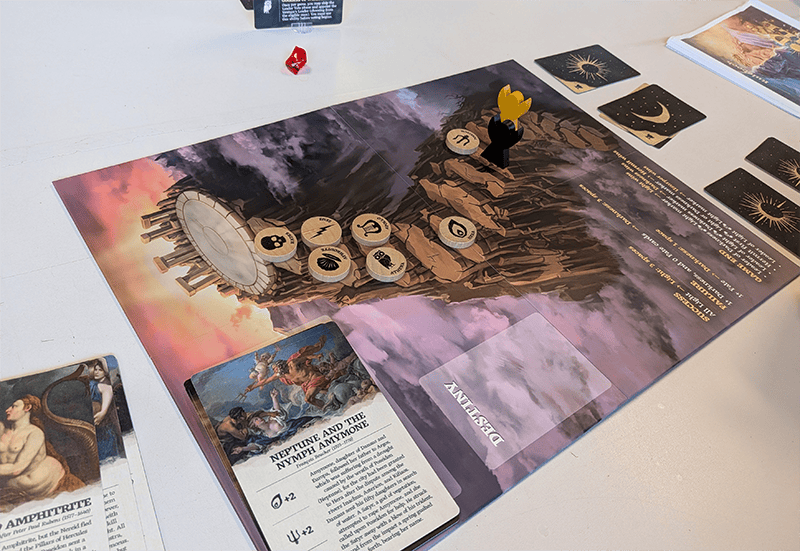
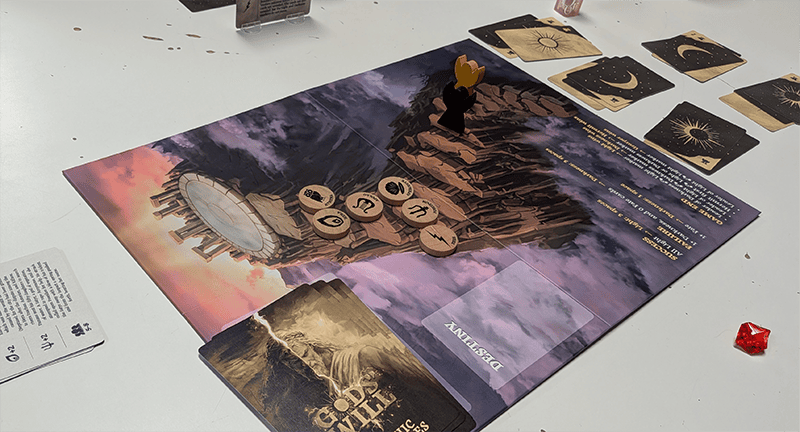
The board is a long track with two forces, Darkness and Light, creeping toward Olympus from the bottom. All of the players start at the top of Mount Olympus. Each round, a leader gets elected, picks a team, and that team goes on a Mission. Sorry, a Venture. The team members secretly choose to pass or fail it; the result moves one of the force markers up the board.
As you would expect, this leads to everyone casting blame and justifying their suspicions with questionable logic. This continues until one of the faction leaders gets caught by the other side’s force (e.g. Light leader hits Dark forces marker) or the loner pulls off whatever scheme they have been running since round one.
Before the actual game starts, there is a night phase. Eyes closed, certain players wake up, and information gets distributed. Darkness players know each other. The Light leader learns who the Darkness players are, but not their leader, and one Light player gets shown to them disguised as Darkness. This player is called the Marked, a false flag to keep the Light leader guessing.
The “loner” faction plays by its own information rules; some see nothing, some might get a morsel of information, depending on the player count. I’m only outlining the basics here. There are plenty of role cards that reveal or conceal more during the night. If you’ve played Resistance: Avalon, you already know a handful of them.
God Squad
Electing a Venture leader breaks from the standard social deduction tradition in a way that actually improves things. You draw from a Venture deck, and the card specifies which Gods are eligible to lead. For example, it may say Zeus plus two, meaning the Zeus player and two other people of Zeus’ choosing. Players go clockwise, announcing their pick, ties break in favor of turn order, and whoever gets the most votes takes the helm. No failed vote loops or proposals that keep getting rejected until the table collapses into exhaustion. The leader is decided, the leader picks their team freely, and the game moves on.
The chosen team members will then receive three Destiny cards, which determine the outcome of the Venture. The participating team members will choose one card and place it face-down in the Destiny pile, and discard the other two face-down. There are three potential options here: Light to pass the Venture, Dark to fail the Venture, and Fate to neutralize it. After a quick shuffle, the submitted Destiny pile cards are revealed.
All Light cards move the Light forces marker up three spaces. A single Darkness card in the pile moves the Darkness marker up three spaces instead. A single Fate card overrides everything and only moves the Darkness marker up one space.
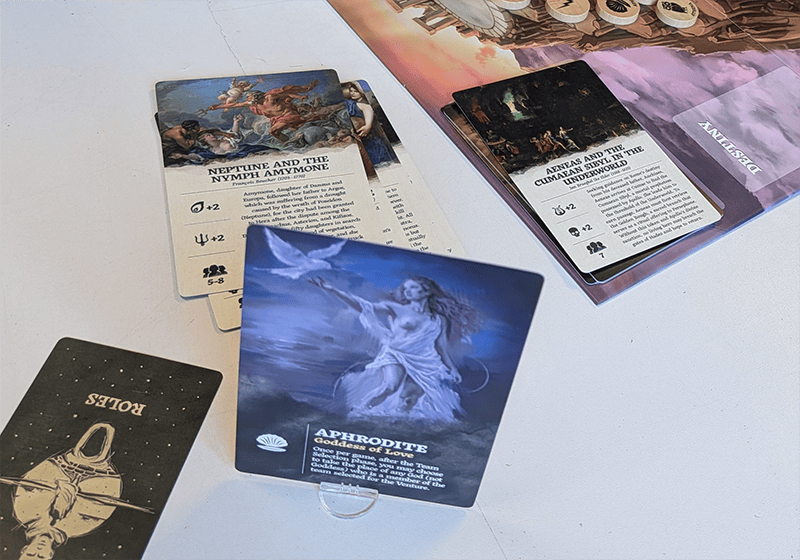
There is also a long block of flavor text on each Venture card referencing Greek mythology that absolutely nobody has ever read during an actual game. It exists in the way terms and conditions exist. Technically present. Spiritually ignored.
Democracy, Divine Edition
Once the Venture resolves, the Expulsion phase kicks in, and this is where Gods’ Will stops being a deduction activity, turning game night into fight night.
Going clockwise, every player points to another God. That God moves one space down, away from Olympus. You point, they move down, and nothing more. If a God’s position ever meets or crosses either Force marker, they are expelled. They can still win, still use their power, and still participate in Ventures. The only real change is that any Destiny card they play is now revealed face-up instead of face-down.
This loop of venture election, results, and expulsion repeats until one of the Leaders meets their fate or the neutral “loner” faction achieves their goal. It’s a game that lasts about 45 minutes and accommodates 5 to 14 players, though I recommend a minimum of 6.
After playing this prototype quite a few times, I don’t see any real reason to play Resistance: Avalon ever again. I went back to Avalon for this review, and I respect what it did for the genre, but its metagaming hasn’t aged well next to what newer social deduction games are doing.
One part that immediately seized my attention is the God Powers. Older social deduction games hand most players nothing to work with and reserve the interesting abilities for a lucky few. Gods’ Will gifts everyone a form of exclusive power over everyone else.
The Pantheon Reports for Duty
And these powers are built around the Greek archetypes in ways that feel genuine. When expelled, Hades immediately drags another God down to his space, a potential instant win or catastrophic misfire depending on his read of the table. Aphrodite can force herself onto a Venture by swapping in for a male God already selected. Demeter can use her expulsion pick to move someone toward Olympus rather than away from it. Every power touches the systems that actually matter: Voting, Destiny cards, expulsion, and team composition. None of them are flavour with no function.
The hidden roles are also well constructed, particularly the loner options. Some Darkness roles reveal themselves upon expulsion, giving their team a parting gift. One might push the Darkness marker up three spaces on their way out, another might make their expulsion count as two spaces down for the rest of the game.
The loner faction mirrors this brilliance with roles like the Usurper, who wins alone if the Light Leader meets the Forces of Light marker, and the Hermit, who wins alone if they are expelled first. You may think this sounds a bit gimmicky, but you’ll learn quickly that they change how every player at the table has to think about every expulsion decision they make.
I’m also glad team selection is far less solvable. A random card draw that limits eligible leaders means the same players won’t keep getting voted onto every team. It forces more of the table into contention. The clockwise system means the game keeps moving instead of drowning in repeat votes. I get that voting is part of the social deduction puzzle, but back-to-back votes blur together fast and make it harder to read the patterns underneath.
Greek Politics
The Fate card deserves its own spotlight moment as well. The obvious question when a Dark player can freely pick their own team is what stops them from just loading the Venture with allies. The answer is that Light players can play a Fate card to blow up the result when they suspect the team has been compromised and is being led astray. The catch is that Fate goes both ways. Darkness and loner players can play one too, using it to muddy the waters and make allegiance deduction significantly harder.
Perhaps my most beloved feature is the Expulsion phase. This is where the game actually comes alive. You are not just deducing anymore, instead you are settling scores, building coalitions, nursing rivalries, and deciding which of your friends gets thrown off a mountain tonight. Suspicion becomes something measurable and actionable rather than just a vibe you are carrying around. The expulsion phase gives the whole table real leverage, not just a voice in who joins a Venture but a say in who answers for its failure.
Put all of this together, and you have a game that won’t let anyone sit still. The Fate cards, the Expulsion phase, and the hidden roles create a procedure where every round generates new information, new suspicion, and new reasons to change your view on everyone at the table. Gods’ Will took the skeleton of Resistance: Avalon and gave every bone in it something to do.
Beauty Sleep
Yet not everything is perfect. Graphic design, or more specifically the interface, is where this one stumbles. There are almost no icons here with text taking up so much card space real estate that you can charge it rent. Every role card hands you a paragraph you are expected to swallow without chewing. The concepts themselves are not complicated, especially for anyone who already knows the genre, but the presentation buries them in words when a handful of icons would do the job faster and with less friction.
The team alignment and whether the Light leader can see you are both pieces of information that could be conveyed with two simple symbols. Instead, they are sentences. The board handles Venture outcomes the same way. Just text. No visual shortcut anywhere.
The God cards look genuinely great. Each one is distinct, clearly given real attention, and committed to the Greek aesthetic in a respectable way. The role cards do not meet the same standard. Despite the high number of roles in the game, there are only three unique art pieces across all of them: one for Light, one for Dark, one for Loner. Every role within a faction shares the same image, which makes an already text-heavy card feel like a chore and a half to go through.
The Gods Have Spoken
Gods’ Will is not reinventing the genre. The loop of electing a leader, sending a team, revealing the outcome, and repeat has not fundamentally changed in over a decade, and if that loop never worked for you to begin with, a toga and a pantheon of Greek powers are not going to change your mind. If you have been chasing something that breaks the chains, this is not that game.
Here’s where I land. Gods’ Will isn’t just another Avalon clone; it’s the rare game that actually earns the comparisons. The roles, the powers, and the expulsion phase all come together to create something distinct yet rooted in familiarity. The interface needs work, and it needs it before this leaves the prototype stage, but that’s a fixable problem, not a foundational one. Mount Olympus has seen worse tenants. This one’s earned its spot.