
Disclosure: Meeple Mountain received a free copy of this product in exchange for an honest, unbiased review. This review is not intended to be an endorsement.
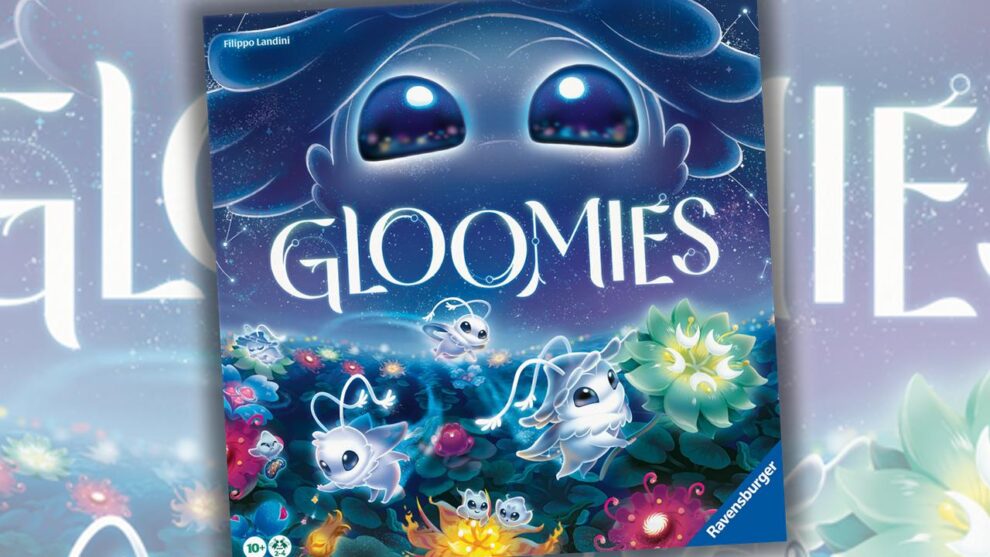
During my visit with the team at Ravensburger during Gen Con 2025, I had the chance to pick up the new family game Gloomies, complete with a spooky cover of what looks like a ghost to go along with what looked like a chance to harvest a space-themed garden. Like other Ravensburger titles, the production looked great, and I was excited to get the game in front of my ever-discerning children to see what they thought.
The best thing about my family as a game-playing institution: they know what they like, and getting games to the table is a breeze. After a couple of plays with the kids and then putting Gloomies in front of my review group, I thought the best comment came from one of our more seasoned players: “This is the kind of game I would play with my aunts and uncles.”
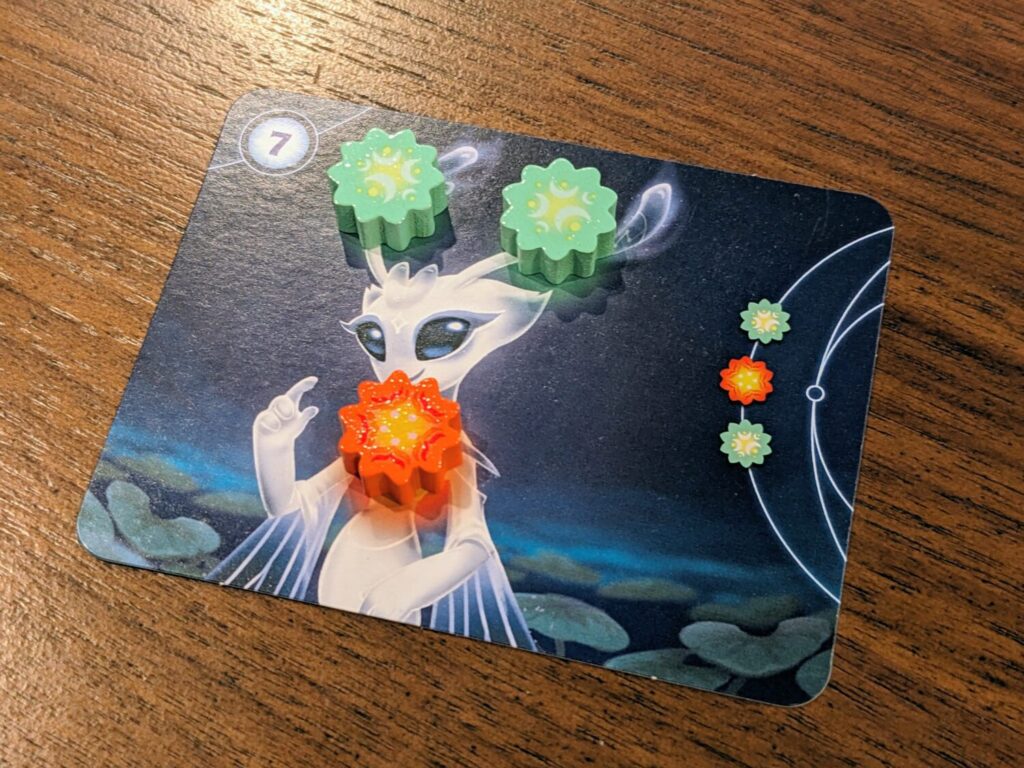
“Daddy, Those Look Like Jellybeans”
Gloomies is a race, with 2-4 players trying to score the most points by growing and harvesting flowers to fulfill orders and collect sets of stardust counters that will score points during a mid-round scoring as well as a second time at the end of the game. The best thing about Gloomies is the playtime—it feels like a lot happens in a game of Gloomies, but when you look at the clock, you will likely find that the entire game only lasted about 30 minutes.
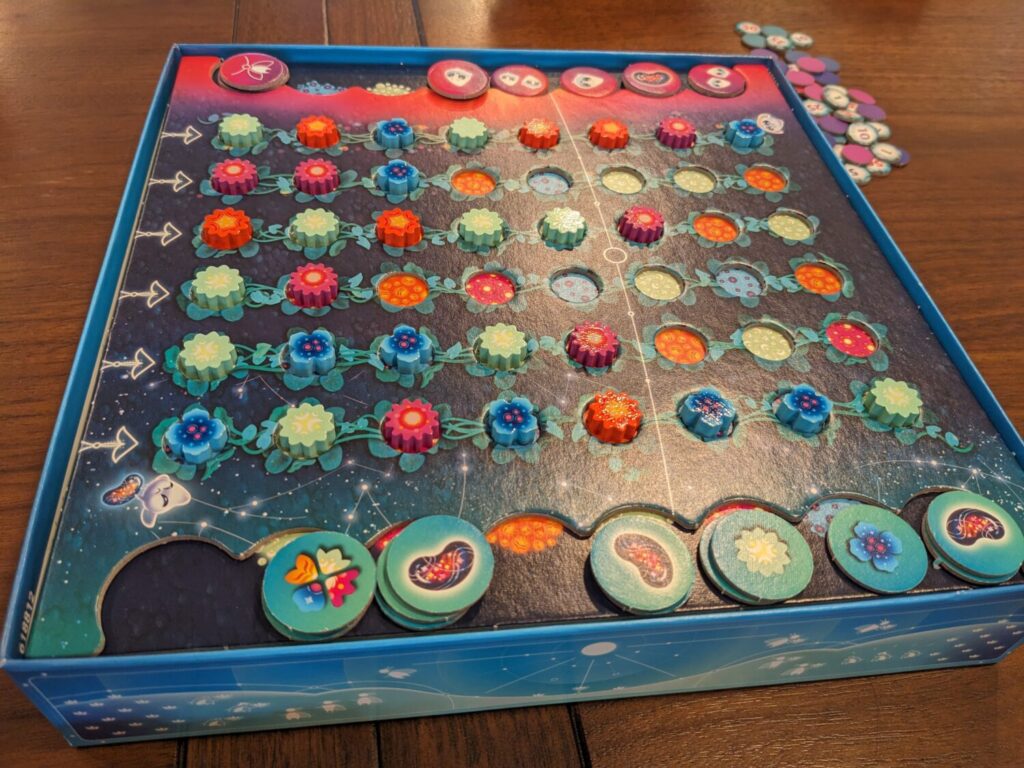
As “garden Gloomies” (per the manual), players will use their turn to play a number of flower cards from hand to either place flowers on the game’s main board, or harvest previously-placed flowers to try and score order cards in the back half of play. Turns are lightning fast, as the active player plays 1-3 cards from their hand matching spaces on the board starting from one side of the board. After placing flowers on the grid matching those cards, that player can take a bonus tile before drawing one or two cards from a simple market to refresh their hand.
Turns go like this until about half the board is full of flowers. Then there’s a very quick scoring round that rewards players who played lots of the same types of flower cards a little more than anyone else, along with points for stardust tokens, which happen to look a lot like cute jellybean counters. Players reform a personal draw deck made of their previously-played flower cards, which is then used for the rest of the game to take matching flowers from the board. At the end of the game, order cards make up a sizable portion of a player’s point total, along with points for stardust and scraps for any leftover “little helper” tokens that were used during play to slightly augment each turn.
Scoring is rather tight—in fact, our first four-player game of Gloomies ended 55-55-55-54, with my nine-year-old winning on the game’s second tiebreaker because he had the most valuable order that was scored. I’m sure I have not played a game all year that finished in a three-way tie with a second-level tiebreaker used to sort out the winner!
Is it Memorable?
I always start with the phenomenon of “winner’s bias” when I play games; so, after that first play, I asked the kids if they wanted to play the game again later that week.
The nine-year-old, who won that first play, was torn. “Eh, Gloomies was OK, Daddy,” he began. “I like the colors and it was fast, but I’m not sure I would play it again.” The 11-year-old and my partner were less diplomatic. “It wasn’t bad,” came the report from my wife, who is usually most interested in playtimes. “It was really quick, and turns were really fast, though.”
After getting this in front of the review crew, my thoughts crystallized nicely. Taking turns in Gloomies is nice because the decision space is so limited. When playing cards, you have to find a way to play at least one card in the first half of the game—and because order cards are so important, it’s fine to only get one or two cards played as long as the bonuses are great. I found myself trying to have at least three, ideally four, order cards in the second half of the game, so that I could track down the right types of flowers to fulfill my orders and outscore my rivals.
The choice of cards to draw at the end of each turn is even better. If a wild flower card is in the market, I would usually go for it to increase flexibility on future turns. If not, taking two of the three cards, ideally different colors, made my brain nice and comfy. You never have to wait long to take a turn, and decisive players will make Gloomies a breeze.
But even as I drafted this review, I found Gloomies quickly fading from view. It does a few things right, but in a crowded space, it’s hard to describe the ways in which Gloomies blows other family-weight games out of the water, even from Ravensburger’s extensive catalog. I’m glad we had the chance to get it to the table, and if you are in the market for a quick, well-produced drafting and order fulfillment game, Gloomies is worth a look.
Gloomies details

- Designer: Filippo Landini
- Artists: Justin Chan
- Publishers: Ravensburger
- Release Date: 2025
- Player count : 2 - 4
- Age range : 10+
- Time range : 45 - 60 minutes
- Mechanism(s): Contracts, Set Collection
- BGG Geek Rating: 7.25203 - converted to Meeple Mountain scale: 3.5.
- More articles about Gloomies.