Disclosure: Meeple Mountain received a free copy of this product in exchange for an honest, unbiased review. This review is not intended to be an endorsement.
Human memory is a funny thing.
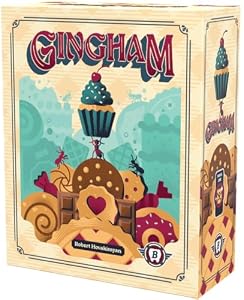
Every time I sit down to play Gingham, the latest collaboration between designer Robert Hovakimyan and publisher Bitewing Games, the song “Teddy Bears’ Picnic” rises like a leviathan from the depths of my memory. “If you go down to the woods today, you’re sure for a big surprise,” I sing as I lay out the checkerboard picnic blanket and organize the ants. “If you go down to the woods today, you’d better go in disguise,” as I set out the sweet treats across the map and set my score counter to 0.
My only exposure to “Teddy Bears’ Picnic,” a popular children’s song in the U.K., was a 1986 VHS tape documenting a live concert on Boston Commons by the musical duo Rosenshontz. I have not seen, let alone thought about, that VHS tape in over three decades. Nevertheless, here we are. Again, and again, and again.
But what of Gingham? We can’t speak of obscure regional concert films forever, though I could probably pitch that to Pitchfork as a series. What about Gingham indeed. It’s a bit of a funny game to describe. I would call it an abstract game centered around route-building with a clever sort of auction system for figuring out turn order. The BGG entry suggests the publisher more or less agrees, though they use different nomenclature. Did you know “Enclosure” was a game mechanism? Now you know the answer to the trivia question, “What mechanism is shared by the games go and Agricola.”
No matter the specific language you want to use, Gingham is a clever little game. You take turns placing your Queen tokens anywhere along one of the four edges, then adding an ant anywhere in the corresponding row on the board. If you form an uninterrupted connection between two matching desserts, the ants condense them, and you score points. Inefficiency is rewarded: the more ants are involved in shuttling the desserts from one place to another, the more points you score.
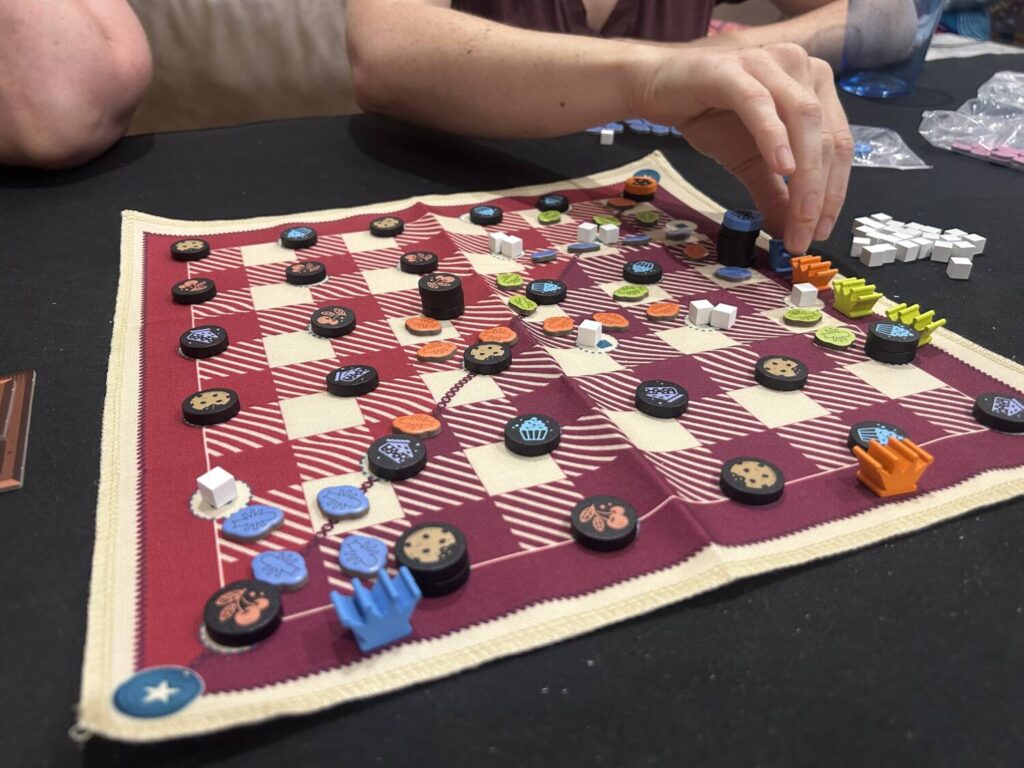
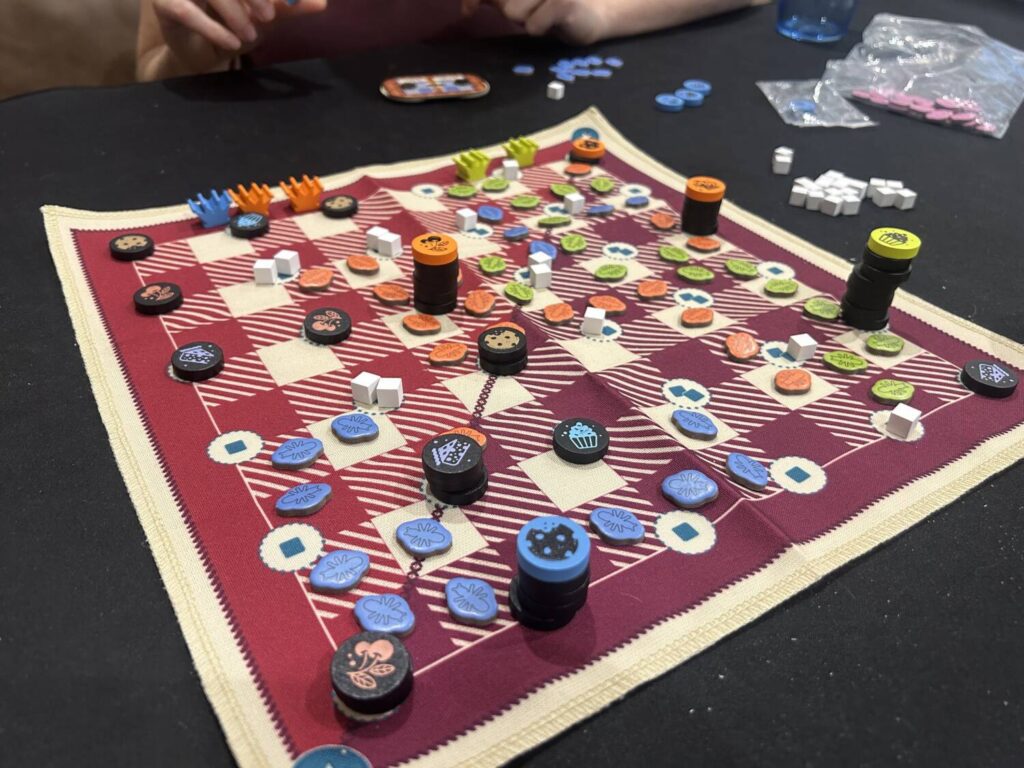
If you ever fully surround a pile of desserts, you can claim them as your own, scoring points for the number of desserts in the pile. At the end of the game, piles score a second time, so they’re worth the investment, and the player with the highest stack of each dessert gets bonus points. Resource hoarding is good, and don’t let anyone tell you different.
The inspired bits of Gingham are the ancillary details. You’re always welcome to place an ant on top of another player’s ant, but be aware that Gingham follows Hansa Teutonica’s lead: getting booted can be a huge help. While ant placement follows a series of restrictions during player turns, a booted ant can be placed in any empty space on the board. With good planning and just a bit of luck, getting foisted can provide enormous benefits.
My favorite part of the game is turn order. Sometimes you write a sentence and wonder if you should try to spend more time outside. For the first round of the game, the starting player picks one side of the board and puts down their first Queen and ant. Play moves clockwise around the table twice, with everyone placing their Queens in different spaces on the same side of the board as the starting player.
The board is cut in half along the diagonal. Ant placement is restricted to spaces on the same side of that divide as your Queen. This puts the starting player in a position of significant authority: they get to set the agenda for the entire round. By choosing the “wrong” side of the picnic blanket, or by outright taking desired spaces, the starting player can play a game of keep-away to prevent other players from making imminent connections. You often want to go first in Gingham, and you do have control over that: starting in the second round, turn order is determined by the Queens.
The player with a Queen closest to the one-square row on the current side of the blanket gets to begin the next round, and turn order goes from the Queen who had the fewest placement options to the Queen who had the most. This is inspired design. You can engineer a two-turns-in-row round for yourself, or make sure you’re going to take both of your turns before a pesky rival. You can decide that choosing the side for the next round is more important than placing an ant right now. That’s the good stuff.
So it is with a sense of tremendous disappointment that I tell you that I don’t enjoy Gingham all that much. I can’t figure out why. I should love it. It’s a positional abstract with high levels of player interaction. It has a mundane and yet charming setting, which is my favorite kind of setting. It rewards both tactical observation and long-term planning. It isn’t terribly hard to teach, nor does it take terribly long to play. It has a very clever turn order mechanism. These are all big, fat pluses in my book. And yet.
Gingham doesn’t, for all the evident care and skill that have gone into it, spark joy. It is relentlessly grindy. It suggests the idea of a game I love without ever becoming that game. It is a little too gnarly, a little too procedural. It is bereft of the moments of discovery that distinguish the games Bitewing, Hovakimyan, and I all clearly adore. This has been a recurring issue for me with Hovakimyan’s games, like Bebop. They’re drawing from a well from which I am more than happy to drink, but they always leave me thirsty for something else. Despite the blanket board and the park-friendly snacks, Gingham is no picnic.
Gingham details
- Designer: Robert Hovakimyan
- Artists: A. Giroux
- Publishers: Bitewing Games
- Release Date: 2025
- Player count : 2 - 4
- Age range : 12+
- Time range : 20 - 40 minutes
- Mechanism(s): Auction: Dutch, Chaining, Connections, Enclosure, Turn Order: Auction, Variable Set-up
- BGG Geek Rating: 7.22665 - converted to Meeple Mountain scale: 3.5.
- More articles about Gingham.