
Disclosure: Meeple Mountain received a free copy of this product in exchange for an honest, unbiased review. This review is not intended to be an endorsement.
Peel Appeal
Weast Coast Games has quickly become one of my favorite publishers. Their catalog may not be huge, but their unique styling and approach to game mechanics makes every release feel worth a look. If you haven’t checked out their early games, hop on over to our reviews of Desperate Oasis and Snakes of Wrath.
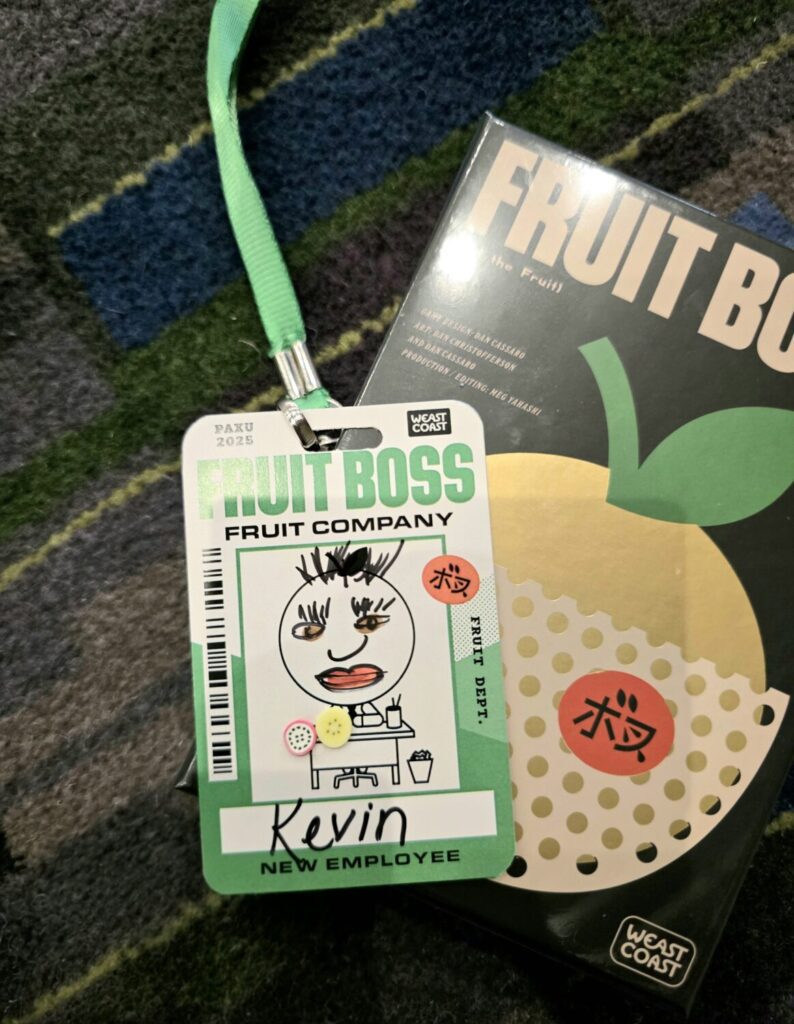
At PAX Unplugged, Dan Cassaro and the Weast Coast team shared a booth with Chris Couch Games, which definitely upped their presence on the floor. You could hardly walk by without noticing it—one side was fully Christmas-themed, and there was even a little photo booth with Dani Strandring drawing caricatures.

While both previous Weast Coast titles were strictly two-player, Fruit Boss expands the range to four. That’s a great move, because the mid-century Americana ad style from the earlier games is enough to pull people in, but the head-to-head format can be a turn-off for some groups.
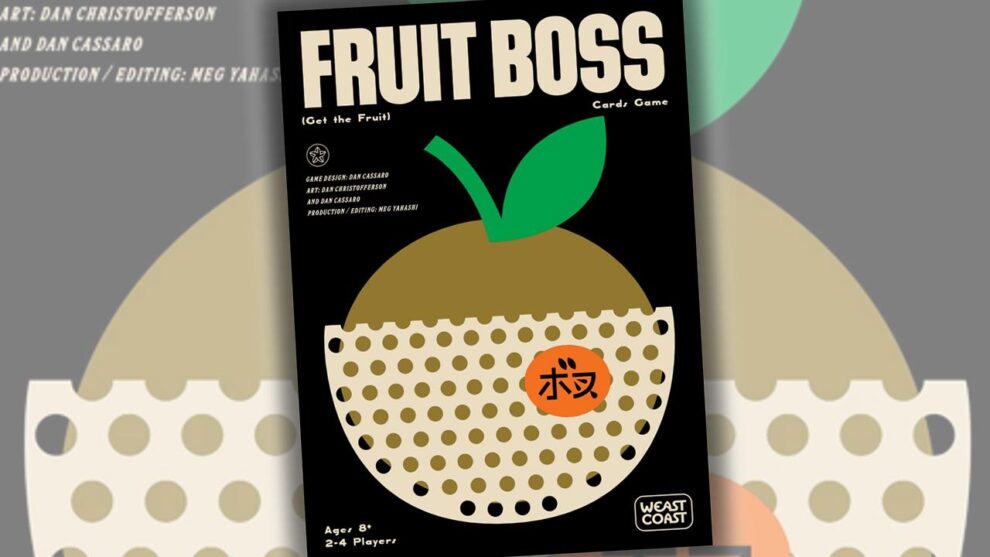
But don’t worry—Fruit Boss keeps all the artistic charm, just with an ’80s minimalism flavor. It looks like something I’d find on a blank VHS tape cover from my childhood (and if you don’t know what I’m talking about, then I feel old).
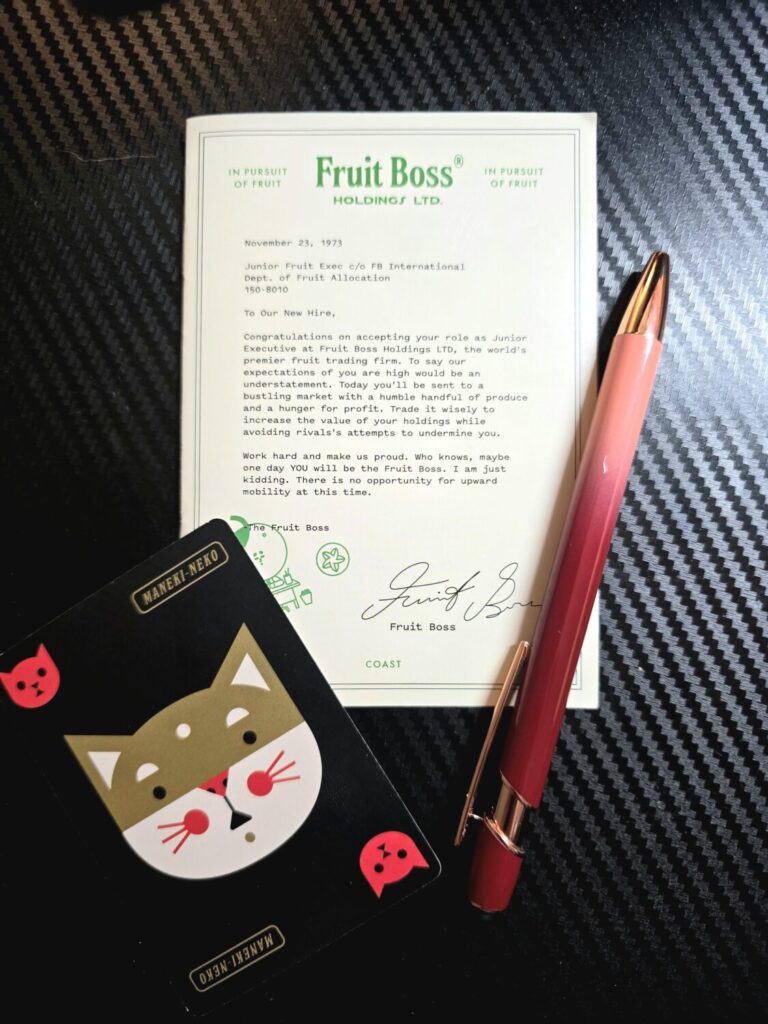
Even the teach video on YouTube has a charming “employee welcome video” vibe, and it makes learning the game almost as fun as playing it.
Fruit Stand Formula
Fruit Boss is a quick card game played in rounds (the number of rounds is up to the players), where you’re trying to collect high-value fruit while dodging the less lucrative stuff.
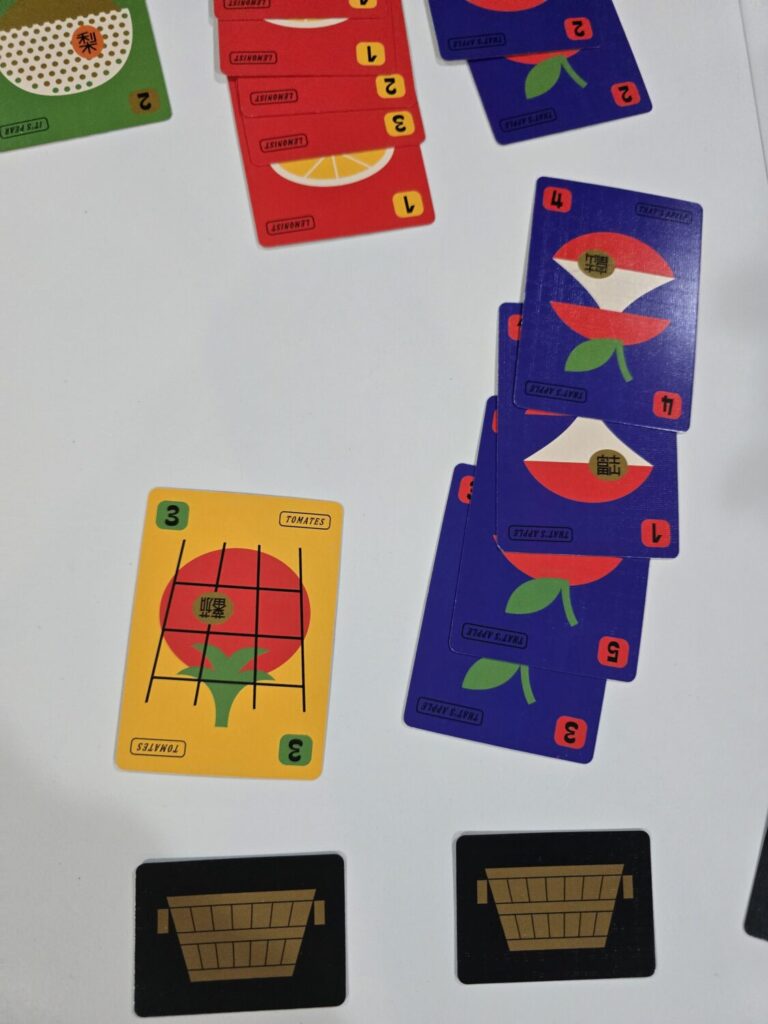
There are seven suits of fruit, each with cards valued from 1–5. The twist is that the 3s, 4s, and 5s only have one card each. There are also wild fruit cards and curiously named maneki-neko cat cards (but more on those in a bit).
On your turn, you have up to two actions. Most often, you’ll play a card into one of the fruit stacks in the market. It must match the fruit already there, and if that stack becomes larger than an adjacent stack, you take the smaller pile into your scoring area.
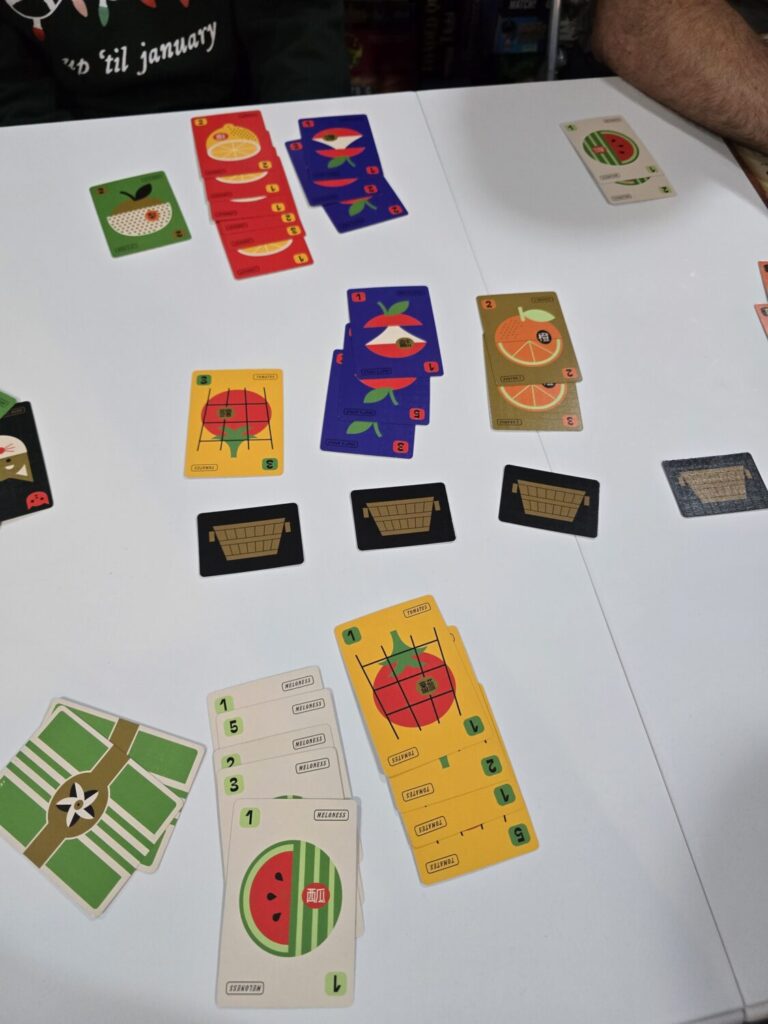
Your other action options include combining matching stacks, sliding stacks through empty spaces (usually to create adjacency), or playing a maneki-neko card, which “eats” a card—removing it from the round.
When the game ends, players score each fruit set by multiplying the total value of that fruit by the number of cards in the set. The catch: you can only score three fruit types. Anything extra—plus cards still in hand—hits you with negative points.
Then you either launch into another round or call it and crown the one and only FRUIT BOSS.
Ripe for the Picking
This game is a delight. It feels like a classic card game you’d play with your grandmother after a Sunday meal, but it’s packed with modern tactics and sharp decisions. The loop is simple, but every play leaves you thinking, “Okay… what’s actually the best way to win this?”
Because it’s so tactical, it’s also hard to plan too far ahead. Even with two actions (and you can do a lot with them), it’s brutal when the next player completely scrambles the market and leaves you holding a handful of regret and low-paying fruit.
One of the key mechanics is “toppling,” which triggers when a stack hits five cards. That stack and an adjacent stack “fall over” and are removed from the round. It’s a great way to bottom out a fruit market you don’t want to feed—or to reset the board in a way that opens the door for your own big payoff.
The rulebook also leans hard into commodities trading, which I loved. I’m just a retail trader in real life, but it’s fun to talk like you’re on the trading floor: “Ughh, you just crashed the watermelon market!” or “Tomatoes are a hot ticket right now!” or “Apples are going to pay off this mortgage, baby!”
That lightness makes it a great social game too—you can chat, joke around, and still stay engaged, because turns move fast. Honestly, they move so fast you’ll barely have time to refill your beer.
That said, there are a few bruises amongst the fruits. The game can feel luck-dependent on the opening draw, and it’s possible to fall behind if your hand doesn’t present any clean plays, especially if you’re stuck with mostly unique suits and no easy way to build a plan. Some players will start with a perfect mix and surge ahead early.
I also found that the threat of negative scoring didn’t really bite as much as I expected. It felt pretty manageable to avoid hoarding too many random fruit types, and the negative points ended up being minor for most players. But for a casual card game, that’s not necessarily a bad thing—it doesn’t need to be punishing.
Fruit Boss is best at four, but it still holds tension and tactical depth at three and two. It’s also the kind of game that gets better the more you play, because you start recognizing patterns and spotting sneaky strategies between the stalls.
With a snappy 20-minute play time, easy-to-learn rules, and fun retro art, I recommend it for casual game nights, as a palate cleanser between heavier games, or as a friendly gateway for non-gamers. Fruit Boss is a fruitful time wheeling and dealing.