
Disclosure: Meeple Mountain received a free copy of this product in exchange for an honest, unbiased review. This review is not intended to be an endorsement.

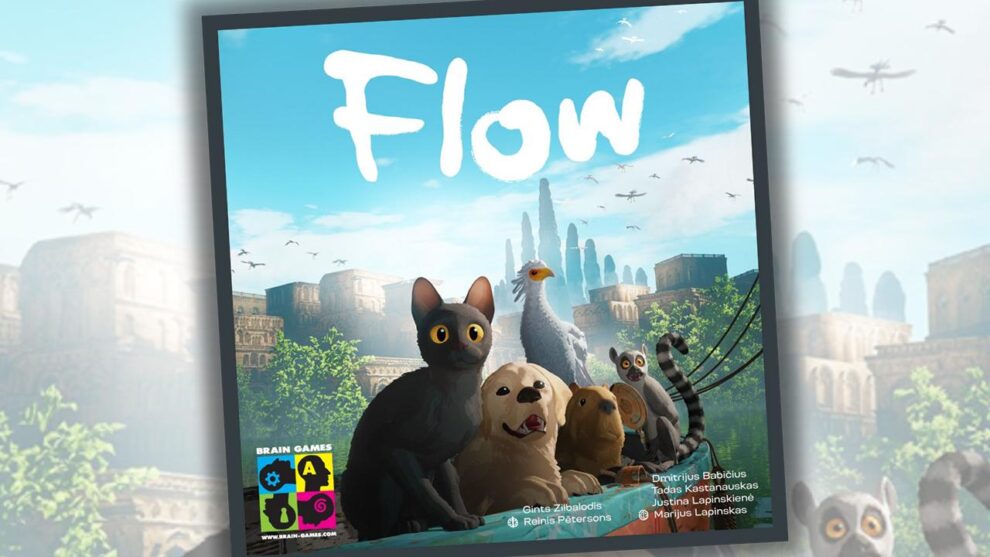
Released in 2024, the movie Flow follows the adventures of a mismatched group of animals as they try to navigate, and survive, a massive flood of apocalyptic proportions. Flow, the cooperative board game (released in 2025) is heavily inspired by this narrative. In the game, players work against the clock, placing tiles to create a pathway for the animals trapped on the edges of the game board to reach the safety of the boat in the middle. Each time the one-minute timer runs out, dice are rolled and, depending on the results, a number of tiles are washed away by the rising flood waters, forcing the players to start again. If the players are able to create pathways for all four animals, they win. But, if the tiles run out before that occurs, they lose.
Overview
The game board is divided into a 7×7 grid. Each corner features the image of one of the four animals the players are trying to save, and each image has the beginning of two pathways connected to it. The center row and column are highlighted in a different color than the other empty squares of the grid. During setup, the boat tile is placed in the center of the board where these stripes intersect. The boat tile is double-sided. One side features an image of the boat with four pathways leading into it. This is the side the game recommends you use for your first few games. But, this tile can be flipped to its more challenging side, featuring only a single pathway into the boat, if desired.
Each pathway tile features an image of a pathway: some straight lines, some crosses, and some 90-degree angles. The object of the game is to use these tiles to create a path from each animal to the boat: a task which, on its face, sounds pretty easy. However, remember that timer I mentioned earlier? Yeah. That timer is going to become the bane of your existence.
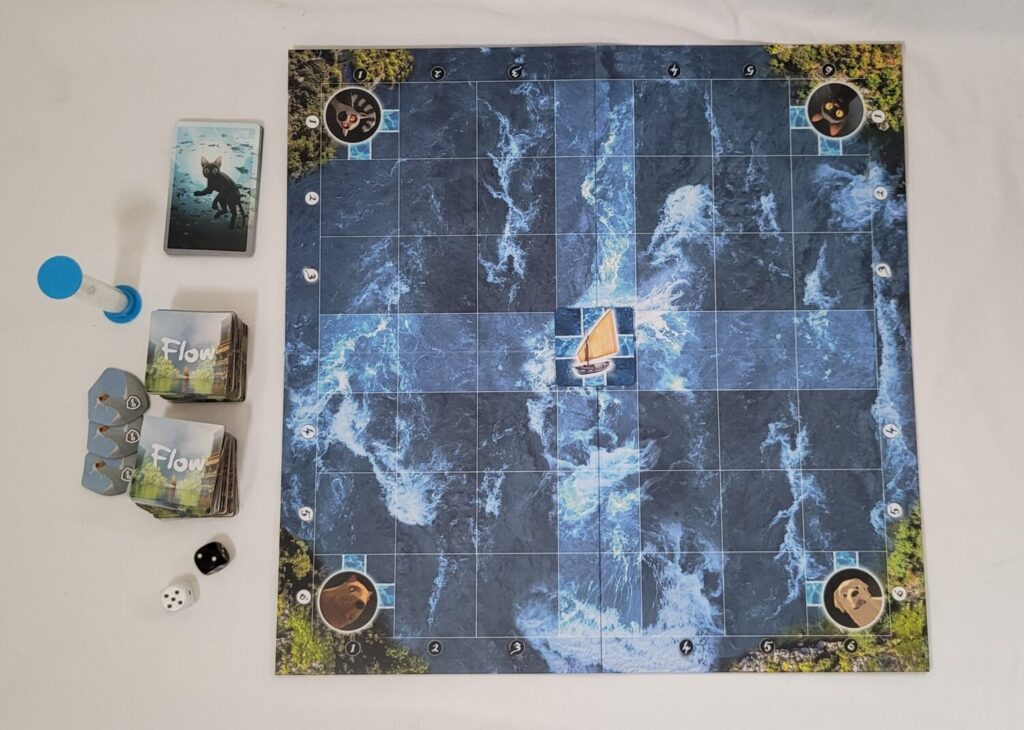
Beginning with the start player, players are going to take turns drawing the pathway tiles from the facedown stacks that will have been created during setup and placing these tiles onto the board in an effort to create the pathways. But, before the first tile is drawn, the one minute timer is engaged. Each time the timer runs out, play comes to a stop, and the two dice are rolled. One of these dice corresponds to the 6 rows and the other corresponds to the 6 columns—the middle row and column are safe zones (hence their different coloring). The row corresponding to the row die gets washed away (the tiles are removed from the game) as does the column corresponding to the column die.
If you’re lucky, one or both of these will skip you by, targeting areas that haven’t been built up yet, or lightly grazing you at the very least, only removing one or two tiles. But, luck will not often favor you. The flood waters will come, and they will wash away all your hard work, forcing you to begin anew. In the early game, when there are plenty of tiles left, this isn’t such a big deal. But when you’re down to your last 10 tiles or so, seeing six tiles get washed away can really hurt. Running out of tiles without completing all four paths will lose you the game.
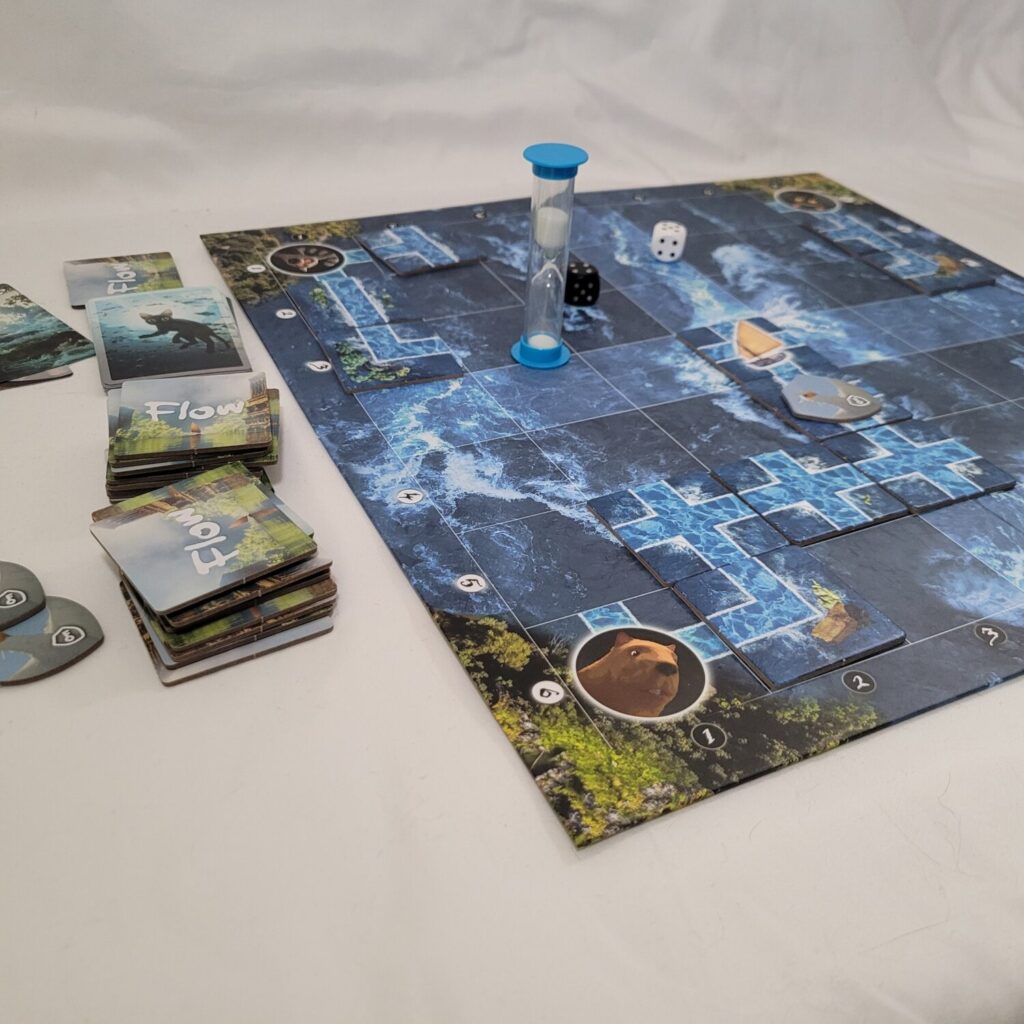
In my plays of Flow , I’ve experienced both ends of the spectrum. There were games that we lost due to ill-timed flooding and running out of tiles as a result, and there were times where the flooding barely even mattered. More times than not, it was the latter. Whether it was all luck or us subconsciously avoiding clustering our tiles together in anticipation of the flood, I couldn’t say. I suspect it’s a mixture of the two. Even though there is a lot of luck involved, the game also rewards skillful play. And, just so you know, you’re not completely at the mercy of the whims of fate. There’s another aspect I haven’t mentioned yet: the action cards.
Action Cards
There are a total of 15 different action cards, composed of six different actions, and players are given a number of these during setup. Instead of drawing and playing a tile on their turn, a player may opt to use their action card instead. When used, these cards provide the players with powerful, game-changing benefits. For instance, the Calm Waters action card makes it so that players only have to roll one die when the timer runs out (as opposed to both). The Bird action card allows the player to place a bird token on top of a tile, which has the effect of protecting that tile from a single flood. If the players find themselves in need of additional action cards as the game wears on, instead of placing the tile they’ve drawn, they can discard it to draw a new action card instead.
These action cards are powerful when used correctly, but I did notice that my 7-year old struggled to grasp what each of his cards was ultimately trying to accomplish, choosing to use his cards at seemingly random times because they were burning a hole in his pocket. Sure, I could have coached him into using his cards when they were of best benefit to the group as a whole—completely understandable within the realm of playing a cooperative game with a child—but I try to give him freedom to make choices, good or bad (especially when they ultimately don’t really matter), whenever possible. One can’t learn from their mistakes if they’re never allowed to make them. So, if you’re the parent of a young child, be forewarned. While the wording on the cards may be easy to follow, the intention behind the words may not be.
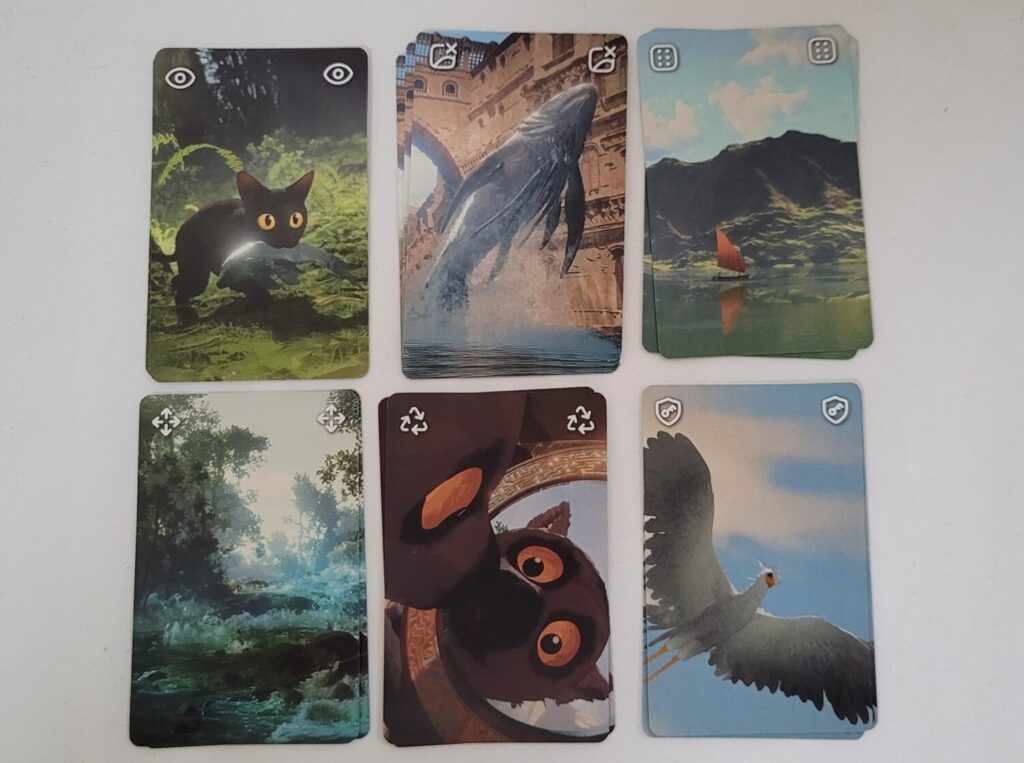
After you’ve played the game a few times, if the gameplay starts to feel a little stale and repetitive, you can amp things up by adding in a number of the scenario cards that are included in the box. These cards change the game by introducing impassable obstacles or imposing restrictions. For instance, the “No New Cards” scenario prevents players from discarding tiles to gain extra action cards, and the “No Communication” scenario only allows players to communicate when the wave dice are being rolled. The more of these your group decides to add to the game, the more challenging the game will become.
I haven’t played with these yet, as I find myself mostly playing with my son. The existence of the action cards presents enough of a challenge that adding in anything else to make the game even harder would ruin the fun. And, I find that Flow is just fine without them. It’s got good pacing, ensuring everyone stays involved. It’s easy enough that it can be taught in just a few brief minutes. It plays quickly, never overstaying its welcome. And, it’s challenging enough that both children and adults remain equally engaged.
Flow details
- Designer: Dmitrijus Babičius, Justina Lapinskienė, Marijus Lapinskas, Tadas Kastanauskas
- Artists: Gints Zilbalodis, Reinis Pētersons
- Publishers: Brain Games
- Release Date: 2025
- Player count : 1 - 6
- Age range : 8+
- Time range : 15 minutes
- Mechanism(s): Cooperative Game, Real-Time
- BGG Geek Rating: 6.31556 - converted to Meeple Mountain scale: 3.0.
- More articles about Flow.